


Middle-class Americans – those with incomes from $44,000 to $88,000 — face mounting out-of-pocket costs that are eroding household disposable income available for food, shelter, and energy line items.
While most of the uninsured are from lower-income families, 11 million of the uninsured live in middle class working families. Most of the growth of the uninsured between 2004 and 2007 — 70% — is in the middle class.
While most of the uninsured are from lower-income families, 11 million of the uninsured live in middle class working families. Most of the growth of the uninsured between 2004 and 2007 — 70% — is in the middle class.
The chart tells the tale: the gap between health premium increases and workers’ wages continues to widen, making health insurance unaffordable for more working families.
Health Care and the Middle Class: More Costs and Less Coverage, a report from the Kaiser Family Foundation published in July 2009, points out that, “workers have to spend more of their income each year on health care in order to maintain their current level of coverage.”
Health Populi’s Hot Points: Put in context of household health spending, the average annual family contribution for employer-sponsored coverage rose to $3,354 in 2008, shown in the chart. KFF calculates that this equates to 7% of a household’s pre-tax income. In the real world of disposable income, this might roughly equal 10% of income after tax – or $1 in every $10 of “take home pay.”
This would be in addition to out-of-pocket costs for deductibles, office and ER visits, and prescription drugs.
As the gap widens between health costs and take-home pay, health care insecurity is growing. A New York Times cover story today is titled, “Reach of subsidies is critical issue for health plan.” In this recession, health reform isn’t just about access-for-all; it’s about affordability-for-all.

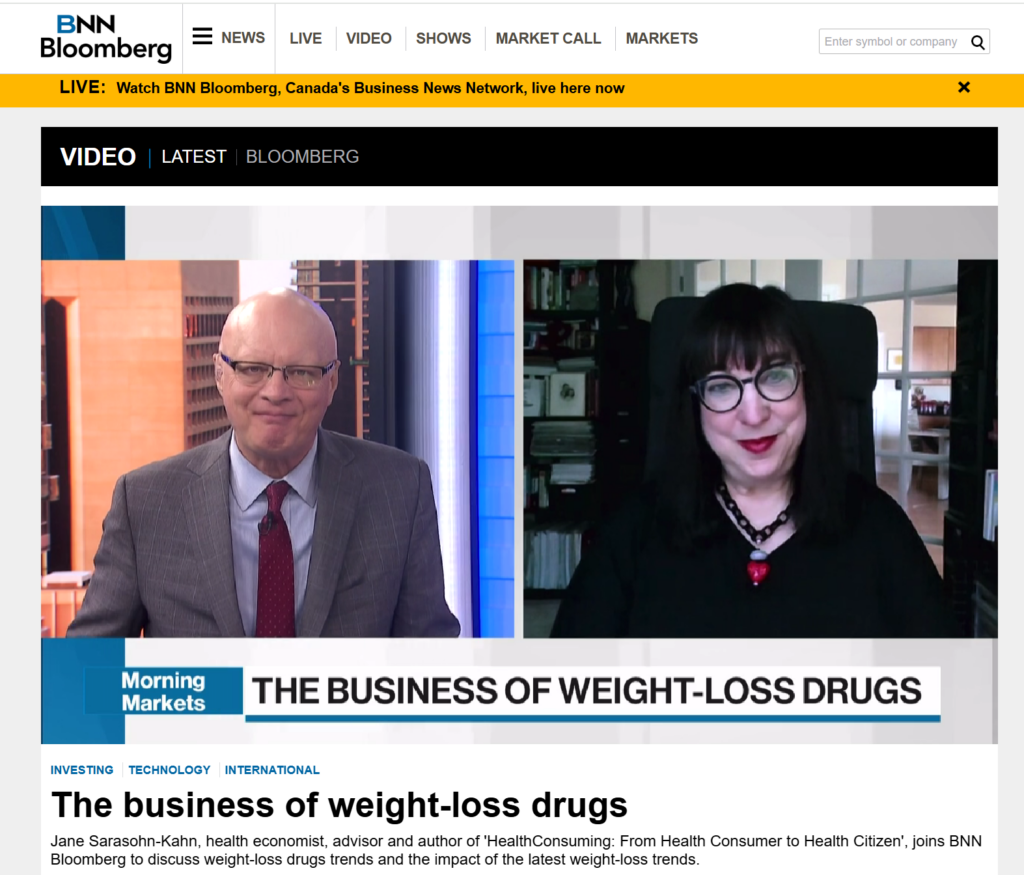 Interviewed live on BNN Bloomberg (Canada) on the market for GLP-1 drugs for weight loss and their impact on both the health care system and consumer goods and services -- notably, food, nutrition, retail health, gyms, and other sectors.
 Thank you, Feedspot, for
  As you may know, I have been splitting work- and living-time between the U.S. and the E.U., most recently living in and working from Brussels. In the month of September 2024, I'll be splitting time between London and other parts of the U.K., and Italy where I'll be working with clients on consumer health, self-care and home care focused on food-as-medicine, digital health, business and scenario planning for the future...