


If you read Health Populi then you’re as confounded as I am by the plethora of polls on Americans’ views on health reform. In the past month, I have received a press release (or two or three) from Rasmussen, ABC-Washington Post, CBS-NY Times, Fox News, Gallup-USA Today, Robert Wood Johnson Foundation, Kaiser Family Foundation, NBC-Wall Street Journal, NPR, Pew, and Quinnipiac, among other pollsters, measuring the changing temperature of Americans on health reform.
I’ve wrestled with how to handle the conflicting, confounding, wide-ranging statistics yielded by these surveys. My solution to this challenge comes tailor-made in this week’s New England Journal of Medicine, dated August 12 2009. The uber-health pollster Bob Blendon of Harvard has done a sort of meta-analysis of the polls and has a fresh take.
His article is titled, “The US Public’s Expectations of Results of Health Care Reform on Various Measures.” Among the measures Blendon focuses on:
Access to health care: about 1 in 2 Americans expect access to expand, while 20% expect access to fall.
Quality of care: 41% believe it will improve, yet 25% forecast quality to fall and 28% expect it to stay the same.
Cost of care: a mixed bag, with the Kaiser Family Foundation poll finding that a plurality of Americans expect costs to fall, while a Gallup poll found a plurality of Americans believe costs will increase. Just how does that happen to fall the way it did, anyway? Inquiring minds want to know!
Taxes: in the Fox poll, most Americans believe they will increase.
I’ve wrestled with how to handle the conflicting, confounding, wide-ranging statistics yielded by these surveys. My solution to this challenge comes tailor-made in this week’s New England Journal of Medicine, dated August 12 2009. The uber-health pollster Bob Blendon of Harvard has done a sort of meta-analysis of the polls and has a fresh take.
His article is titled, “The US Public’s Expectations of Results of Health Care Reform on Various Measures.” Among the measures Blendon focuses on:
Access to health care: about 1 in 2 Americans expect access to expand, while 20% expect access to fall.
Quality of care: 41% believe it will improve, yet 25% forecast quality to fall and 28% expect it to stay the same.
Cost of care: a mixed bag, with the Kaiser Family Foundation poll finding that a plurality of Americans expect costs to fall, while a Gallup poll found a plurality of Americans believe costs will increase. Just how does that happen to fall the way it did, anyway? Inquiring minds want to know!
Taxes: in the Fox poll, most Americans believe they will increase.
Blendon and his co-author John Benson identify three factors that shape Americans’ potential support for health reform: “Will reform improve the nation’s health care system? Will their own care get better? Will their own costs become less burdensome?”
Health Populi’s Hot Points: Blendon and Benson concur (as I do) that the majority of Americans want major change in our health system. However, at the end of the day — that is, when/if health reform gets passed — support on the final plan will depend on, “Americans’ believing that they and the country will be better off if such a change is enacted.”
At the end of the day, that means it’s, first, all about “me” — a very American concept.

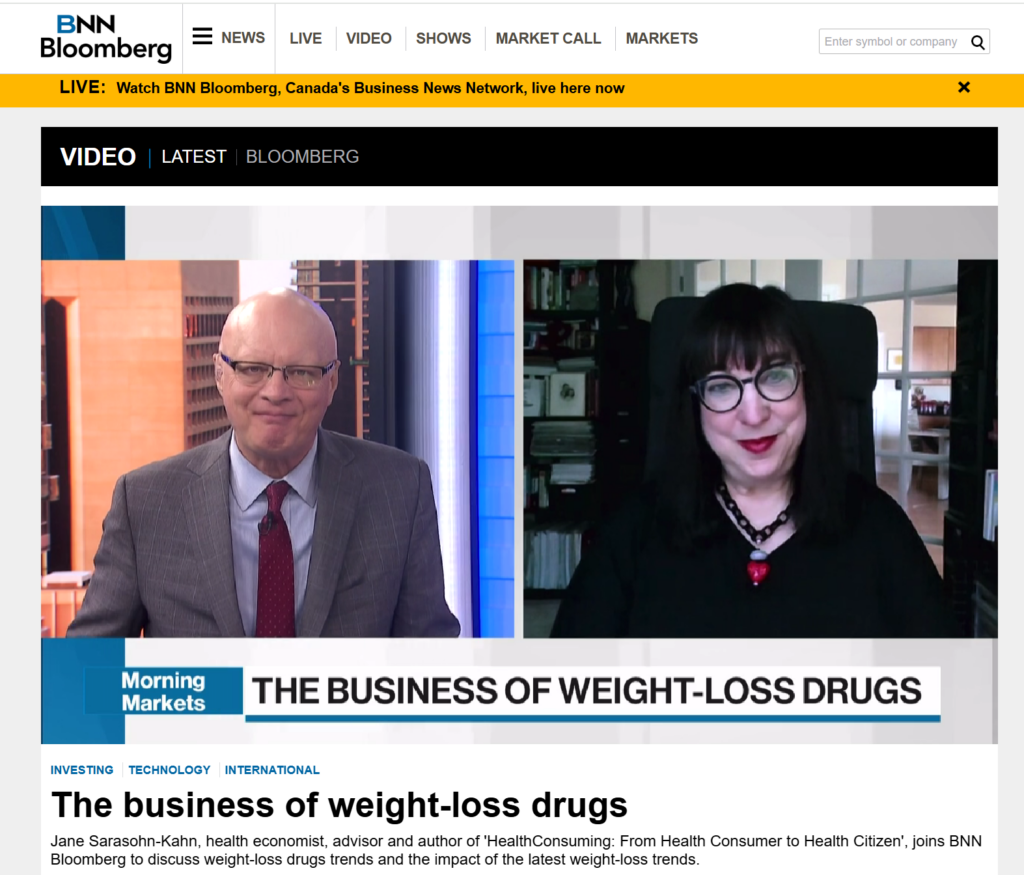 Interviewed live on BNN Bloomberg (Canada) on the market for GLP-1 drugs for weight loss and their impact on both the health care system and consumer goods and services -- notably, food, nutrition, retail health, gyms, and other sectors.
 Thank you, Feedspot, for
  As you may know, I have been splitting work- and living-time between the U.S. and the E.U., most recently living in and working from Brussels. In the month of September 2024, I'll be splitting time between London and other parts of the U.K., and Italy where I'll be working with clients on consumer health, self-care and home care focused on food-as-medicine, digital health, business and scenario planning for the future...