


At least one-third of American adults use social media for some aspect of health. Most seek health information online, and increasingly via mobile platforms. While many physicians engage in social networks on a peer-to-peer basis in Sermo and Ozmosis, among others, most physicians have avoided social networks where their patients and health citizens interact.
The American Medical Association (AMA) released guidelines to help physician members enter the social media fray. There are five areas of recommendations:
- Protect privacy: using settings to protect personal information and content on social networking sites
- Monitor internet persona: routinely monitor presence on the internet to ensure that information is accurate and appropriate – both information posted by themselves, and by others.
- Maintain boundaries: to ensure ‘appropriate’ boundaries for the patient-physician relationship when interacting with patients online, as well as to maintain patient privacy and confidentiality.
- Separate personal and professional content: to consider keeping a wall between personal and professional content online.
- Get smart about the world of social media: to recognize that posting content online can change, sometimes negatively, professional reputations, leading to unintended consequences.
The AMA has been meeting this week in San Diego on policy matters, where these recommendations were finalized.
Health Populi’s Hot Points: Physicians are among the most highly-trusted relationships health citizens have in their personal health ecosystems. That trust is a prime driver for health engagement…and health engagement can lead to better health outcomes. That the AMA, a late-comer to social media on behalf of physicians, has wrestled down these recommendations on doctors’ use of these platforms, is most welcome. Patients are already ‘there.’ They will welcome physicians who meet them in these forums for dialogue, support, and actionable information. Three pioneering examples of social media-embracing physicians worth getting to know are Dr. Sean Khozin of New York City and MacArthur OB/GYN in Irving, TX, and Dr. Sam Pejham, a pediatrician whose pediatric patients friend him on Facebook, from Pleasanton, CA.


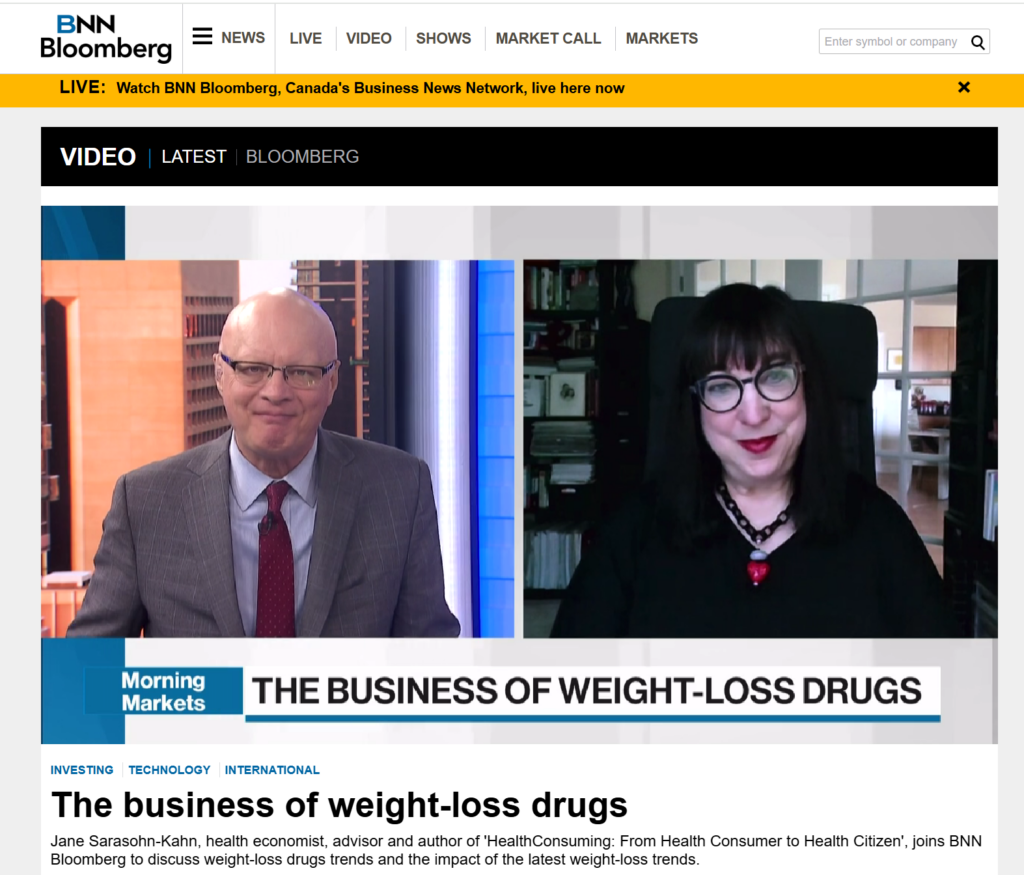 Interviewed live on BNN Bloomberg (Canada) on the market for GLP-1 drugs for weight loss and their impact on both the health care system and consumer goods and services -- notably, food, nutrition, retail health, gyms, and other sectors.
 Thank you, Feedspot, for
  As you may know, I have been splitting work- and living-time between the U.S. and the E.U., most recently living in and working from Brussels. In the month of September 2024, I'll be splitting time between London and other parts of the U.K., and Italy where I'll be working with clients on consumer health, self-care and home care focused on food-as-medicine, digital health, business and scenario planning for the future...