

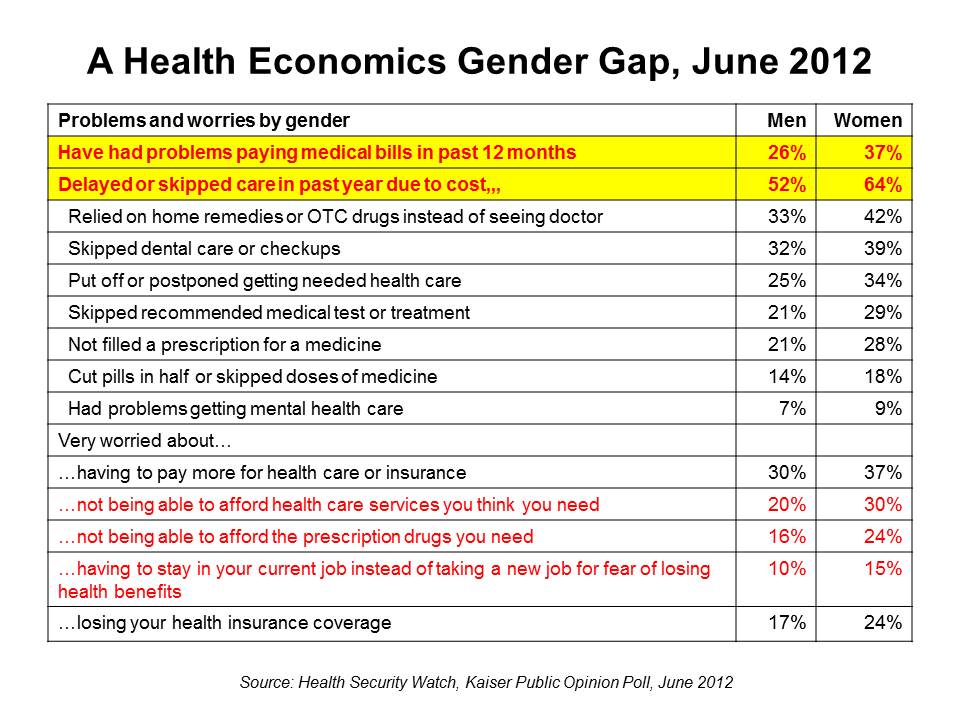
 50% more women than men are worried about health care affordability and access in the U.S., revealed in a new Kaiser Opinion Poll, the Health Security Watch, based on interviews from May 2012.
Overall, about the same proportion of men and women had problems paying medical bills in the past year — 26% vs. 27%, respectively.
However, when it comes to self-rationing health care — delaying or skipping treatment due to cost — gender gap shows, with 52% of men and 64% of women delaying or skipping health care.
Underneath these numbers are even greater gaps between men and women. The largest differences in Mars and Venus in health care economics deal with relying on home remedies, where women do more healthcareDIY than men: 42% of women compared with 33% of men. In addition, putting off or postponing treatment due to cost is more prevalent among females, with 34% of women postponing care vs. 25% of men.
But the biggest differences show up when Kaiser Family Foundation asked men and women if they are “very worried about” various aspects of health care economics and access, shown in the chart. The 50% differences show up in red, and include:
- Not being able to afford the health care services you think you need, 30% women vs. 20% men
- Not being able to afford the prescription drugs you need, 24% women vs. 16% men
- Having to stay in your current job instead of taking a new job for fear of losing health benefits (often referred to as “job-lock”), 15% women vs. 10% men
- Losing your health insurance coverage, 24% women vs. 17% men.

 Thank you
  Jane joined host Dr. Geeta "Dr. G" Nayyar and colleagues to brainstorm the value of vaccines for public and individual health in this challenging environment for health literacy, health politics, and health citizen grievance.
  I'm grateful to be part of the Duke Corporate Education faculty, sharing perspectives on the future of health care with health and life science companies. Once again, I'll be brainstorming the future of health care with a cohort of executives working in a global pharmaceutical company.