

 Of all the functions a smartwatch could play, it’s activity tracking that’s top of most consumers’ minds.
GfK conducted a survey in August 2014 among 5,000 smartphone-owning consumers in five countries — China, Germany, South Korea, the UK, and the U.S. The market research firm found that 29% of people see “activity tracking” the most important function. Phone calls ranked second with 13% of consumers, telling time 11%, and 10% voted for basic apps and navigation system. 7% of consumers noted the smartwatch would be desirable for basic web search.
In this survey, activity tracking included the broad definition covering health, fitness, heart rate, and sleep quality.
The chart from Statista shows some variation between the health citizens across the five countries studied: In the U.S., activity tracking, telling time, and basic apps were consumers’ top 3 functions. In the UK, navigations were seen to be more important than accessing basic apps. In China, more people placed activity tracking #1 than in any of the other 4 nations, but also noted that using the smartwatch as a phone would be useful (noted, too, by people living in South Korea). In Germany, fitness, time telling, and phone calls were the top functions among consumers.
The smartwatch relationship with the smartphone is important to consumers. 9 in 10 consumers expect that smartwatches and smartphones would operate on the same software systems. Furthermore, 56% would expect a smartwatch to include a SIM card to operate independently from their smartphone. This option was much more popular among consumers in China (84%) than in the UK (46%).
In terms of branding, the majority of consumers in South Korea (69%) and China (54%) would trust well-known technology companies for smartwatches. In Germany, 1 in 2 consumers would look to major tech companies for their smartwatch, while fewer in the UK (47%) and US (42%) would prefer a large well known tech firm for their smartwatch purchase.
 Health Populi’s Hot Points: The list of smartwatch launches for early 2015 gets longer by the week…thus far I’ve inventoried the following makers: Apple, ASUS, Blocks, Cookoo, Google, HTC, Huawei, LG, Martian (plus Guess), Motorola, Neptune, OnePlus, Pebble, Samsung, Sony, Swatch, TAG Heuer…and it’s not even 4Q14 yet…
Give it time. By New Year’s Eve this list may double in size.
And that’s the supply side. We have very little consumer research quantifying just how much demand there will be — that is, willingness-to-pay-for — such devices.
For the time being, remember that currently, less than 10% of U.S. consumers track using digital means. “Market penetration” for activity tracking “is not yet out of the first quartile,” notes James Mullock, technology lawyer with Osborne Clarke, a UK-based law firm.
“Has smartwatch fatigue set in?” Michael Antonoff, technology reporter, asked in USA Today last month.
I know it will when I’m walking the miles of aisles checking out smartwatches in January 2015 in Vegas.


 It was an honor to be
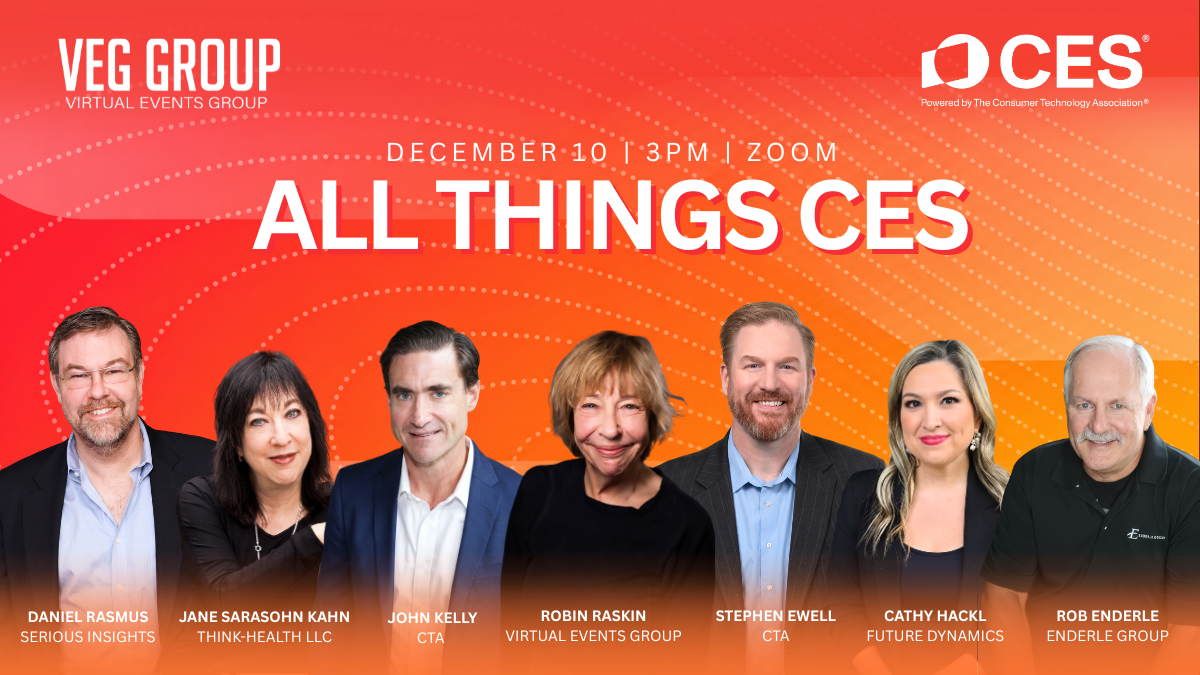 January 2027 is in our sights, and that means we're making plans for #CES2027. I've attended the largest consumer electronics show for nearly 20 years, tracking the evolution of digital health which enables people for greater self-care and health agency and literacy. I'm looking forward to collaborating on this webcast with fellow CES experts in their fields to brainstorm what we expect in this
 Jane joined host Dr. Geeta "Dr. G" Nayyar and colleagues to brainstorm the value of vaccines for public and individual health in this challenging environment for health literacy, health politics, and health citizen grievance.