

Health care professionals (HCPs) have adopted smartphones and tablets faster than the man-and-woman-on-the-street. As a result, mobile devices have become an all-important channel for communicating information to all clinicians: doctors, nurses and pharmacists.
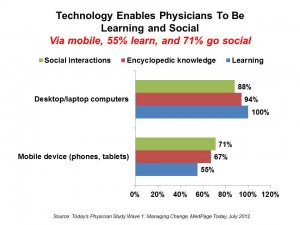
Today, medical practice is “done” via computers: the chart, from MedPage Today’s survey of physicians conducted in July 2012, shows that 100% of doctors get their learning via desktop and laptop computers (THINK: continuing medical education, for example). 88% of doctors go social online, including using point-of-care tools based on MedPage’s definition of “social interactions.”
9 in 10 doctors have increased the use of the internet in daily medical practice. Two-thirds of doctors spend three or more hours a day using a computer, and 24% spend over 3 hours via a mobile device, according to the survey.
MedPage finds that there is no digital divide among physicians. 98% of doctors 56 or older use a computer, smartphone or handheld device compared with 94% of doctors 55 or younger. 60% of doctors 56 or older have a smartphone vs. 80% of doctors who are 55 or younger.
Doctors are fast-adopting mobile platforms (including smartphones and tablets) for managing their workflows, as well. 71% go social via mobile, and 55% do their learning via phones and iPads.
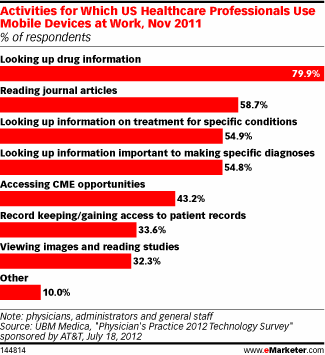 Health Populi’s Hot Points: Most electronic health record systems aren’t quite mobile yet, but that’s where doctors want them to go. About one-half of health leaders polled by Sprint in July 2012 found that electronic health records made available on wireless devices were in demand versus other platforms for EHRs. Currently, 1 in 3 doctors say they’re using mobile devices for some aspect of medical record keeping or tracking patients, according to the survey results graphed in the second chart from a July 2012 survey from AT&T.
The surprising finding from MedPage’s survey is that 80% of doctors believe that advances in technology have improved their communication with patients. Three in five doctors say they’re using technology to communicate more effectively with patients, such as an in-office tablet during a patient exam, email with a patient.
This fits nicely into the new recommendations from the National eHealth Collaborative’s Patient Engagement Framework, launched on November 19, 2012. Check out the five pillars:
- Inform Me
- Engage Me
- Empower Me
- Partner with Me
- Support my e-Community.
Each of these areas for patient engagement has information and way-finding implications that clinicians can address using the technologies, both desk-based on mobile, they’re coming to love.


 Thank you
  I'm grateful to be part of the Duke Corporate Education faculty, sharing perspectives on the future of health care with health and life science companies. Once again, I'll be brainstorming the future of health care with a cohort of executives working in a global pharmaceutical company.
 Jane joined host Dr. Geeta "Dr. G" Nayyar and colleagues to brainstorm the value of vaccines for public and individual health in this challenging environment for health literacy, health politics, and health citizen grievance.