

 The road to universal coverage will be paved more slowly as the Obama administration comes to terms with the impact of the recession on the general economy, the national deficit, and RealHealthPolitik.
An interview with Peter Orszag in this morning’s Financial Times (London’s daily business newspaper) featured a sentence that gave me a double take; it was,
“The president has said he wants a path to universal coverage.”
A path is not an end-game or an outcome: it is a process, a journey. I believe that Orszag, the head budgeteer and Director at the Office of Management and Budget, carefully chose the word “path” for the interview with the FT.
The context for this is the deficit. When he was a Fellow at the Brookings Institution, Orszag told the City Club of Cleveland in a speech nearly five years ago in July 2004 that Medicare costs were the most significant driver of the long-term fiscal ill-health in the U.S.
Five years later, he tells the FT, “We have been very clear that a deficit-increasing health-care reform is neither practical nor desirable.”
Health Populi’s Hot Points: While Orszag said in his interview, “There are different ways of putting us on a path to universal coverage,” the uber-force isn’t universal coverage — it’s slowing down costs, or dare I say, “cost control?”
Orszag (and Obama, since Orszag speaks about these issues on the President’s behalf) is transparent about this reality. Embracing this priority can help stakeholder organizations in U.S. health care focus on plans that rationalize services and technologies, optimize cost-effectiveness, and deliver quality outcomes to as wide a population as practical. Health plan-service-product planners and marketers should adopt this lens on innovation for current projects in the pipeline and, especially, for new-new market introductions.

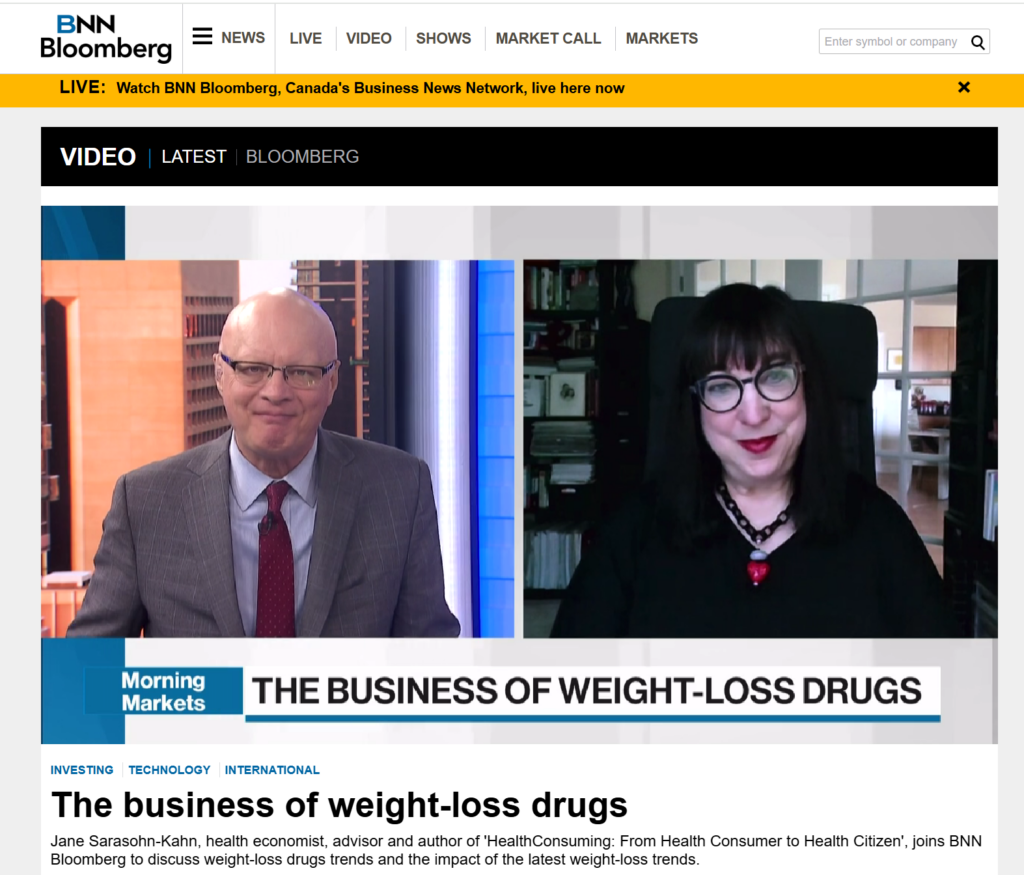 Interviewed live on BNN Bloomberg (Canada) on the market for GLP-1 drugs for weight loss and their impact on both the health care system and consumer goods and services -- notably, food, nutrition, retail health, gyms, and other sectors.
 Thank you, Feedspot, for
  As you may know, I have been splitting work- and living-time between the U.S. and the E.U., most recently living in and working from Brussels. In the month of September 2024, I'll be splitting time between London and other parts of the U.K., and Italy where I'll be working with clients on consumer health, self-care and home care focused on food-as-medicine, digital health, business and scenario planning for the future...