

Thanks to Progressive Grocer’s 91st annual report and research therein, we have fresh insights into where wellness and nutrition fit into food retailers’ — and pharmacies’ and Big Box stores’ — strategies.
That priority ranks high in grocers’ plans for in-store services in 2024 and beyond.
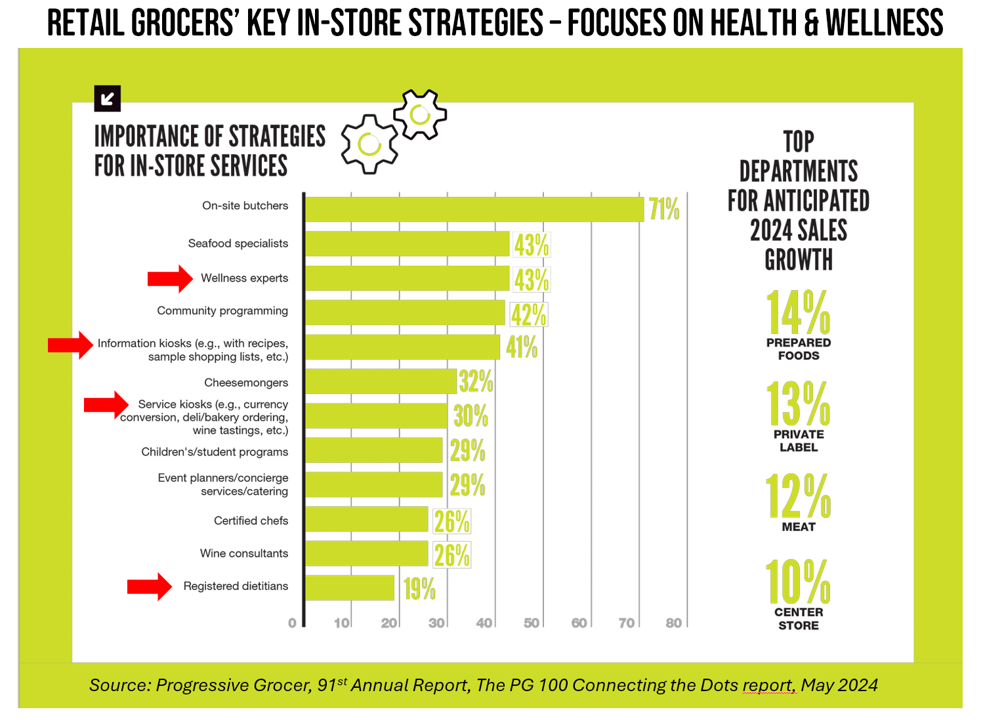
Far above all other strategies for food retailers’ in-store services, we see that on-site butchers rank high — among 3 in 4 retailers. Why this might be the case: cost- and value-focused consumers often have questions about how to cook different (lower-priced) costs of meat, or desire recipe advice and/or personal levels of service.
Following that, employing wellness experts ranks next-in-line with 43% of stores calling out this new-store employee role tied with seafood specialists and community programming,
Note that information kiosks and service kiosks are also important for roughly one-third of stores. Both of these service types can be productively purposed for health and well-being, whether for medical information about food-medicine contraindications or recommendations for recipes and basket purchases when managing diabetes, heart disease, or gut indications.

Health Populi’s Hot Points: In this 91st edition of Progressive Grocer’s annual report, it’s useful to review the PG100 Top 100 store companies: Walmart ranks top, followed by Amazon, Costco, Kroger, CVS Health, Walgreens, Target, Sam’s Club, Albertsons, and Loblaw.
Clearly, there is already health-and-wellness baked into so-called “grocery” destinations, with the very nature of “grocery” expanding into health-and-wellness — and vice-versa, with the once-core-business of retail pharmacy expanding the square-footage of fresh food and frozen cases and other foods beyond sugary sodas and candy-at-the-checkout counter.
Thanks to Progressive Grocer and Oracle for the work on this “progressing” market segment in the increasingly omnichannel health/care ecosystem.


 Jane will be working with EU- and UK-based clients in September and October 2026, collaborating with stakeholders in digital health, public/community health, retail health, and growing opportunities for health-at-home. Stay tuned to her updates here on Health Populi on-the-ground as she lives the digital nomadic work-life in Italy, Belgium, the Netherlands, and in London.
 I was grateful to be Jasmine's first conversation-guest on her new podcast,
  Jane joined host Dr. Geeta "Dr. G" Nayyar and colleagues to brainstorm the value of vaccines for public and individual health in this challenging environment for health literacy, health politics, and health citizen grievance.