


When it comes to luxury goods, forget about that Rolex watch, a Louis Vuitton bag, or Porsche. The top luxury item among U.S. consumers in 2025 is time, and with many luxury goods, time is in short supply for most people.
An important new report from Duckbill explores the Permission to Ask: Why Americans Need Help — And Why They Struggle to Get It.
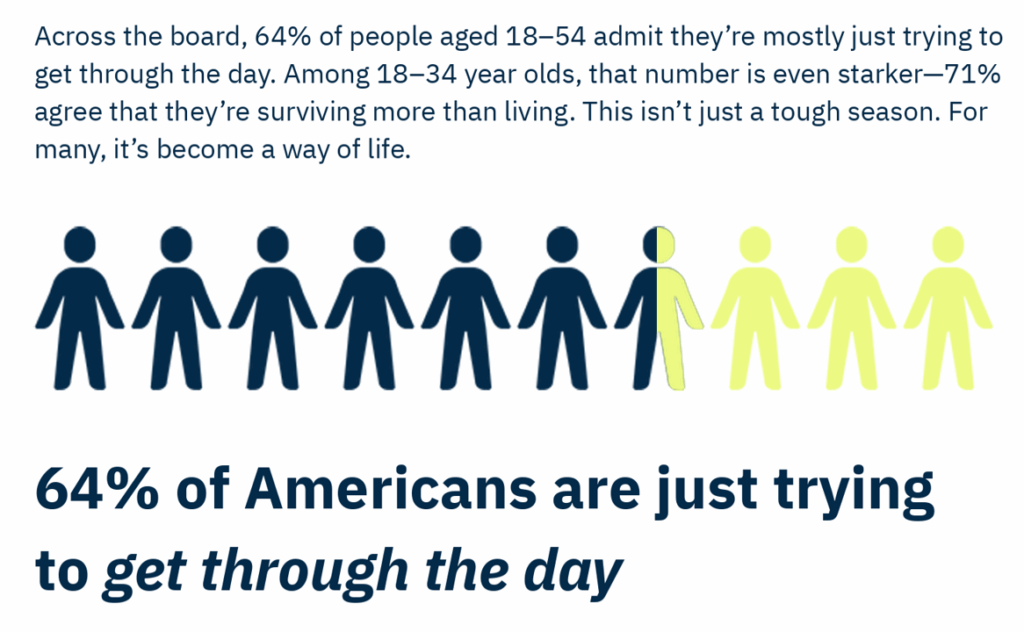
The top-line finding gleaned through Duckbill’s survey of 2.069 U.S. consumers in early May 2025 was that 2 in 3 Americans are just trying to get through the day. This struggle is even more acute among younger people ages 18-34 years old.
“This isn’t just a tough season,” Duckbill observes. “For many, it’s become a way of life.”

Key for Health Populi readers is Duckbill’s realization that “procrastination is common — but asking for help is rare,” even when it comes to our health.
The line chart illustrates this datapoint from the Duckbill/Harris survey: the youngest Americans tend to avoid or delay doctor’s appointments (more women than men), a phenomenon that generally declines with age where people 65 years of age and older — both men and women — are the least likely to skip doctor’s appointments (a low of 10% of folks cross-gender).
I’ve frequently discussed the phenomenon of health consumers self-rationing care due to dollar-cost and medical bill management in the context of household budgets, In this research, we see the “time cost” constraint as another factor contributing to peoples’ self-rationing health care.
There is a particular time-burden on parents (noted as “the parent penalty”) and specifically on women discussed in a section titled, “The Weight Women Carry.”

The time constraints and mental load that people carry aren’t driven by “monumental crises,” Duckbill found, but by, “the endless stream of necessary, invisible work that’s essential to keep life moving,” they describe.
“Americans need the cultural permission — and practical tools — to get the help they so desperately need,” Duckbill concludes — and this is particularly necessary for women and that “weight they carry.”
Consider the disparities across the data points in this bar chart — that more women between 18-54 years of age do not want to burden others, are nervous the help they might ask for won’t meet their expectations, or don’t know who to even ask for help.
Bottom-line: “free time doesn’t feel free,” and this is feeling especially spiking for women between 18 and 34 years of age, 74% of whom feel this way.

Health Populi’s Hot Points: The Duckbill research findings are incredibly salient and timely for health care ecosystem stakeholders in 2025 and beyond.
In my scenario planning work for AHIP’s 2024 conference, I generated four alternative futures on consumers and health care in the U.S., the summary of that work shown here in four quadrants of futures. These scenarios were built out based on two key uncertainties looking toward 2030: “who” would be the key payer (public sector/government vs. private sector/self- and commercial-pay) vis-a-vis the social ethos in American society: individualistic versus community-driven.
In this moment of many health care uncertainties in the U.S., my read for 2025-26 tends southern on the Y-axis toward individualism, less toward social/community cohesion, and more toward private sector and self-pay.
That leaves health citizens to being either committed to DIY health care as the “CEO” of their own care, or feeling like castaways in a fragmented system with few assists.
This is where Duckbill argues for designing support that “actually helps” in its concluding section of the report.
“It’s not enough to offer support — you have to make that support safe, seamless, and stigma-free,” the authors assert.
At the end, they say: “time is not a luxury, it is a human right.”
Thus, their design-thinking calls out the importance of designing solutions that pack in “empathy and clarity, not complexity.”
If you want to explore more of the underlying factors driving consumer-driven health care and the larger retail health ecosystem, please check out my latest webcast with Gregg Malkary and Beyond the Blueprint on trust, tech & the rise of the health care consumer. As Gregg explains, “we examine the evolving landscape of consumer healthcare. Jane breaks down how shifting expectations, digital innovation, and eroding institutional trust are reshaping how patients engage with care. From wearable tech adoption and the power of food-as-medicine to health equity blind spots and the cultural readiness for omni-channel care, this episode dives into what hospitals must start—and stop—doing to regain trust and stay relevant. Whether you’re a hospital leader, technology partner, or frontline clinician, Jane offers candid insights and practical strategies to reimagine healthcare delivery with empathy, design, and the consumer at the center.”
Please let me know what you think!
 Thanks to Jennifer Castenson for
  Jane joined host Dr. Geeta "Dr. G" Nayyar and colleagues to brainstorm the value of vaccines for public and individual health in this challenging environment for health literacy, health politics, and health citizen grievance.
  I'm grateful to be part of the Duke Corporate Education faculty, sharing perspectives on the future of health care with health and life science companies. Once again, I'll be brainstorming the future of health care with a cohort of executives working in a global pharmaceutical company.