


Consumers Using AI for Health — Especially Motivated When People Lack Access to Care
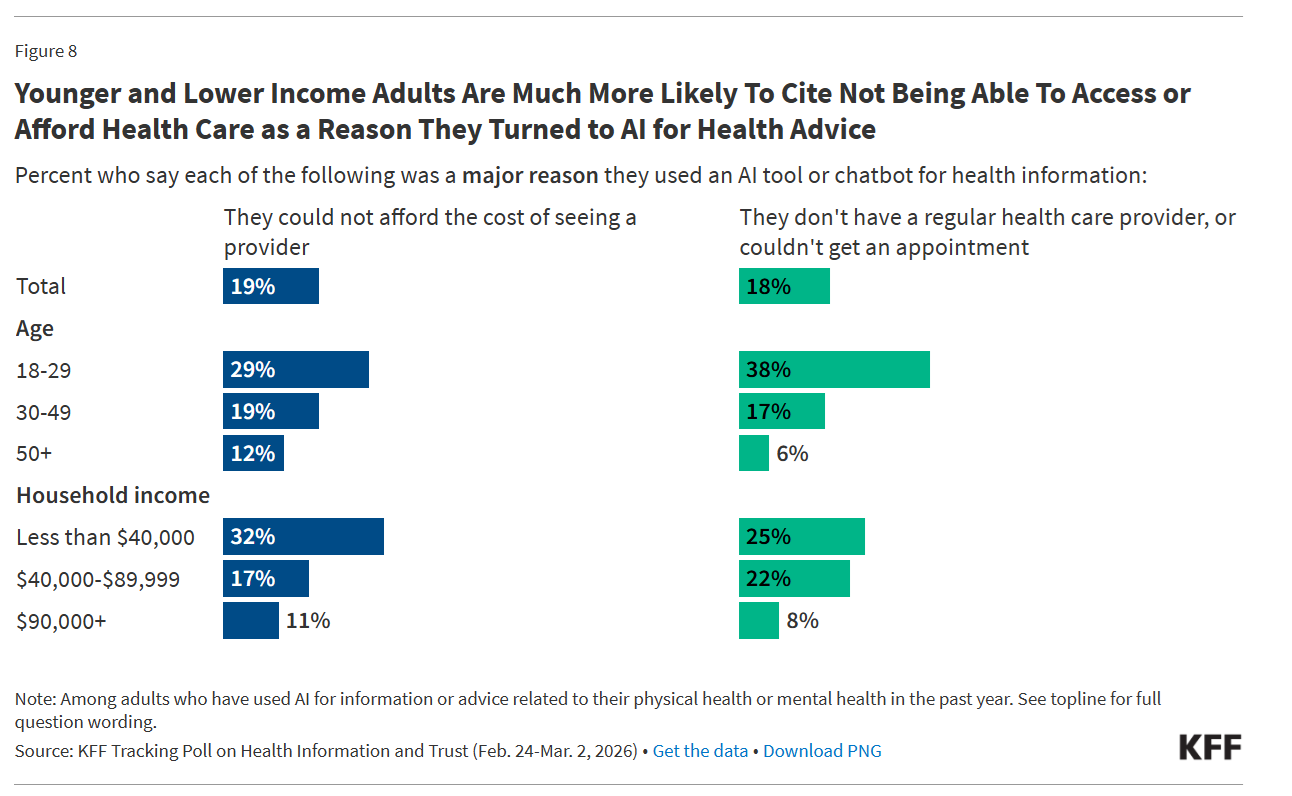
Peoples’ use of AI for researching health information and supporting mental health appears to trump consumers’ trust in the technology, based on the March 2026 Kaiser Family Foundation (KFF) Tracking Poll on Health Information and Trust. Similar to the recent Rock Health consumer survey on AI adoption (discussed in Health Populi earlier this week), about 1 in 3 U.S. adults have used AI for health information in the past year for either physical or mental health queries. There are many studies gauging consumers’ use of AI in health care, but
Consumer Adoption of AI for Health and Self-Care – Doubling to 36% in a Year, Via Rock Health’s Latest Snapshot
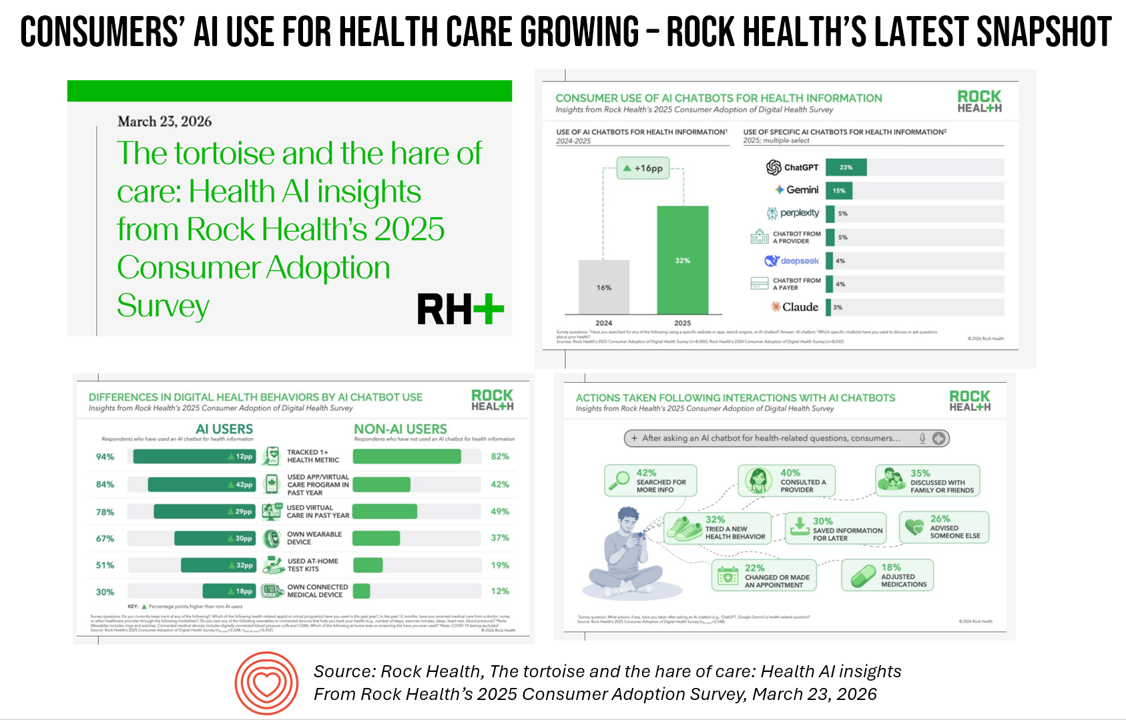
From pre- and self-diagnosis of symptoms to prescription drug treatments and ongoing care, millions of U.S. consumers have used AI chatbots for health and wellness according to the consumer health adoption survey from Rock Health. The report was published in late March 2026, with AI-focused data from the consumer survey fielded in December 2025. In just one year from 2024 to 2025, consumers’ use of AI chatbots for health information doubled from 16% of people to 32%. The most popular brand of AI for health information seeking was ChatGPT (owned by OpenAI, with whom
Healthcare AI Direct-to-Consumer: Everything, Everywhere, All At Once
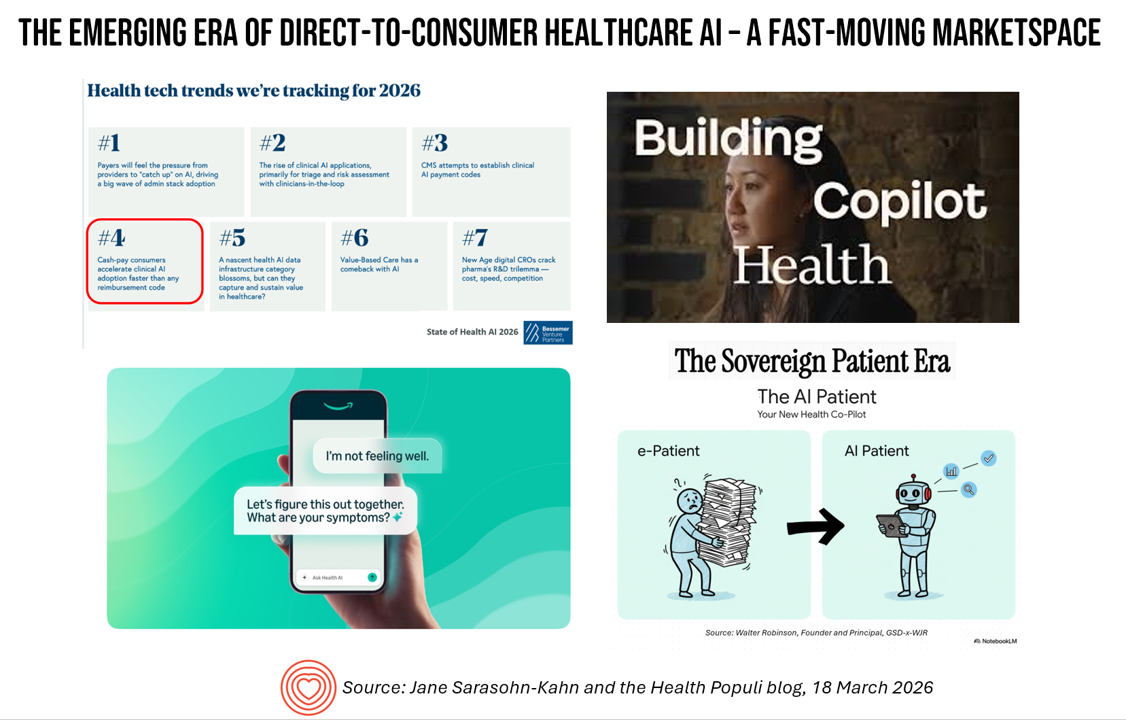
The announcements of consumer-focused AI for health are coming Fast and Furious. As we are coming off of the 2026 Oscars broadcast, it inspires me to quote another movie title, Everything, Everywhere, All at Once. In the moment, it feels like consumer health-focused AI is indeed in a fast-and-furious launch phase. It’s time for me to provide an update on this fast-moving-consumer service, discussing the latest vendor announcements and the ongoing concerned embrace of AI among early adopting citizen-users of AI for health/care. For context, let’s start with long-time AI-medical expert Dr. Eric Topol’s view on the current state. Registering
Consumers Are Ahead of Consumer Health Innovation: Insights from IQVIA
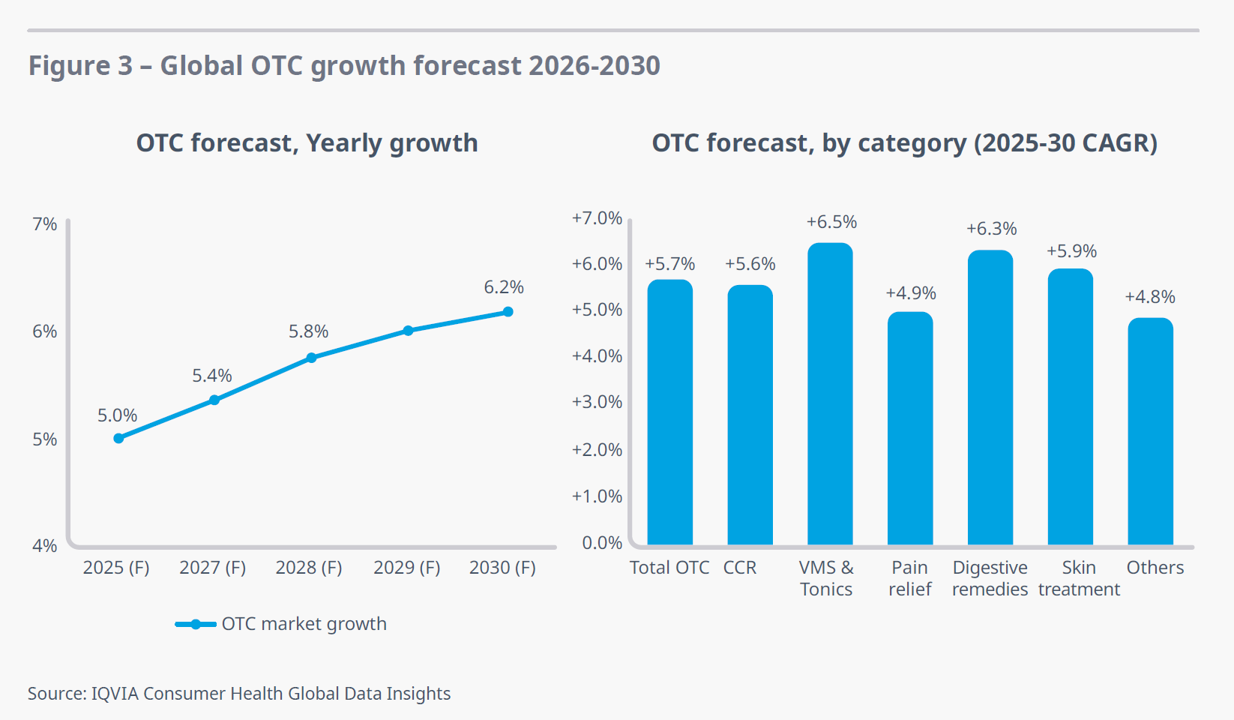
As patients in the U.S. bear more costs out-of-pocket, from deductibles to co-sharing the price of higher-cost specialty drugs (say for cancers, Parkinson’s, and so on), health care looks and feels more like a retail transaction stretching peoples’ health consumer muscles. A new report from IQVIA, whom you probably know through their data collection and analysis in the prescription drug sector, forecasts Consumer Health’s Next Phase, with the observation that the market is changing faster than its narratives (the subtitle of the report). To come to this judgment, IQVIA analyzes six trends shaping the
Why Clorox Talks about Hygiene at Home: Health, Wellbeing, and the Home as Health Hub
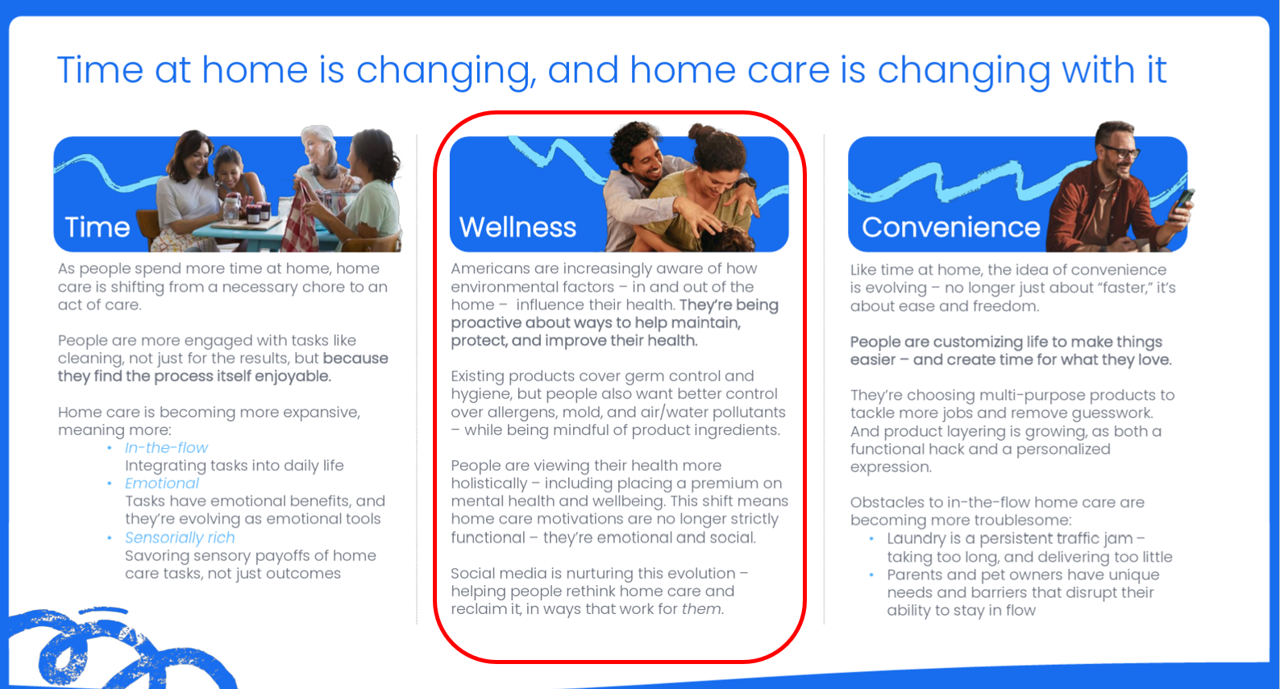
The COVID-19 pandemic was a watershed era for people re-assessing and re-imagining their homes as hubs for health, healthcare, and well-being (as well as learning, exercising, and baking sourdough bread). This graphic comes from my book, Health Citizenship: How a Virus Opened Hearts and Minds, written in the midst of the pandemic based on consumers’ newly adopted behaviors during the #workfromhome and #stayhome epoch. We experienced the digital transformation of people through life and home-based work and education, a growing sense of DIY for things we could do
Dr. Wachter Bets on A Giant Leap for AI in Health Care
“Stop worrying and let AI help save your life,” a New York Times op-ed prescribed in January. So I wanted to ask Dr. Robert Wachter, author of that essay, “why not worry?” and read his latest book, A Giant Leap, before speaking with him. I spent time with Bob on a Zoom session last week to dig into some patient/consumer-facing issues regarding AI and health care. Before I launch into our engaging conversation, I’d like to share some context about Dr. Wachter and his evolution that I believe makes him
Financial Stress and Trust in Health Care Takes Many Forms – Listening to Jarrard’s 2026 State of Play Survey
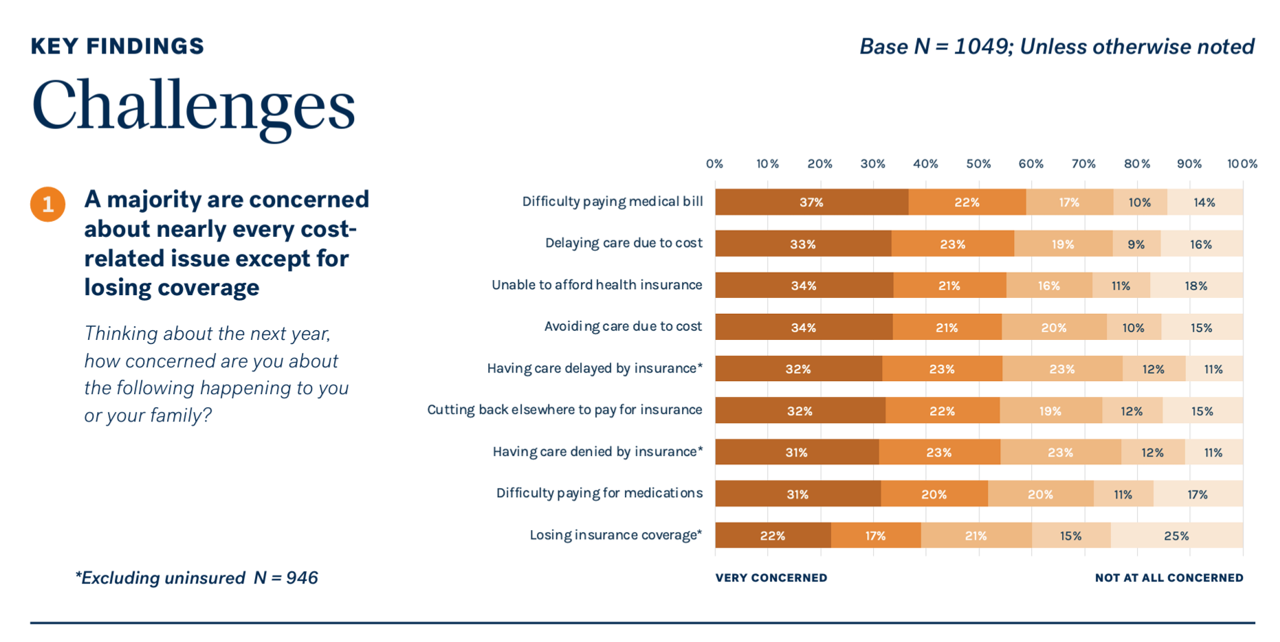
Most people in the U.S. are concerned about many cost-related aspects of health care, we learn from Jarrard’s 2026 survey report on Americans’ health care financial angst titled Navigating the Riptide: Public views on healthcare, health policy, and healthcare organizations. Jarrard fielded the consumer study among 1,049 U.S. adults 18 years of age and older in early January 2026. Here are the details, listing nine cost-related issues U.S. consumers face in their health care journeys – including, Difficulty paying medical bills (net 59% very or somewhat concerned) Delaying medical care due to cost (55%) Inability
Health Care Ads at the Big Game (Super Bowl LX) – Edgy, Entertaining, Educational
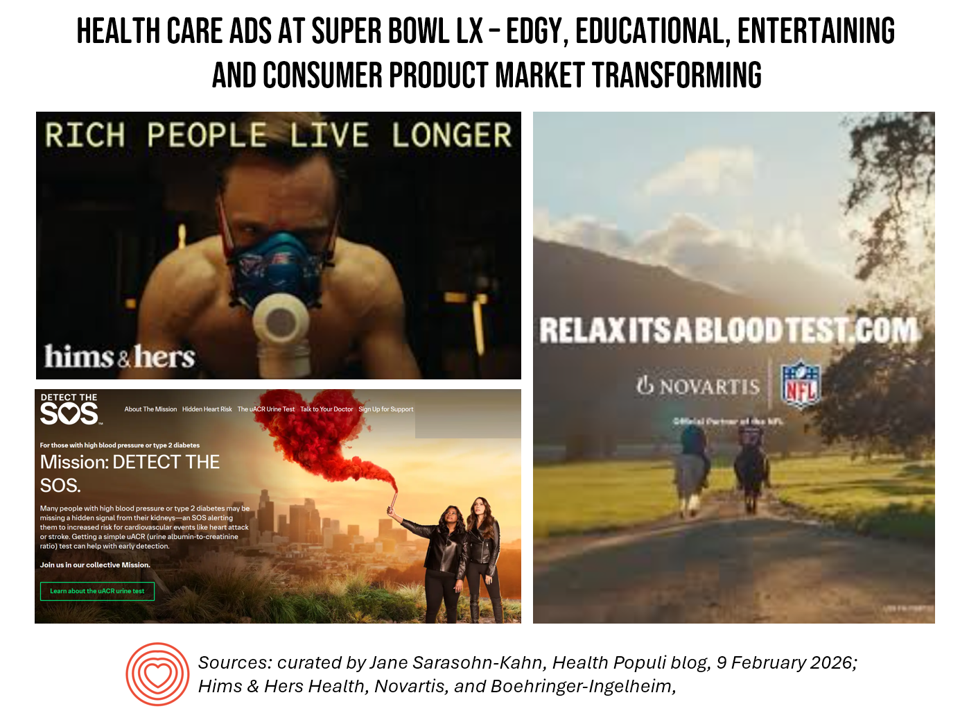
“When Weight Watchers dared to run an ad in 2015, it was likened to a record scratch,” AdAge noted in its preview of ads planned for broadcasting during Super Bowl LX. A decade+ later, healthcare and health-related promotions are part of the Big Game’s financial lifeblood, where a 30-second spot can cost $8 million according to AdMeter And on the aesthetics/design front, some of the ads this year are downright edgy — entertainment-intended, but also educational in their own way. Take “Rich People Live Longer,” this year’s ad from Hims & Hers Health. The company advertised at last year’s game
When a Hotel Becomes Your Health Partner – Learning from Novotel and Accor
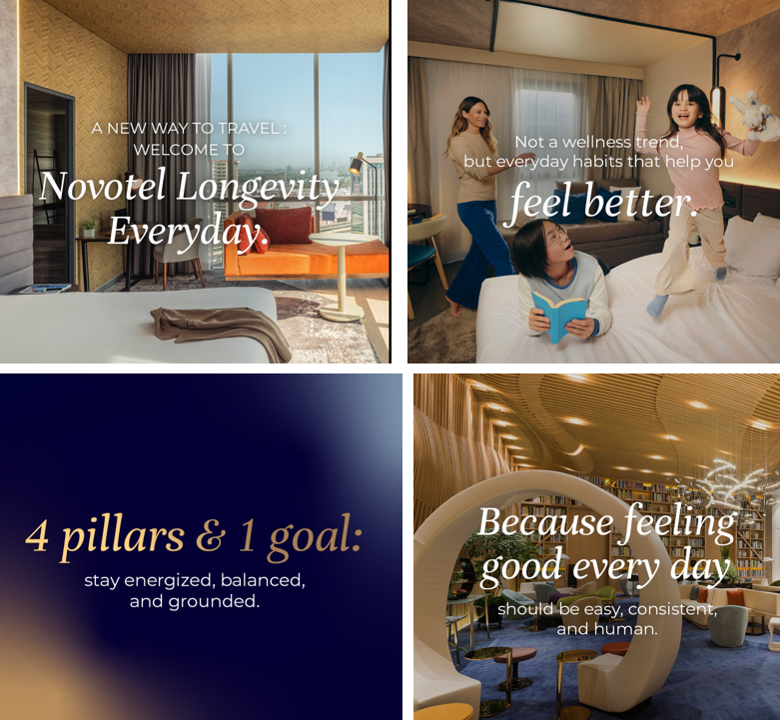
“Novotel Launches ‘Longevity Everyday.'” That’s the title of the global, France-based hotel chain’s press release, announcing the Novotel brand’s initiative to serve up healthy hospitality. Check out this video… Behind this strategic positioning decision, the hotel notes, “Accor data reveals that one in three travelers is taking daily steps to improve their mental and physical wellbeing, yet most longevity programs remain out of reach for many people. This gap between demand and accessibility has created a strategic opportunity that Novotel, Accor’s founding brand, is uniquely positioned to address.” This approach will extend to over 600 hotels operating in 67 countries
The Healthcare Affordability Elections, 2026 and 2028 – Listening to the KFF Tracking Poll, January 2026
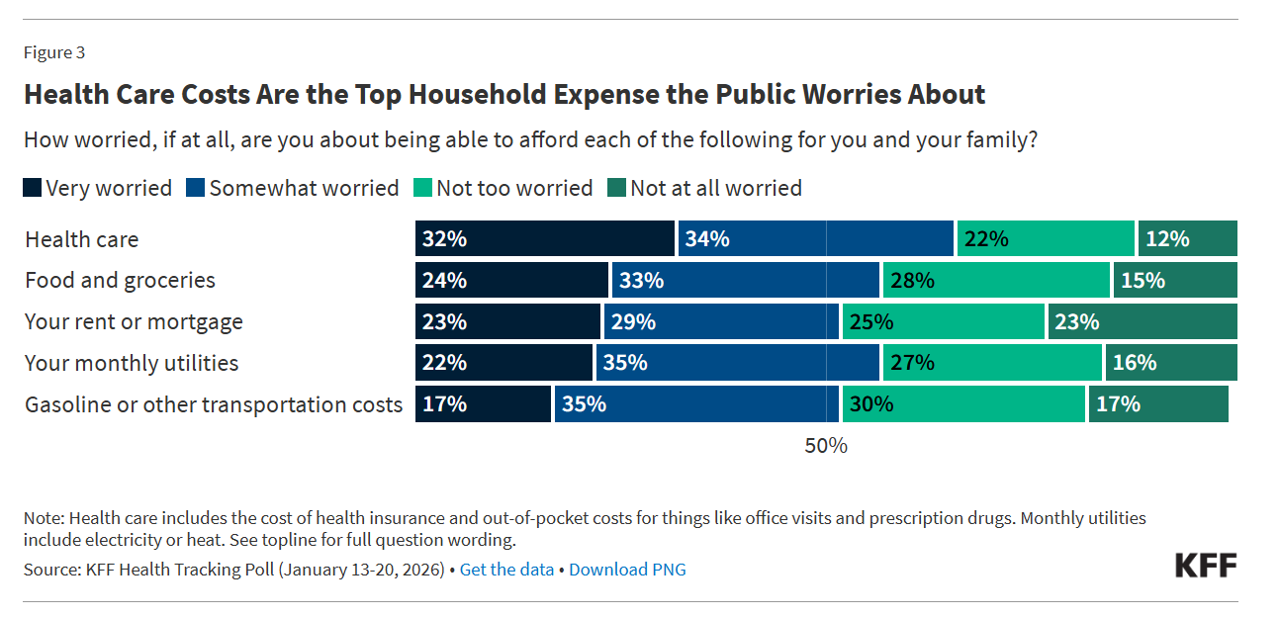
The title of KFF’s press release launching the Foundation’s January 2026 Health Tracking Poll clearly observes, “Health Care Costs Tops the Public’s Economic Worries as the Runup to the Midterms Begins.” I’ve pulled out the key details to share my lens on the 2026 midterm and 2028 Presidential election forecast, which I believe will turn out to be (in part) The Patients’ Elections. Here’s the top-line title finding — where most people in the U.S. — 2 in 3 people (66%) — are worried more about health care costs compared with other major household expenses.
Optimistic and Skeptical: How Older Americans Are Using and Seeing AI – the View from AARP
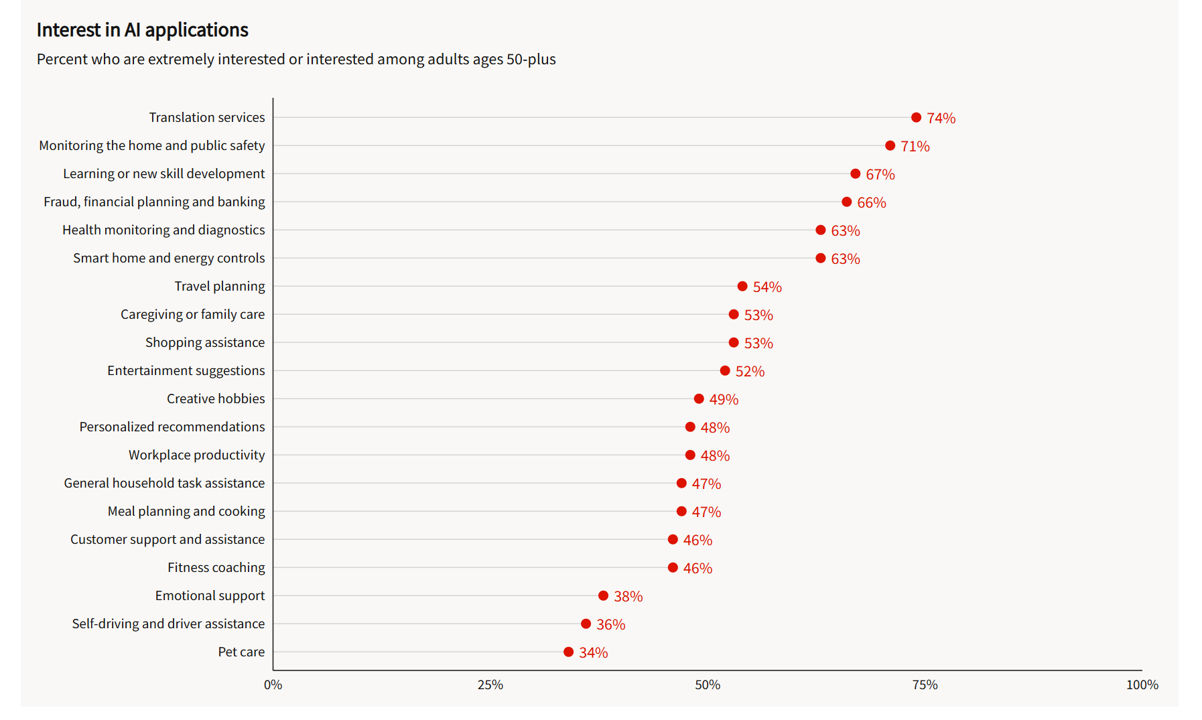
People over 50 in America typically hold two thoughts in mind at once when it comes to AI: they’re optimistic and skeptical, depending on the “job” that AI could do, according to research from AARP explained in the report, Navigating the World of AI: Awareness, Attitudes, and How People Expect to Use It. Topline, most people 50 and over have used AI in some way, with roughly 3 in 5 older Americans saying “I am a beginner” in using AI across age groups from 50 to 70+. Most older Americans are familiar with many terms in the
As Adult Vaccination Levels Fall, We Must Assert the Value of Vaccines
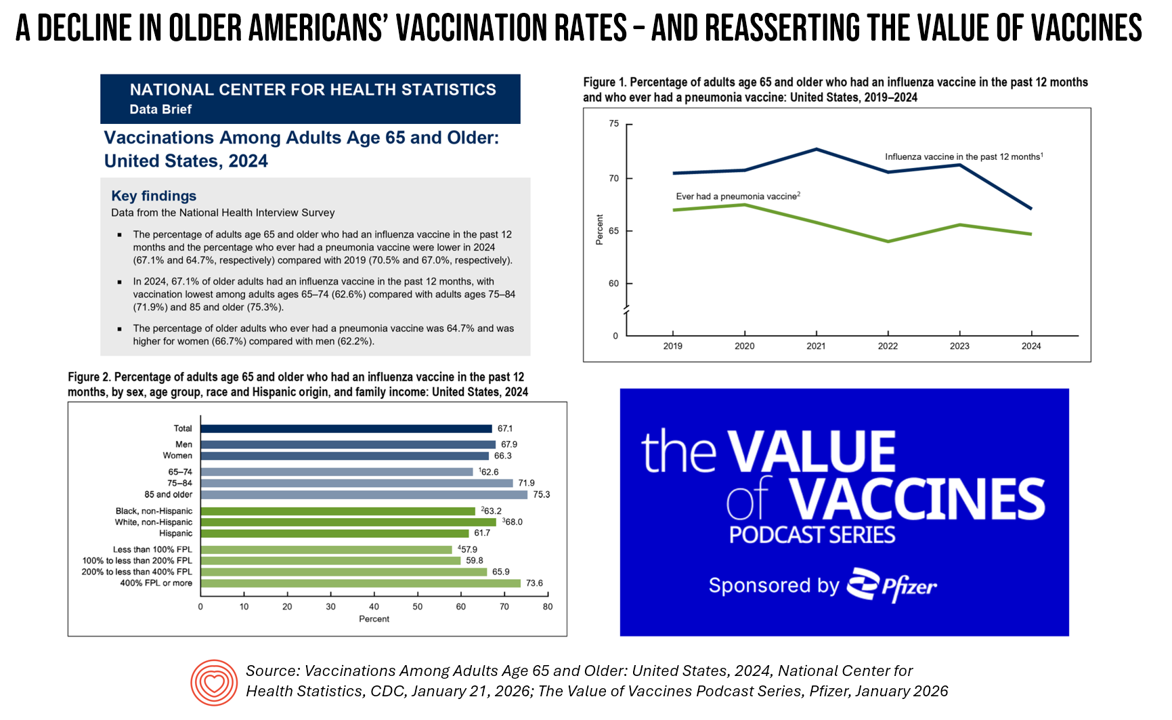
The rate of vaccinations among people 65 years of age and older has declined since 2019 — a personal health challenge for aging Americans and their caregivers and families, and a public health problem for the U.S. The Centers for Disease Control’s National Center for Health Statistics published Data Brief 547 on the situation on January 21, 2026. In the meantime, serendipity and timing are uncanny in the moment as The Value of Vaccines conversation series from Pfizer was launched this week. I am grateful to have participated in this project with several sisters-in-expertise: Elif Alyanak from Avalere, Venesa Day
Why Progresso Soup was at CES 2026: How Food is Playing Into the Evolving Health Consumer and Retail Health Landscape
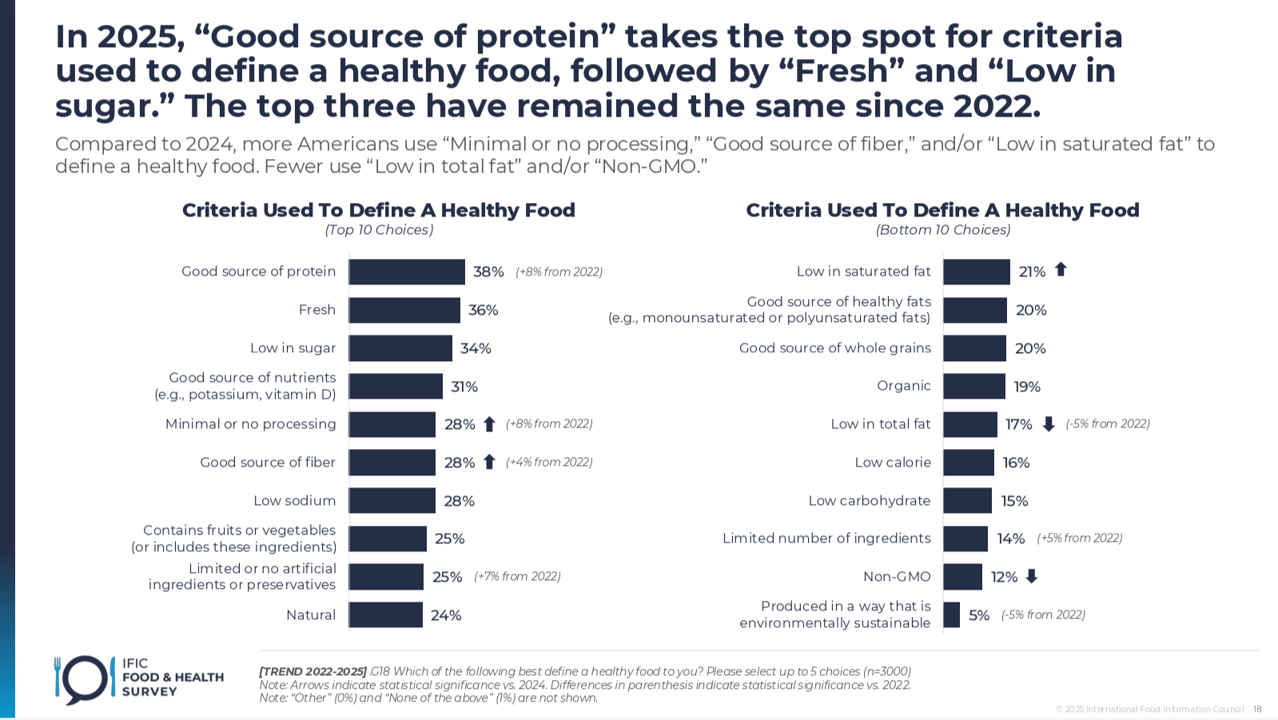
Why was Progresso Soup and its manufacturer General Mills at CES 2026? Specifically, in the AgeTech Collaborative curated by AARP? If you are part of the health/care ecosystem in any of its segments, chances are you’re attending conferences at the start of 2026 or soon to attend one. I spent last week at CES 2926 in Las Vegas getting updates on digital health, well-being, and self-care innovations. This week, hundreds of my colleagues are attending #JPM2026, the 44th annual J.P. Morgan Healthcare Conference held in San Francisco every year at this time. One conference that would not have been well-attended
While Nurses Continue to Rank Top in Honesty and Ethics, Americans’ Respect for All Professions is Tanking
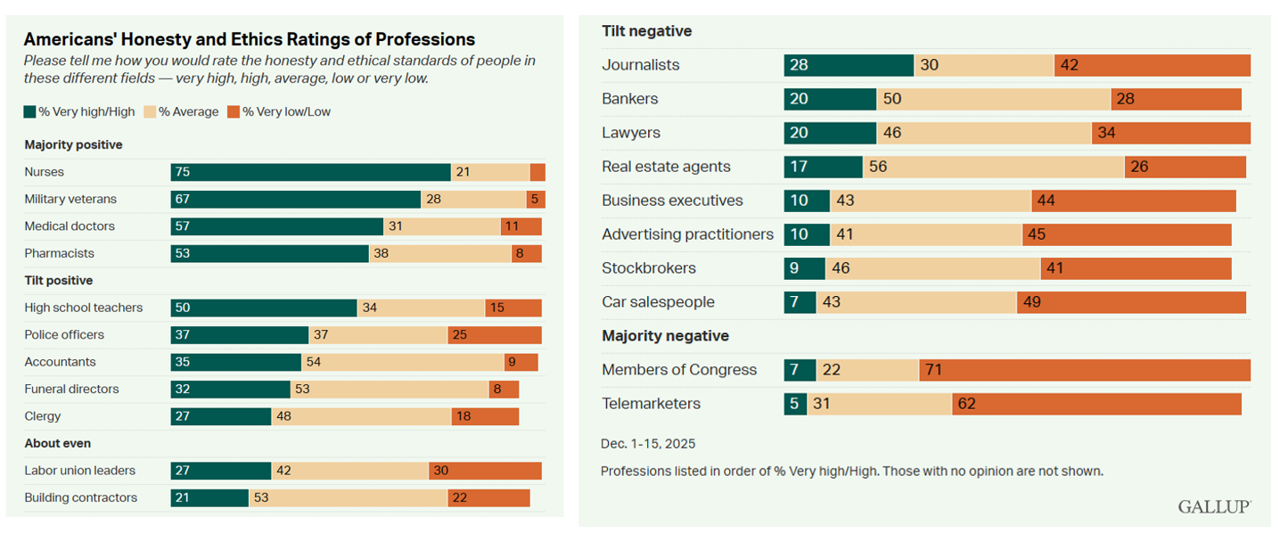
While nurses continue to rank high for honesty and ethics, Americans’ trust in the nations’ professions is tanking, found in this year’s Gallup Poll update titled, Nurses Continue to Lead in Honesty and Ethics Ratings. Nurses perennially top this chart, usually followed by doctors and pharmacists. But this year, it’s military veterans who garner the second spot in the Gallup Poll, with doctors and pharmacists in positions 3 and 4. Ranking at the bottom as least-respected for honesty and ethics are Members of Congress, again garnering the low-point in this study, with telemarketers trailing the
Sleep as a Pillar of Health at CES 2026 — What Can Happen When A Lamborghini Legacy Mashes Up With Sleep Tech

Well-being is a new form of luxury….and sleep is an inherent aspect of well-being and health, a message reinforced during a press conference hosted by the National Sleep Foundation at CES 2026. Sleep has been an ongoing theme at CES for many years: here’s a post I wrote on sleep at CES 2025 a year ago for some historical context. In today’s growing home-as-our-health-hub ethos, sleep-tech takes on a variety of forms, from new-fangled beds and sensors, smart rings, other wearable tech (like earbuds), and circadian rhythm lighting innovations. In yesterday’s Health Populi, I focused
The Bathroom’s Role in the Home as Health Hub: Catching Up with Kohler Health’s CEO at CES 2026

A key Tech Trend to Watch at CES 2026 is consumers’ re-imagining and fitting out their homes as sites for bolstering health and well-being. I’ve been tracking this concept as far back as 2011 when I wrote this post from the 2011 Consumer Electronics Show. A decade-and-a-half later, in déjà vu spirit, the concept is no longer theoretical or futures-thinking. Fast forward from 2011 to the COVID-19 pandemic, when everyone’s home spaces became re-purposed for health, for medical care, for well-being, for fitness and exercise, for cooking up nutritious food, for
Tech Trends to Watch at CES 2026 – For Health, It’s About Longer Living, Smarter Living, and Better Living
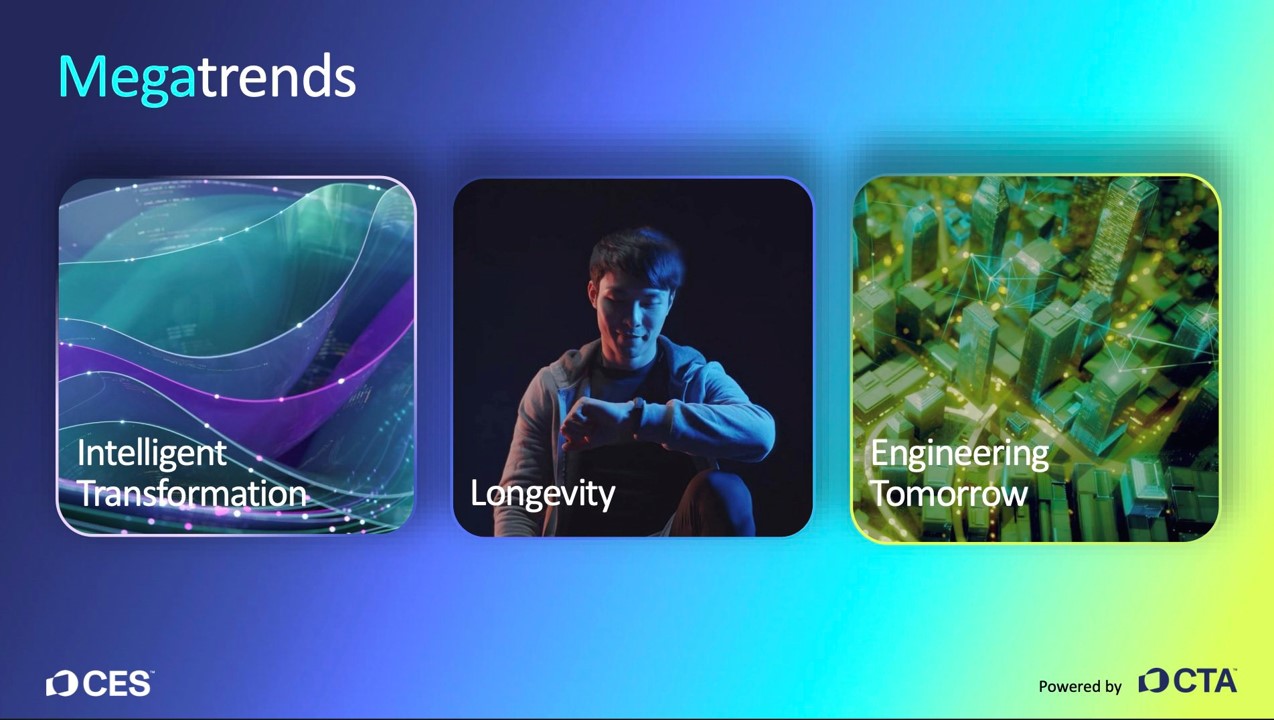
Live from CES 2026 in Las Vegas…the first day of CES Media Days preceding the big show always covers a context-setting report on Tech Trends to Watch. This is one of my annual go-to programs which helps orient media and industry analysts with a lens on CES’s key tech categories and some hard data on market size and growth expectations. While I’ll focus on the health/care specifics in the trend forecast, let me first update you on the overall technology market revenues for the U.S. which are estimated at $565 billion for 2026.
Health Tracking Wrapped Around Your Finger: All About Wearable Tech’s Growing Smart Rings Category at CES 2026
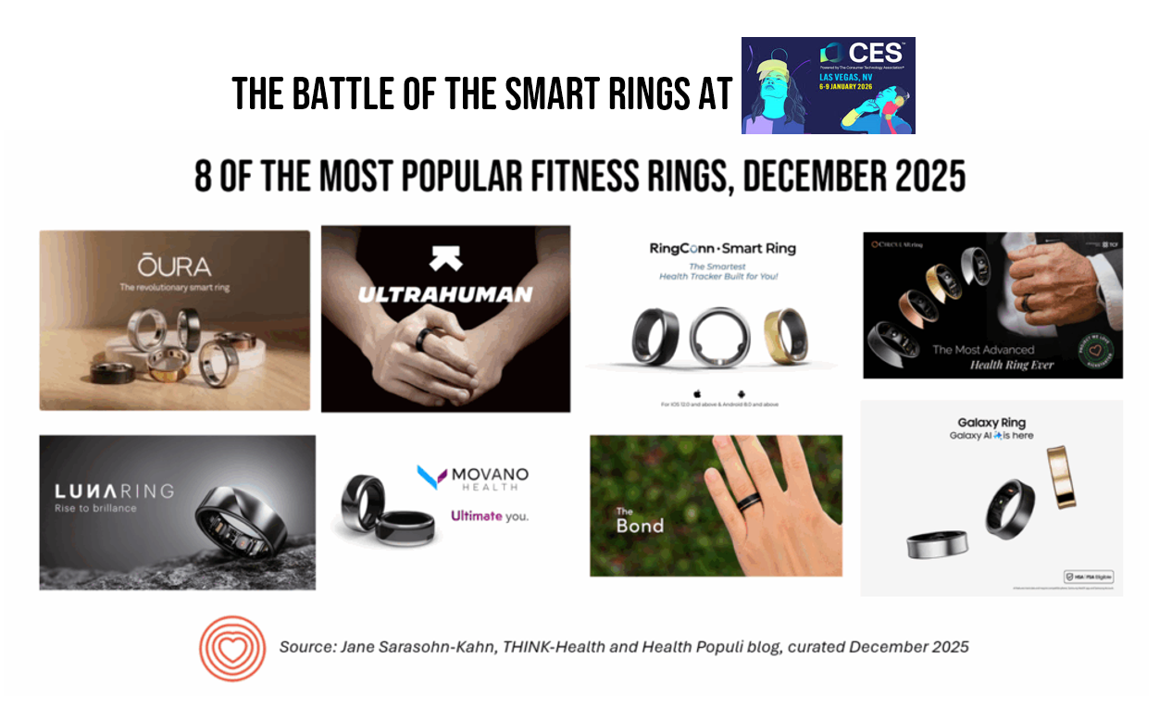
For well over a decade, wearable technologies have been developed for humans from head-to-toe — from forehead-worn bands to address stress and headaches to smart shoes with sensor-embedded soles that assess our gait and posture. In 2013, my CES coverage had a focus on “The Battle of the (Wrist)Bands.” This year, the #wearabletech category feels like a fierce competition for the human real estate of the finger — that is, a battle of the smart rings. Twelve years later, smartwatches are mainstream trackers for health embedded with sensors that are gaining clinical evidence for use in medical care well beyond
Exercise is Health Care, and Consumers Are Willing to Pay – Context for #CES2026
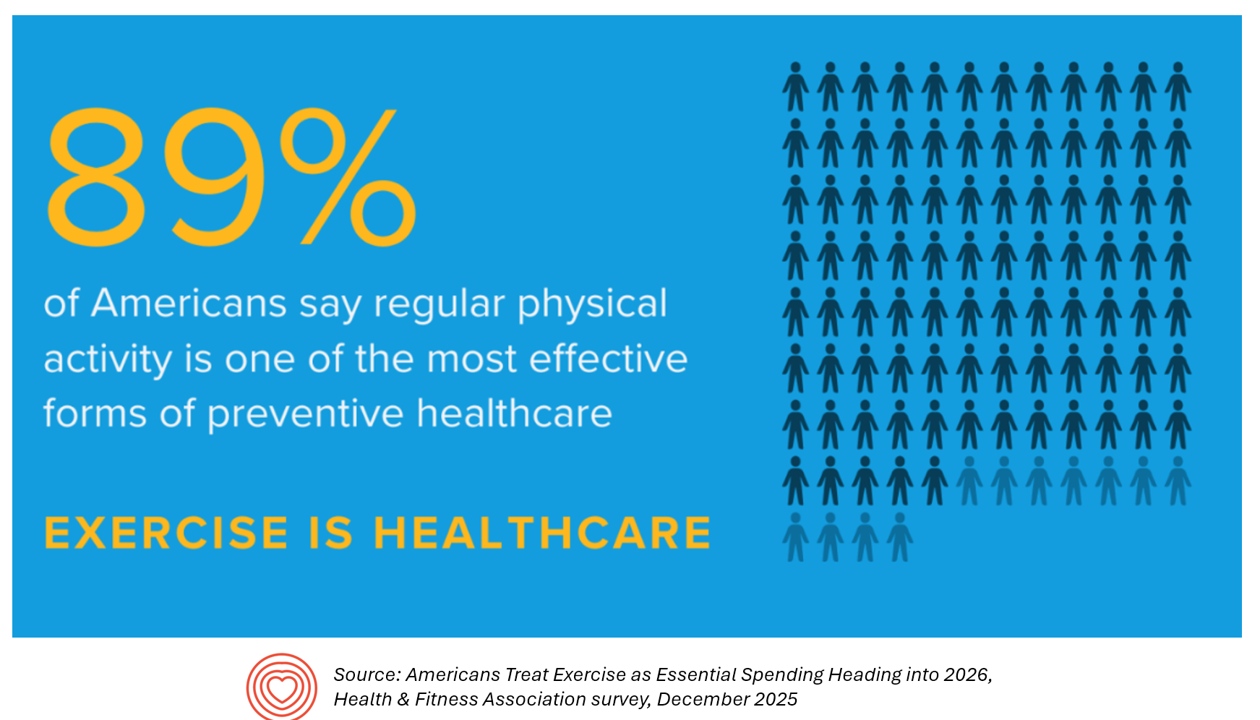
“Americans are not just setting fitness goals; they are budgeting for them,” Liz Clark, President and CEO of the Health & Fitness Association observed. “People increasingly see exercise as an essential investment in their long-term health. Even in a challenging economic environment, Americans are prioritizing physical activity as a proactive form of preventive healthcare.” Americans see exercise as healthcare — and health — according to a survey from the Health & Fitness Association (HFA). HFA commissioned Kantar to conduct the online survey among 2,000 U.S. adults 18 and over in December 2025 — well-timed for the
A Primer on Health Consumers for CES 2026 – How Macro Consumer Trends Will Shape Healthcare Consumers in 2026
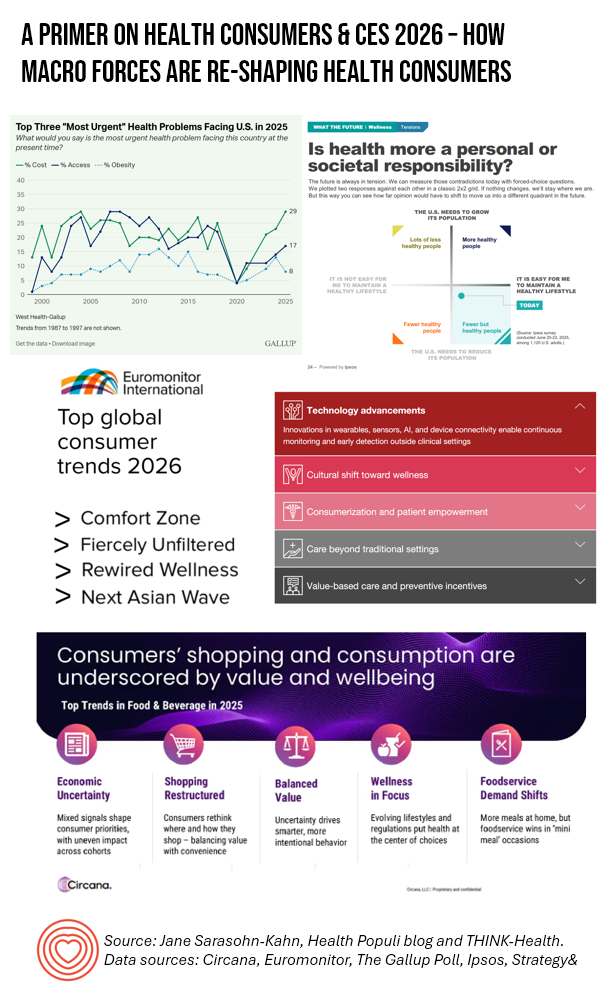
Increasingly, people are engaging more in health care decision making due to many factors impacting their personal medical choices — from the cost and access to health insurance to co-payments for prescription drugs and the supply of primary care doctors, more patients developed and exercised their health consumer muscles in 2025, For 2026, the health consumer muscle-building will grow as people will be re-shaped by macro market factors we are currently gleaning from forecasts looking into the new year: for personal finances, social issues, technology adoption, views on AI and privacy, and other issues. Here are some data points to
Navigating a Constellation of Uncertainties: Health/Care in 2026 (My Un-Forecast)
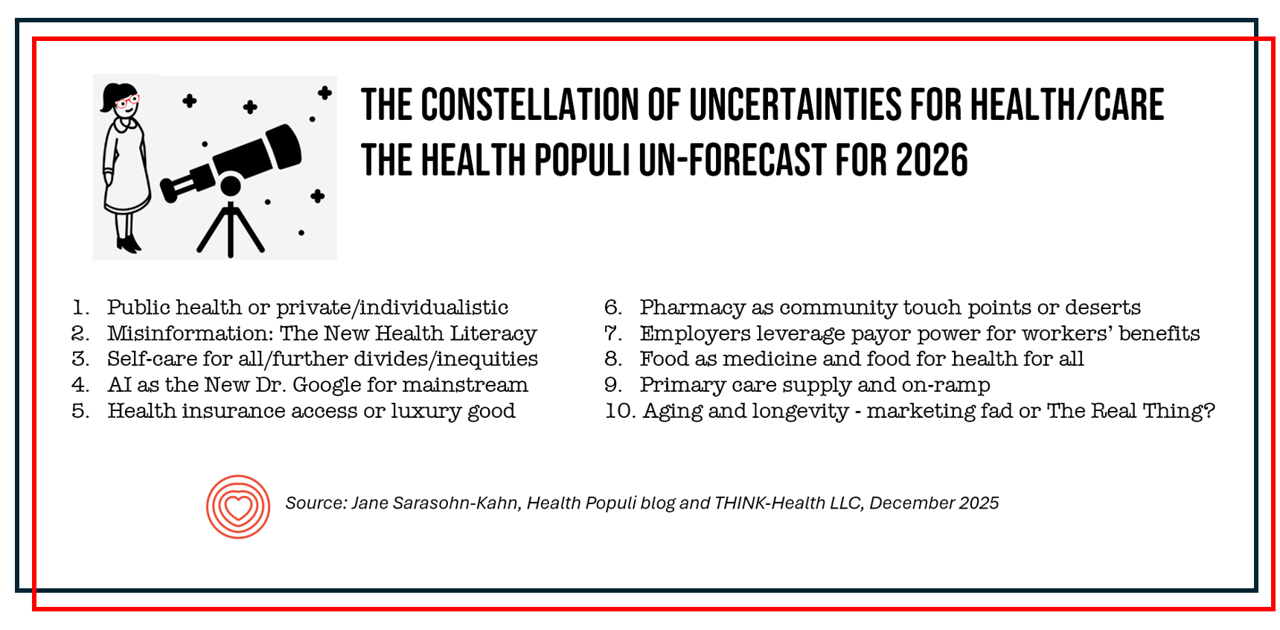
Almost from the first year of launching Health Populi in 2007, I’ve written a “TrendCast” for the coming year of health care. Over many years, there weren’t so many blogs devoted to health care which featured such prognostications, and so readers could divine signal from noise and move forward into new years with manageable lists of What To Expect Next Year in Healthcare. Here’s one from ten years ago that brings a sense of déjà vu: most of the findings are consistent with what we know for sure about 2026 and it’s useful to look back with today’s eyes to
The New Health Consumer Mindset and Wallet: From GLP-1s to Trading Up for Health & Longevity
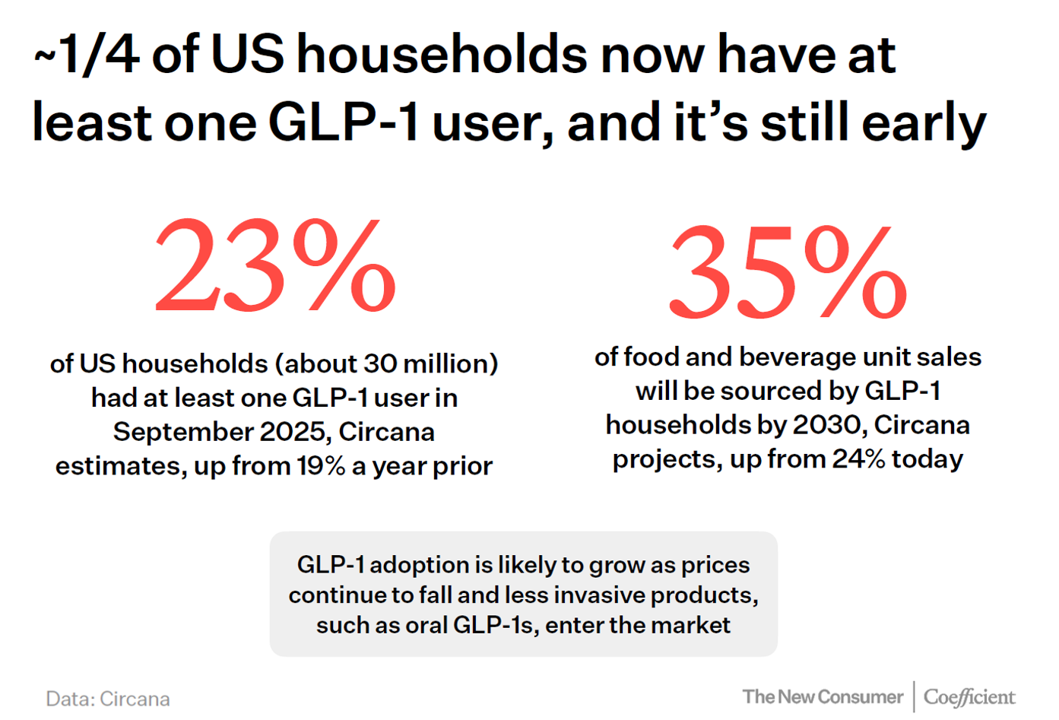
From GLP-1s to longevity and new views on self-care for healthcare, the people are taking their health in-hand, at-home, and via-tech to complement and sometimes replace the legacy health system touchpoints which are the traditional categories for care: hospitals, doctors, rehab centers, diagnostics and labs, and health care financing and plans — some opting out of plans and going full-risk (cash, out-of-pocket) truly self-insuring against future medical risks. As I prepare to publish my Year-End/New Year TrendCast for 2026, I felt like front-ending next week’s annual long post with details on the demand side of the forecast — a focus
Men’s Fertility Feelings – The Influence of Trust and Social Media (My Progyny Post #3)

Trust is a key enabler for people’s health engagement. As the American Medical Colleges’ Center for Health Justice defines it, trustworthiness is “rooted in honesty and honors lived experience….. key to a successful patient-provider partnership.” In his book, Notes On Being A Man, Scott Galloway calls out that men’s fertility issues are formed as part of a larger societal context and crisis point, exacerbated by economic pressures and lack of opportunities for male bonding and in-person social touchpoints. In the second post in this series of three, we discussed those economic pressures Galloway notes, and the financial stressors that shape
Trust and AI in Healthcare: At a Crossroads, Edelman Finds
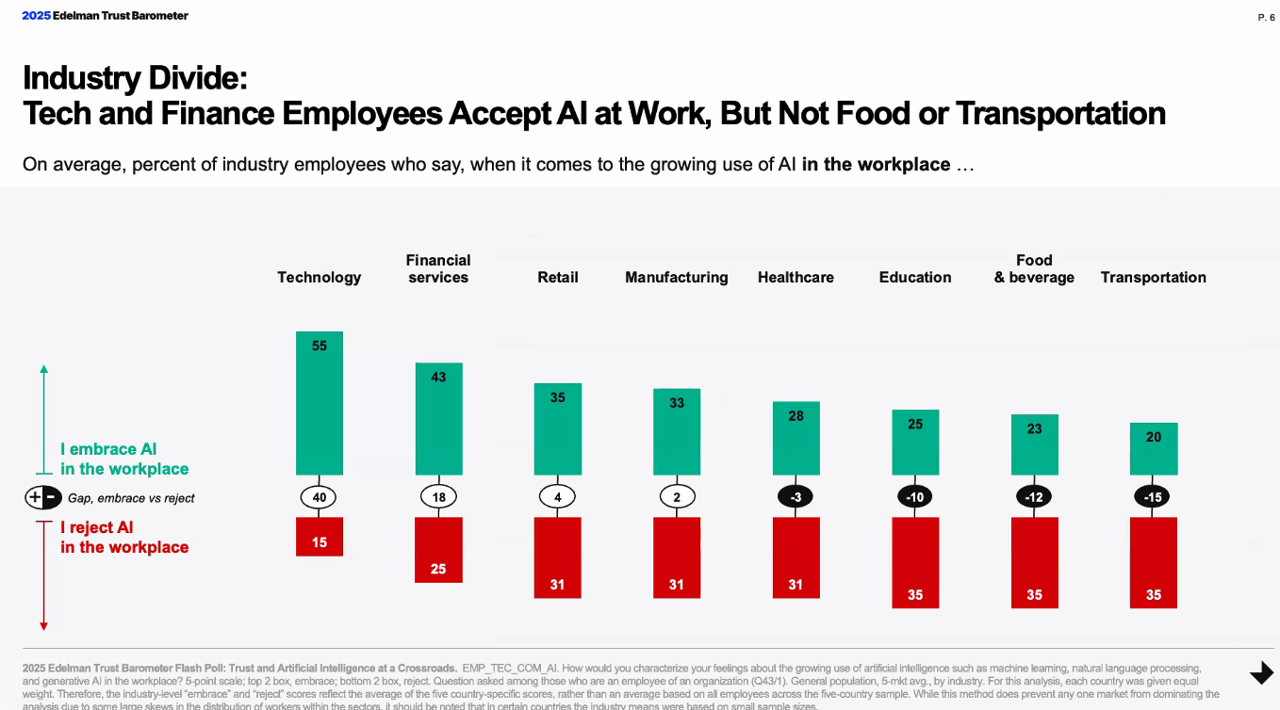
Enthusiasm for innovation is not a guaranteed thing; furthermore, trust in AI lags trust in the overall technology sector, we find in the 2025 Edelman Trust Barometer research through a Flash Poll: Trust and Artificial Intelligence at a Crossroads, discussed in a webcast on 3 December. People in the U.S. are more than twice as likely to reject the growing use of AI than embrace it, with the embrace of AI much lower than peoples’ enthusiasm for it. Edelman conducted the poll in five countries — Brazil, China, Germany, the UK and the US — with sample sizes at least 1,000+
A Month Until #CES2026 – The Journey to Our Personal Health Operating Systems

In a month, I’ll board a plane for Las Vegas to spend a week at CES 2026, the annual electronics conference that last year brought together over 140,000 global technology stakeholders to display, demonstrate, and sell the latest in consumer-facing tech. This will be my fourteenth CES (including the virtually convened meeting held in 2021). If you want to time travel, here’s a link to an early CES post featuring “The Battle of the (Wrist)bands.” Indeed, the digital health aisle at the time had many wrist-worn activity trackers, largely amped-up pedometers, with the likes
The Home Economics of Family and Fertility: Men’s Financial Views on Their Fertility Journeys (My Progyny Post #2)
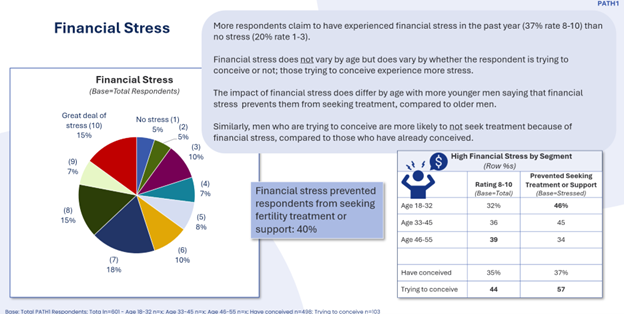
Cost is a leading reason why people say they could not obtain the fertility care they need. But the costs of IVF and other forms of fertility care lie within a larger home economics framework of family-building and -raising. The context and costs of raising a child in America. Consider the layers of a household budget starting with the home’s “macro”-economics of income. Then within that circle, especially in the U.S., the factor of whether that household is covered by employer-sponsored health insurance. The next layer of more health micro-economics in the family is the
Feeling Under-Served and Overlooked: Men’s Views on Their Fertility Journeys (My Progyny Post #1)
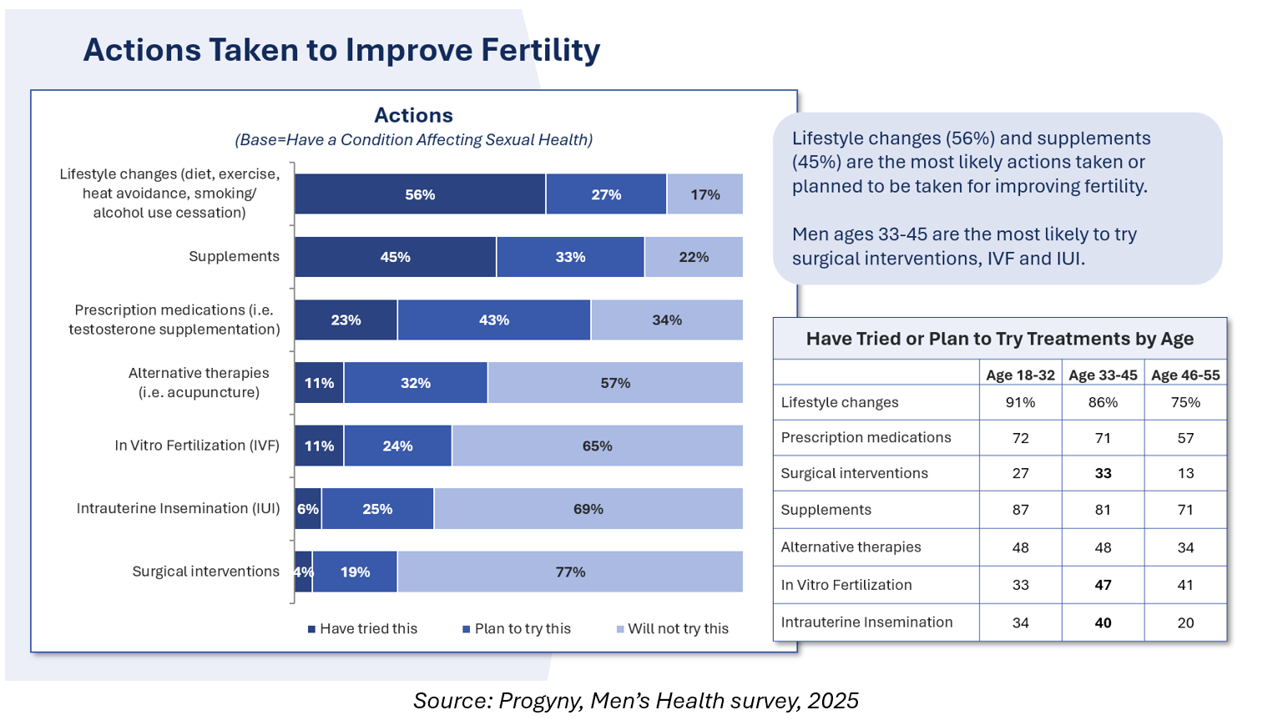
In his latest book, Notes on Being a Man, Scott Galloway discusses his personal fertility journey in the larger social context of what it means to be a man in modern America. Galloway’s infertility challenges shared with his wife inform his views on men’s health across all dimensions — physical, mental health, social health, financial well-being — and how, of course, men’s overall health is also a women’s and children’s issue. Men can feel “left out” of infertility discussions, based on results from the first and largest multi-national study into men’s feelings about their infertility revealed. “How men feel about
Where Health Meets Beauty, Mental Health, and Faith: Learning from the Farmaceutica di Santa Maria Novella
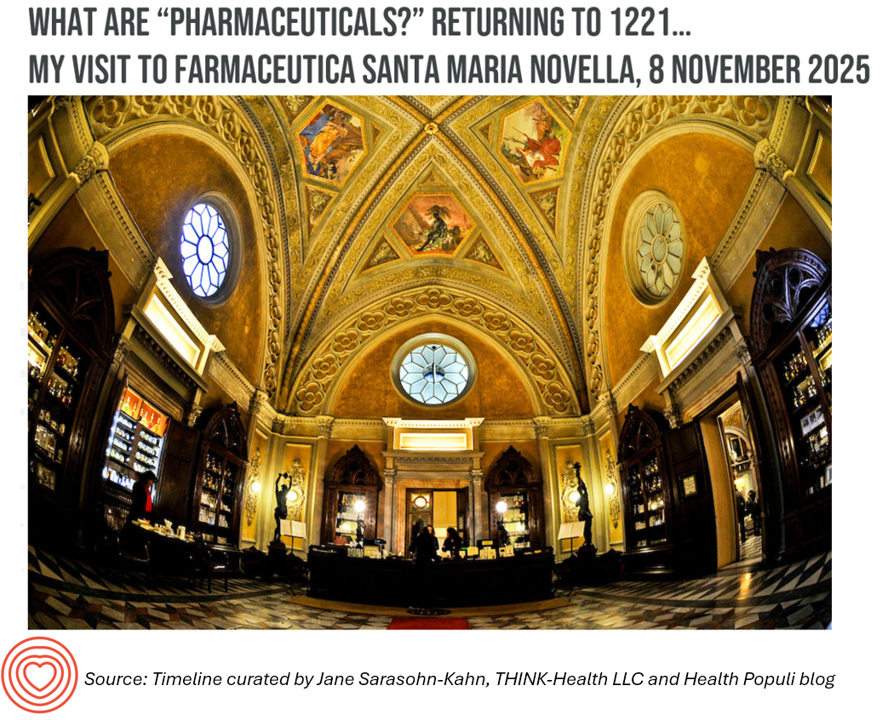
What is a pharmacy? And what are “medicines?” I’ve been thinking about this question for some time, and had the opportunity to consider this in real-time in a sort of back-to-the-past-to-the-future moment when I spent time at the glorious Farmaceutica of Santa Maria Novella (SMN) in Florence, Italy (in longhand, the “Officina Profumo-Farmaceutica di Santa Maria Novella)” on 8th November. This meet-up at this 800+ year old institution is one of many touchpoints in my work and personal life between late October and late November, where I’m working on health/care issues in 4 Euro cities: starting with London in week
Why I Love The LEGO MRI Scanner
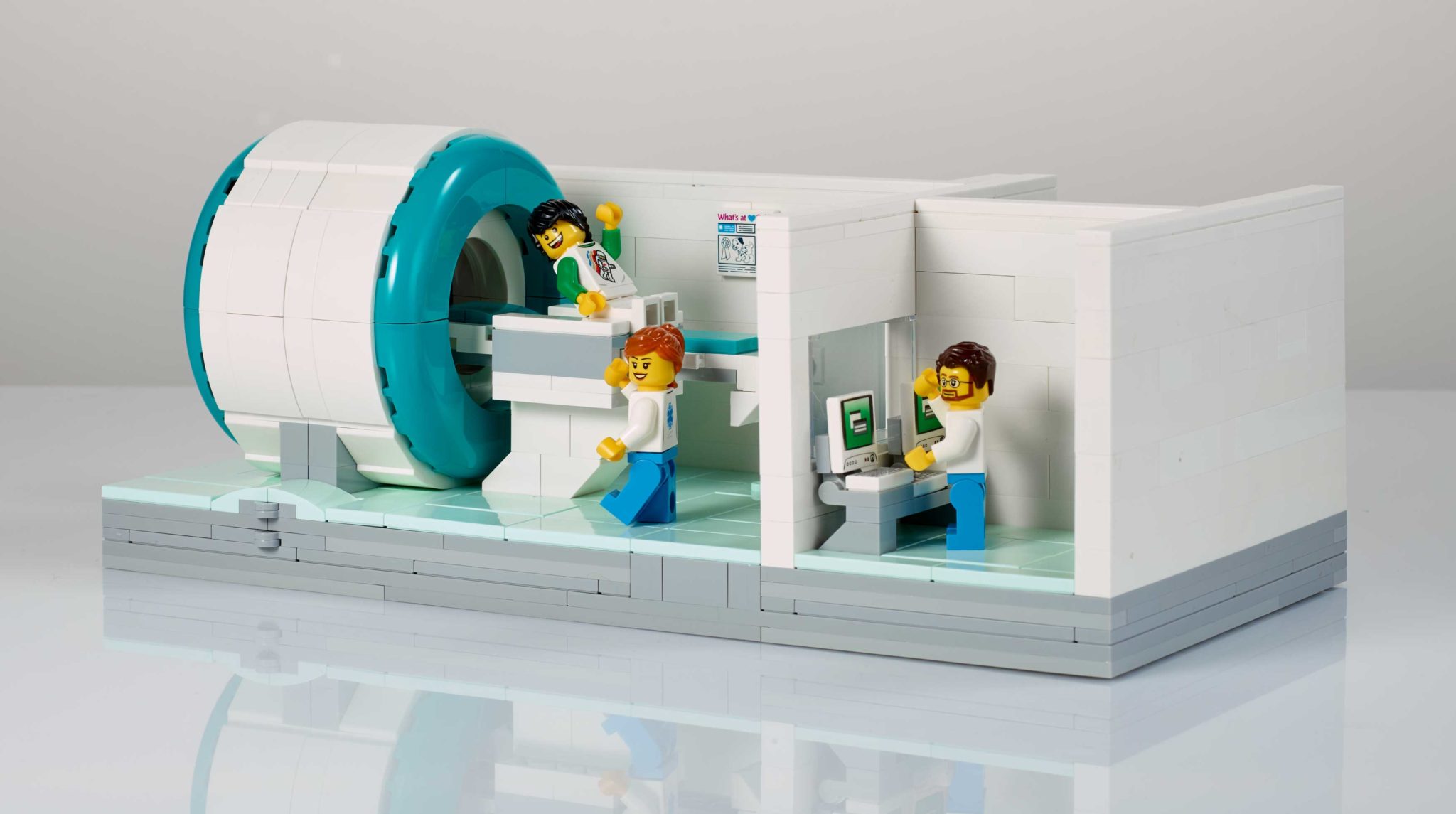
Over one million children around the world have played with an MRI building set from LEGO, which has reduced the young patients’ feelings of anxiety pre-scan along with reducing levels of need for anaesthesia to prep for the MRI procedure, according to the company’s October 13 press release. The LEGO MRI set is a project of The LEGO Foundation and its commitment to ESG — Environmental, Societal, and Governance goals. “Since 2023, more than 10,000 LEGO MRI Scanner sets have been donated to hospitals and health professionals around the world as part of the LEGO
Paging Dr. Verily – What Consumers Want from Health Tech: Personalization, Control, Privacy, and Ease
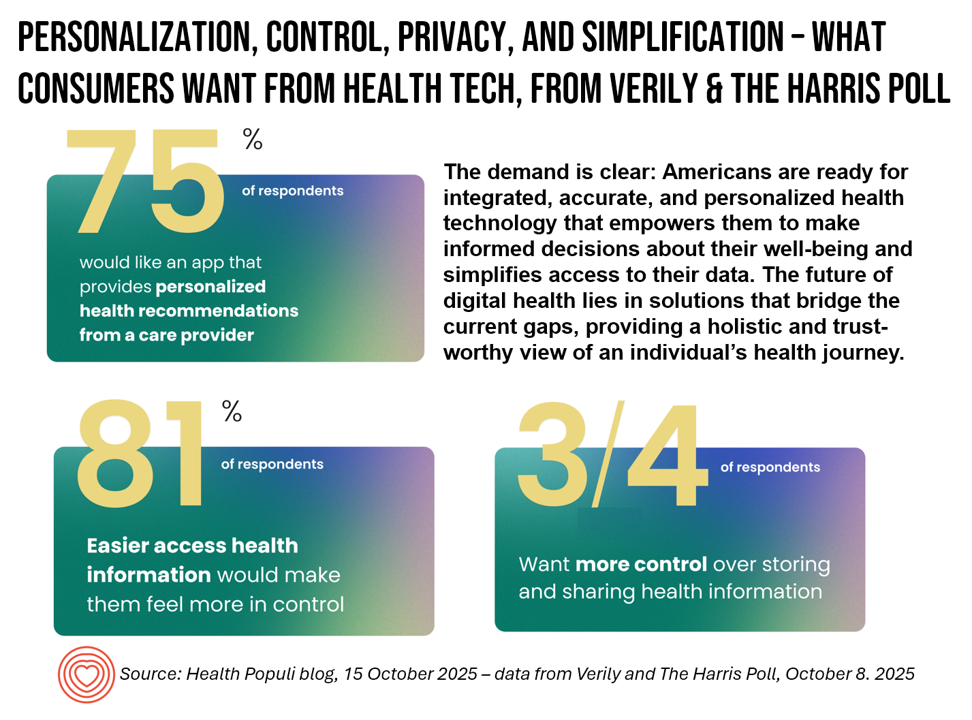
“What do consumers want from their health technology?” wondered a poll conducted among smartphone-owning health care decision makers. Greater control and engagement in health care, assurance of privacy and security for their health data. and greater personalization of advice coming out of the analysis of that shared personal health information. Welcome to the Consumer Survey on Personal Health Technology, market research conducted by Verily with The Harris Poll among 2,000 U.S. adults 18 and older in July 2025. The screening criteria used to include a survey respondent were two-fold: whether they owned a smartphone, and made the majority of their
Sleep in Our Lives: Self-Care, From Using PTO and Vacation Time to Tracking and Digital Detoxes

Sleep is a sort of luxury good when you don’t have it or get it: like water in a desert, it’s priceless and life-saving. When someone thinks of health, “sleep” falls into the top 3 factors, as measured by the Kearney Consumer Institute’s global survey conducted for the Consumer Goods Forum 2025. You can see from Kearney’s data shown here that physical activity (say, mobility and walking and moving about) ranks top for global health citizens, followed by diet and nutrition. Amerisleep, a sleep
What Pantone’s and Insulet’s Omnipod Mango Colorway Means for Patients and Community
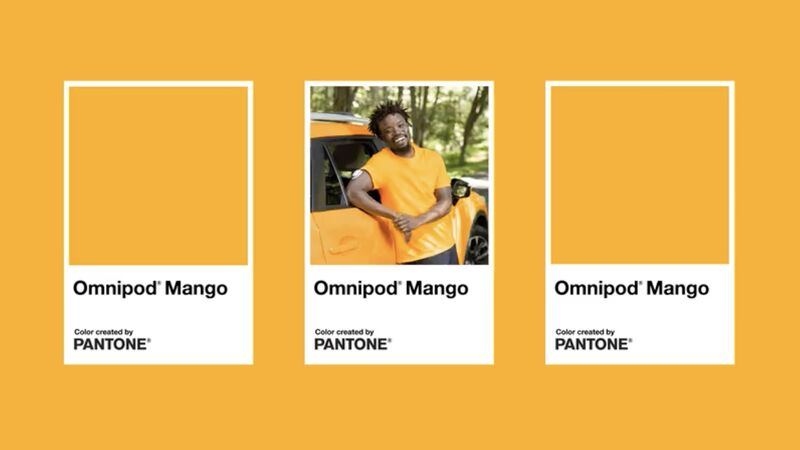
“From Pod to Pantone: Omnipod Mango becomes an iconic color,” the Insulet press release reads. How delighted I am to see that Insulet has collaborated with Pantone on developing the Omnipod Mango color for the company’s insulin delivery system. Here’s some of the story. So why “Mango?” To celebrate individualism and empowerment…and break away from “the world of traditional blues that dominate the medical and diabetes landscapes.” Instead….a bright tropical orange instead of the “medical blues,” as the color researchers pointed out. How wonderful is this? Uplifting, joyful, and representative of the Podders community and identity.
The Emotional Drivers of Healthcare Discontent – Press Ganey Points to Access and Affordability Worries Driving Anxiety and Anger
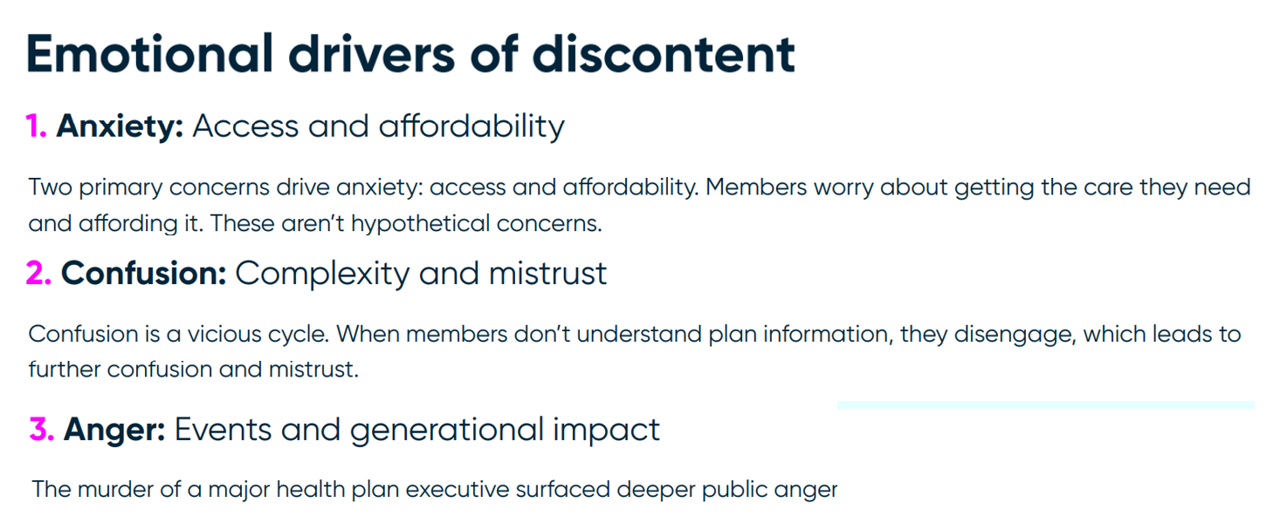
In the current era of U.S. health citizen grievance with the health care system, people feel anxious, confused, and angry — especially when it comes to access and affordability of health care. We learn more about these emotional drivers of health/care grievance in Understanding Health Plan Member Discontent, an assessment of health consumers’ views of satisfaction across health insurance plan types (commercial, Medicaid, Medicare, and marketplace plans) and age of member, from the health consumer experience team at Press Ganey. Those three underlying factors driving discontent translate to different generations differently. Overall, anxiety relates to
How Consumers’ Access to Telehealth Impacts Medical Real Estate and Design Decisions
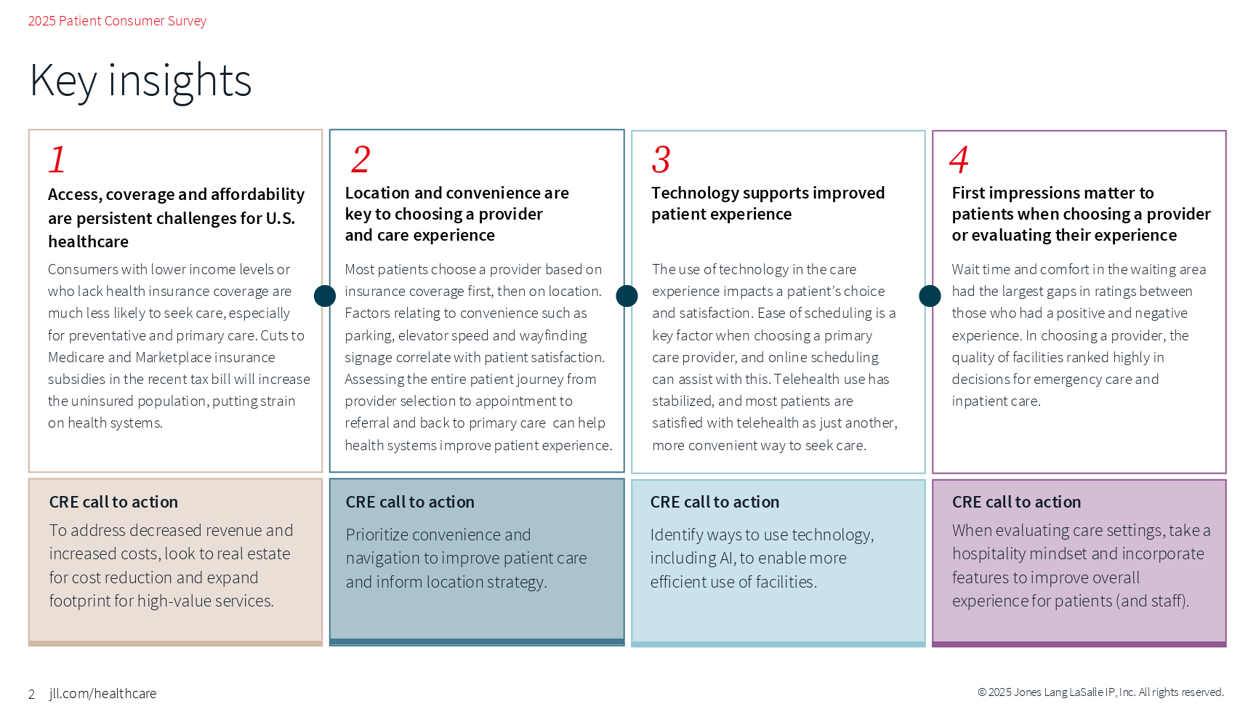
The idea of “hospitality” in health care is not new, but the nature of how patients-as-consumers are dealing with health care choices based on what looks and feels good is changing the nature of what hospitality means in technology-enabled health care delivery, we learn from the 2025 Patient Consumer Survey conducted by JLL. Jones Lang LaSalle Inc. (JLL) is one of the largest global commercial real estate firms with a strong portfolio of medical buildings. So it is worthwhile to track what the company is learning about health care delivery distributed both inside and outside of brick-and-mortar medical buildings.
In 10 Years, Health Care Will Happen Where Life Happens – PwC’s Tea Leaves into 2035
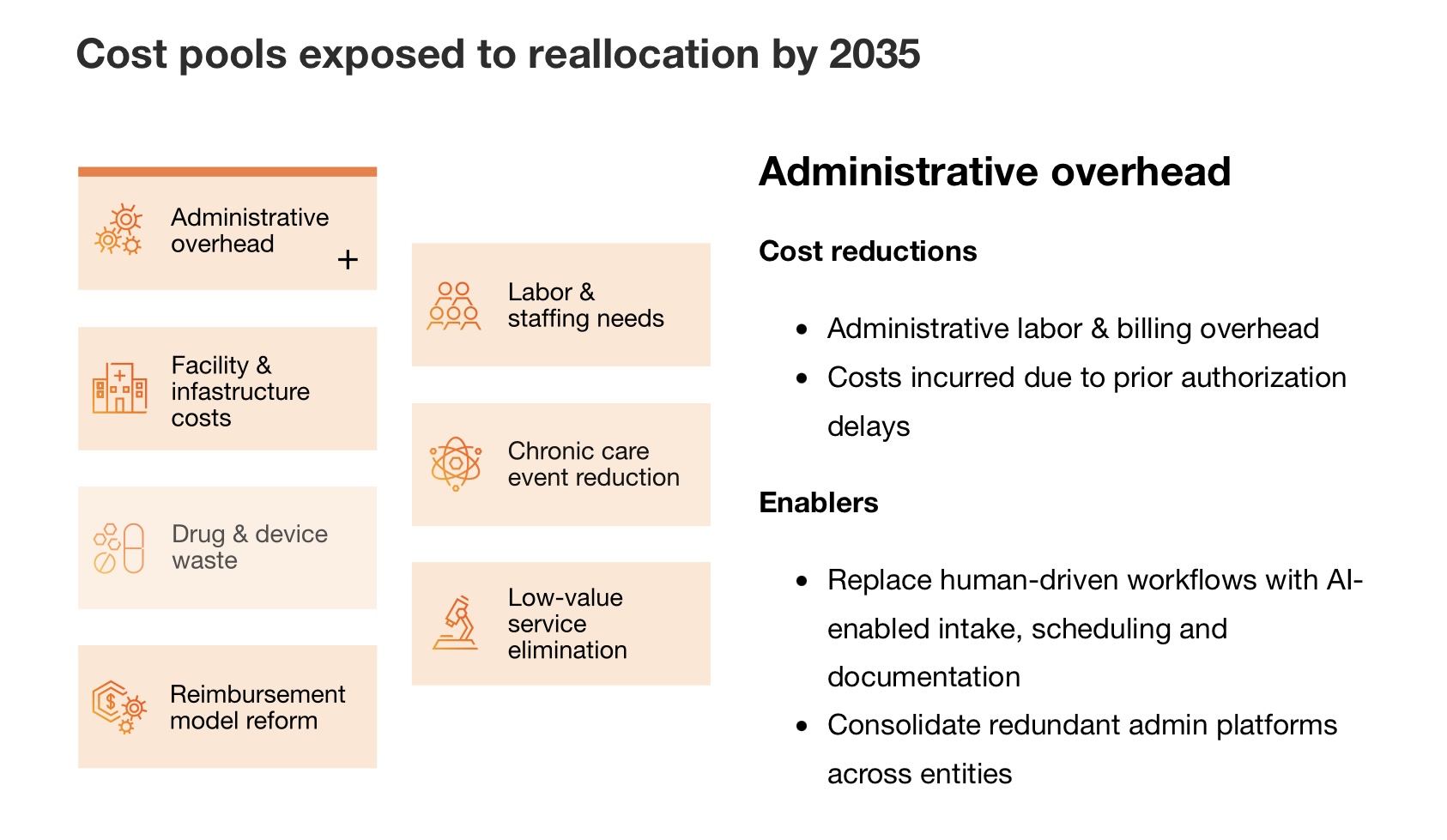
The costs of medical care are breaking the system, PwC asserts at the start of its new report on the $1 trillion opportunity to reinvent healthcare. The past 3 years of 8+% U.S. national health expenditure increases are “untenable,” PwC says, with 90% of that spending going toward patients with chronic and mental health conditions. What will transform the system and move us from “breaking point to breakthrough?” Biology and technology, PwC explains, with technology moving exponentially and simplifying care at scale, and biology decoding the “human operating system” enabling precision at scale. This
Trust Is Eroding for Vaccines Among U.S. Parents — New Insights from KFF and the Washington Post
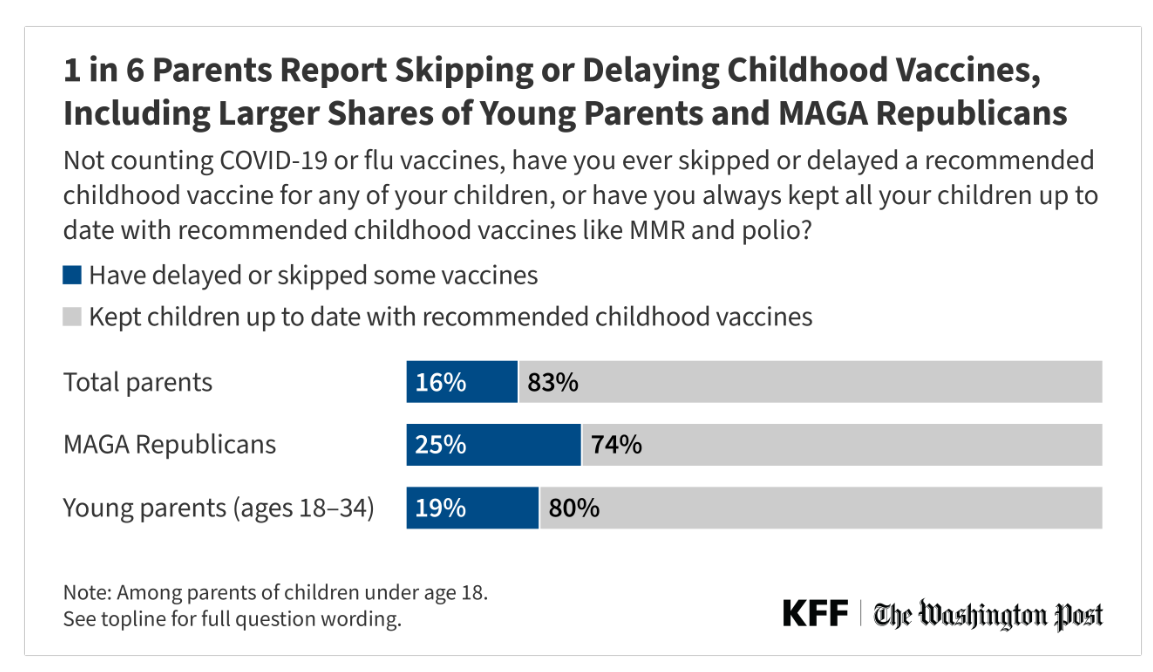
By the summer of 2025, 1 in 6 U.S. parents had skipped or delayed childhood vaccinations, discovered in the 37th annual edition of the KFF/The Washington Survey of Parents. The study was conducted among 2,716 parents or legal guardians of children, via interviews online in English and Spanish between July 18 and August 4, 2025. In detail by demographic, 83% of all U.S. parents had kept children up-to-date with recommended childhood vaccines (16% not doing so) 74% of self-described MAGA Republicans kept kids up to date with the recommended vaccines (25% not doing so),
Dr. Osterholm Explains “The Big One” – A Deja Vu Moment with a True North Public Health Expert
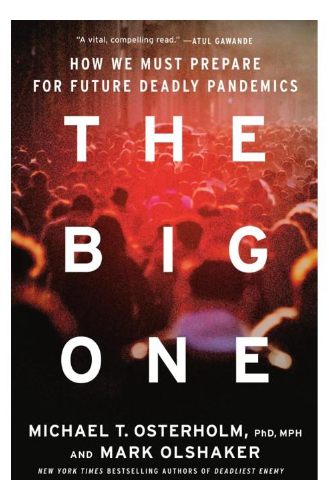
“The truism that no one is completely safe until everyone is safe is a truism because it happens to be true.” So caution Michael Osterholm, epidemiologist, professor at the University of Minnesota School of Public Health, and director of CIDRAP (the Center for Infectious Disease Research and Policy at the U-MN) and collaborating writer Mark Olshaker in their new book, The Big One. (In this post, for the sake of brevity, I’ll refer to the two authors as “O&O”). Simply put, the tagline tells us what we are about to read: a
Prescription Drug Pricing in America – a 3-Part Update, From the Over- the-Counter OPill and “Half-Price” Ozempic to Most-Favored-Nation Rx (Part 3)
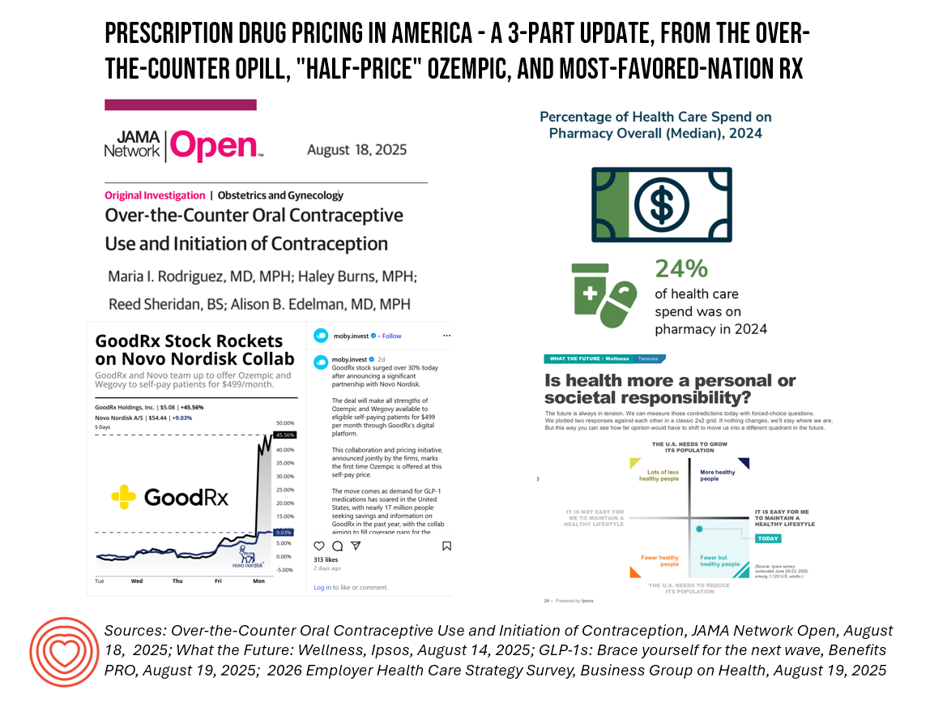
Welcome to Part 2 of 3 in my consideration of Prescription Drug Pricing in America. You can catch up with yesterday’s Part 1 post here, and Part 2 here. The macro-context for these 3 posts are the forecasts for health care spending for the coming year. Health care cost increases forecasted for 2026 will, in significant part, be driven by prescription drug trend. This graphic from this week’s release of the Business Group on Health’s employer survey on healthcare cost growth to 2026 illustrates a key finding that’s echoed in other similar studies recently released and covered here in Health Populi.
Prescription Drug Pricing in America – a 3-Part Update, From the Over- the-Counter OPill and “Half-Price” Ozempic to Most-Favored-Nation Rx (Part 2)
“Big Pharma has a new vision for selling drugs. It’s going to the mattresses,” writes Josh Nathan-Kazis in MSN earlier this week. That is, going direct-to-consumer (DTC) the way the mattress industry has done in the past decade, cutting out brick-and-mortar sleep shops at retail. In the case of “Make(ing” like a mattress company,” Josh explains, the pharma manufacturers “sell shots and pills straight to the consumer.” In this case, that’s cutting out the pharmacy benefits managers and other intermediaries that have taken dollars in the transactions of drug benefit claims which have added costs to payers (health plan sponsors
Prescription Drug Pricing in America – a 3-Part Update, From the Over- the-Counter OPill and “Half-Price” Ozempic to Most-Favored-Nation Rx (Part 1)
Health care costs will increase, overall, as much as 10% in 2026, the consensus of several health benefit analysts inform us. And, “workers to bear brunt of health cost increases in 2026,” reads today’s Axios headline on the topic, weaving together several studies from the Business Group on Health, Mercer, and the International Foundation of Employee Benefit Plans. A kay cost-contributor cited in all of these health cost forecasts is the prescription drug line item: specialty drug prices, and specifically the costs of GLP-1 medicines and cancer therapies. One strategy gaining fast-traction on both the
What U.S. Consumers Are Thinking About Tariffs’ Impacts on Health Care: Looking to Ipsos, QCentrix and Goldman Sachs
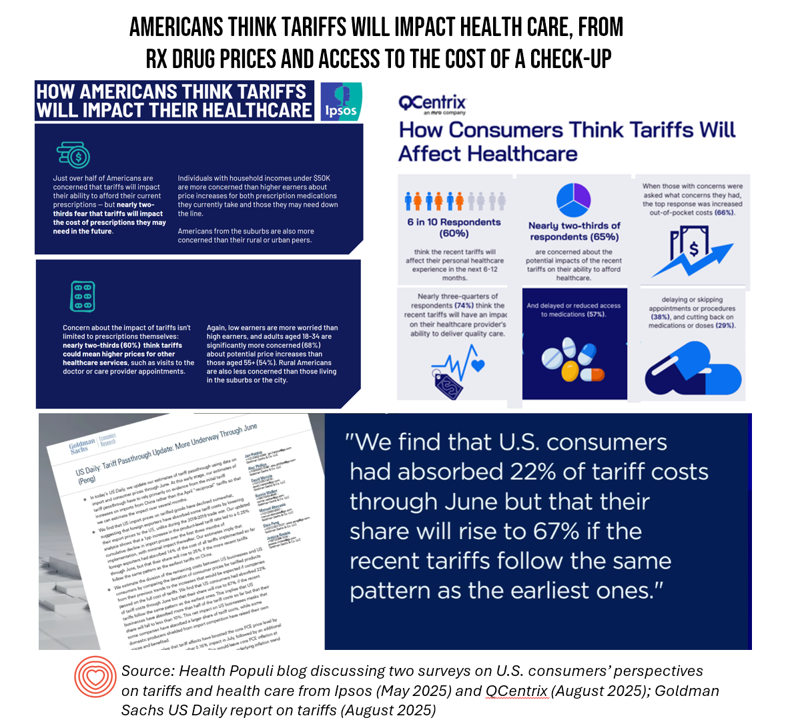
Most Americans, thinking as health consumers, believe that tariffs could impact peoples’ ability to pay for costly prescription drugs and be priced out of paying for check-ups and medical supplies, based on results from two studies on consumers’ views on tariffs and their health care from Ipsos and Q-Centrix. Ipsos’s consumer survey found that younger consumers, people earning lower incomes, and folks living in the suburbs feel even more stressed about tariffs’ impact on medical care — along with more people identifying as Democrats or Independent voters. With
To Garner Patient Loyalty, Focus on Convenience, Availability, and Affordability. Consumers Trust AI to Help the Journey.
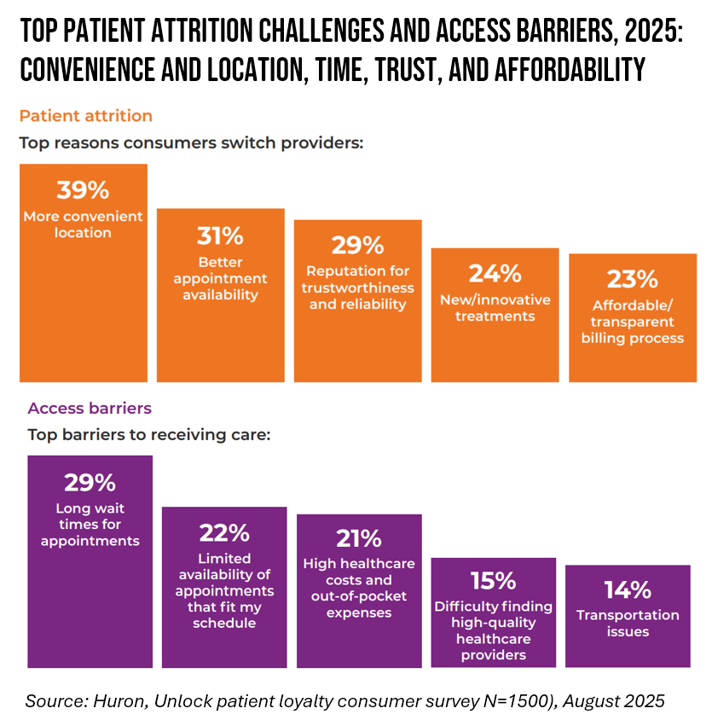
U.S. health consumers are roughly split 40/40 when it comes to AI analyzing personal health data to provide personalized advice, with 21% feeling neutral about that. But using AI for regular health updates and guiding us through a pre- or post-care medical journey would be welcome by one in two people, we learn in how to Unlock patient loyalty: New healthcare consumer insights, Huron Consulting Group’s consumer research report polling 1,500 U.S. healthcare consumers. Start with peoples’ top reasons for switching health care providers, along with main barriers preventing consumers from
Women Walk a Financial Tightrope: What That Means for Women’s Health, Mind, Body, & Wallet
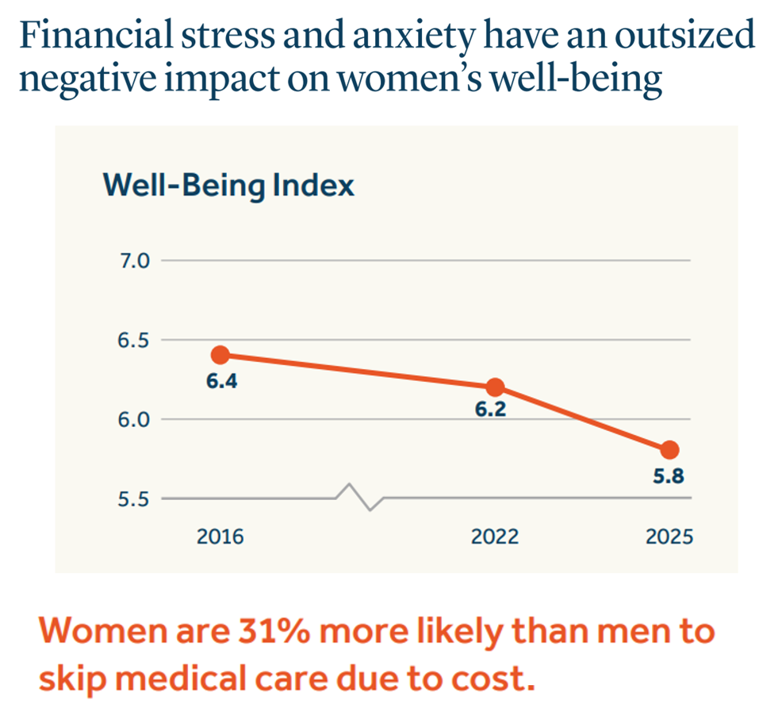
Financial stress and anxiety have an ‘outsized’ negative impact on the well-being of women in America, compared to male counterparts, we learn in Health. Wealth, and Happiness – Helping to overcome roadblocks to women’s well-being, a report from the Guardian Life Insurance Company. This report is part of Guardian’s annual research program called Mind, Body, Wallet, which the company launched 14 years ago. The goal of Mind, Body. Wallet is to assess how health citizens define “well-being” in daily living, making the crucial connections between mental health (“Mind”), physical health (“Body”), and money
Ozempic: A Medicine, and a “Cultural Shorthand” – What The Harris Poll Knows About Gen Z Consumers and Health Care in America

Among the top 20 fastest-growing growth brands beloved by Americans between 18 and 28 years of age — that is, Gen Z consumers — we see brand-equity love for companies channeling athleisure, fashion, new-fangled financial products, and food & beverage brands. And then there’s Ozempic, which gained 10 full percentage points from Q1-2025 to Q2-2025, according to The Harris Poll’s QuestBrand research. What does it mean that a prescription drug has joined these brand-loved rankings? The QuestBrand research found that as of the second quarter of 2025, more than one in 3
Why a Grocery Store Signed On to “Make Health Tech Great Again”

Joining the ranks of technology heavyweights Amazon, Anthropic, Apple, Google, and OpenAI, as well as digital health innovators Noom, Oura, Virta Health and Welldoc, who have pledged to “Make Health Tech Great Again,” Albertsons, one of the largest grocery chains in the U.S., put its name on the list with these and other early adopter collaborators. The Albertsons’ company blog published on 31 July discussed the background and rationale for this decision. “Specifically, we pledge to explore how our Sincerely Health platform can connect to The Centers for Medicare and Medicaid Services (CMS) Aligned
The Patient as Consumer – Updates from Fidelity on Retiree Health Care Costs ($172,500), Delaying Care, Tariff Impacts on Spending, and Roche Going DTPatient for Rx’s?

As of August 2025, U.S. patients of all demographics and geographies face many uncertainties with respect to their care. Issues such as health plan coverage, prescription drug costs, and access to services, among other challenges, continue to re-shape patients-as-health-consumers seeking transparency, clinical choices, and trust-worthy relationships with touchpoints in their personal health ecosystems. Four just-breaking stories across the health/care ecosystem illustrate several of these uncertainties and forces in U.S. health care — some adding friction and angst in a patient’s life, others perhaps providing some relief for certain health consumers. These news items address health care costs in retirement, the
How Taking Care of Our Pets Could Inspire Us to Care Better for Ourselves (and Each Other)

In a recent study which was part of the American Heart Association’s Healthy Bond for Life initiative, two-thirds of Americans told the AHA that they took better care of their pets than themselves. So with a lens on how to help inspire peoples’ self-care, I was keen to dive into research from Pet Partners Insurance (PPI), a pet health insurance provider, collaborating with the Human Animal Bond Research Institute (HABRI), to learn more about The Power of Pet Perks: How Pet-Inclusive Benefits Drive Employee Engagement, Retention, and Positive Workplace Culture. My interest
Most People Would Choose Food Over Meds to Get Healthy. But Barriers to Consumers Doing So Will Require Collaborative Approaches That Get Closer and Personal
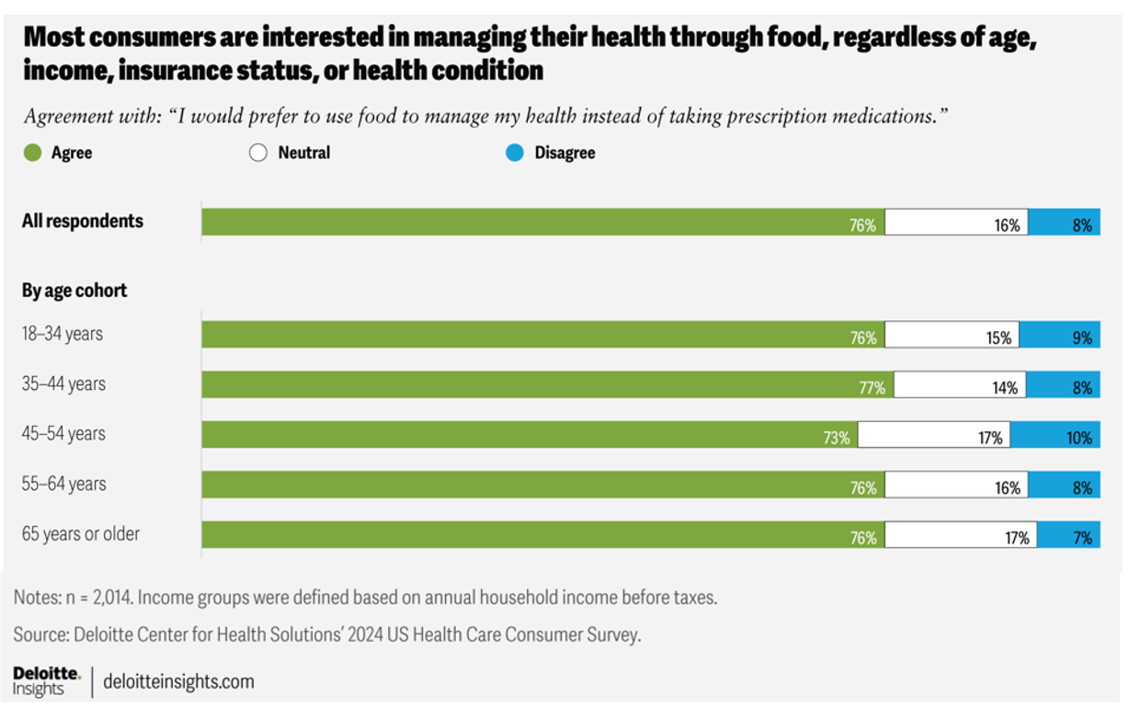
The pandemic era re-shaped consumers’ views on food as an input for health across all dimensions. We look back with affection for our local grocery stores and pharmacies which played leading roles as first responders f0r our health and, quite literally, the basic needs at the base of our personal hierarchies the way Maslow conceived them. As I tracked home-bound consumers’ behaviors from the start of COVID-19 in March 2020, I hunted-and-gathered data from Nielsen, Acosta, Circana, Gallup, Harris, and other sources of consumers @ retail. The DIY food-health concept, coined by Nielsen, was the build-up of our “pandemic pantries.”
Medical Cost Trend at 8.5% in 2026? PwC Sees “No End in Sight” for Increased Healthcare Spending
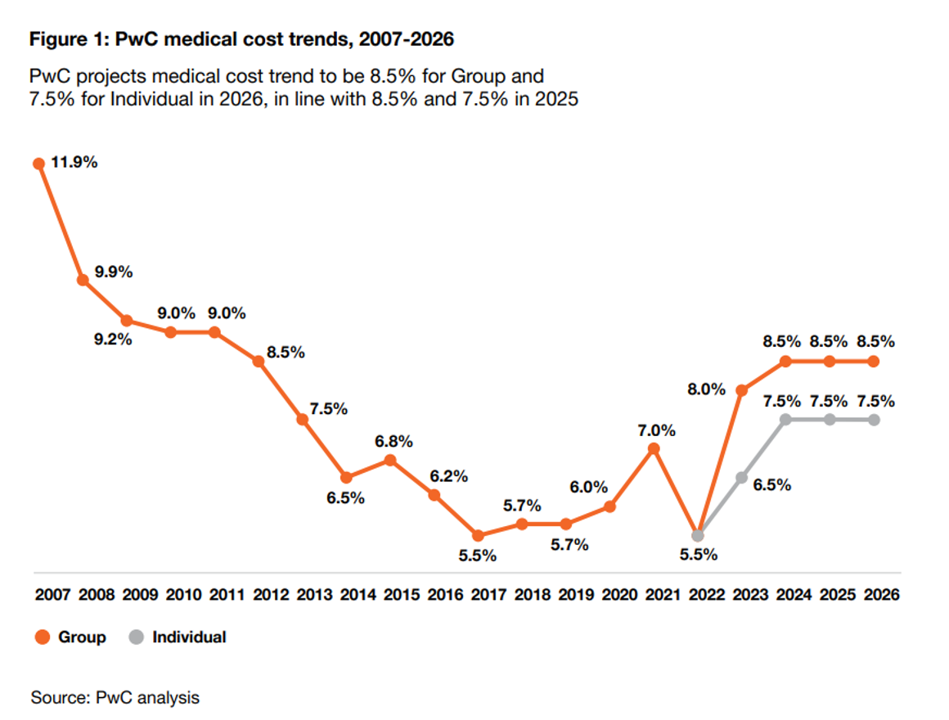
For the third year in a row, medical cost trend — the expected increase of health care costs by health plans — will be 8.5% for group health insurance. This contrasts with a low of 5.5% in 2022 when cost trend dipped coming out of the COVID-19 pandemic….then shot up to 8.0% the following year in patients’ healthcare catch-up mode. Welcome to Behind the Numbers 2026, the annual medical trend report from PwC. What’s continuing to drive up health care costs? PwC identifies 4 medical cost inflators, and 2 “deflators” (these being
As Time Becomes More of a Luxury Thing, Consumers Ration Visits to Health Care Providers

When it comes to luxury goods, forget about that Rolex watch, a Louis Vuitton bag, or Porsche. The top luxury item among U.S. consumers in 2025 is time, and with many luxury goods, time is in short supply for most people. An important new report from Duckbill explores the Permission to Ask: Why Americans Need Help — And Why They Struggle to Get It. The top-line finding gleaned through Duckbill’s survey of 2.069 U.S. consumers in early May 2025 was that 2 in 3 Americans are just trying to get through the day. This struggle
National Health Spending in the U.S. in 2033: What 20.3% of the GDP Will Be Spent On
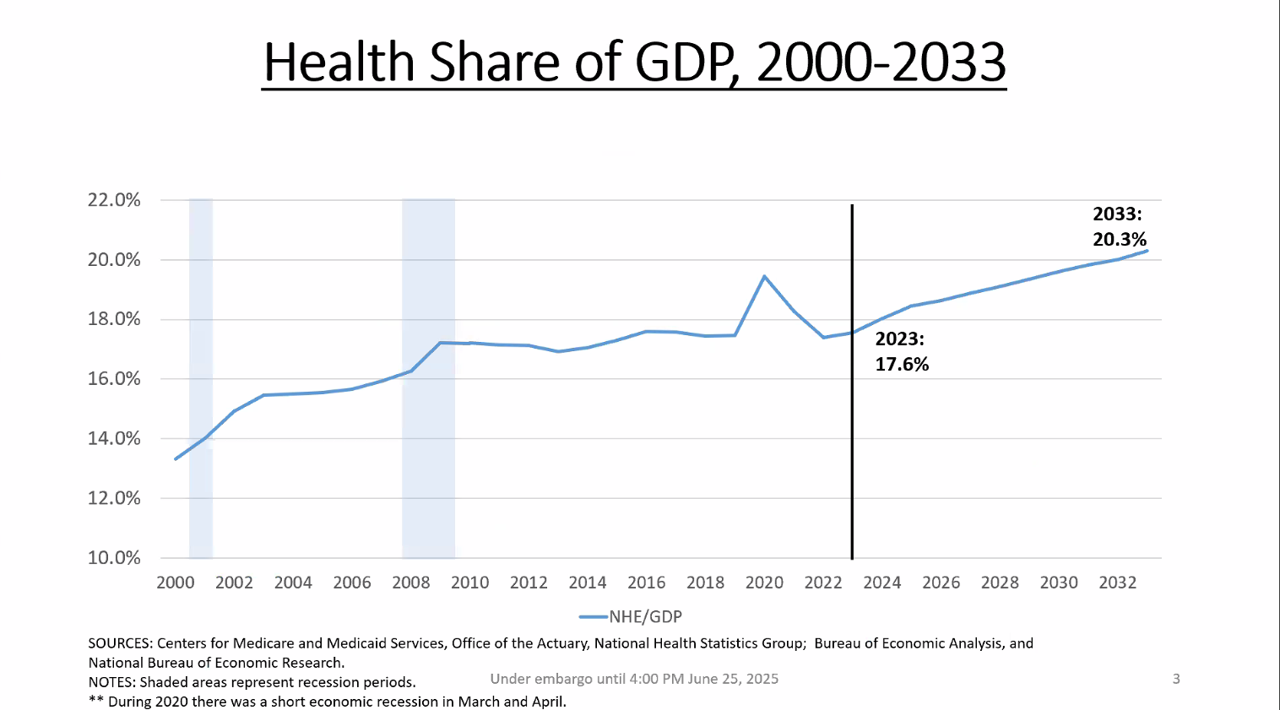
By 2033, national health spending will comprise 20.3% of the U.S. GDP, based on the latest national health expenditure projections developed by researchers from the Centers for Medicare and Medicaid Services (CMS). This growth will be happening as CMS projects coverage of insured people to decline over the period. Earlier today, I attended a media briefing hosted by Health Affairs to receive the CMS team’s top-line forecast of NHE from 2024 to 2033 discussing these findings. Fuller details on the projections will be released in the July issue of Health Affairs on 7
Consumers’ Favorite Brands for 2025 Look a Lot Like Pandemic Times: All About Hygiene, Safety, Personal Care, and Packages

Shades of the year 2020; it’s déjà vu all over again when it comes to consumers’ most trusted brands in 2025 featured in Morning Consult’s Most Reputable Brands report. Here’s the list of the top 25 most trusted brands across all consumer touch-points and industries for all adults, ages 18 and older. A quick calculation reveals that consumers most trust brands covering, Home keeping and hygiene – Dawn, Clorox, Lysol, Mr. Clean, Home Depot Self- and personal care – Dove, Oral-B, Kleenex, Colgate Health – BAND-AID, Tylenol Packages
Americans Hear More Frequently About GLP-1 Drugs Than About Menopause, Sleep, or Bird Flu
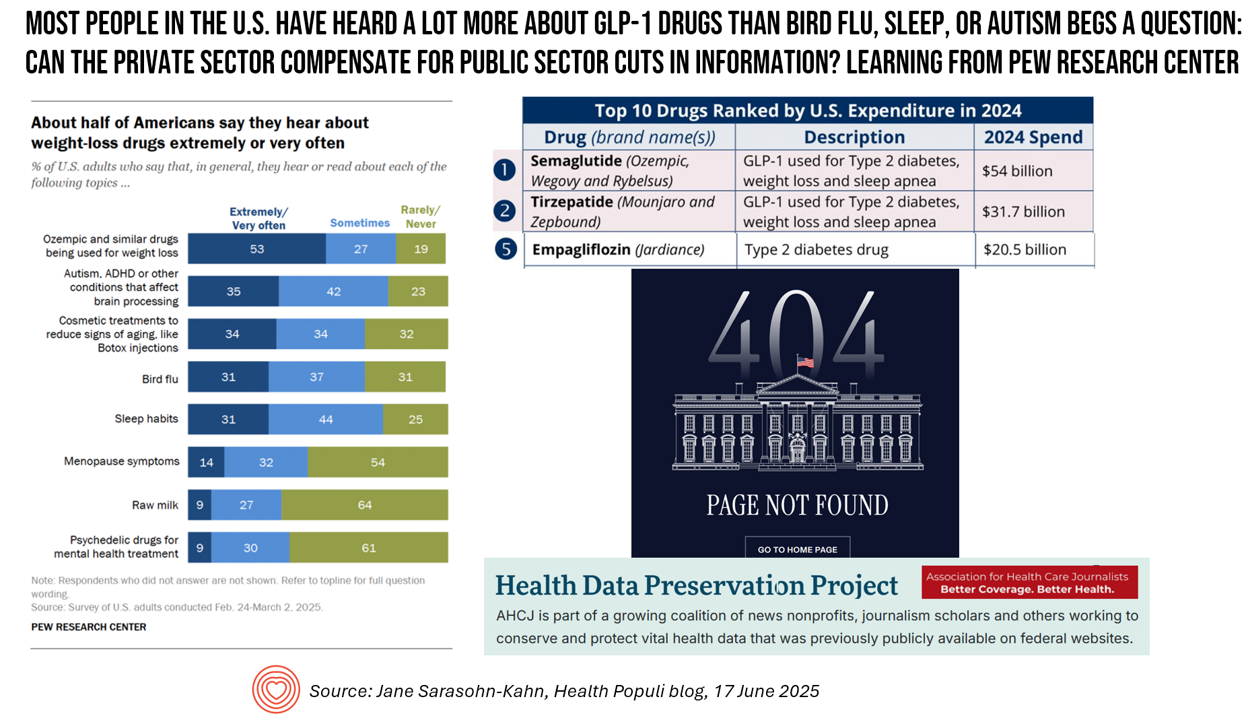
Yu In a sign of our health communications times, GLP-1s are a much more frequently health topic Americans hear about than autism and ADHD, cosmetic treatments like Botox, Bird flu, sleep issues, or menopause. The Pew Research Center polled 5,123 U.S. consumers in February and March 2025 to gauge peoples’ perspectives on health information and communications trends in America. In the study summary titled, From weight-loss drugs to raw milk, Americans hear more often about some health topics than others, the Pew Research team. The finding that
What Children Can Teach Us About Using GenAI – Insights from The Alan Turing Institute and LEGO

“While children are the group that may be most impacted by the widespread deployment of generative AI, they are simultaneously the group least represented in decision-making processes relating to the design, development, deployment or governance of AI,” we learn in Understanding the Impacts of Generative AI Use on Children, research conducted by The Alan Turing Institute in partnership with the LEGO Group. But it’s the children who shared their perspectives who can teach adults about some potential positive and negative aspects of GenAI, and help inform us in managing downside risks. FYI, The Institute is headquartered in the British Library
The Spirit for Eating Healthier Is Willing, But the Cost of Doing So “Outweighs” the Will – Listening to Escoffier

It’s been a full week’s coverage on food-as-medicine and food as a driver of health in America this week on the Health Populi blog. Today we turn to the chefs at Escoffier who know food, teach food, and now offer programs in holistic nutrition and wellness through the lens of culinary arts. With that lens, Escoffier recently published a report on the future of healthy eating, which will round out this week’s Health Populi landscape on food and health. In the paper, the Escoffier team curated data points from many studies — via Gallup, Mintel, Innova,
Consumers Are Keen to Invest in Health and Well-Being – But Show Them the Evidence

Consumers around the world feel more invested than ever in what makes people feel both well and prosperous, we learn in the NielsenIQ Global State of Health & Wellness 2025 survey report. But there’s a trust deficit that must be healed in order for a health consumer to invest in services and products that feed health and well-being. NIQ fielded the survey research online in January and February 2025 among nearly 19,000 adults living in 19 countries: Brazil, Canada, China, the Czech Republic, France, Germany, Hungary, India, Indonesia Italy, Mexico, Netherlands, Poland, South Africa, Spain, Turkiye, UAE, United Kingdom, and
Marketing Women’s Health: How Organon’s Nexplanon Took a Page Out of Romance Novels

With women’s health and femtech investing in the spotlight in 2025, most of the focus has been on either women’s access to health care services (e.g., for abortion and prenatal/primary care) to start-ups focusing on fertility technology and benefits, along with growing awareness of the long-overlooked menopause market opportunity. Contraception? Not so visible. Of course, we welcomed the Opill to the over-the-counter medicines market last year with FDA approval of the switch to retail pharmacy and vending machine access. Now let me point you to a newfangled marketing campaign for
In Health Care, Consumers Are Seeking Kindness Coupled with Efficiency

Kindness + efficiency + listening + personalization: together, these are the most important experiences consumers seek from health care touchpoints, we learn in Humanizing Brand Experience: Healthcare Edition from Monigle. In this 8th volume of the company’s Humanizing series, Monigle tracks a different pattern of patient engagement — to be sure, built on trust, yet not just as a health consumer dealing with a diagnosed condition — but more holistically for getting me and keeping me healthy and well. The implication and recommendation here is to deliver even more personalized care
The Next Version of Medical Tourism: Medical Immigration?

One in three Americans could imagine leaving America for good as expatriates — with access to affordable and reliable health insurance the top consideration, according to research conducted by the Harris Poll on behalf of GeoBlue and International Citizens Insurance (ICI). “Thirty-one percent of potential expats cite concerns about healthcare coverage abroad being the reason they haven’t yet taken the leap to move abroad. This trumped concerns about their work and social life abroad,” the survey found. Earlier this year, The Harris Poll’s American Expats Survey, published in February 2025, found that health care accessibility
If Food Is Medicine, Some Might Feel It’s a Luxury Good Like a Specialty Drug
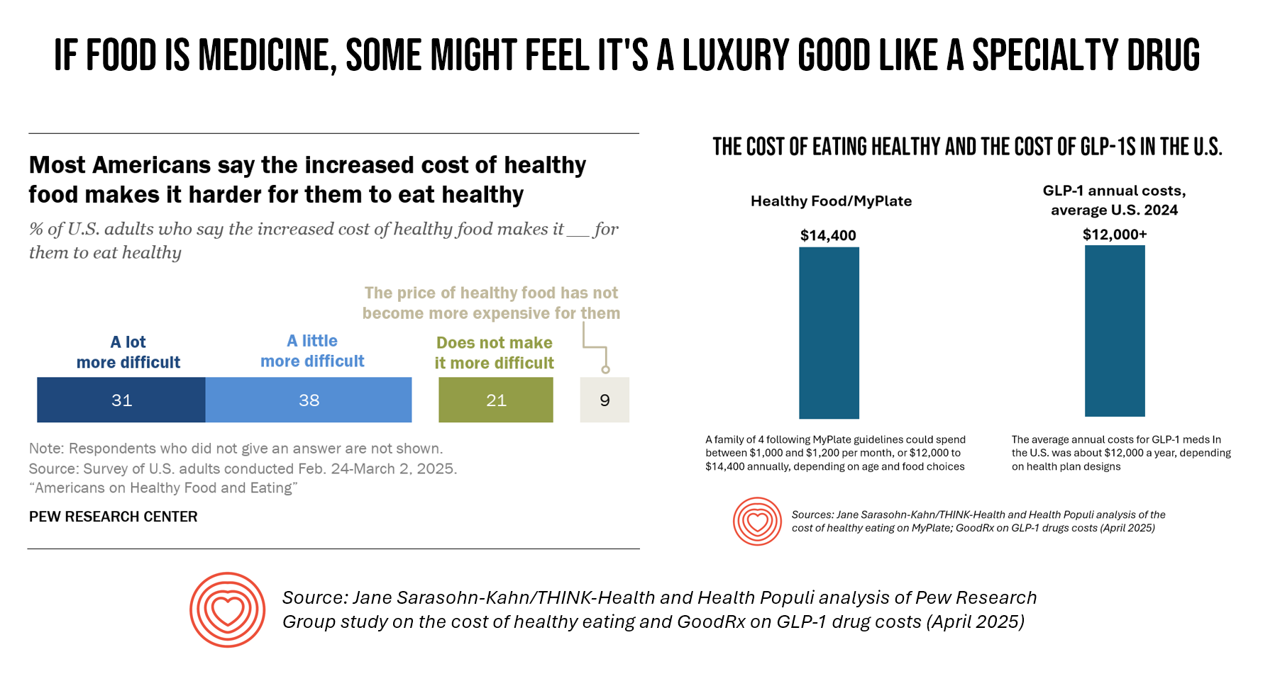
Most people in the U.S. say it’s harder to eat healthy given the cost of “healthy food,” we learn in the report on Americans on Healthy Food and Eating from the Pew Research Center, published 7 May 2025. With a view that healthy food is “too expensive,” it may feel like aspiring for it feels like luxury-good shopping, or being a patient prescribed a specialty (high-cost) drug. The Pew team polled 5,123 U.S. adults’ perspectives on eating, fielded between 24 February and 2 March 2025. This report is timely as Secretary of Health and
Americans’ Trust in Public Health Agencies Has Become Politicized, Though There is Bipartisan Support for Many Public Health Priorities

While health citizens’ trust in the “messengers” of health information has become polarized by partisans’ political views, there is real concordance of support for many public health priorities. We weave together two current studies to come to this realization: the latest (April 2025) KFF Tracking Poll on Health Information and Trust, KFF’s ongoing health survey (published 6 May); and, the de Beaumont – Harvard Chan School of Public Health poll into Americans’ views on public health in “the first 100 days” of President Trump’s presidency. First, consider the KFF study, conducted among
How Consumers’ Economic Sentiments Are Shaping Peoples’ Financial and Emotional Well-Being (Spoiler: Not So Good): Learning from CivicScience
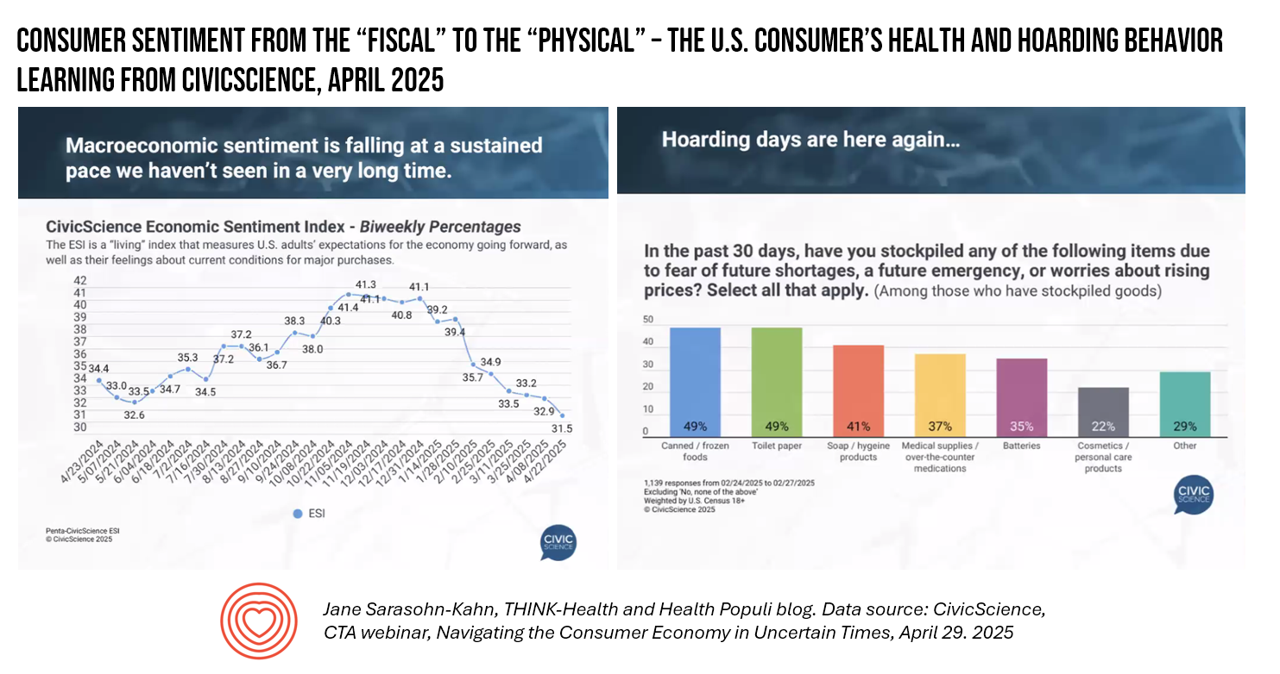
When it comes to health, the words “fiscal” and “physical” are morphing as peoples’ economic feelings (the “fiscal”) are shaping physical and emotional health, we find in U.S. consumer data presented by John Dick, Founder and CEO of CivicScience. The Consumer Technology Association convened a special session with John, who painted a portrait of the U.S. consumer at a point in time — late April 2025 — reminding us more than once during the hourlong session that, “Everything is constantly changing.” One certainty that we can be sure of, in the dismal-scientist way
Loneliness As Risk Factor for Health and Medication Adherence

The role of loneliness and social isolation plays into every aspect of human health, beyond mental and behavioral impacts: loneliness is a risk factor for overall health status and well-being, as well as a barrier to medication adherence, we learn in Loneliness and Health Behaviors: A Missing Link in Chronic Care from Pleio. Pleio launched the report at the Assembia AXS25 Conference in Las Vegas yesterday, Pleio surveyed 2,008 U.S. adults in March 2025 living with at least one chronic condition to gauge patients’ perspectives on loneliness, health outcomes, and peoples’ adherence to prescribed medicines.
The Era of Healthcare Grievance: The Edelman Trust Barometer’s Take on Health and Trust in 2025

Health citizens globally are feeling and behaving more empowered with respect to their personal health from physical and mental health to social and environmental. Most people believe they can identify good sources of health information, with nearly one in two consumers 18-34 believing an average person can know as much as a doctor. But too many people feel unwell compared to how they felt during the pandemic, and most think major institutions are preventing them from accessing quality care and services which is resulting in an ethos of health care grievance. These
A Profile of Health Consumer-Generations’ Use of Digital Health – Rock Health Takes Us Through the Ages

In the past year, most consumers in the U.S. have used virtual care, tracked at least one health metric digitally, and own a wearable or connected health device. Digital health has certainly gone mainstream across U.S. consumers, with varying utilization and motivation by generation, we learn in the report, Screenagers to Silver Surfers: How each generation clicks with care from Rock Health. To segment health consumers by age/generation, the RH team mined the firm’s 10th Consumer Adoption of Digital Health Survey which polled over 8,000 U.S. adults in 2024 on peoples’ perspectives
U.S. Health Care in 2025 Requires Scenario Planning: The Uncertainties (AI!?) That Inspire DIY Healthcare

As Weight Watchers prepares to initiate bankruptcy proceedings, I file the news event under “thinking the unthinkable.” “Thinking about the unthinkable” is what Herman Kahn, a father of scenario planning, asked us to do when he pioneered the process. In this book, for Kahn, “the unthinkable” was thermonuclear war, and the year was 1962. The book was tag-lined as “must reading for an informed public” and in it, Kahn I’ve been drawn back to this book lately because of a more intense workflow using
The Biggest Opportunity for Sporting Goods is Consumers’ Physical Inactivity: Learning from McKinsey (with a personal nod to pickleball)
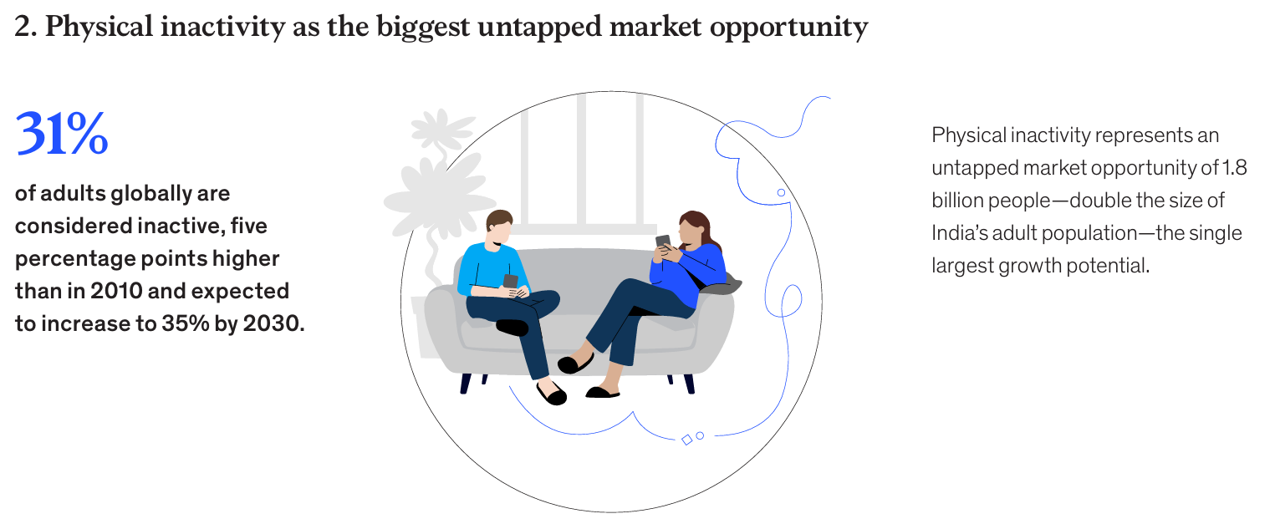
McKinsey just published a detailed report into Sporting Goods 2025, which the firm calls a “new balancing act” that must turn uncertainty into opportunity. The report is based on five key observations: Only a few sporting goods companies have expanded growth and margins since 2018 — and must “rethink the value chain” in the face of challenging geopolitical headwinds One-half of so-called “active consumers” say that fitness is a core element of their identity, with emotional connections to brands they purchase for the lifestyle Incumbent sporting goods companies are losing market share to
Are We Liberated Yet? Tariffs Can Impact Financial Health (Riffing on MoneyLion’s Health Is Wealth Report)
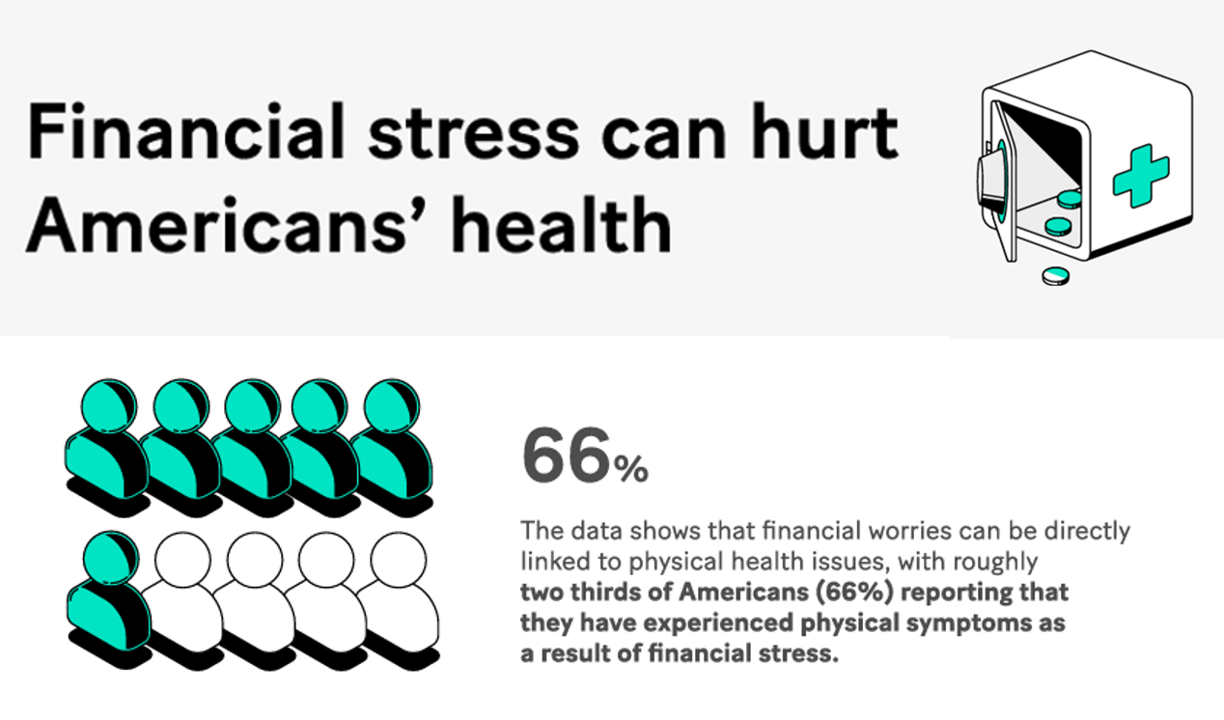
Americans’ financial health was already stressing consumers out leading up to Liberation Day, April 2nd, when President Trump announced tariffs on dozens of countries with whom the U.S. buys and sells goods. A new report from MoneyLion and Mastercard called Health is Wealth is well-timed for today’s Health Populi blog. The study was fielded by The Harris Poll online among 2,092 U.S. adults 18 and older between February 28 and March 4, 2025, so it was completed a month before the tariffs came to hit peoples’ 401(k) savings and employers’ company stock market caps.
How BioPharma Can Improve Consumers’ Experience and Health
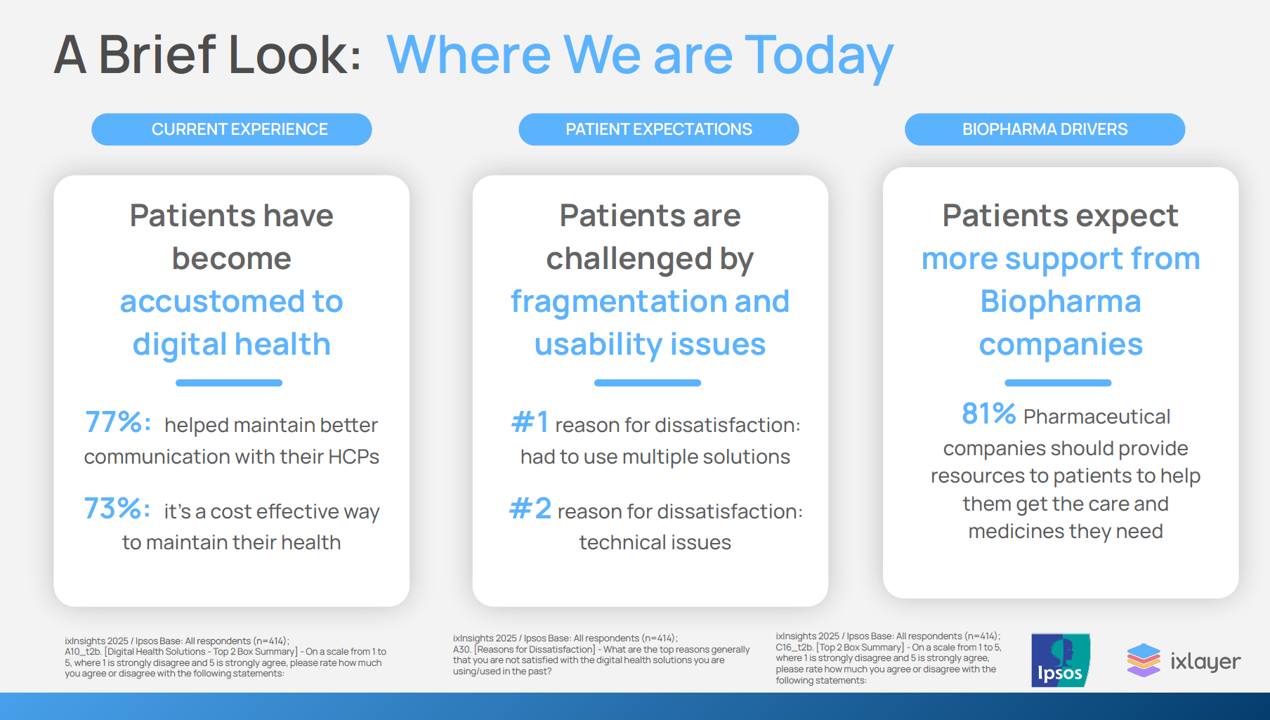
Patients as health consumers now know what “good” looks like in their digital experiences. People have tasted the convenience and respect they feel from well-designed, streamlined omnichannel retail experiences, and they now expect this from health care — specifically supported by the pharmaceutical companies who manufacture the medicines they use in managing chronic conditions, we learn in ixlayer ixInsights 2025: Pharma’s Role in Improving the Health Experience from ixlayer and Ipaos. The patient-focused report gets specific about people dealing with asthma, COPD, Type 2 diabetes, heart disease, psoriasis, and atopic dermatitis with a lens on
What is a Consumer Health Company? Riffing Off of Deloitte’s Report on CHCs/A 2Q2025 Look at Self-Care Futures
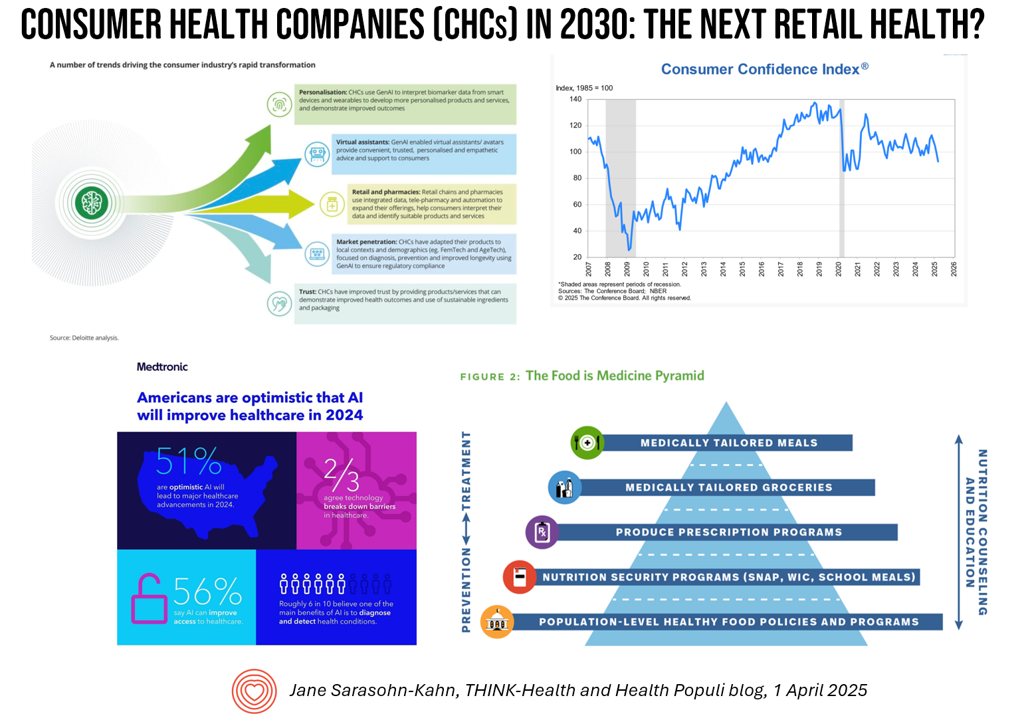
The health care landscape in 2030 will feature an expanded consumer health industry that will become, “an established branch of the health ecosystem focused on promoting health, preventing, disease, treating symptoms and extending healthy longevity,” according to a report published by Deloitte in September 2024, Accelerating the future: The rise of a dynamic consumer health market. While this report hit the virtual bookshelf about six months ago, I am revisiting it on this first day of the second quarter of 2025 because of its salience in this moment of uncertainties across our professional and personal lives — particularly related to
Health Care Nation – How to Inspire a Rosa Parks Moment for Healthcare in America?
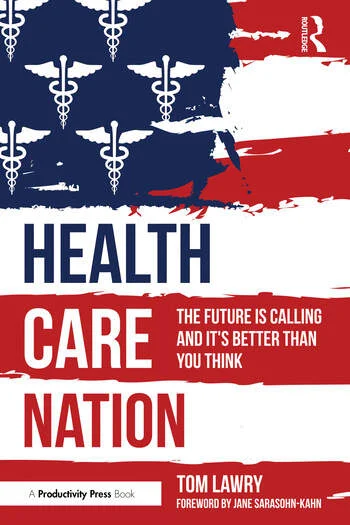
Tom Lawry may be best-known as a leading voice on AI in health care; after all, he’s written two very well-selling books on the topic, speaks all over the world on the subject, and in his most recent company-based gig helped lead Microsoft’s efforts in AI in health care and life sciences. When his publisher asked him to write a third book on AI in health care – still a hot topic in publishing – Tom said he’d rather turn to a subject long on his mind: the state of health care in America and how to change the conversation
The New “Paging Dr. Google?” DTC-AI for Health Care
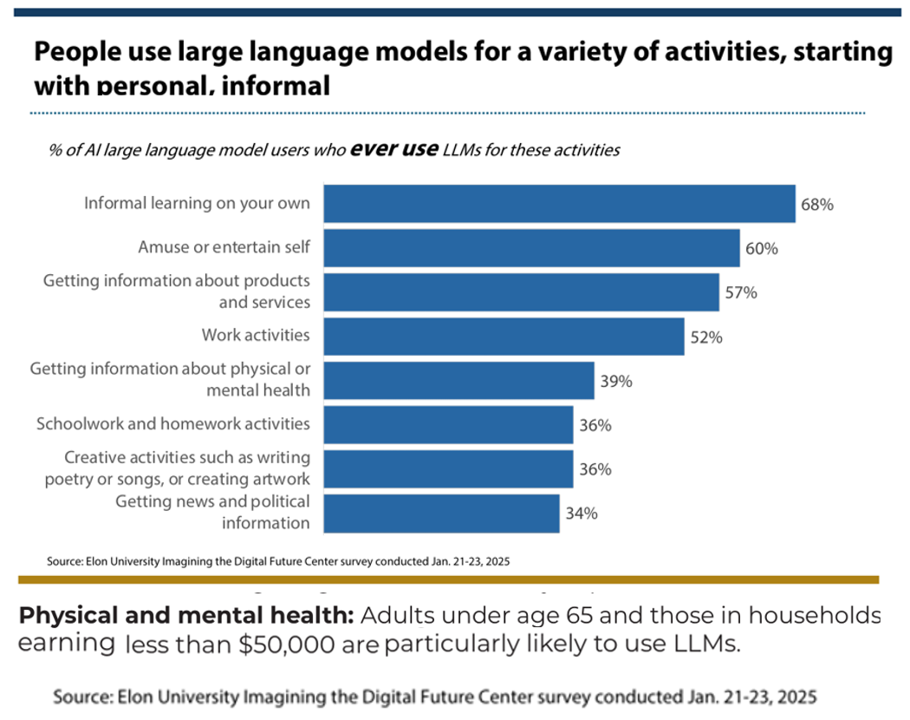
While most people in the U.S. who have used large language models (like ChatGPT) for informal learning, entertainment, and getting information about products and services, 39% of U.S. adults have also tapped into LLMs to source information about physical or mental health. This insight is brought to us in the brilliantly titled report, Close encounters of the AI kind, from the Imagining the Digital Future Center at Elon University. The principle author of the survey report is the Center’s Director, Lee Rainie, whose name many of you will know from his two+ decade career at the Pew Research Center (and
The Growth of DIY Digital Health – What’s Behind the Zeitgeist of Self-Reliance?
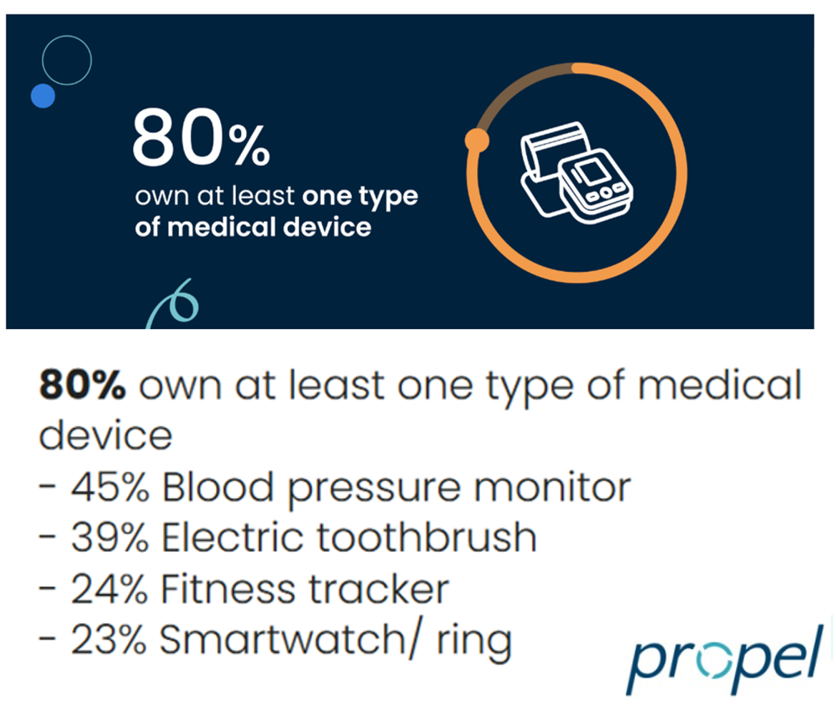
Most people in the U.S. use at least one medical device at home — likely a blood pressure monitor. used by nearly one-half of people based on a survey of 2,000 consumers conducted for Propel Software. The Propel study’s insights build on what we know is a growing ethos among health consumers seeking to take more control over their health care and the rising costs of medical bills and out-of-pocket expenses. That includes oral health and dental bills: 2 in 5 U.S. consumers use electric toothbrushes (a growing smart-device category at the
A Mis-Trust Hangover for Health Care 5 Years After COVID Began – an Edelman Trust Barometer Update
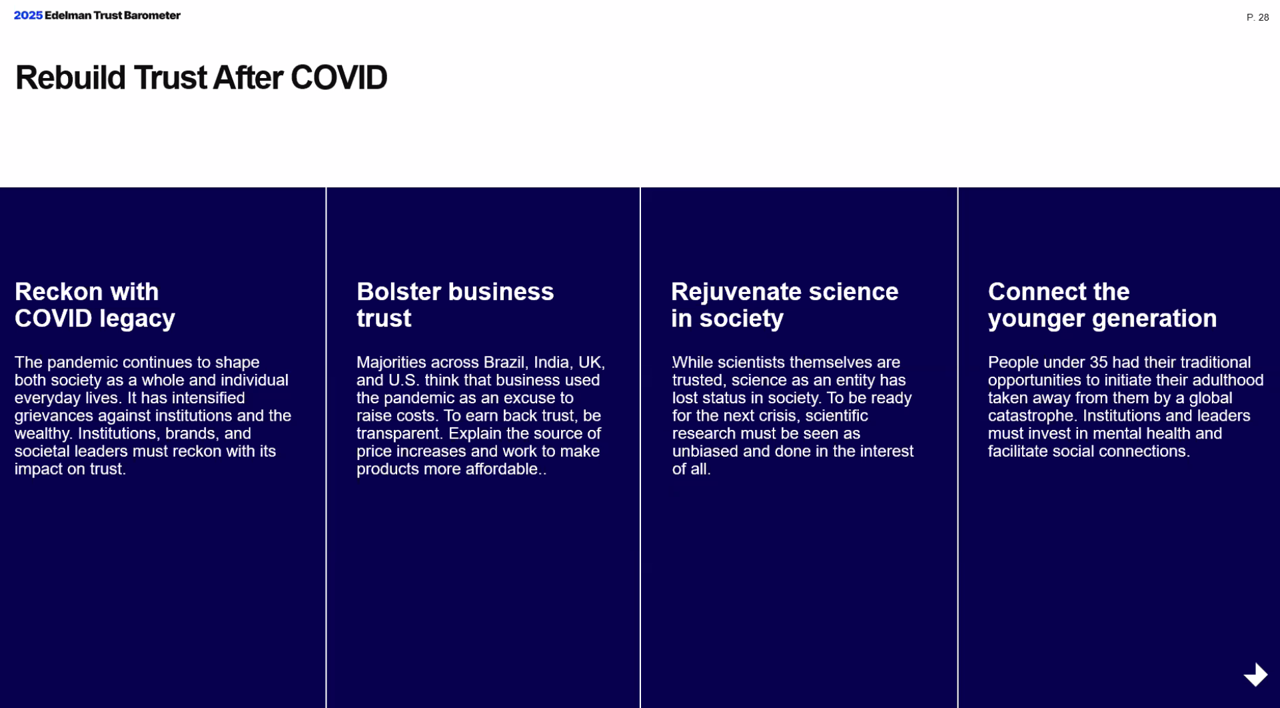
On March 11, 2020, The World Health Organization announced that the coronavirus was deemed a pandemic. WHO Director-General Dr. Tedros Adhanom Ghebreyesus asserted, “We have called every day for countries to take urgent and aggressive action. We have rung the alarm bell loud and clear.” Five years later, Edelman has fielded a survey to determine what some 4,000 health citizens living in 4 countries (Brazil, India, the UK, and the U.S.) are thinking and feeling about life after COVID-19 — and especially where their trust lies in institutions, fellow citizens, and future public health emergencies. I listened in on a discussion
The Top Patient Safety Risks in 2025 Are Mostly About the “Human OS” – Reading ECRI’s Annual Report
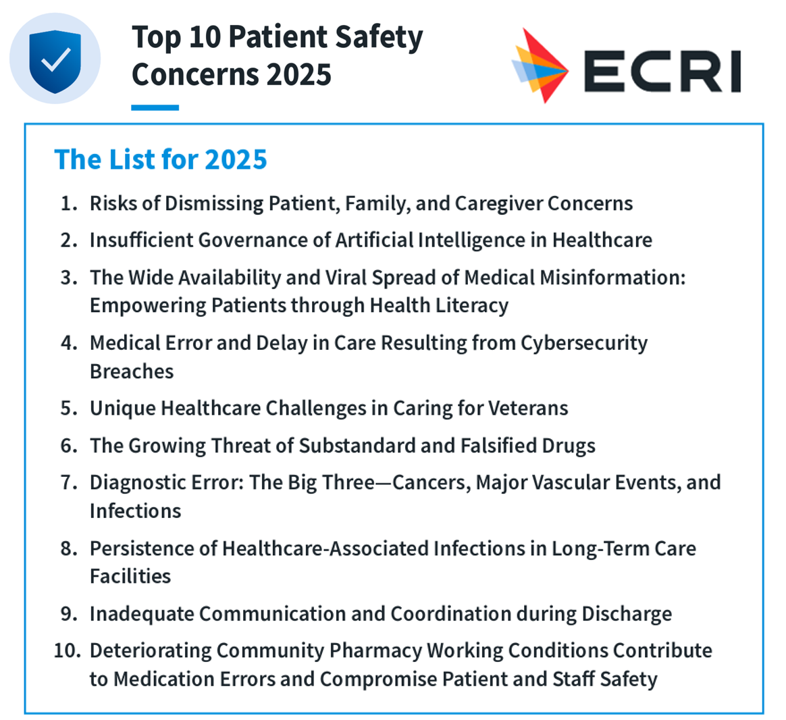
Each year, ECRI (the ECRI Institute) publishes an annual report on the Top 10 Patient Safety Concerns for the year. The 2025 list was published today. My read of it is that most of these risks have to do with what I’ve been referring to as the Human OS, the Human Operating System, in my talks and teachings. In this post, I’ll focus on 2 of the 10 most top-of-mind in my current workflow with clients and speaking: #1 and #3. Here’s the list of 10, calling out: Risks of dismissing
Consumers Are Financially Stressed – What This Means for Health/Care in 2025
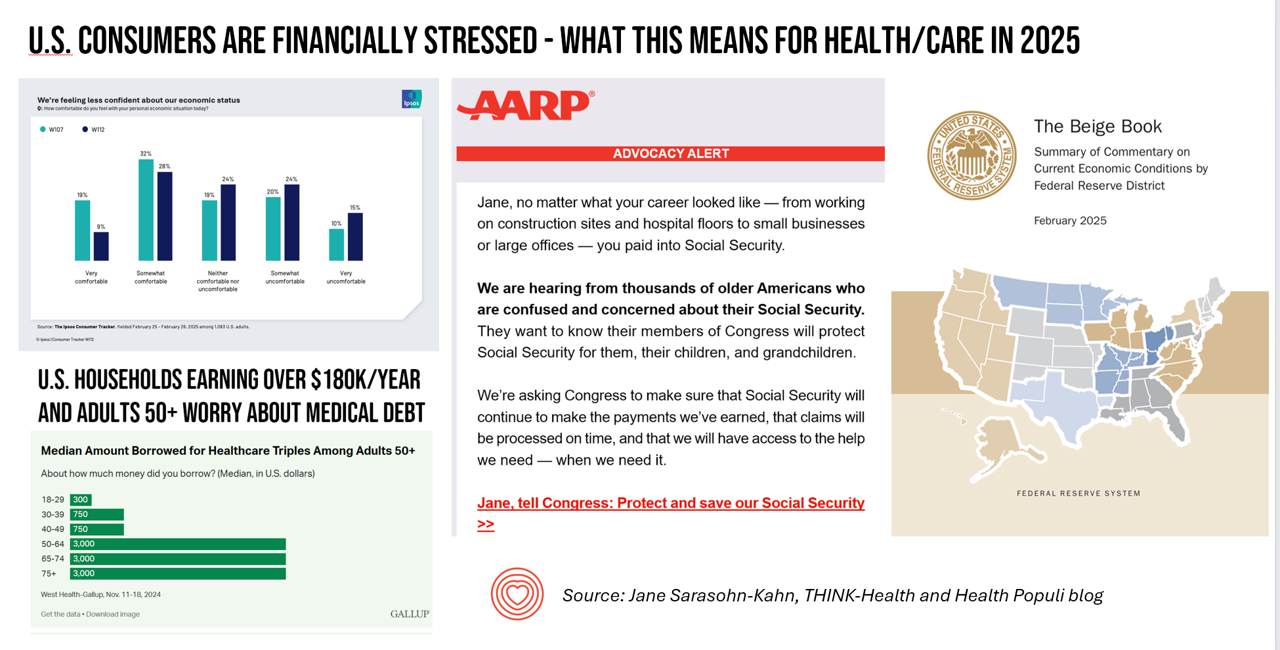
People define health across many life-flows: physical health, mental health, social health, appearance (“how I look impacts how I feel”) and, to be sure, financial well-being. In tracking this last health factor for U.S. consumers, several pollsters are painting a picture of financially-stressed Americans as President Trump tallies his first six weeks into the job. The top-line of the studies is that the percent of people in America feeling financially wobbly has increased since the fourth quarter of 2024. I’ll review these studies in this post, and discuss several potential impacts we should keep in mind for peoples’ health and
Think Quintuple Aim This Week at #HIMSS25
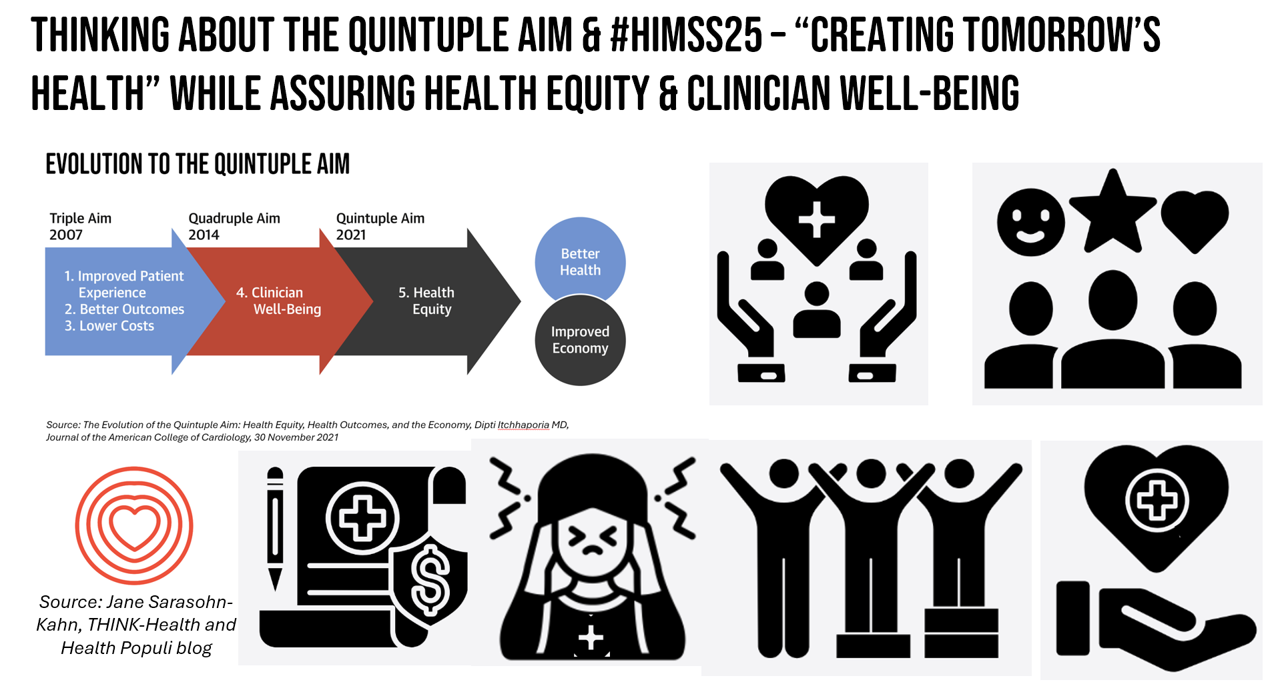
As HIMSS 2025, the largest annual conference on health information and innovation meets up in Las Vegas this week, we can peek into what’s on the organization’s CEO’s mind leading up to the meeting in this conversation between Hal Wolf, CEO of HIMSS, and Gil Bashe, Managing Director of FINN Partners. If you are unfamiliar with HIMSS, Hal explains in the discussion that HIMSS’s four focuses are digital health transformation, the deployment and utilization of AI as a tool, cybersecurity to protect peoples’ personal information and its use, and, workforce development. I have my own research agenda(s) underneath these themes
Improve Sleep, Improve the World and Health: ResMed’s Look at Global Sleep Trends
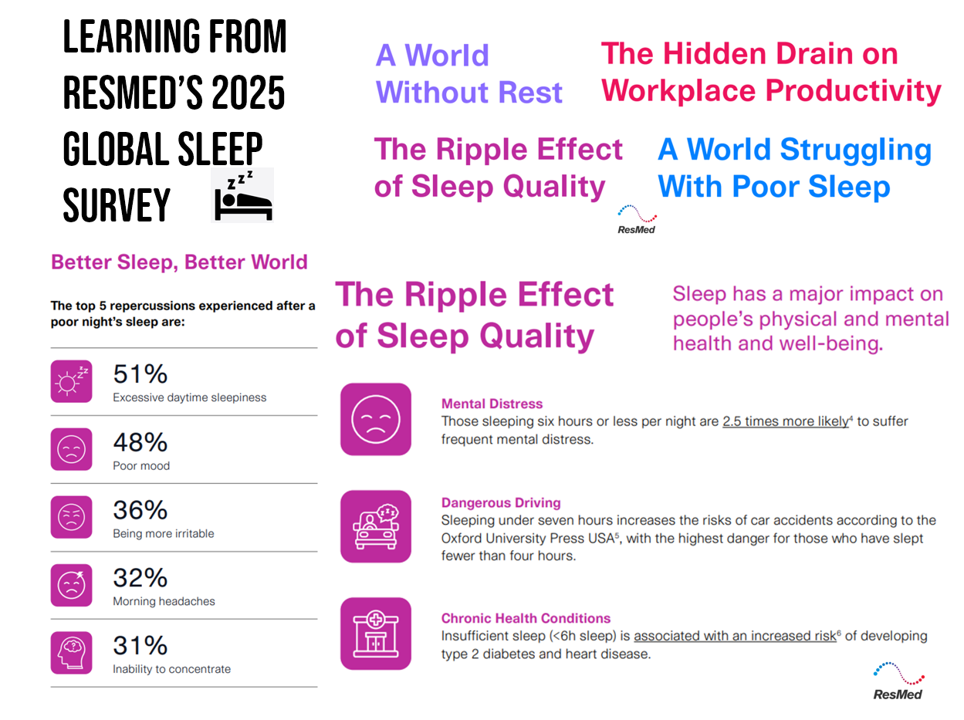
The world would be a better place if we had more, and better quality sleep. That’s the hopeful conclusion from the fifth annual Global Sleep Survey from ResMed. ResMed’s global reach with the sleeping public enabled the company to access the perspectives of over 30,000 respondents in 13 markets, finding that one in 3 people have trouble falling or staying asleep 3 or more times a week. We now live in “a world struggling with poor sleep” — “a world without rest,” ResMed coins our sleepless situation. The irony is that most people believe
GLP-1s at the Pharmacy – A Lens on Consumer-Driven Retail Health (with Hims & Hers stock price update)
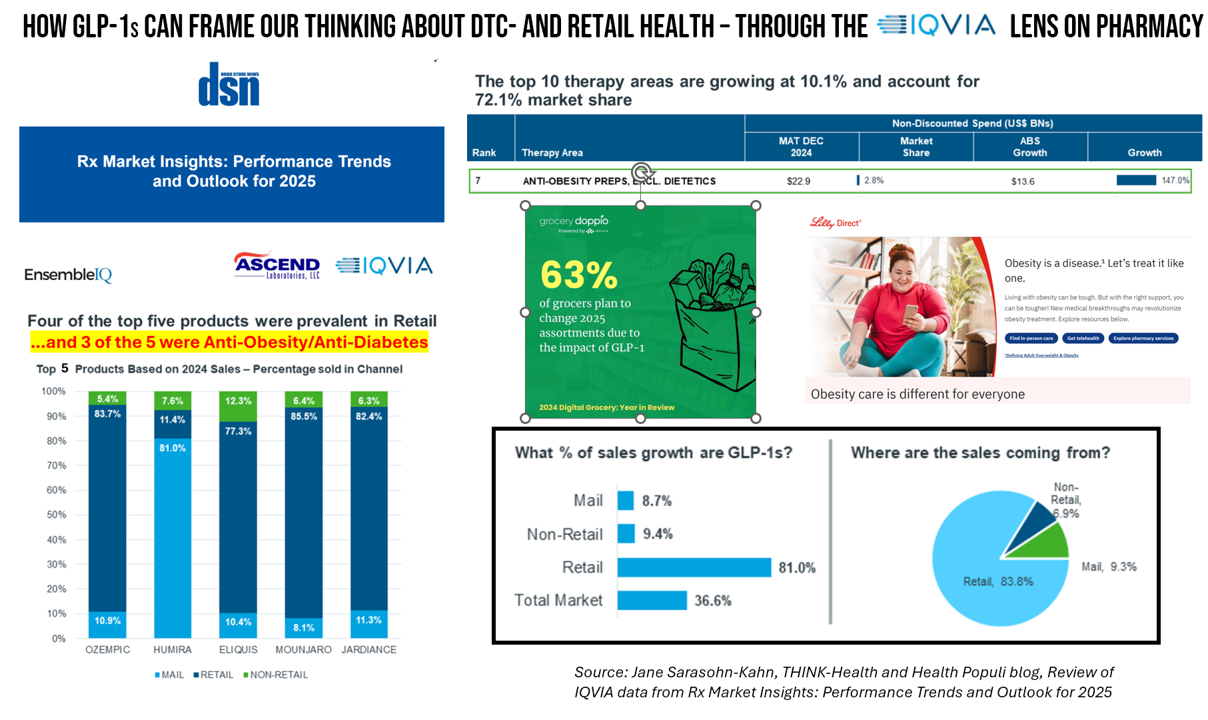
The nature of retail pharmacy is changing, with both threats and opportunities re-shaping the business itself, and the pharmacy’s role in the larger health/care ecosystem. To keep sharp on the topics, I attended Rx Market Insights: Performance Trends and Outlook for 2025, a data-rich session presented on February 18 by IQVIA and sponsored by Ascend Laboratories. The webinar was hosted by DSN (Drug Store News), appropriately so because the action-packed hour went into detail providing the current state of prescription drugs and the pharmacy in America. Doug Long, IQVIA’s VP of Industry Relations, and Scott Biggs, the company’s Director of Supplier
COVID-19 Further Splits American Society as Trust Continues to Erode – a 5-Year Perspective from Pew
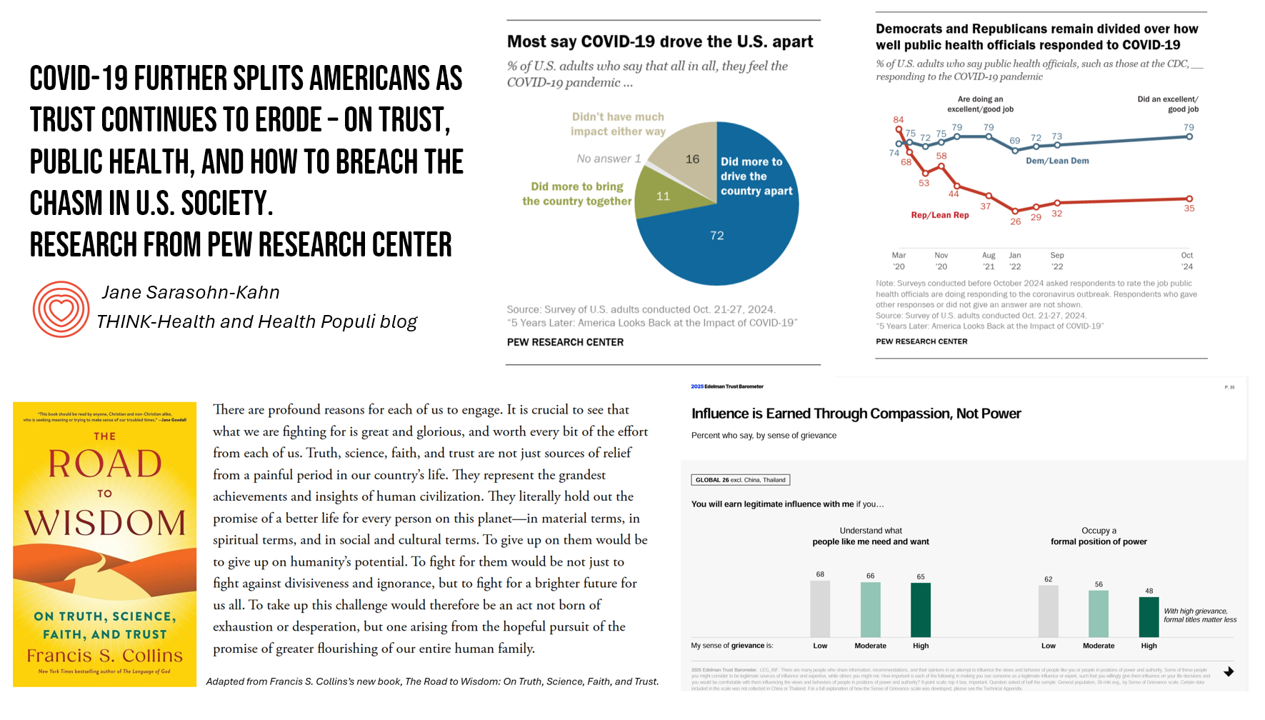
The partisan divide in the U.S., exacerbated by the COVID-19 pandemic, could set the stage for another public health emergency given eroding trust in institutions — especially in media, government, and public health officials. I base this sobering forecast on the latest study from the Pew Research Center which polled people in the U.S. about their pandemic-perspectives, detailed in the report 5 Years Later: America Looks Back at the Impact of COVID-19. Couple these findings with the recent dismissal of public health “disease detectors” working with the Centers for Disease Control (CDC), and what is currently termed a “quademic” (that
Health/Care at Super Bowl LIX, GLP-1s, Kaiser and Tufts on Food-As-Medicine, and the RFK, Jr. Factor: A Health Consumer Check-In
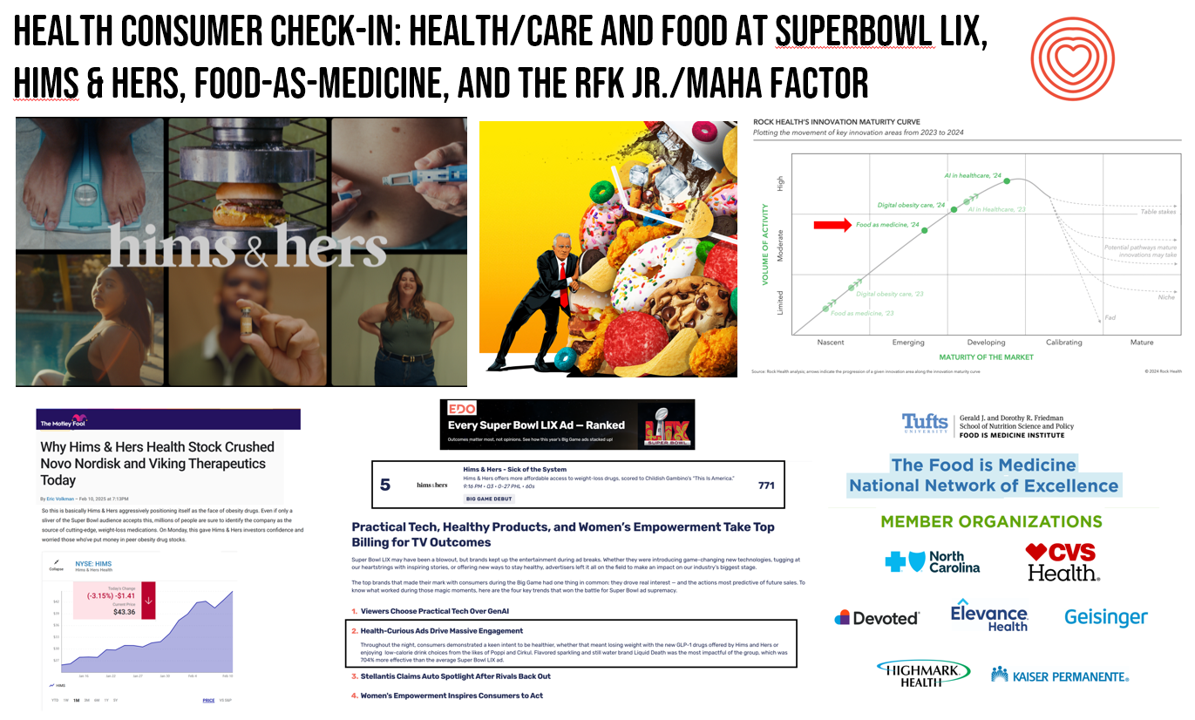
In the wake of the always-creative ads for Super Bowl and last Sunday’s LIX bout, game-watchers got to see a plethora of commercials dedicated to the annual event’s major features: food and game-day eating. Oh, and what’s turned out to be the most controversial commercial, the one on GLP-1s from Hims & Hers. In that vein, and converging with many news and policy events, I’m trend-weaving the latest insights into that most consumer-facing of the social determinants of health: food, and in particular, health consumers viewing and adopting food as part of their health and well-being moves. First, to the
Measuring Progress for Life Sciences: Trust, Patient Access, and Prevention at a Fork in the Road of Public Health
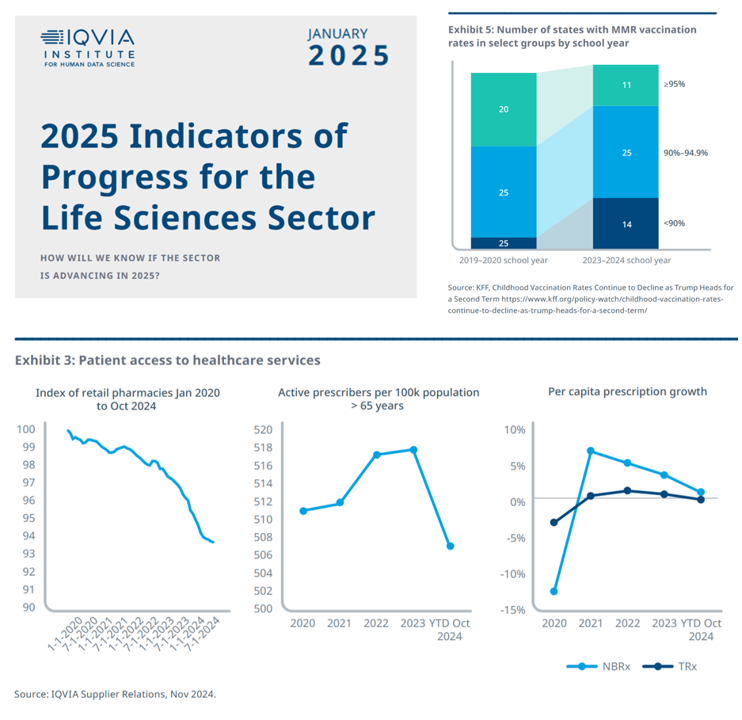
How will we know if the life sciences sector is advancing in 2025? This is the question asked at the start of the report, a Research Brief: 2025 Indicators of Progress for the Life Sciences Sector, from the IQVIA Institute for Human Data Science (IQVIA). To answer that question, IQVIA identified ten indicators for this 2025 profile on the life sciences sector. I selected four key data points for this discussion which provide particularly informative insights for my advisory work right now at the intersection of health, people/consumers, and technology: Trust for/with/in life science
Can the Private Sector Serve Up Sufficient Health Media to Compensate for Public Sector Gaps?

In researching several .gov websites from last Monday 20th January 2025, I had an ongoing frustrating user experience in being faced with “404 Error” messages like this one from WhiteHouse.gov. “President Trump’s First Week Hammered Public Health,” Dr. Arthur Kellerman, an ER doc, public health researcher, and patient advocate asserted in Forbes yesterday: “For now, the only health communications Americans receive will come from sources outside the government, such as professional societies, non-governmental organizations, advocacy groups, and businesses, vaccine skeptics, conspiracy theorists, foreign agents and bots posing as Americans to spread disinformation. It will be up to us to figure out what to
Connecting for Health at Home: A Unified Field Theory from #CES2025 (On Samsung, Withings, and Panasonic)
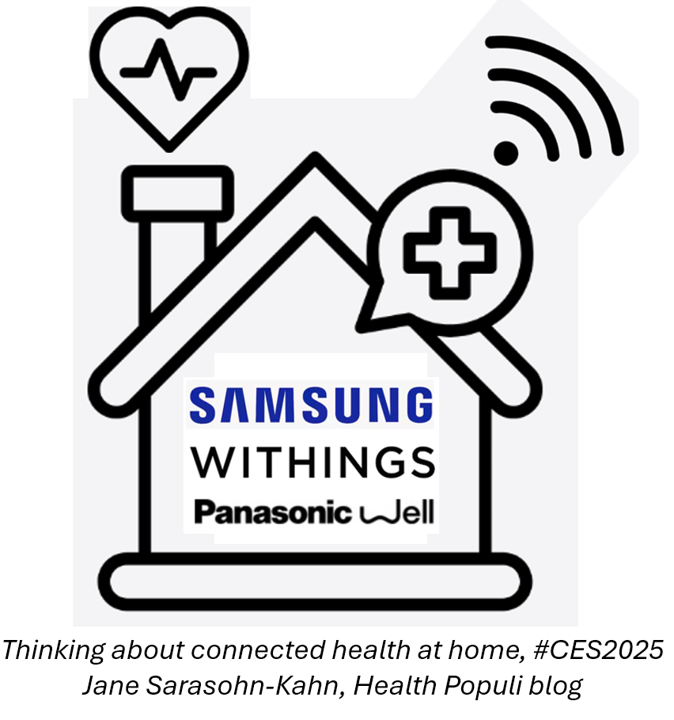
There were over 4,500 exhibitors on the show floor of the 2025 CES in Las Vegas last week, addressing every imaginable aspect of consumers’ daily lives as we increasingly coexist with technology to support life, liberty, and our personal pursuits of happiness….. ….and health. My focus is always on health, and in the past decade and a half, health/care, everywhere. So my lens on #CES2025 looked out for specific point solutions for health, medical care, fitness and well-being, along with adjacencies for mobility/auto, environmental health (think: clean air, clean water), kitchen appliances and food-tech, and home care (not the medical
How GLP-1s Are Showing Up at CES 2025
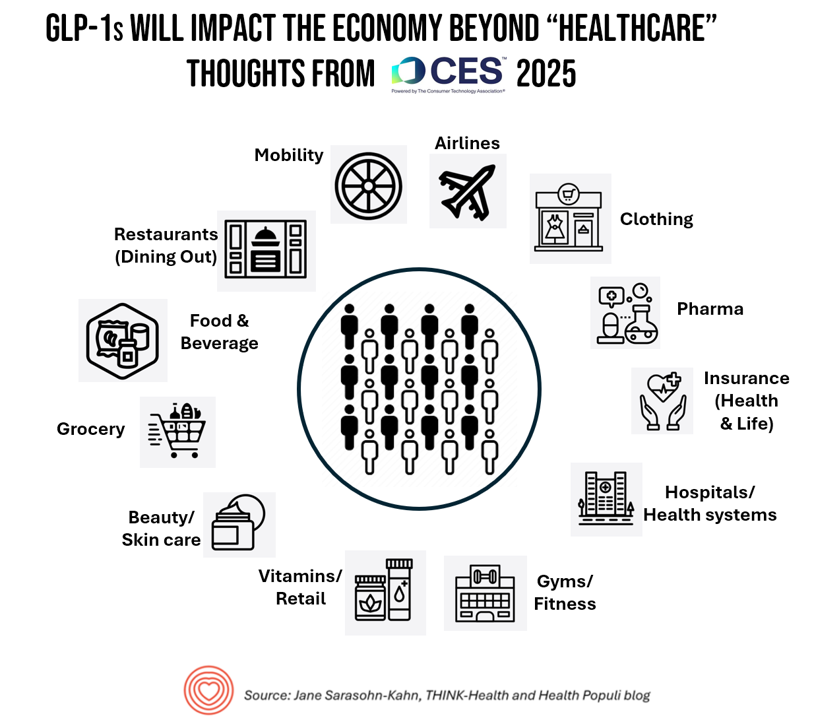
CES 2025: as you read the acronym and year, your brain registered an image like consumer technology and the start of a new year, or some variation of those thoughts. When you saw the title of this post with the acronym “GLP-1,” your brain might not have connected the dots between a medicine and “CE,” consumer electronics. But here we are in real-time, in real life, at the convergence of pharmaceuticals and medicines and consumer-facing technology. And keep in mind that we’re at the annual meeting of CES which is convened by the Consumer Technology Association, CTA. GLP-1s are showing
CTA Tech Trends to Watch for 2025 – Health-Context for Kicking off #CES2025
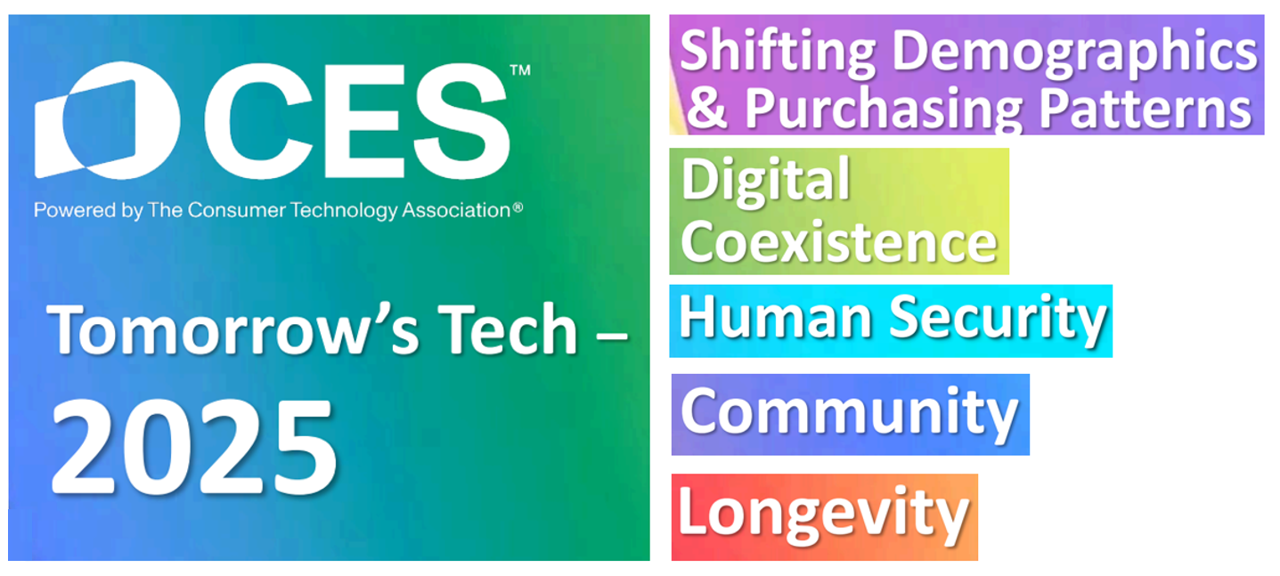
People are living everyday life in digital coexistence — where the connected technologies we use for communication and entertainment now enable life-flows across our lives, morning to night, at work and play and even while we’re sleeping. Welcome to the five key tech-trends for 2025, brought to life Sunday afternoon by Melissa Harrison, CTA’s Vice President of Marketing & Communications tag-teaming with Brian Comiskey, Senior Director, Innovation & Trends. This annual session at CES always provides a practical context for exploring the annual conference, the largest in the world covering technology used by everyday people. And this year, the trends
The Rough Guide to Health/Care Consumers in 2025: The 2025 Health Populi TrendCast
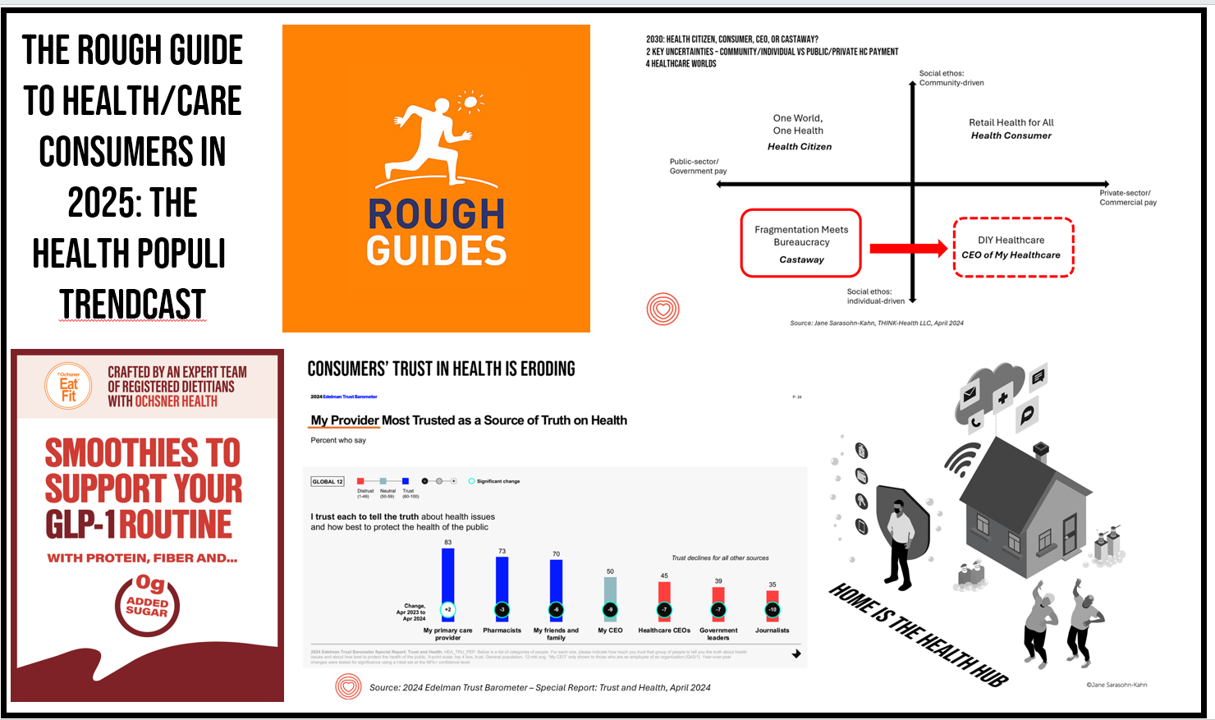
At this year-end time each year, my gift to Health Populi readers is an annual “TrendCast,” weaving together key data and stories at the convergence of people, health care, and technology with a look into the next 1-3 years. If you don’t know my work and “me,” my lens is through health economics broadly defined: I use a slash mark between “health” and “care” because of this orientation, which goes well beyond traditional measurement of how health care spending is included in a nation’s gross domestic product (GDP); I consider health across the many dimensions important to people, addressing physical,
Americans’ Views on the Quality of Healthcare Fell to a Record Low — with Costs Ranking as the Most Urgent Problem for Health in the U.S.
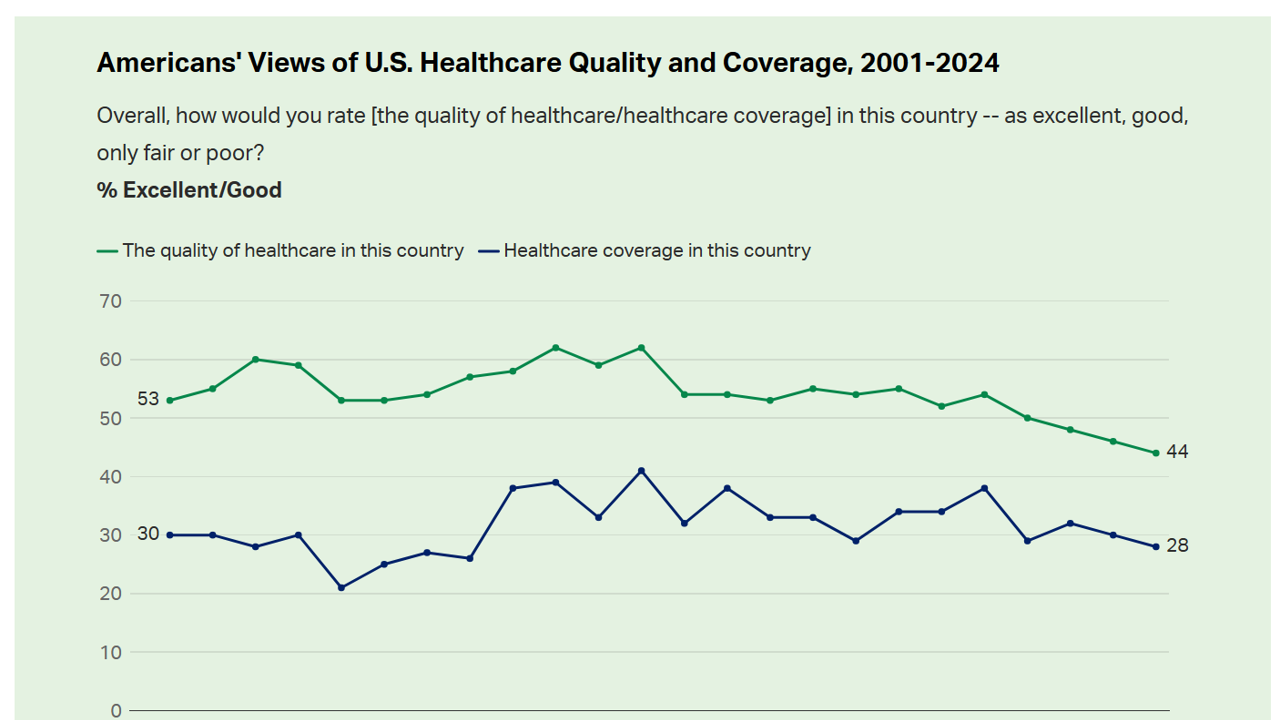
Americans’ perception of the quality of health care in the U.S. fell to the lowest level since 2001, Gallup found in a poll of U.S. health citizens’ views on health care quality, published December 6, 2024. In 2024, only 44% of Americans said that the quality of health care int he U.S. was excellent or good — conversely, 56% of Americans though health care quality was only fair or poor. By political party, that included 50% of Democrats evaluating the quality of care highly compared with 42% of Republicans. Only 28% of people in
Digital Divides and Disability – Ranking Health Determinants in a Digital Age: Learning from WHO and LSE
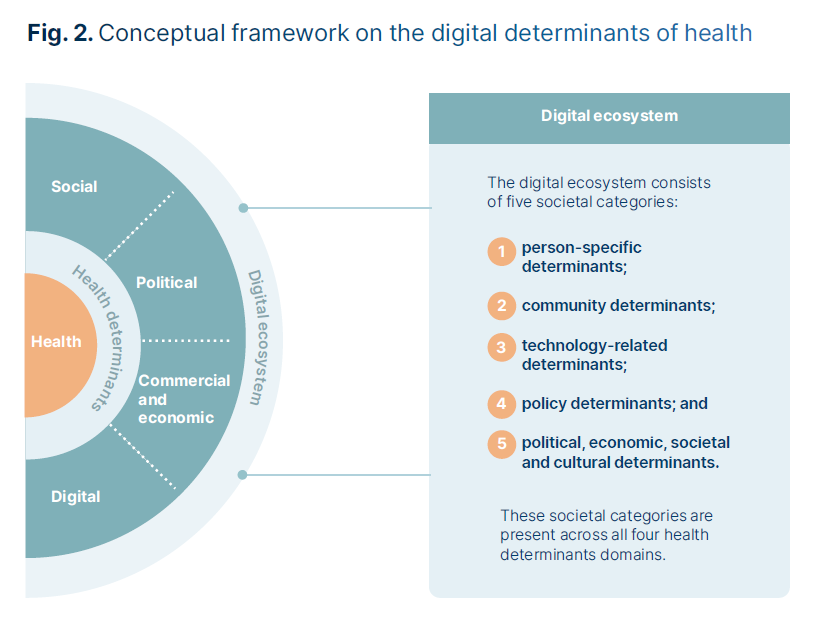
Among 127 health determinants, two rank highest: digital divides in the era of tech-enabled health and care: digital divides that shape a person’s political, economic, and social environment, and the person’s health/disability status. The digital transformation of health and care compel us to re-consider and re-frame social determinants of health in the “digital age,” which is what the World Health Organization in collaboration with the London School of Economics have done in research, published this week in the report, Addressing health determinants in a digital age. The report was funded by the European
How World AIDS Day 2024 Can Inform Healthcare in 2025

December 1 2024 was World AIDS Day, which was observed by the Biden White House with the display of the entire AIDS Memorial Quilt on the South Lawn — all 54 tons of it. The Biden-Harris Administration announced efforts, in advance of World AIDS Day, to continue to fight HIV/AIDS “at home and abroad.” The press release for the effort noted that, ”We remember those who have died from AIDS-related illnesses—honoring their courage and contributions as essential to the progress made thus far. We also stand in solidarity with the more than 39 million people with HIV around the world.
The Evidence for Gratitude and Health, 2024 Giving Thanks
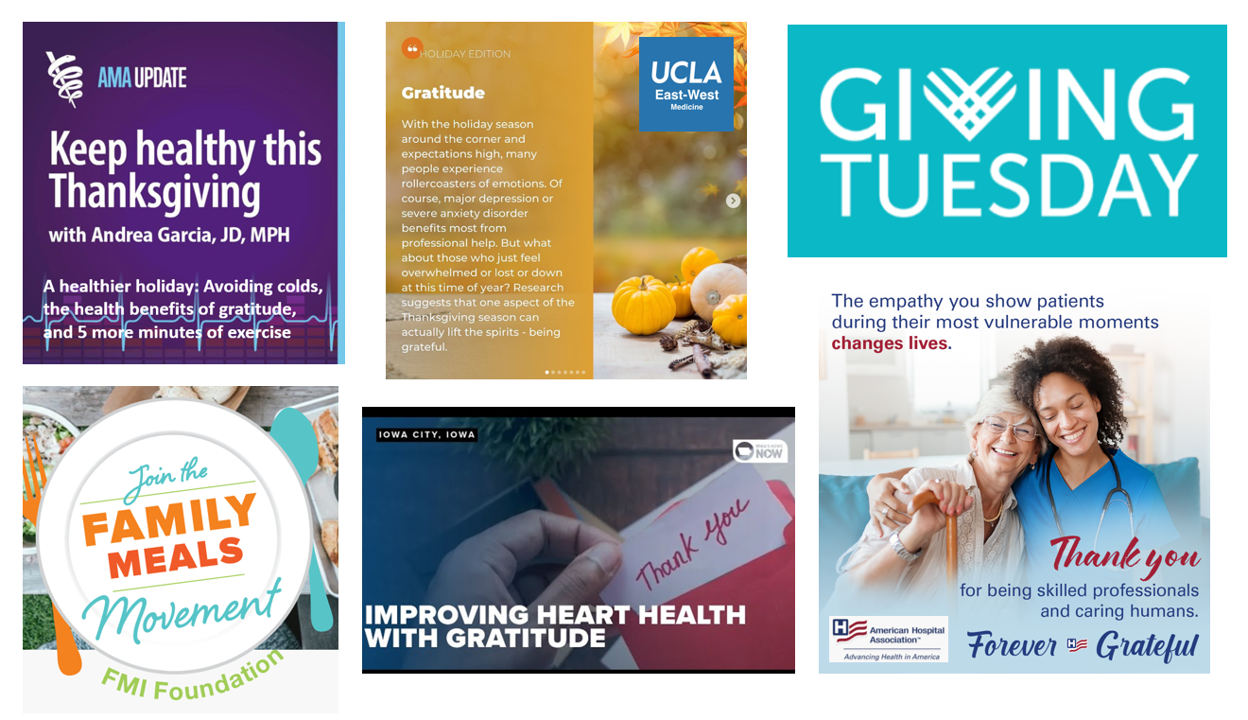
In our home, we’re feeling very grateful for our healthy lives and work-flows right now, being very mindful about seeing blessings around me and within me…. So I’m sharing the love (or “scaling the love” as I recently coined at OSF’s Digital Health Symposium!) to honor American Thanksgiving 2024 here in Health Populi pointing out several sources highlighting the evidence on gratitude and health….underpinned with love, the ultimate driver of health and well-being. Leslie Sarasin, President and CEO of FMI, the Food Industry Association, reminds us that, “Our immigrant ancestors, the pilgrim settlers, worked hard
3 in 4 U.S. Patients Say the Healthcare System is Broken — But Technology Can Help
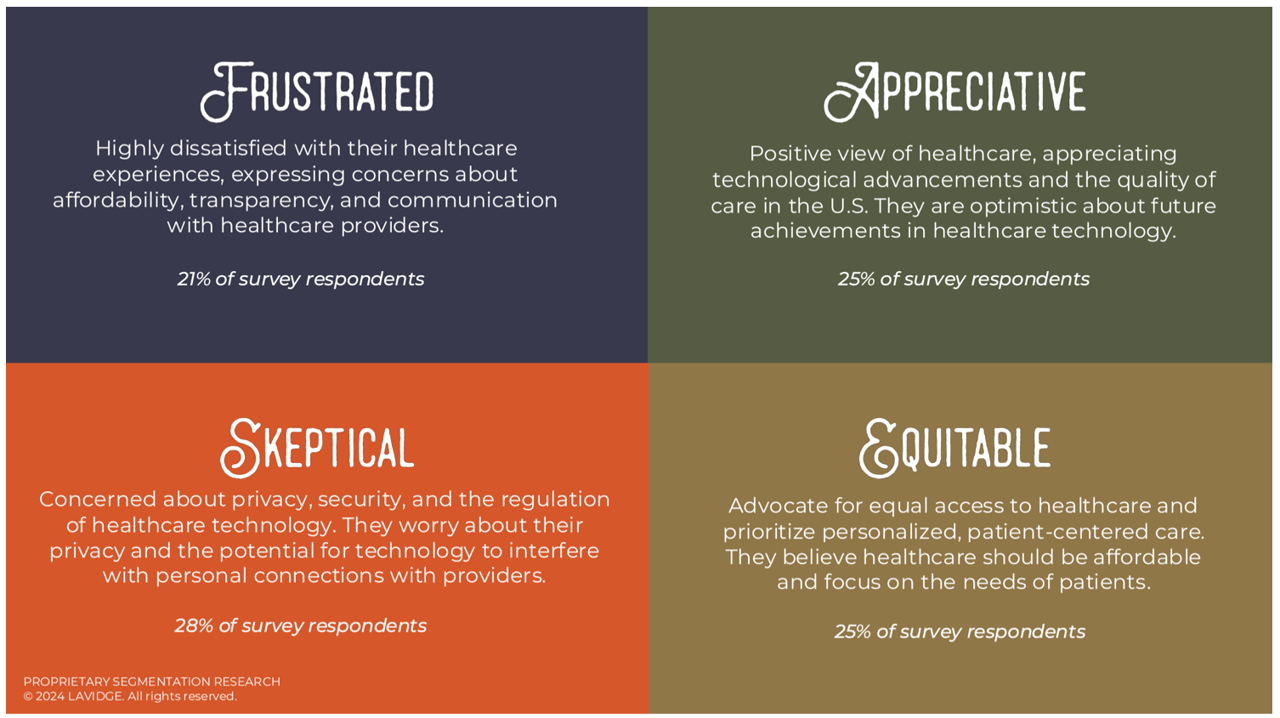
Patients “yearn” for personalized services and relationships in health care — optimistic that technology can help deliver on that hope — we learn in Healthcare’s Future: Balancing Progress and Perception, a health consumer survey report from Lavidge. Lavidge, a communications/PR/marketing consultancy, polled U.S. patients’ attitudes about health care and technology in June 2024, publishing the report earlier this month. Start with over-arching finding that, “Three out of four patients believe the U.S. healthcare system is broken and there is a strong sense of distrust,” Lavidge asserts right at the top of
What Stays True for U.S. Health Care Post #Election2024 (1) – Consumers’ Dissatisfaction with Drug Prices
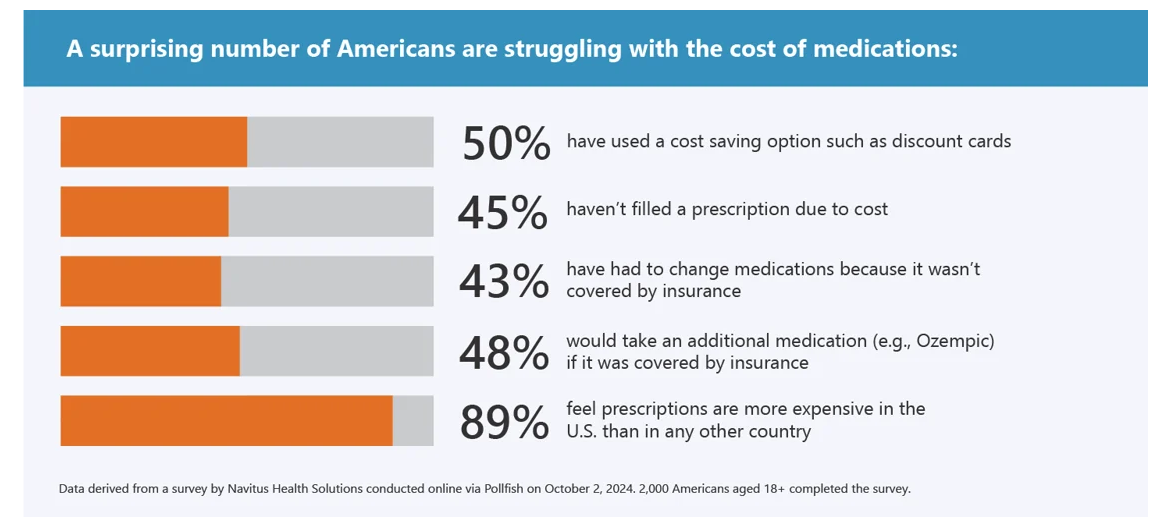
For health care, there are many uncertainties as we reflect, one week after the 2024 U.S. elections, on probably policy and market impacts that we can expect in 2025 and beyond. In today’s Health Populi post, I’ll reflect on the first of several certainties we-know-we-know about U.S. health citizens and key factors shaping the American health ecosystem. In this first of several posts on “What Stays True for U.S. Health Care Post #Election2024,” I’ll focus on U.S. consumer dissatisfaction with drug prices — across political party identification. Let’s set the context with data from a recently-published
We Are Stressed in America – APA’s 2024 Stress in America Survey on “A Nation in Turmoil”
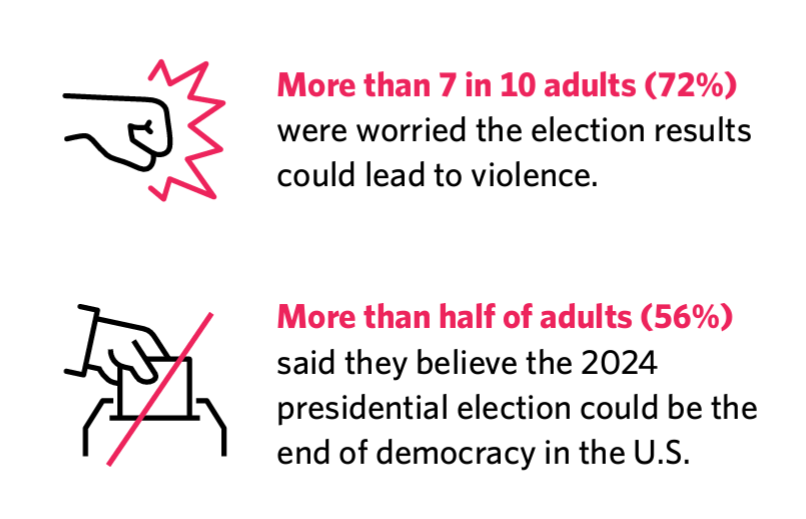
Two in three people in the U.S. are dealing with Presidential Election Stress — a significant contributor to Americans’ overall stress we learn from the American Psychological Association’s study into Stress in America 2024. I’ve covered the APA’s Stress in America studies for many years, appreciating the role that anxiety and stress play in peoples’ overall health status and well-being. In 2024, “stress” is a mainstream factor in daily life whether you identify with Main Street or Wall Street. Here was my most recent post on the APA study here in Health Populi,
Closing the Chasm Between Patients and Clinicians With Digital Health Tools – Some Health Consumer Context for #HLTHUSA
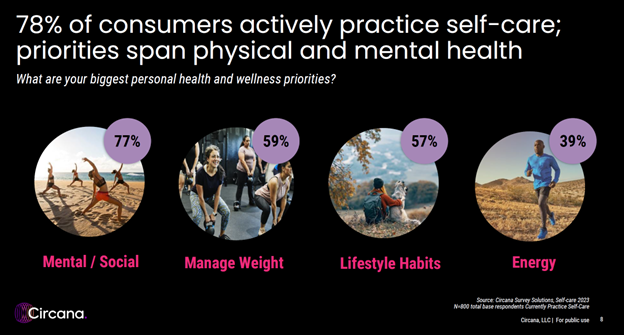
As the annual HLTH conference convenes this week in Las Vegas, numerous reports have been published to coincide with the meeting updating various aspects of technology, health care, providers and patients. In this post, I’m weaving together several of the papers that speak to the intersection of health care, consumers, and technology – the sweet spot here on Health Populi. I hope to provide attendees of HLTH 2024 along with my readers who aren’t in Vegas useful context for assessing the new ideas and business model announcements as well as a practical summary for those of you in planning mode for
How Much Would Adults Age 50+ Trust AI-Generated Health Information? Not Much.
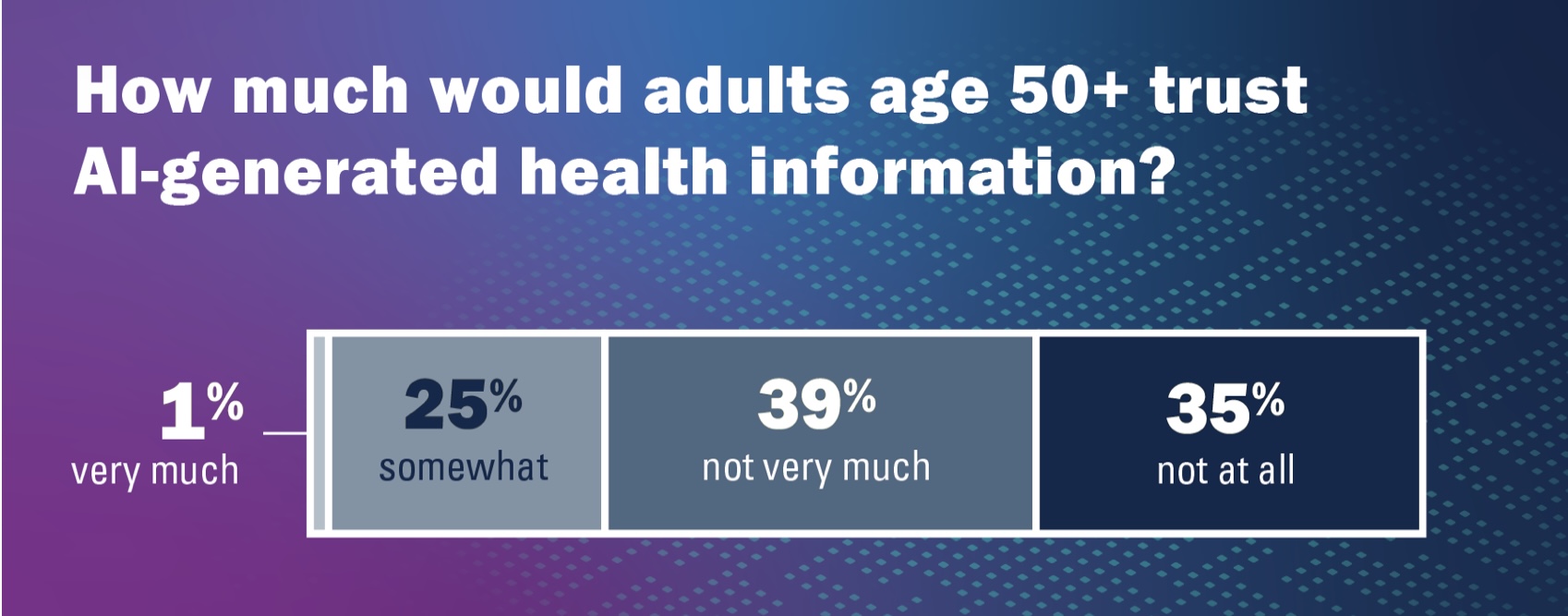
Health literacy and, indeed, literacy across the many layers relevant for health (digital, medical, financial), is a challenge for people of all ages. The Institute for Healthcare Policy Innovation’s National Poll on Healthy Aging at the University of Michigan focused on people 50 and over in their latest study published this month: Health Literacy – How Well Can Older Adults Find, Understand, and Use Health Information. On the upside, 4 in 5 older people (50+) feel confident in being able to spot health mis-information, the chart from the Poll report clearly tells us. 20% of older U.S. health citizens are
The Smart Home for Health, Brought to You by Samsung and Ashley

Today I am keynoting the OSF Digital Health Symposium in Peoria, IL, discussing The State(s) of Digital Health. A double-entendre intended, one of the states I’ll be discussing is the migration of acute care back to peoples’ homes, embedded with sensors, householders donning smart rings, and rooms fitted with Internet-of-Things for health and well-being. In this context, news that Samsung has begun to partner with Ashley, the national furniture dealer, struck me as interesting and important. I visited the Samsung Health House at CES 2024 last January: here is my write-up about what I
Growing Investments in Digital Health Are Driven by Consumer Demand, Clinical Outcomes, and Cost-Savings
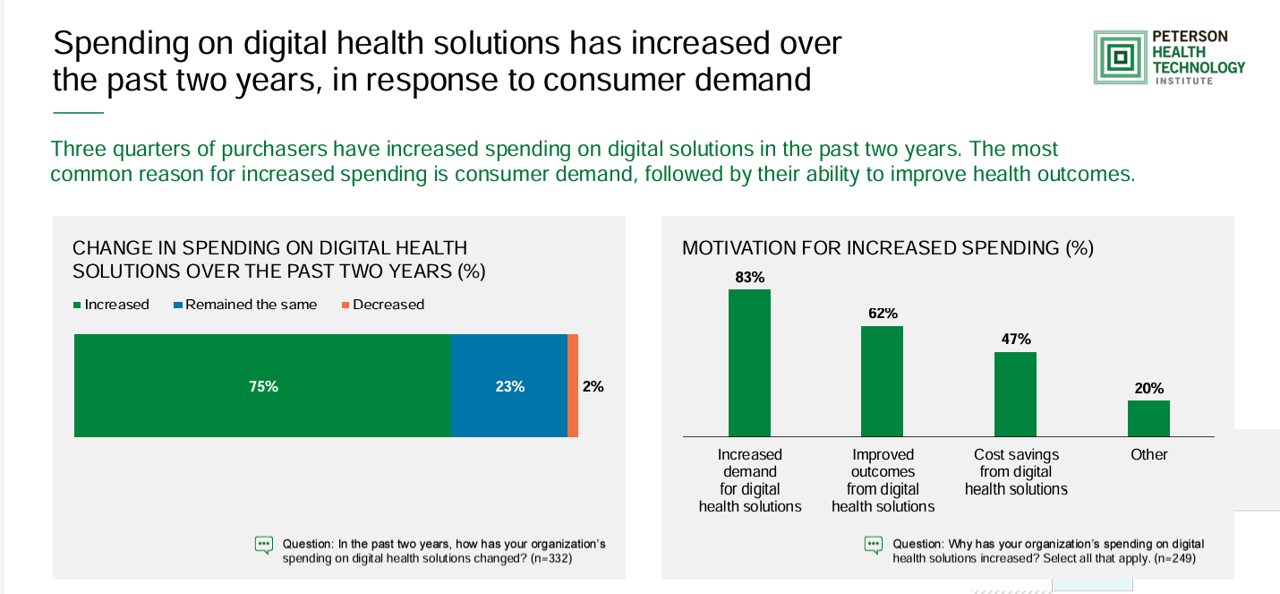
The marketing for purchasing digital health technologies is expecting to grow, driven by increased consumer demands for tech-based solutions, improved outcomes enabled through the innovations, and cost savings derived from deploying the technologies. That’s the top-line finding in the 2024 State of Digital Health Purchasing from the Peterson Health Technology Institute (PHTI). PHTI surveyed 322 digital health decision makers working in employers, health plans, and health systems, fielding the study in July and August 2024. 3 in 4 purchasers grew spending on digital health technologies in the past two years,
Peoples’ Lack of Trust in Science Extends to Views on Food and Nutrition
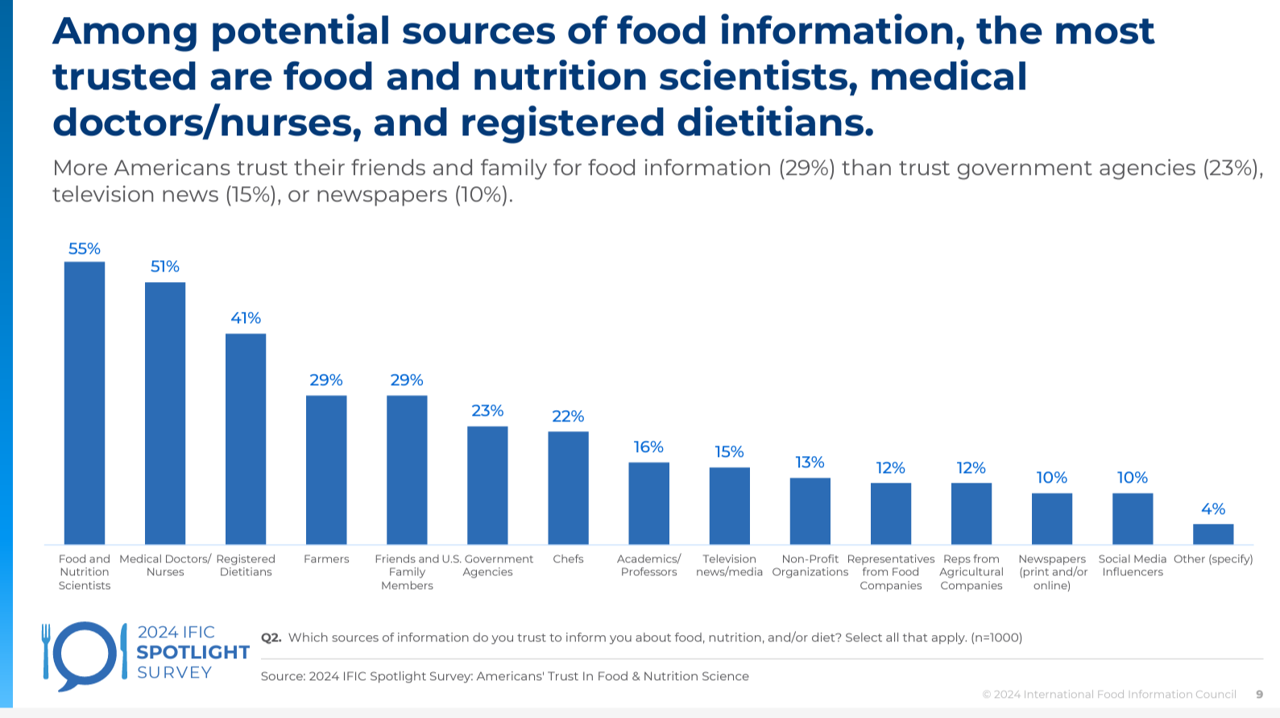
Only 2 in 5 people in the U.S. strongly trust science concerning food, nutrition, or diet, we learn from the 2024 IFIC Spotlight Survey: Americans’ Trust in Food & Nutrition Science, published in October. IFIC is the International Food Information Council, a non-profit organization with a mission of communicating science-based information about food safety, nutrition, and sustainable food systems. IFIC surveyed 1,000 U.S. adults online in July to gauge consumers’ views on food and science. The most-trusted sources of food information are the scientists involved in researching nutrition,
Americans Want More Health Care Issues Baked into the 2024 Elections – Gallup
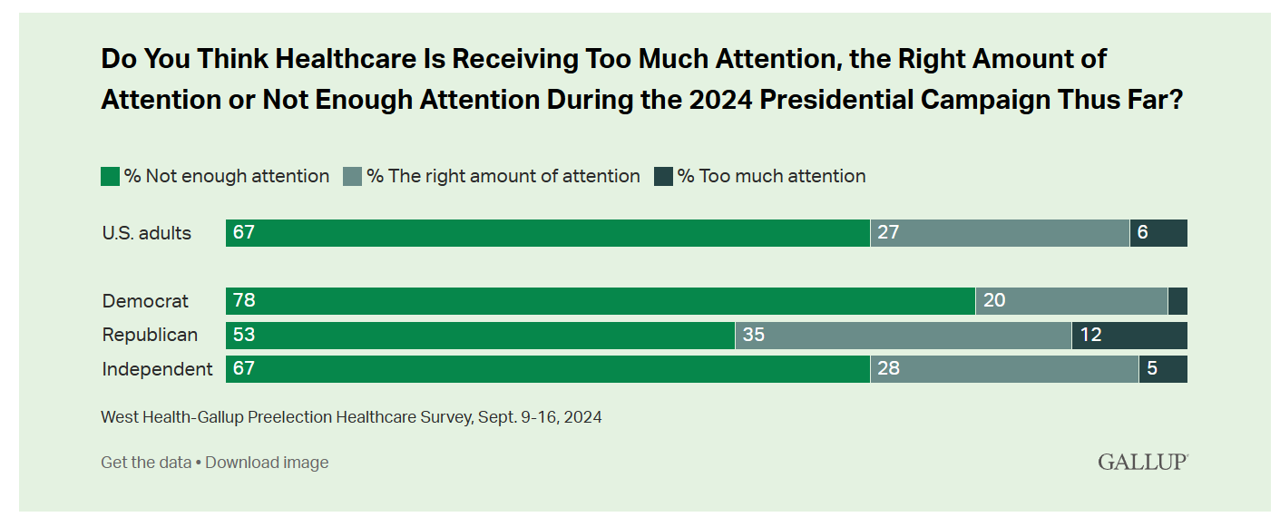
Beyond women’s health and abortion politics, most Americans are looking for more health care baked into the 2024 Elections, based on a new poll from Gallup in collaboration with West Health. Two in three U.S. adults thought health care was not receiving enough attention during the 2024 Presidential campaign as of September 2024. This is a majority shared opinion for voters across the three party IDs in the U.S., shown in the first bar graph. The research polled 3,660 U.S. adults in September, about two-thirds before the presidential debate held September 10, and about one-third
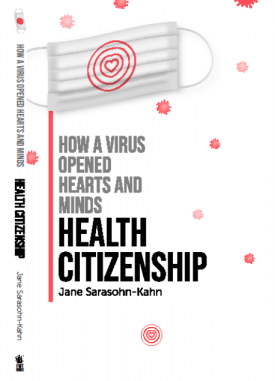
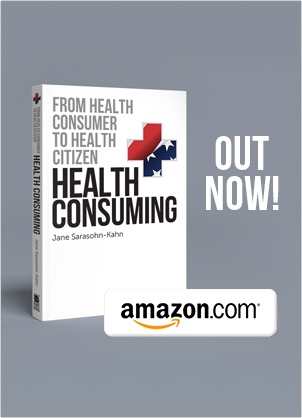
 Thank you Aaron Strout for hosting our conversation on the Reaching Higher Podcast, now live on Apple, Spotify, and YouTube. We covered a lot of ground addressing health care and health citizenship, the growing prospects for our homes as our health hubs, and how our humanity is a key ingredient in health-making for all.
 Jane joined host Dr. Geeta "Dr. G" Nayyar and colleagues to brainstorm the value of vaccines for public and individual health in this challenging environment for health literacy, health politics, and health citizen grievance. Click onto the Pfizer Value of Vaccines site and you can watch four episodes covering the challenges with adult vaccination, the employer and health plan member's journey to vaccination, reimbursement, and collaborating for proactive prevention.
 I'm grateful to be part of the Duke Corporate Education faculty, sharing perspectives on the future of health care with health and life science companies. Once again, I'll be brainstorming the future of health care with a cohort of executives working in a global pharmaceutical company.