


A Primer on Health Consumers for CES 2026 – How Macro Consumer Trends Will Shape Healthcare Consumers in 2026
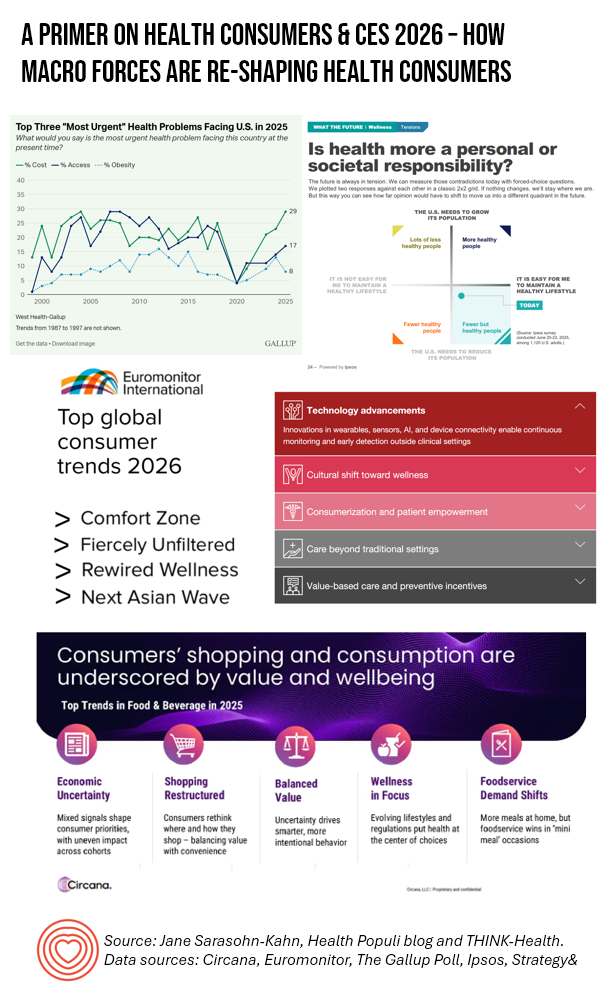
Increasingly, people are engaging more in health care decision making due to many factors impacting their personal medical choices — from the cost and access to health insurance to co-payments for prescription drugs and the supply of primary care doctors, more patients developed and exercised their health consumer muscles in 2025, For 2026, the health consumer muscle-building will grow as people will be re-shaped by macro market factors we are currently gleaning from forecasts looking into the new year: for personal finances, social issues, technology adoption, views on AI and privacy, and other issues. Here are some data points to
A Month Until #CES2026 – The Journey to Our Personal Health Operating Systems

In a month, I’ll board a plane for Las Vegas to spend a week at CES 2026, the annual electronics conference that last year brought together over 140,000 global technology stakeholders to display, demonstrate, and sell the latest in consumer-facing tech. This will be my fourteenth CES (including the virtually convened meeting held in 2021). If you want to time travel, here’s a link to an early CES post featuring “The Battle of the (Wrist)bands.” Indeed, the digital health aisle at the time had many wrist-worn activity trackers, largely amped-up pedometers, with the likes
How BioPharma Can Improve Consumers’ Experience and Health
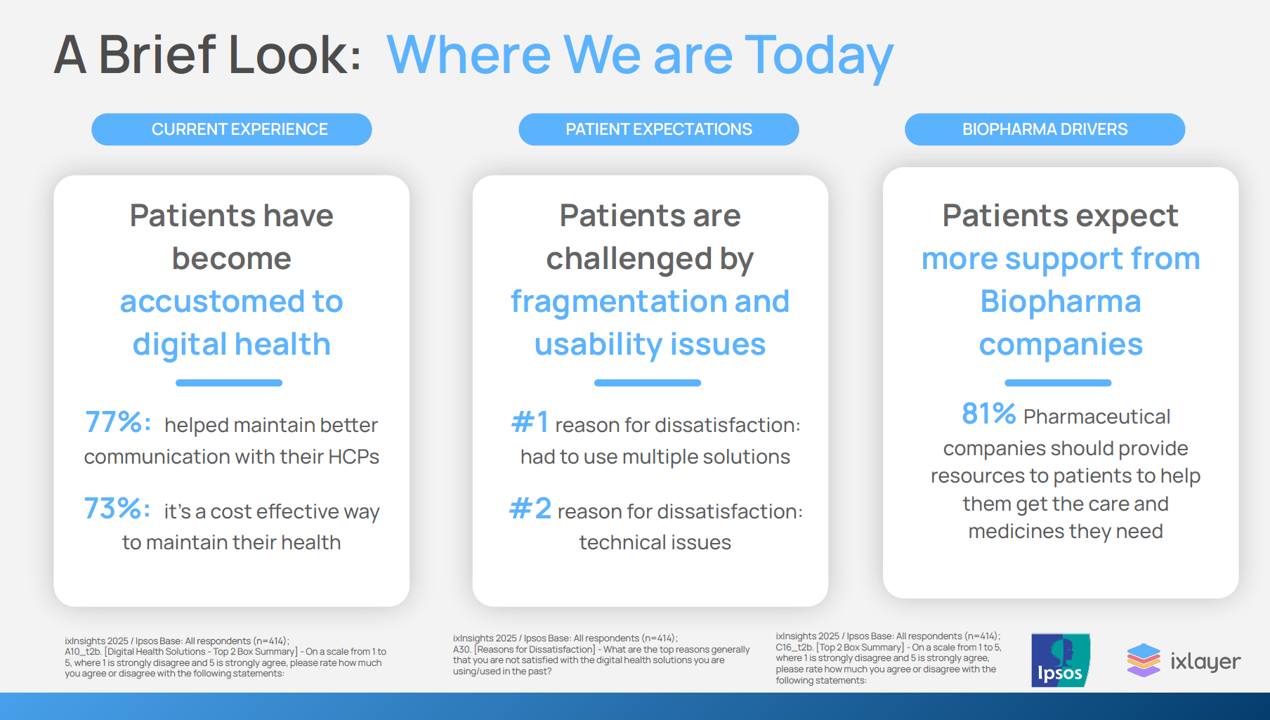
Patients as health consumers now know what “good” looks like in their digital experiences. People have tasted the convenience and respect they feel from well-designed, streamlined omnichannel retail experiences, and they now expect this from health care — specifically supported by the pharmaceutical companies who manufacture the medicines they use in managing chronic conditions, we learn in ixlayer ixInsights 2025: Pharma’s Role in Improving the Health Experience from ixlayer and Ipaos. The patient-focused report gets specific about people dealing with asthma, COPD, Type 2 diabetes, heart disease, psoriasis, and atopic dermatitis with a lens on
One Way to Improve U.S. Healthcare, Lower Costs and Drive Outcomes? “Unvendor,” Asserts Dr. Harm Scherpbier in His New Book
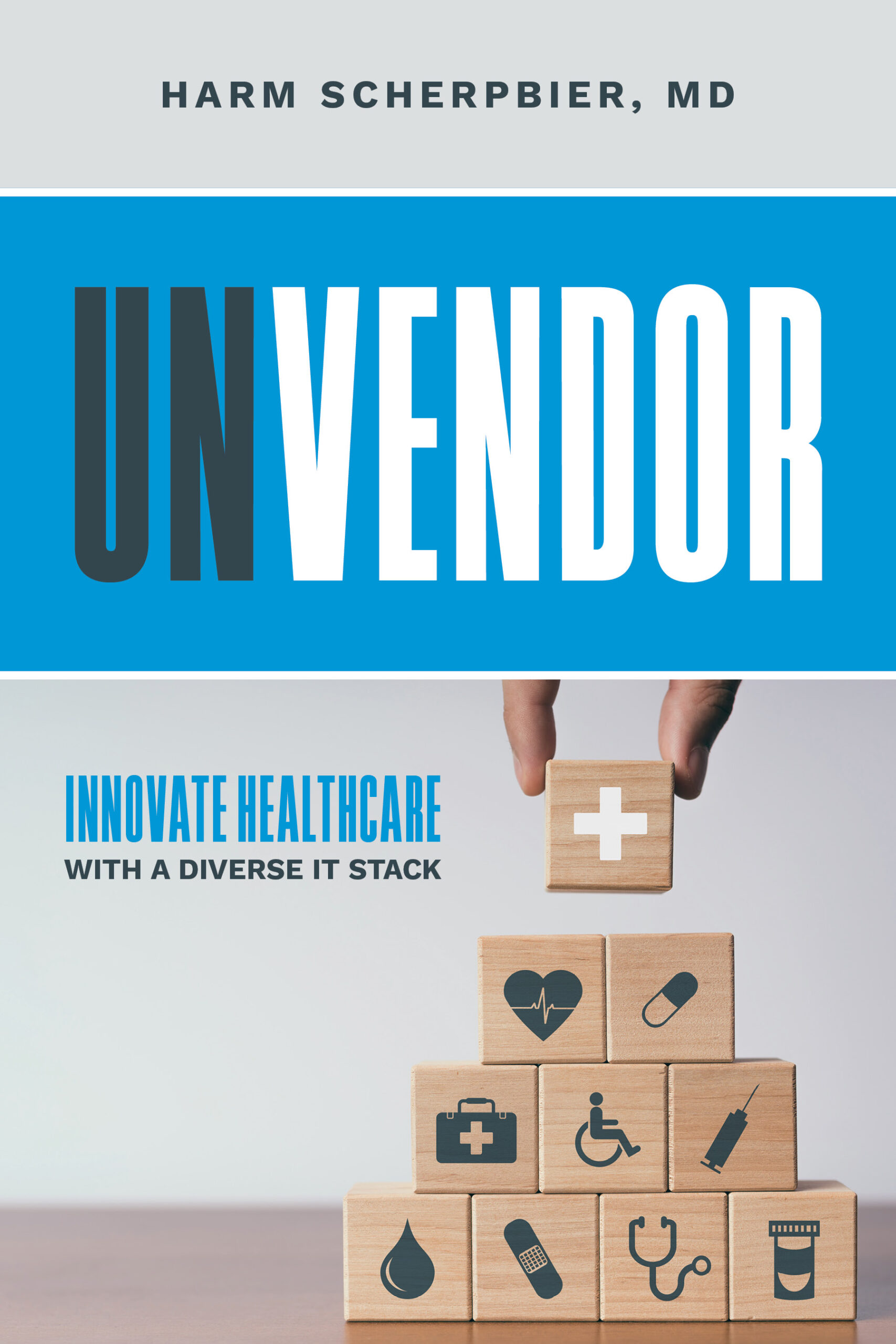
Health information technology professionals charged with selecting, implementing, updating, and paying for health IT in hospital and care delivery settings are essentially the first-line “consumers” of health IT – specifically, electronic health records. But these health IT leaders feel far from empowered and choiceful as consumers in todays EHR vendor “monoculture,” Harm Scherpbier, MD, explains in his book, Unvendor. I spent time with Harm to discuss the book, its backstory, and what he hopes to accomplish by raising the issue of single-vendor health IT and how clinicians, health IT staff, and
Hims and Hers and Hearts – Cardiology Blurs Into DTC Retail Health

Statin therapy has been used for decades to lower cholesterol with the goal of reducing mortality and preventing cardiovascular problems such as heart attacks and strokes. Hims & Hers announced a new service offering for health consumers and clinicians concerned about heart health called Heart Health by Hims. This is Hims & Hers’ first foray into cardiovascular health, working in collaboration with the American College of Cardiology (ACC). ACC clinical guidelines will inform the Hims’ provider platform for the program. “Prevention is the ideal mechanism to decrease cardiovascular events and ensure optimal heart
A Public Health Wake-Up Call: Reading Between the Lines in IQVIA’s 2023 Use of Medicines Report
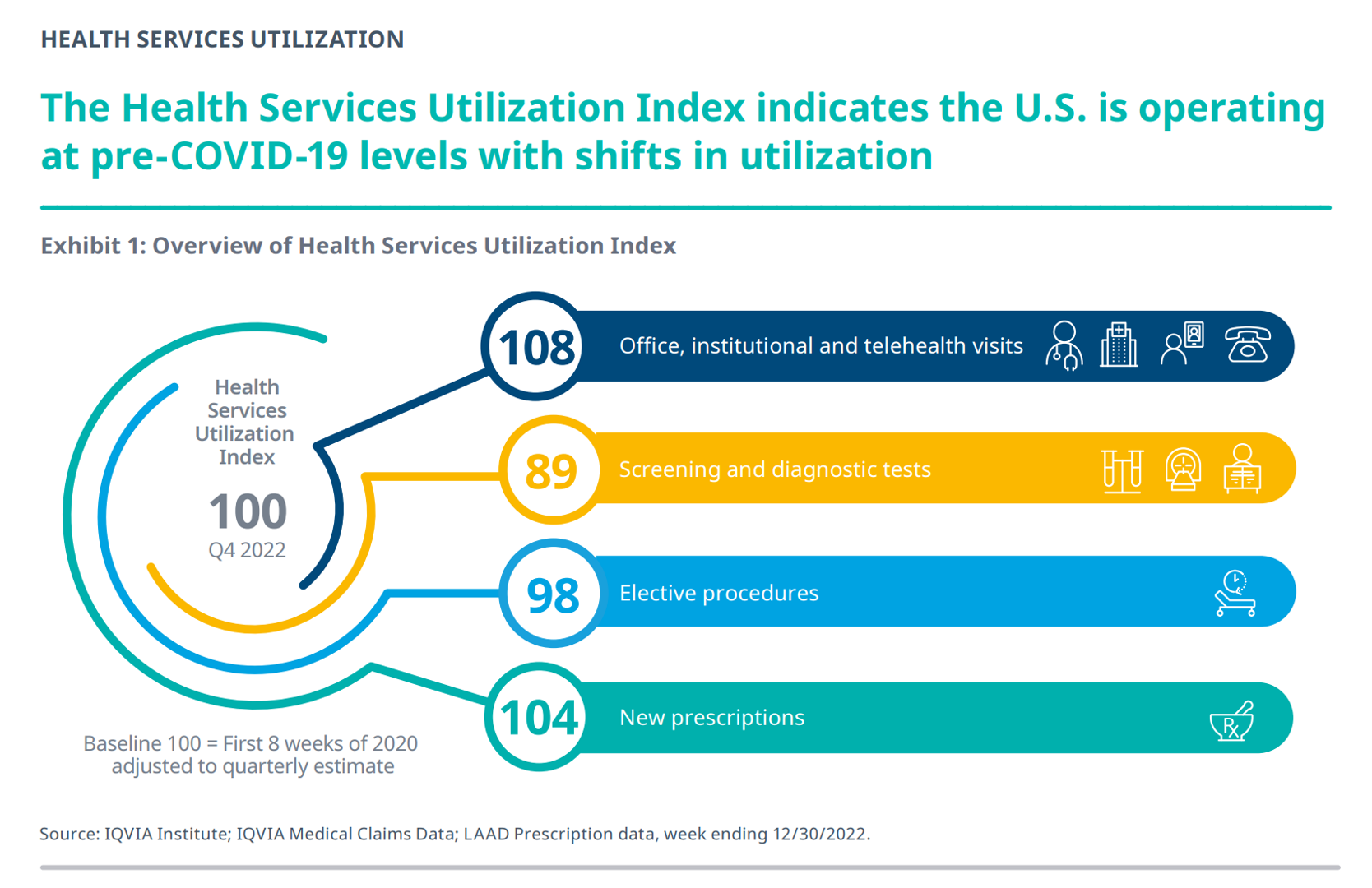
Reviewing the annual 2023 report from the IQVIA Institute for Human Data Science discussing The Use of Medicines in the U.S. is always a detailed, deep, and insightful dive into the state of prescription drugs. It’s a volume speaking volumes on the current picture of prescribed meds, spending and revenues, health care utilization trends, and a forecast looking out to 2027. In my read of this year’s review, I see a flashing light for U.S. health care: “Wake up, public health!” I’ve pulled out a few of the data points that speak to me about population health, prevention and early
Your Home as Clinical Lab: Withings Brings “Your Urine, Your Self” to #CES2023

We’ve all been morphing our homes into our personal HealthQuarters since the start of the coronavirus era. Millions of global health citizens have taken to telehealth who never used a health care “digital front door” before. Other patients adopted remote health monitoring to avoid perennial visits to doctors for managing chronic conditions like diabetes or heart disease. From the kitchen to the bedroom, our homes have become our health hubs. And now, to the bathroom and specifically, the toilet. Withings, maker of my personally favorite connected weight scale, announced U-Scan, a direct-to-consumer lab test platform that analyzes our urine from
 Thanks to Jennifer Castenson for her article in Green Builder Media tracking the growing trend of home-building baked with wellness inside and out. She interviewed me for the piece and I'm grateful to have my perspectives covered in this important issue. Here's one snippet: “Now, we are starting to see areas of the home purposed for health and we have started to think about how to repurpose the home for health."
 Jane joined host Dr. Geeta "Dr. G" Nayyar and colleagues to brainstorm the value of vaccines for public and individual health in this challenging environment for health literacy, health politics, and health citizen grievance. Click onto the Pfizer Value of Vaccines site and you can watch four episodes covering the challenges with adult vaccination, the employer and health plan member's journey to vaccination, reimbursement, and collaborating for proactive prevention.
 I'm grateful to be part of the Duke Corporate Education faculty, sharing perspectives on the future of health care with health and life science companies. Once again, I'll be brainstorming the future of health care with a cohort of executives working in a global pharmaceutical company.