


Why Clorox Talks about Hygiene at Home: Health, Wellbeing, and the Home as Health Hub
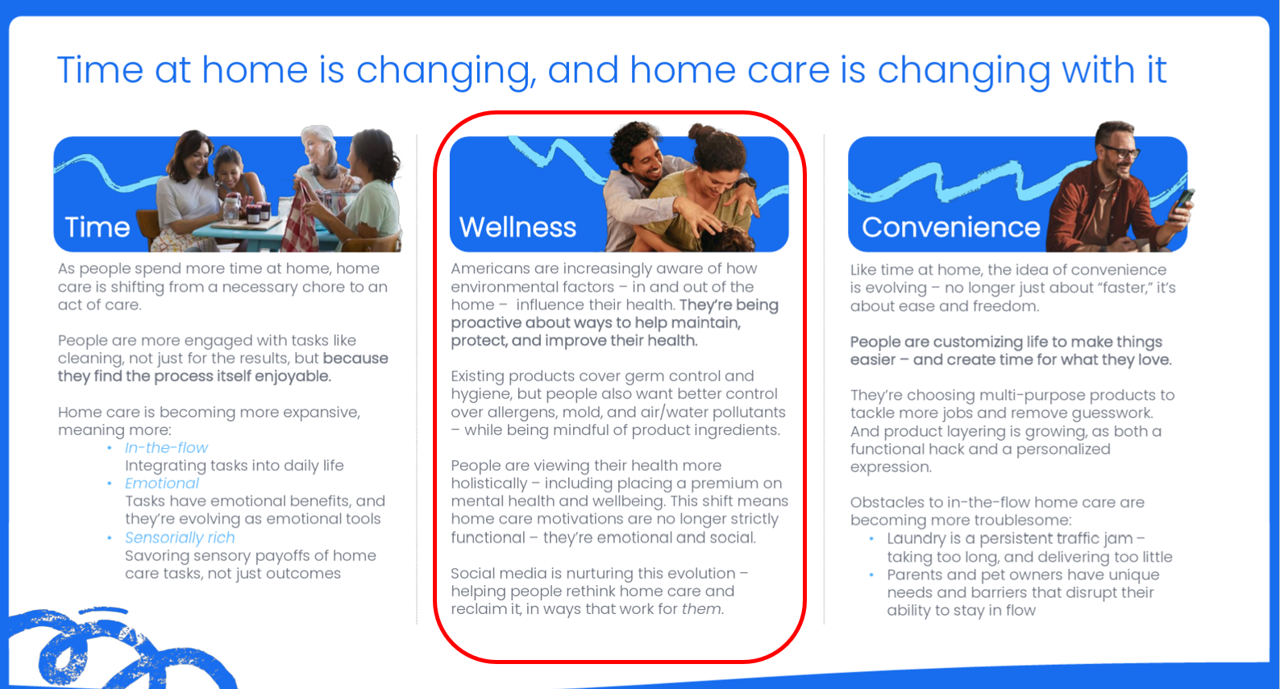
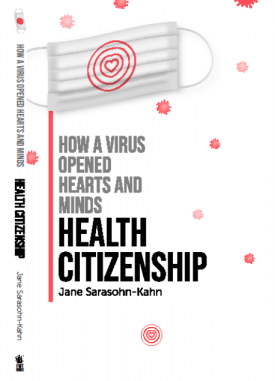
The COVID-19 pandemic was a watershed era for people re-assessing and re-imagining their homes as hubs for health, healthcare, and well-being (as well as learning, exercising, and baking sourdough bread). This graphic comes from my book, Health Citizenship: How a Virus Opened Hearts and Minds, written in the midst of the pandemic based on consumers’ newly adopted behaviors during the #workfromhome and #stayhome epoch. We experienced the digital transformation of people through life and home-based work and education, a growing sense of DIY for things we could do
When a Hotel Becomes Your Health Partner – Learning from Novotel and Accor
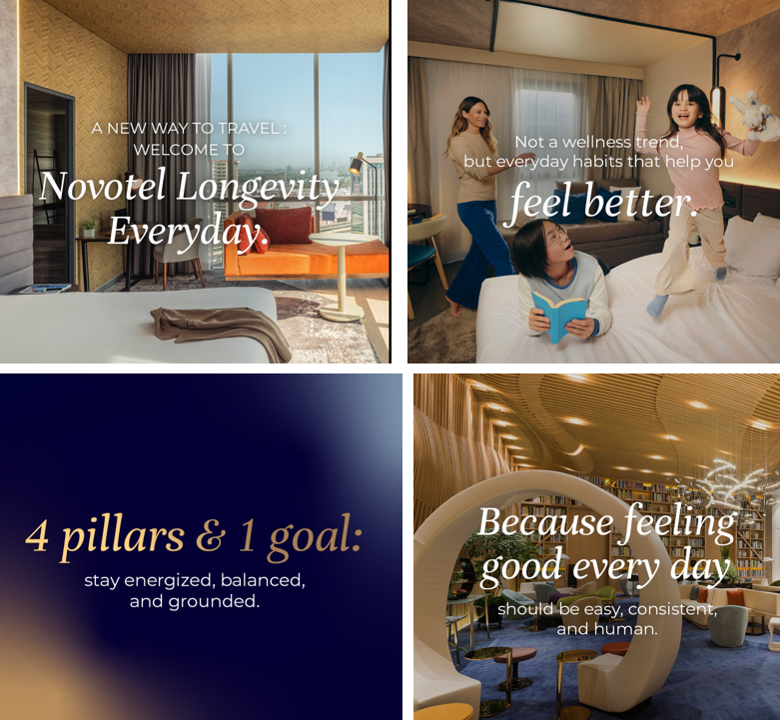
“Novotel Launches ‘Longevity Everyday.'” That’s the title of the global, France-based hotel chain’s press release, announcing the Novotel brand’s initiative to serve up healthy hospitality. Check out this video… Behind this strategic positioning decision, the hotel notes, “Accor data reveals that one in three travelers is taking daily steps to improve their mental and physical wellbeing, yet most longevity programs remain out of reach for many people. This gap between demand and accessibility has created a strategic opportunity that Novotel, Accor’s founding brand, is uniquely positioned to address.” This approach will extend to over 600 hotels operating in 67 countries
Aging is Not a Decline, but an Awakening at CES 2026 – Learning from AARP About Consumers, Lifespan, and Technology
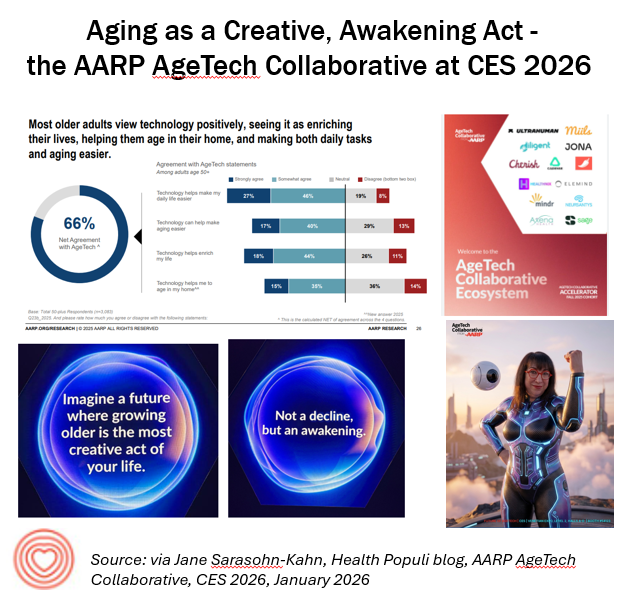
Aging and longevity are key themes driving technology innovations and markets, and walking the miles of aisles of CES 2026 demonstrates the expanding landscape of the role of tech in healthy living across the lifespan. I spent time at the AARP AgeTech Collaborative space this week as I did last year (here was my write-up of AARP and CES 2025 for historical context). In experiencing this year’s portfolio of AgeTech collab partners, from start-ups to Fortune 100 companies in the mix, was informative, inspiring, and even energizing as someone who has been a member of AARP since turning 50 some
Sleep as a Pillar of Health at CES 2026 — What Can Happen When A Lamborghini Legacy Mashes Up With Sleep Tech
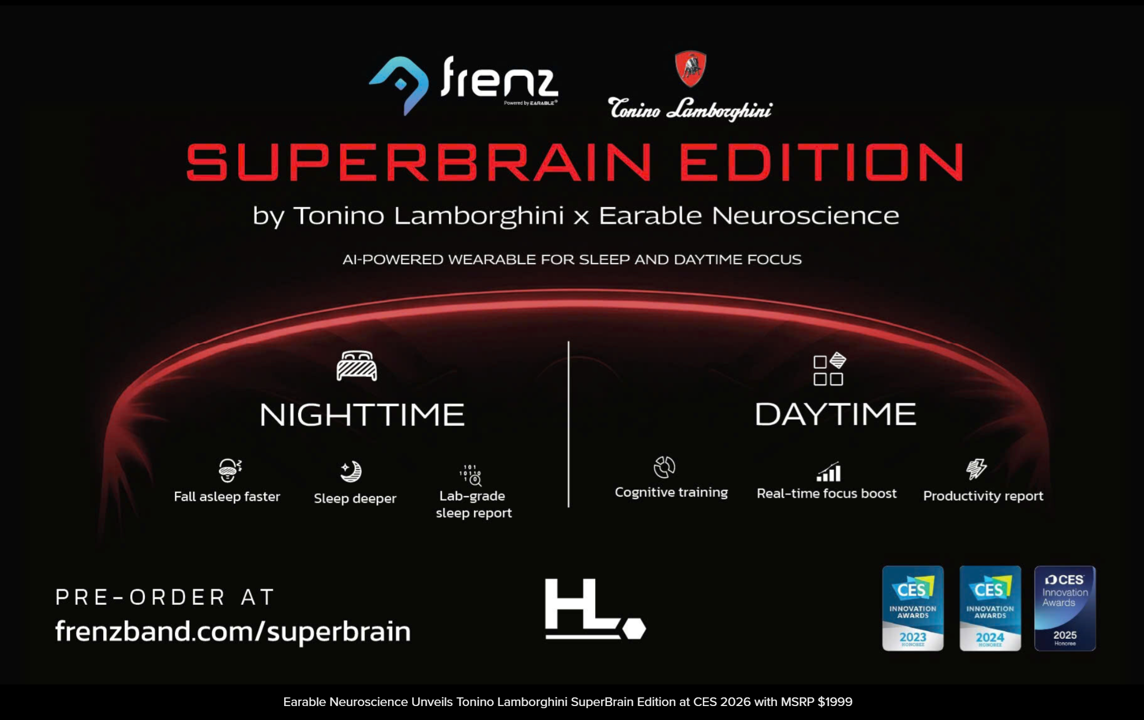
Well-being is a new form of luxury….and sleep is an inherent aspect of well-being and health, a message reinforced during a press conference hosted by the National Sleep Foundation at CES 2026. Sleep has been an ongoing theme at CES for many years: here’s a post I wrote on sleep at CES 2025 a year ago for some historical context. In today’s growing home-as-our-health-hub ethos, sleep-tech takes on a variety of forms, from new-fangled beds and sensors, smart rings, other wearable tech (like earbuds), and circadian rhythm lighting innovations. In yesterday’s Health Populi, I focused
The Bathroom’s Role in the Home as Health Hub: Catching Up with Kohler Health’s CEO at CES 2026

A key Tech Trend to Watch at CES 2026 is consumers’ re-imagining and fitting out their homes as sites for bolstering health and well-being. I’ve been tracking this concept as far back as 2011 when I wrote this post from the 2011 Consumer Electronics Show. A decade-and-a-half later, in déjà vu spirit, the concept is no longer theoretical or futures-thinking. Fast forward from 2011 to the COVID-19 pandemic, when everyone’s home spaces became re-purposed for health, for medical care, for well-being, for fitness and exercise, for cooking up nutritious food, for
Tech Trends to Watch at CES 2026 – For Health, It’s About Longer Living, Smarter Living, and Better Living
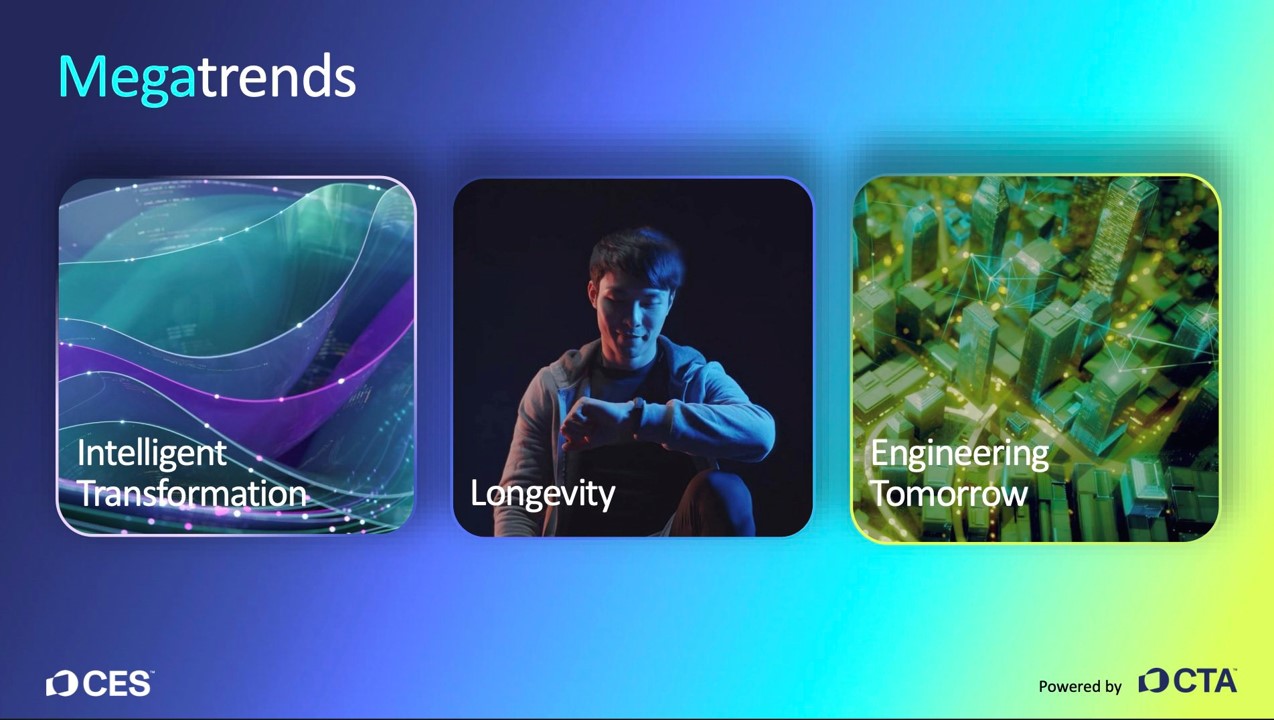
Live from CES 2026 in Las Vegas…the first day of CES Media Days preceding the big show always covers a context-setting report on Tech Trends to Watch. This is one of my annual go-to programs which helps orient media and industry analysts with a lens on CES’s key tech categories and some hard data on market size and growth expectations. While I’ll focus on the health/care specifics in the trend forecast, let me first update you on the overall technology market revenues for the U.S. which are estimated at $565 billion for 2026.
A Primer on Health Consumers for CES 2026 – How Macro Consumer Trends Will Shape Healthcare Consumers in 2026
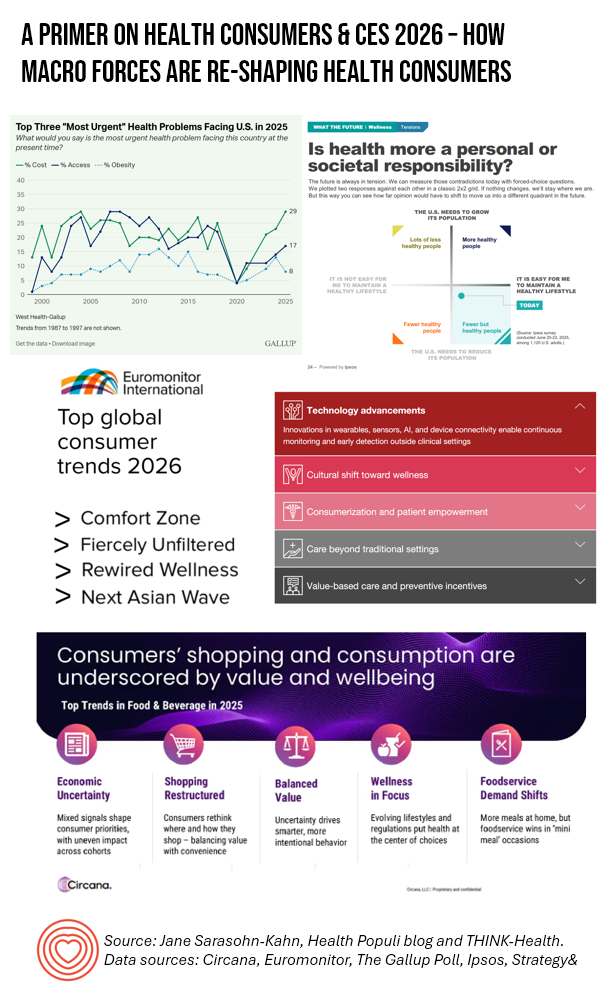
Increasingly, people are engaging more in health care decision making due to many factors impacting their personal medical choices — from the cost and access to health insurance to co-payments for prescription drugs and the supply of primary care doctors, more patients developed and exercised their health consumer muscles in 2025, For 2026, the health consumer muscle-building will grow as people will be re-shaped by macro market factors we are currently gleaning from forecasts looking into the new year: for personal finances, social issues, technology adoption, views on AI and privacy, and other issues. Here are some data points to
Men’s Fertility Feelings – The Influence of Trust and Social Media (My Progyny Post #3)

Trust is a key enabler for people’s health engagement. As the American Medical Colleges’ Center for Health Justice defines it, trustworthiness is “rooted in honesty and honors lived experience….. key to a successful patient-provider partnership.” In his book, Notes On Being A Man, Scott Galloway calls out that men’s fertility issues are formed as part of a larger societal context and crisis point, exacerbated by economic pressures and lack of opportunities for male bonding and in-person social touchpoints. In the second post in this series of three, we discussed those economic pressures Galloway notes, and the financial stressors that shape
A Month Until #CES2026 – The Journey to Our Personal Health Operating Systems

In a month, I’ll board a plane for Las Vegas to spend a week at CES 2026, the annual electronics conference that last year brought together over 140,000 global technology stakeholders to display, demonstrate, and sell the latest in consumer-facing tech. This will be my fourteenth CES (including the virtually convened meeting held in 2021). If you want to time travel, here’s a link to an early CES post featuring “The Battle of the (Wrist)bands.” Indeed, the digital health aisle at the time had many wrist-worn activity trackers, largely amped-up pedometers, with the likes
Feeling Under-Served and Overlooked: Men’s Views on Their Fertility Journeys (My Progyny Post #1)
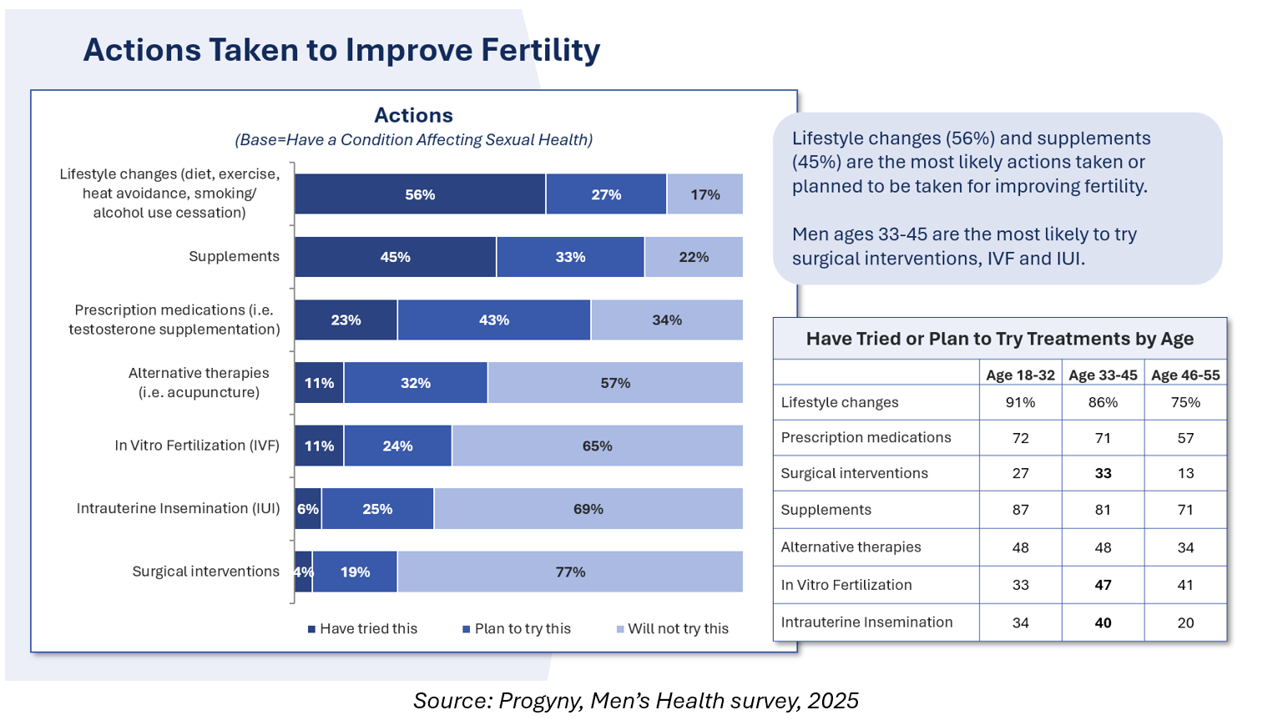
In his latest book, Notes on Being a Man, Scott Galloway discusses his personal fertility journey in the larger social context of what it means to be a man in modern America. Galloway’s infertility challenges shared with his wife inform his views on men’s health across all dimensions — physical, mental health, social health, financial well-being — and how, of course, men’s overall health is also a women’s and children’s issue. Men can feel “left out” of infertility discussions, based on results from the first and largest multi-national study into men’s feelings about their infertility revealed. “How men feel about
Where Health Meets Beauty, Mental Health, and Faith: Learning from the Farmaceutica di Santa Maria Novella
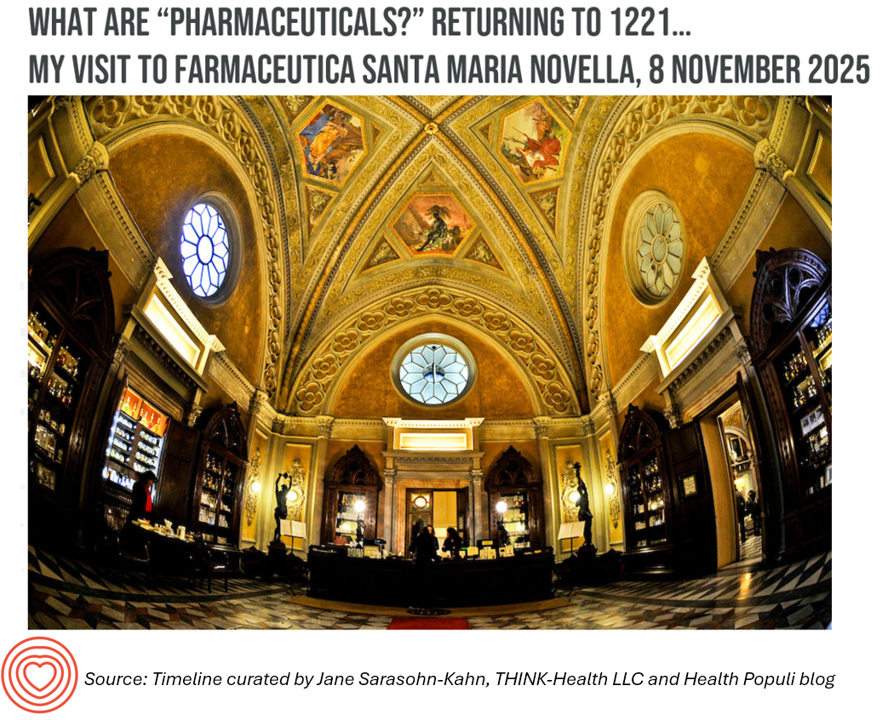
What is a pharmacy? And what are “medicines?” I’ve been thinking about this question for some time, and had the opportunity to consider this in real-time in a sort of back-to-the-past-to-the-future moment when I spent time at the glorious Farmaceutica of Santa Maria Novella (SMN) in Florence, Italy (in longhand, the “Officina Profumo-Farmaceutica di Santa Maria Novella)” on 8th November. This meet-up at this 800+ year old institution is one of many touchpoints in my work and personal life between late October and late November, where I’m working on health/care issues in 4 Euro cities: starting with London in week
Sleep in Our Lives: Self-Care, From Using PTO and Vacation Time to Tracking and Digital Detoxes

Sleep is a sort of luxury good when you don’t have it or get it: like water in a desert, it’s priceless and life-saving. When someone thinks of health, “sleep” falls into the top 3 factors, as measured by the Kearney Consumer Institute’s global survey conducted for the Consumer Goods Forum 2025. You can see from Kearney’s data shown here that physical activity (say, mobility and walking and moving about) ranks top for global health citizens, followed by diet and nutrition. Amerisleep, a sleep
 Jane will be working with EU- and UK-based clients in September and October 2026, collaborating with stakeholders in digital health, public/community health, retail health, and growing opportunities for health-at-home. Stay tuned to her updates here on Health Populi on-the-ground as she lives the digital nomadic work-life in Italy, Belgium, the Netherlands, and in London.
 I was grateful to be Jasmine's first conversation-guest on her new podcast, "Aperture - Widen the Frame," where this expert in narrative medicine is bringing together the broad range of voices to sit at the table and address what health care needs: those humans in the health-system-loop who address health equity and empathy along with delivering evidence-based medicine for all.
 Jane joined host Dr. Geeta "Dr. G" Nayyar and colleagues to brainstorm the value of vaccines for public and individual health in this challenging environment for health literacy, health politics, and health citizen grievance. Click onto the Pfizer Value of Vaccines site and you can watch four episodes covering the challenges with adult vaccination, the employer and health plan member's journey to vaccination, reimbursement, and collaborating for proactive prevention.