

Most Americans believe it’s very important for the nation to lead in scientific achievements. But twice as many Democrats as Republications, 65% versus 32%, say the U.S. is losing ground in science innovations.
The Pew Research Center asks and answers the Do Americans Think the Country Is Losing or Gaining Ground in Science? And the answer is, “millions of people do think so.”
The Pew team polled 5,111 U.S. adults in late October 2025 for this research.
There are a few political chasms related to science-trust in the U.S. that are important to call out because they shape peoples’ views on health policy and resource allocation to research.
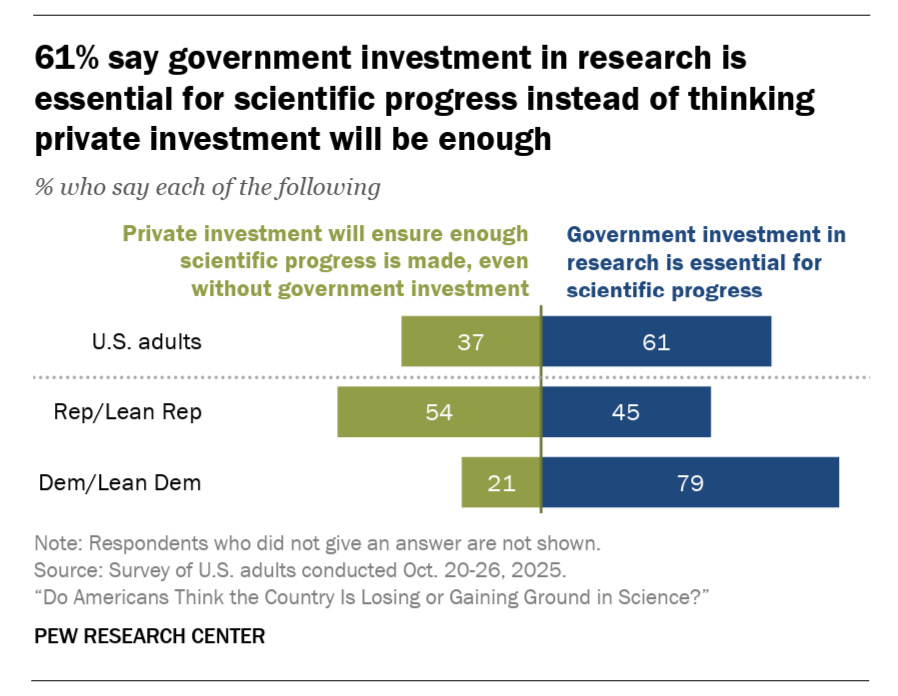
First, note that many more Americans who identify as Democrat or leaning Dem believe that government investment in research is essential for scientific progress.
In contrast, less than one-half of Republicans or GOP-leaners say government investment in research is essential. So the inverse situation holds — that most of those people identifying as Republican believe that the private sector investment will ensure enough science progress is made even without government investment (54% of those with GOP ID) versus only 37% of the Democrats. 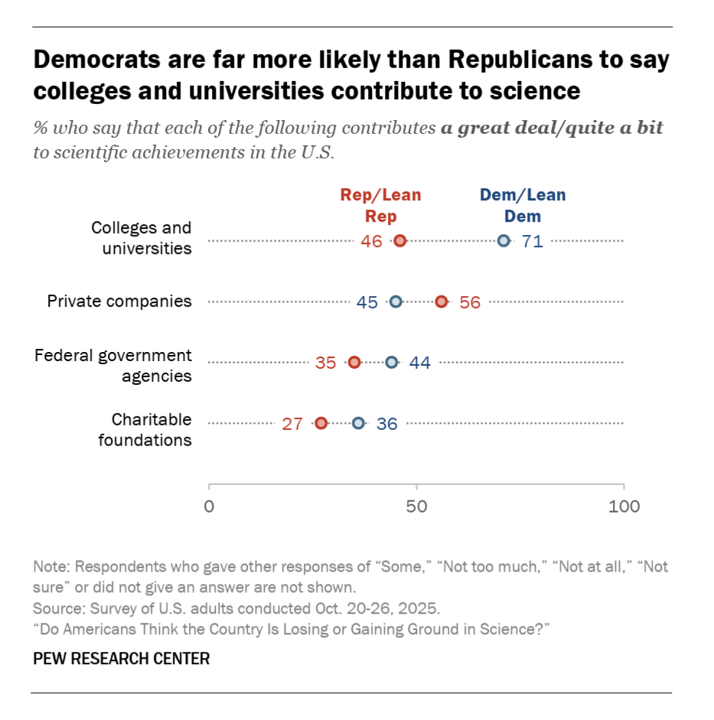
Here is another important contrast based on party ID: Democrats are far more likely than Republicans to say colleges and universities contribute to science; on the other hand, most Republicans, 56%, say it’s private companies who contribute to science (versus 46% of Republicans who pointed to academia).
Lower down on investment confidence are Federal government agencies, but still with a party ID split: 44% of Dems say Federal government agencies contribute to scientific advancements in America compared with 35% of Republicans.

Finally, education makes a difference in bolstering a citizen’s trust in science: the more college, the more people have confidence in scientists to act in the best interests of the public, shown in the bar chart.
Overall, 37% of college graduates have “a great deal” of confidence in scientists, compared with 23% of people with some college or less.
By political party ID, nearly all college-graduated Democrats have confidence in scientists compared with 70% of Republicans who have graduated from college.
As the Pew’s report notes, “Education is closely related to how Americans view the effect of science on society.”
Health Populi’s Hot Points: Politicizing science, and as part of that countering evidence-based medicine, got turbocharged during the COVID-19 pandemic when public health’s proven pillars like vaccination got challenged beyond the fringe.
The Pew study codifies where we stand on politicizing science and research some six years after the pandemic was called out as such.
With RFK Jr. turning the longstanding food pyramid on its head (calling out meat (that is, beef) and beef tallow as top of the pyramid nutritious goodness, and shortening the vaccine schedule for kids, we are living with this phenomenon in 2026. And in the meantime, certain stakeholders are talking back to the RFK regime and sticking to evidence-based practices such as the pediatric vaccine schedule, the benefits of a Mediterranean-style diet, and gender-challenging health care information.
A short-term consequence of pulling back from science research and public funding to both universities as well as research institutions has been an outflow (call it a “brain drain”) of some scientists and clinicians seeking greener research and practice pastures — whether researchers fleeing the U.S. border bound for Ireland, the UK, France, and other destinations, or clinicians switching states for kinder, gentler approaches to women’s health and Medicaid expansion for health access for a state’s health citizens.
The implications of the Pew research are many and impact every stakeholder organization in the U.S. health ecosystem. As we are now all-in and in the bullish era of AI-investment, we should nonetheless stay mindful about a mega-trend such as this one shaping both health citizens for trust and health engagement, as well as health access and health equity,
 I'm grateful to be part of the Duke Corporate Education faculty, sharing perspectives on the future of health care with health and life science companies. Once again, I'll be brainstorming the future of health care with a cohort of executives working in a global pharmaceutical company.
 Thank you
  Jane joined host Dr. Geeta "Dr. G" Nayyar and colleagues to brainstorm the value of vaccines for public and individual health in this challenging environment for health literacy, health politics, and health citizen grievance.