

One-half of people living in the U.S. in the fourth quarter of 2025 said they could afford health care in America, according to research from Gallup and West-Health discussed in U.S. Adults’ Ability to Afford Healthcare at a Five-Year Low. 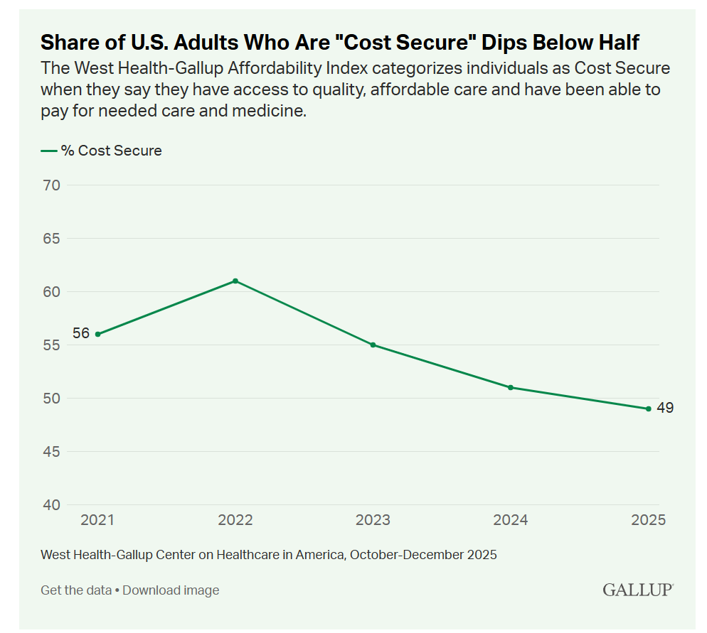
Gallup and West Health polled 5,660 adults aged 18 and older between October and December 2025 as part of the organizations’ Affordability Index. This research defines Americans’ health care financial access in three tiers:
- Cost Secure, when people say they have access to quality, affordable care, able to pay for both needed care and prescription drugs (= 49% in late 2025)
- Cost Insecure, when people say they lack access to quality, affordable care or have recently been unable to pay for either needed care or prescription drugs (= 41% of U.S. adults in 2025)
- Cost Desperate, when people lack access to quality, affordable care and have been unable to pay for both needed care and prescription drugs (= 10% in 2025).
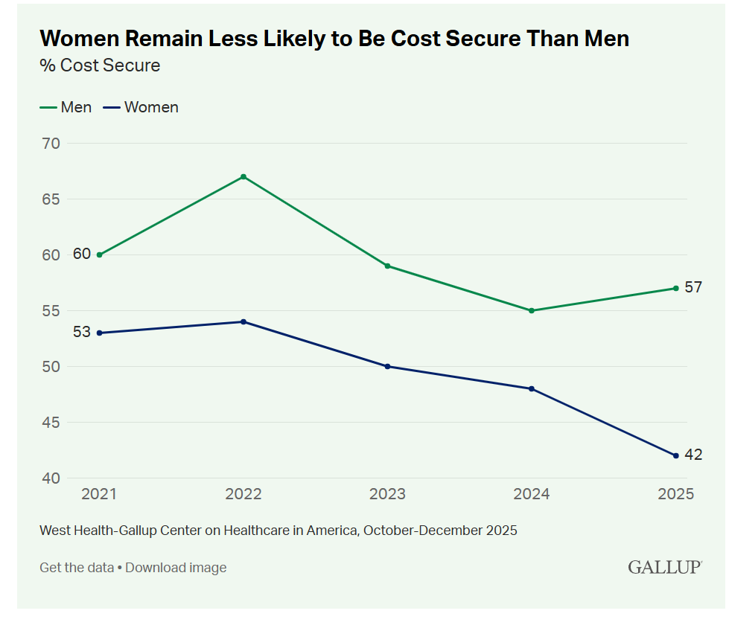
Based on these definitions, women were much more likely to feel health care cost insecure in late 2025, as shown in the second line graph. Note that the level of American men’s sense of health cost security stayed relatively flat compared with 2021, declining just 3 percentage points from 60% of U.S. men feeling insecure versus 57%.
Among women, there was an 11 percentage point drop in cost security, from 53% (just over one-half of women in the U.S.) versus 42% in 2025.
[I’ve talked about women facing a “pink tax” in health care and consumer goods for some time – most recently here.]
In addition, fewer than 50% of U.S. adults under 50 years of age also felt cost insecure for health care access in late 2025. 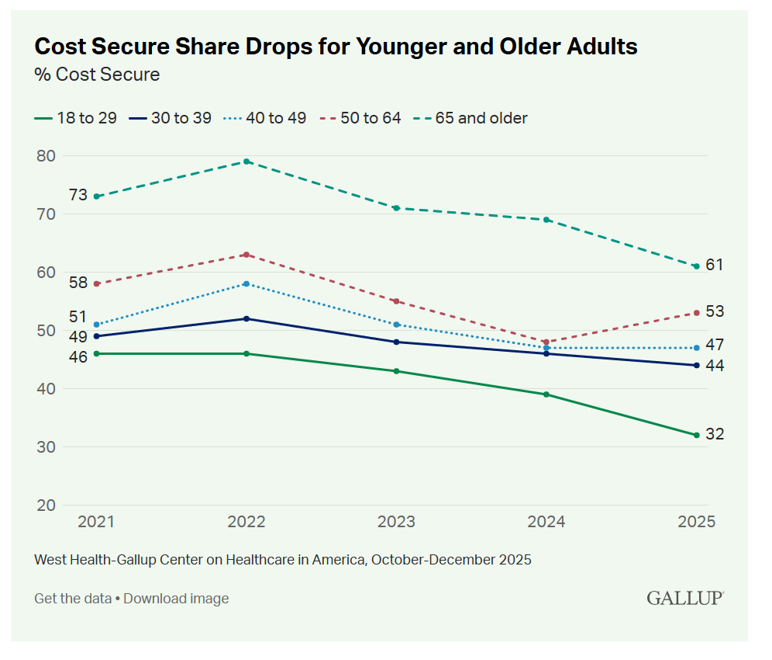
This line graph details the decline in health care cost security for U.S. adults under t0 years of age.
Note that only 1 in 3 people in the youngest cohort between 18 and 29 felt cost secure.
44% of those 30 to 39 said they could afford health care, and 47% of people between 40 and 49 felt they were cost secure to access health care in America in late 2025.
There was also a drop in health cost security among Americans 65 and older, even as this group of people is covered by Medicare.
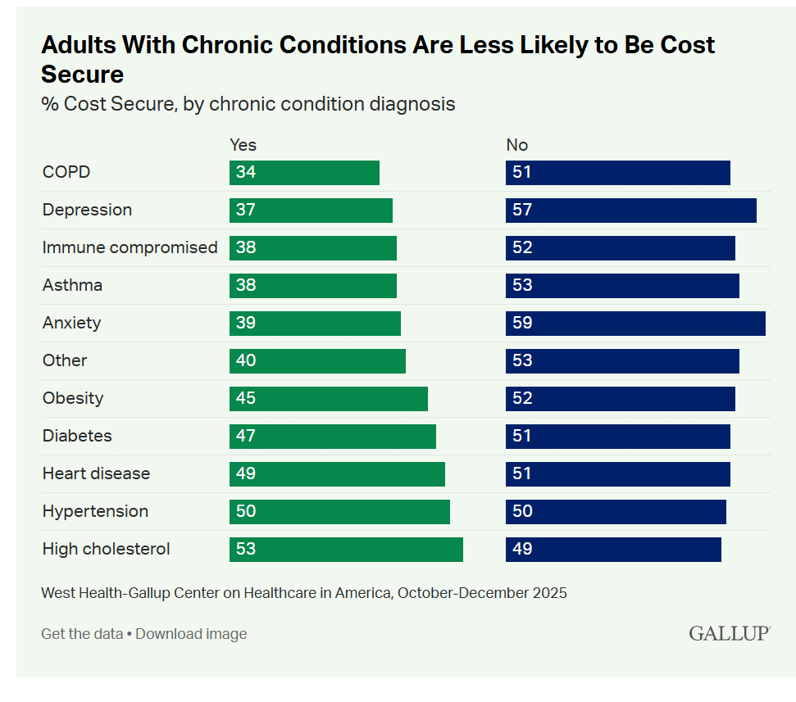
Health Populi’s Hot Points: Dealing with a chronic condition is also a risk for being health care cost insecure in America, illustrated by the last bar chart.
The conditions most likely to lead to folks feeling health care cost insecure included COPD (for 34% of American adults feeling secure), depression (37% feeling secure), immune compromised (38%), asthma (38%), anxiety (39%), among other higher-risk conditions leading to health care cost insecurity.
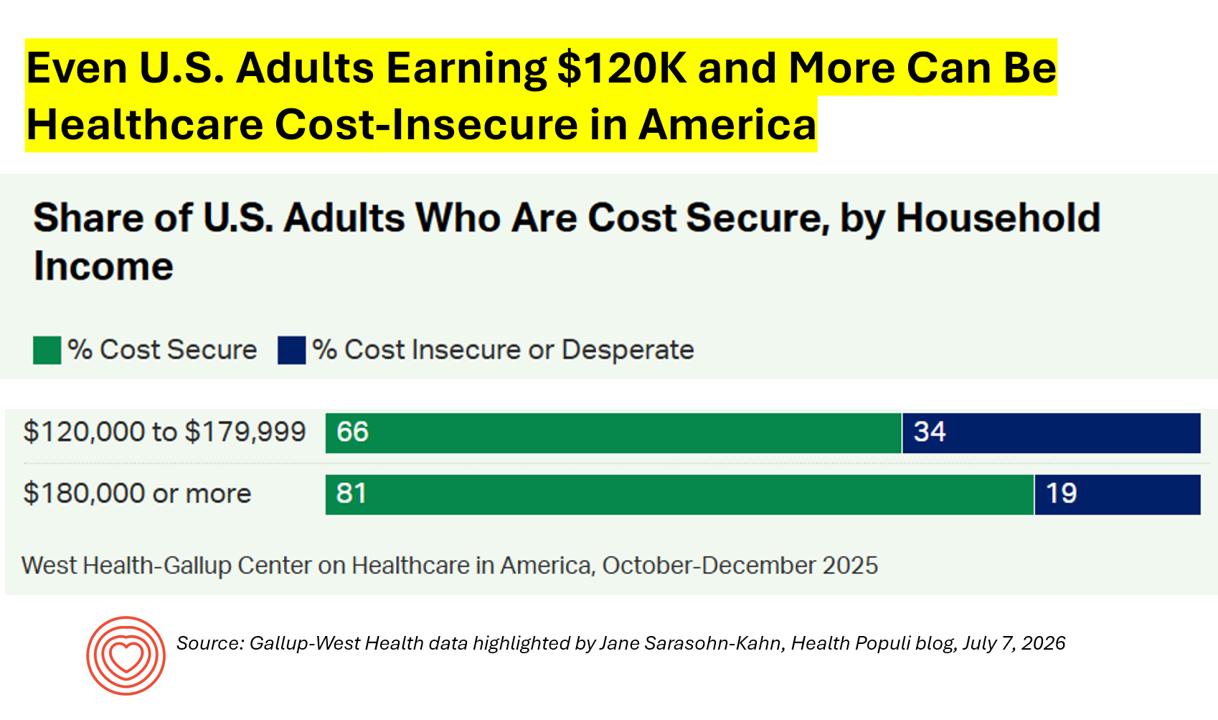
Health care affordability is an issue facing even the most affluent Americans in late 2025. I isolated the income levels of $120K-$179,999K and $180K or more to call out that one in 3 and 1 in 5, respectively, were facing health care cost insecurity by the end of 2025.
The American Heart Association found in a survey published earlier this year that U.S. workers were so financially challenged, 50% of employees said health care costs made it difficult for them to afford day-to-day expenses including food, childcare, and rent. And, 47% of workers were reducing or stopping their retirement contributions due to financial burdens.
Given persistent U.S. household inflationary pressures in mid-2026, we can hypothesize with pretty solid certainty that even the most affluent households in America are feeling health care cost insecurity as they face higher costs at grocery stores, petrol pumps, and high utility bills.
These health care cost pressures will also continue to inspire people as health consumers to shop for and curate personal health care ecosystems that provide value in the context of their values throughout and beyond 2026…
 Jane will be working with EU- and UK-based clients in September and October 2026, collaborating with stakeholders in digital health, public/community health, retail health, and growing opportunities for health-at-home. Stay tuned to her updates here on Health Populi on-the-ground as she lives the digital nomadic work-life in Italy, Belgium, the Netherlands, and in London.
 I was grateful to be Jasmine's first conversation-guest on her new podcast,
  Jane joined host Dr. Geeta "Dr. G" Nayyar and colleagues to brainstorm the value of vaccines for public and individual health in this challenging environment for health literacy, health politics, and health citizen grievance.