

AI adoption is scaling faster than trust, where trust is tied to concerns about data privacy, transparency, and control in the U.S., Canada, and the UK. Welcome to the AI Atlas, what The Harris Poll calls “A living map of how people relate to AI and how those relationships evolve.”
I consumed the Atlas with my lens on healthcare and self-care firmly in context, and in the Hot Points below, distill some thoughts on Harris’s fascinating market segmentation of AI/consumers.
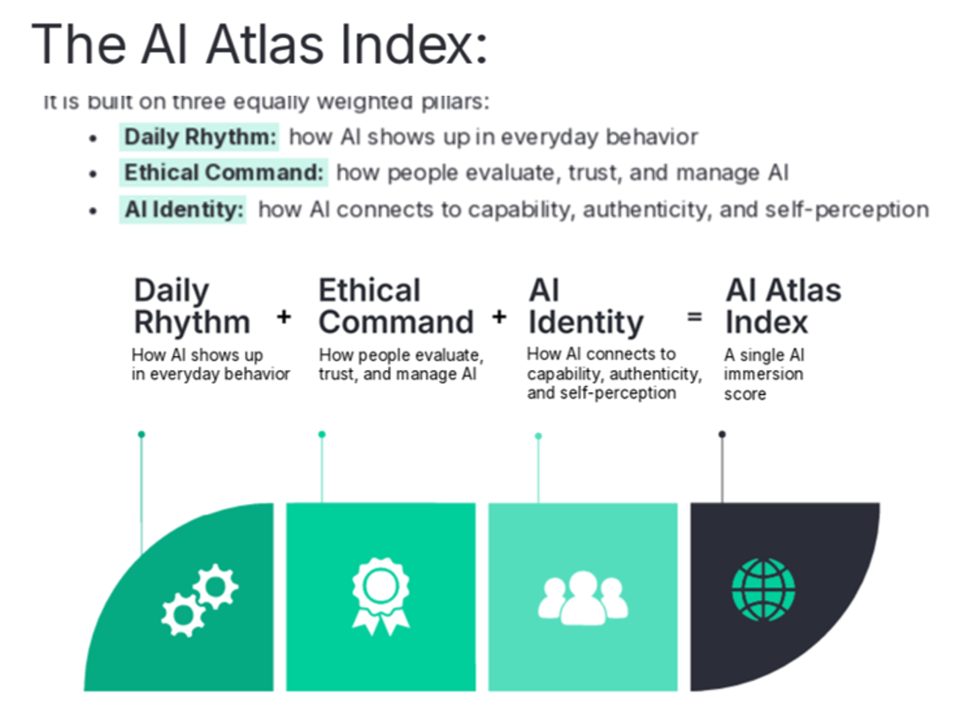
To construct the Atlas, The Harris Poll conducted a survey online in January 2026, assessing some 16,017 adults aged 18 and over in Brazil, Canada, Germany, India, Japan, Mexico, the U.K., and the U.S.
Harris explored three pillars of consumers’ AI behaviors to build the market segments:
- Daily rhythm, exploring how AI “shows up” in daily behavior
- Ethical command, how people evaluated, trust, and manage AI, and,
- AI identity, considering how AI connects to capability, authenticity, and self-perception.
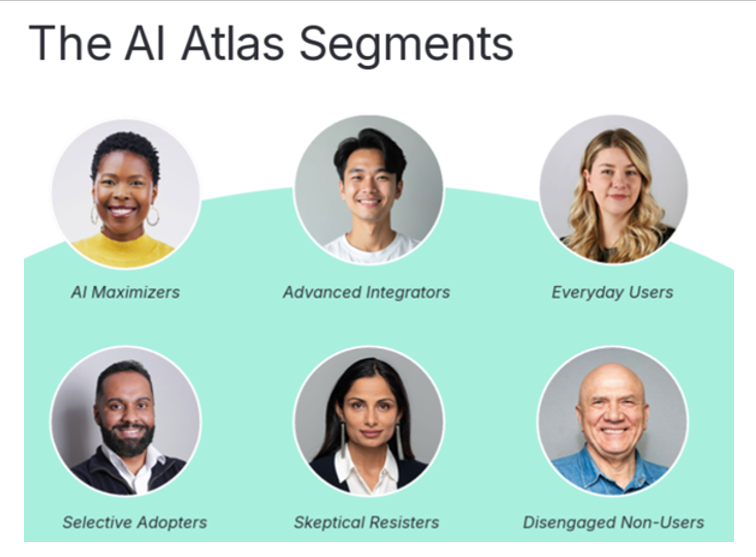
Based on this methodology and survey research, The Harris Poll divined six distinct groups of people who share a pattern of behavior, trust, and identity.
The segments are shown in the graphic, including:
- AI Maximizers
- Advanced Integrators
- Everyday Users
- Selective Adapters
- Skeptical Resisters, and,
- Disengaged Non-Users.
I’ll focus on #1 and #5 here in Health Populi, the AI Maximizers and Skeptical Resisters, and hope you’ll visit the full report to gain insights into all six AI-personae.
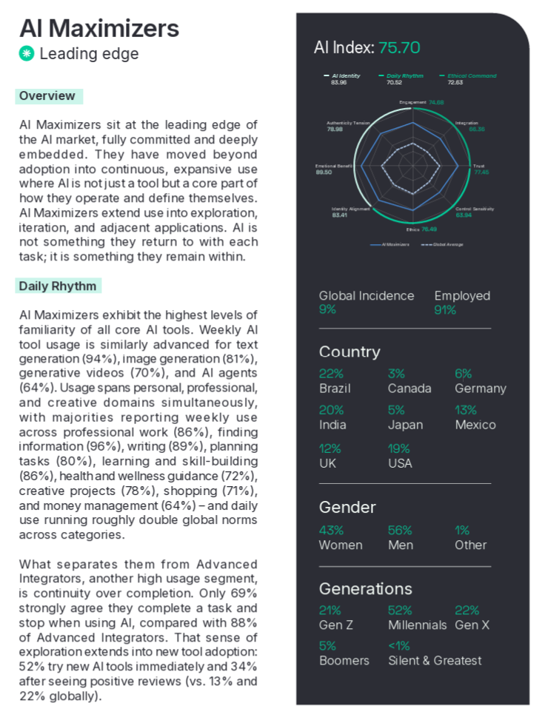
Let’s start with the most intense, leading-edge users of AI: the AI Maximizers.
For these consumers, Harris explains, AI is not just a tool but core part of how people operate and define themselves. They are the most familiar with AI tools, and their use of AI spans the personal, professional, and creative. They use AI to find information, to write, to plan tasks, to learn and build skills — and 72% of these Maximizers use AI for health and wellness guidance.
This group comprises about 1 in 5 people in the U.S., more men than women, and over one-half of Millennials globally.
The next-most intensive users of AI in Harris’s segmentation are the Advanced Integrators — with a key differentiating factor of using AI for efficiency and completing tasks compared with the Maximizers who have a more exploratory approach to AI.
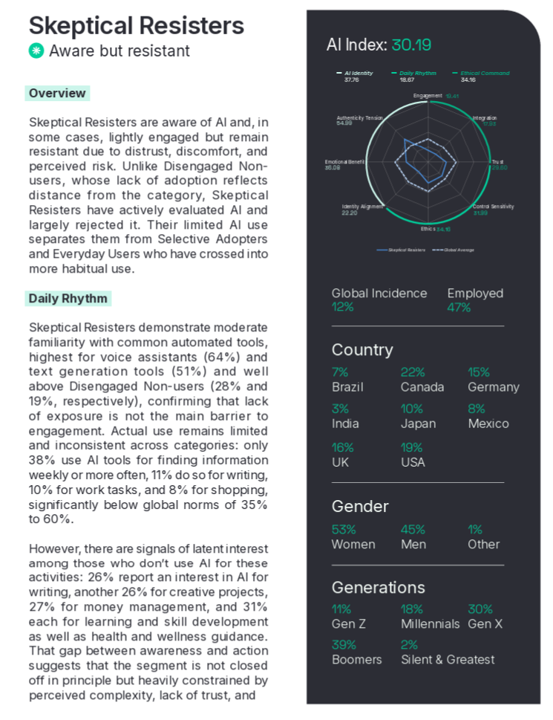
I wanted to explore this AI-using consumer segment as health consumers because many health citizens who are Skeptical Resisters could benefit from aspects of AI-delivered health information and services — but their resistance to the technology would be a barrier to realizing potential benefits of the AI + health convergence.
The Skeptical Resisters know about AI but are resistant, Harris found, due to distrust, discomfort, and perceive risks.
These consumers have looked into AI and “largely rejected it,” Harris observed. Only 38% use AI tools to find information at least weekly, and only 11% use AI for writing, 10% for work — well below global norms for regular users.
On the upside for opportunity and health services planning, 31% of Skeptical Resisters would be interested in using AI for health and wellness guidance.
Health Populi’s Hot Points: Of the three pillars making up the AI Atlas Index underlying the six consumer segments, it is the second factor of Ethical Command that informs peoples’ behaviors in evaluating, trusting, and controlling AI tools.
It is clear across the segments in Harris’s survey data that between one-fourth and one-third of consumers, globally and generally, would be interested in adopting AI tools for health and wellness guidance. Harris points out in assessing the major these coming out of this research that the biggest growth opportunity is in deepening use of AI with the “middle market” of “moderately engaged, curious consumers.” AI use for health and well-being isn’t broad or habitual in the mainstream yet, but Harris suggests that, “growth is likely to come from converting their (that is, peoples’) situational use into repeat, expanded use.”
This is where health consumers’ trusted touchpoints for their healthcare and service delivery can make a profound impact on peoples’ initial trial of the technology and subsequent adoption and habitual use — the way the top two segments in this study have come to use AI in daily life for tasks, insights, and life-flows.
Health citizens, particularly those in the U.S., are currently confronted with medical bills and lack of transparency for health care costs in the midst of a persistent inflationary economy where affordability can also compromise trust when it comes to filling a prescription, schedule a necessary medical test or procedure, or finding an on-ramp to primary care.
These examples of barriers to getting care can often be enabled through various AI tools, whether chatbots served up by health plans or providers, prescription drug information delivering personalized pricing for copays or discount cards, or telehealth/virtual visits enabled through AI-built on-ramps to care — say, for behavioral or mental health visits (where trust is an enabler to seeking and getting needed services) or symptoms of a daunting infectious disease.
The Harris Poll gives us insights into six consumer personae that can help us tailor AI-enabled services that can be built with trust- and privacy-by-design. For healthcare, these principles will be key to boosting AI adoption for health consumers’ self-care and sense of agency about their and their loved ones’ health.
 Jane will be working with EU- and UK-based clients in September and October 2026, collaborating with stakeholders in digital health, public/community health, retail health, and growing opportunities for health-at-home. Stay tuned to her updates here on Health Populi on-the-ground as she lives the digital nomadic work-life in Italy, Belgium, the Netherlands, and in London.
 I was grateful to be Jasmine's first conversation-guest on her new podcast,
  Jane joined host Dr. Geeta "Dr. G" Nayyar and colleagues to brainstorm the value of vaccines for public and individual health in this challenging environment for health literacy, health politics, and health citizen grievance.