

As people have taken on self-agency for their health and health care decisions, two sides of a coin are responding to market forces to meet health-inspired consumers where they are, and where they want to “be:” consumer brands on one side of that coin, and healthcare companies on the other, we learn in the report Consumer Brands Are Becoming Healthcare’s Next Leader from Lauren Berry at Ipsos. 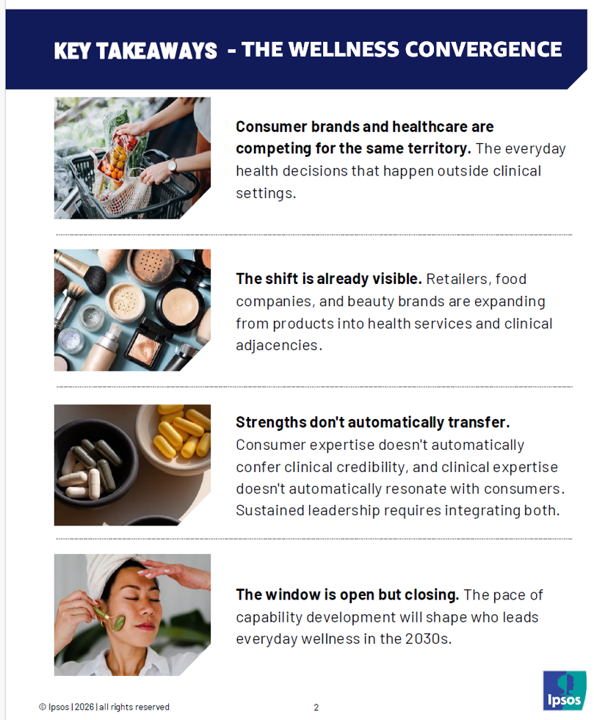
Lauren points to four converging forces shaping the blur of consumer goods firms and healthcare stakeholders like providers and life science companies:
- Consumer brands and healthcare are competing for the same territory
- The shift, for retailers, food companies, and beauty brands, is already in play
- A company or sector’s strengths do not necessarily translate to the consumer/retail health demands or values
- “The window is open,” but closing, Ipsos warns.
That is, the pace of change is on right now with a steep slope of innovation, and “who” will lead mainstream consumer wellness remains to be seen.
This is consumer-driven stuff: 4 in 5 citizens globally want more control over their health, Ipsos quantifies.
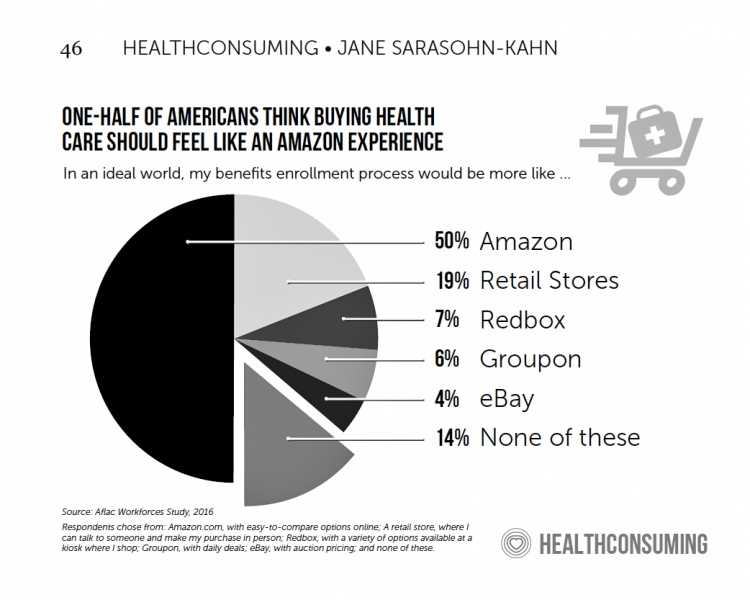
As I pointed out in my book HealthConsuming, published in 2019, one-half of Americans at that time thought buying health care should feel like an Amazon experience — which I coined as “the Amazon Prime-ing of the health consumer,” shown in the pie chart here from a 2016 Aflac Workforce Study screenshot here from the book.
Health consumers have been hankering for such service experience in health care of these past ten years, and then some. Better late(r) than never, right?!
I write this as Amazon announced its program to deliver the Novo Nordisk Ozempic® pill (a new form of the GLP-1 medicine taken via mouth, not injection) via same-day delivery as well as kiosks in omnichannel mode.
While the growing retail health landscape in grocery store chains, Big Box and discount stores, beauty companies (at retail and as manufacturers), and food (Big Food and smaller smart, innovative brands) have been growing their consumer-facing wellness portfolios for years, the impact of GLP-1 medicines have truly transformed these categories, and others.
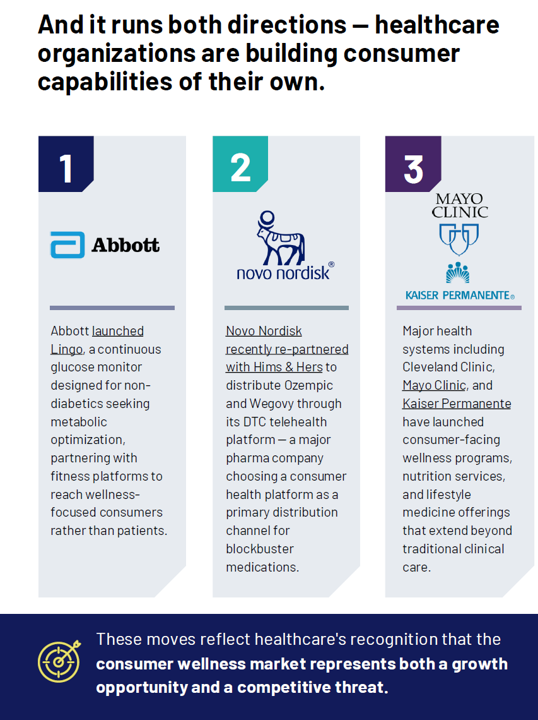
On the healthcare (regulated and not-for-profit provider) front, these stakeholders are pushing in the other direction, from medical care to health and well-being. Here’s a chart from the Ipsos report on 3 healthcare organizations growing their own consumer-facing chops including Abbott (which I’ve seen annually for a few years at CES, expanding its presence and reputation as a “consumer tech” company; Novo Nordisk, the major competitor for GLP-1 meds which recently formally partnered with Hims & Hers to boost direct-to-patient platform in omnichannel mode; and the Mayo Clinic and Kaiser-Permanente offering more DTC wellness programs which Ipsos writes are extending beyond traditional clinical care.
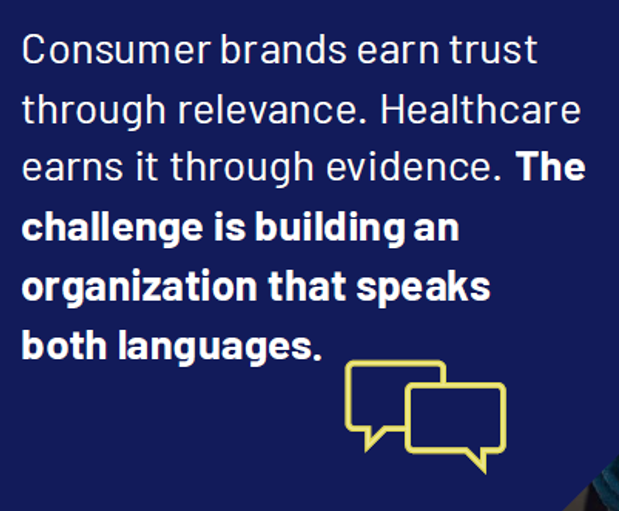
As each side of the consumer health-driven coin jockeys, innovates, partners, and communicates for the health citizens attention and out-of-pocket payment, we cannot predict just “who” will advance to the winner’s circle of retail/consumer health fave(s). What is certain is that whether a consumer brand or healthcare enterprise, each will have to be “bilingual,” communicating BOTH evidence and science information and competency coupled with enchanting design, cultural relevance, and communications skills that the best of consumer brands know how to deliver.
Watch for those organizations looking to grow and benefit this marketspace to build on both consumers’ values along with peoples’ sense of value-for-money — especially as patients continue to take on more cost and clinical decision making responsibility.
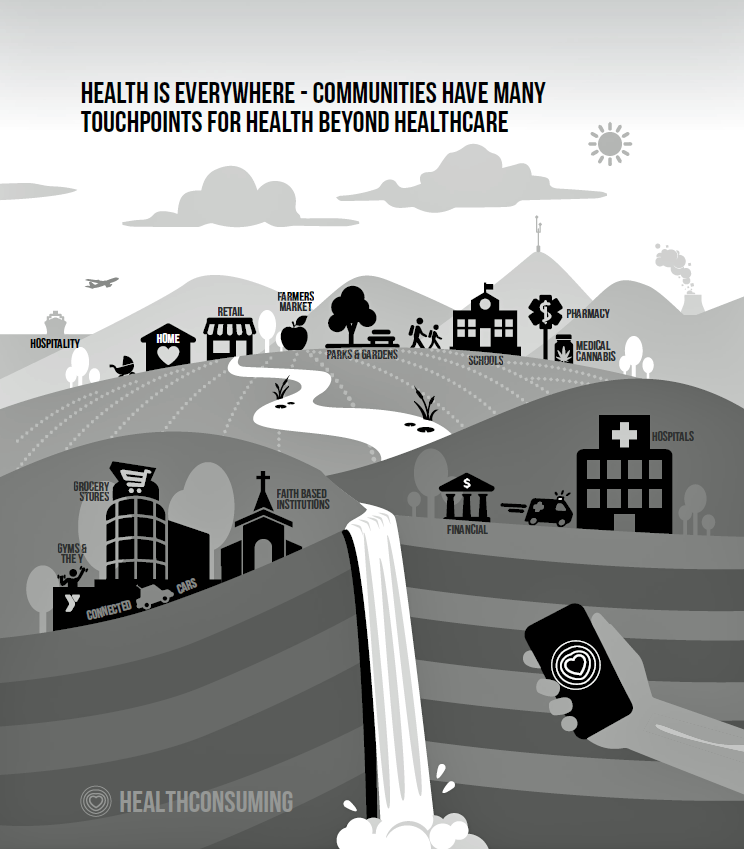
Health Populi’s Hot Points: Health can made — and un-made — everywhere, as I posited in my book HealthConsuming in 2019, a year before the COVID-19 pandemic turbocharged healthcare to the home and self-care beyond OTC medicines and Goop’s aesthetic for the affluent.
Today, as Ipsos notes in this report, Walmart continues to shape its role in healthcare (recently laucnhing a telehealth platform) and is sourcing free-range eggs, bolstering its beauty aisles with personalized AI-driven advice and enhancing the pharmacy channel.
Nestle is growing its nutrition and longevity chops, and GLP-1s are inspiring consumer-facing sectors from transportation and hospitality to clothing and smoothie-QSR restaurants to partner with patients managing weightloss, diabetes, and inflammation.
As Ipsos’s tea leaves read the situation, “the next generation of healthcare leaders may not look like the ones we know today.” She could be leading a global health-and-beauty conglomerate, growing the next high-protein foodstuff, or researching at a life science lab bench this very moment solving for brain health and longevity.
“Consumers have already decided who they trust for health guidance,” Ipsos concludes — and that is sage advice for those enterprises looking to earn the loyalty and hard-won dollars of health-seeking consumers and families.
 Thank you
  I'm grateful to be part of the Duke Corporate Education faculty, sharing perspectives on the future of health care with health and life science companies. Once again, I'll be brainstorming the future of health care with a cohort of executives working in a global pharmaceutical company.
 Jane joined host Dr. Geeta "Dr. G" Nayyar and colleagues to brainstorm the value of vaccines for public and individual health in this challenging environment for health literacy, health politics, and health citizen grievance.