

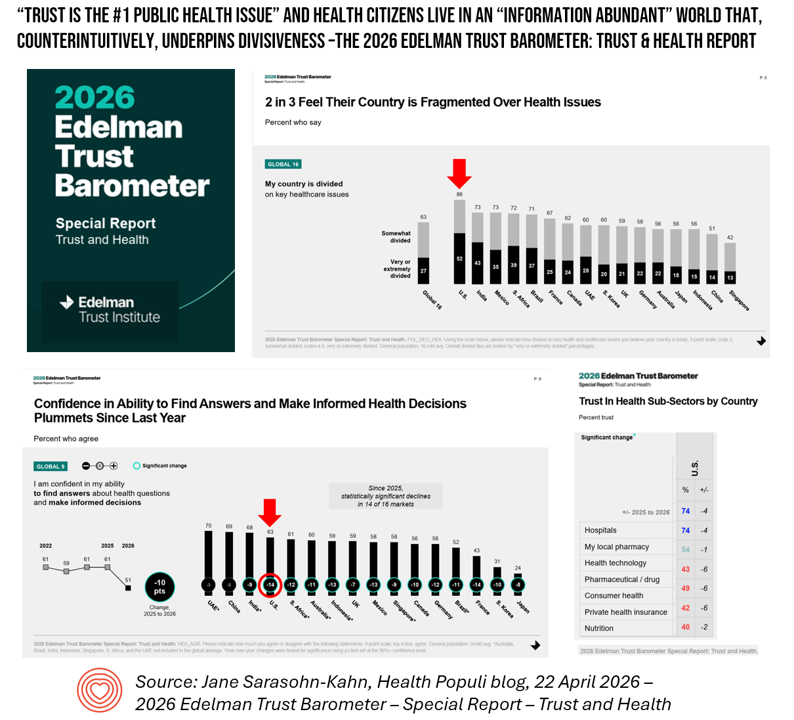
It would sound like good news that more health citizens, globally, are engaged with more information about health – a health information “abundance,” by the look at the data.
But it’s not such great news when we learn that said information abundance also underpins health citizens’ confidence in finding answers and making informed health decisions, we learn in the 2026 Edelman Trust Barometer’s Trust and Health edition.
In the U.S., the percent of people who felt confidence in their ability to find answers and make informed health decisions “plummeted,” in the words of the Edelman team, by 14 percentage points in just one year, from 2025 to 2026 – the largest decline among the nations Edelman polled except for France, whose health citizens were tied in their fall of health decision confidence with the U.S.
Following Edelman’s launch of the 2026 Edelman Trust Barometer in January at the World Economic Forum (covered here in Health Populi), the Edelman Trust Institute has followed up with a lens of health and trust, the report launching today with a live data-readout along with an informative and inspiring panel discussion with four global experts covering different aspects of the health care ecosystem.
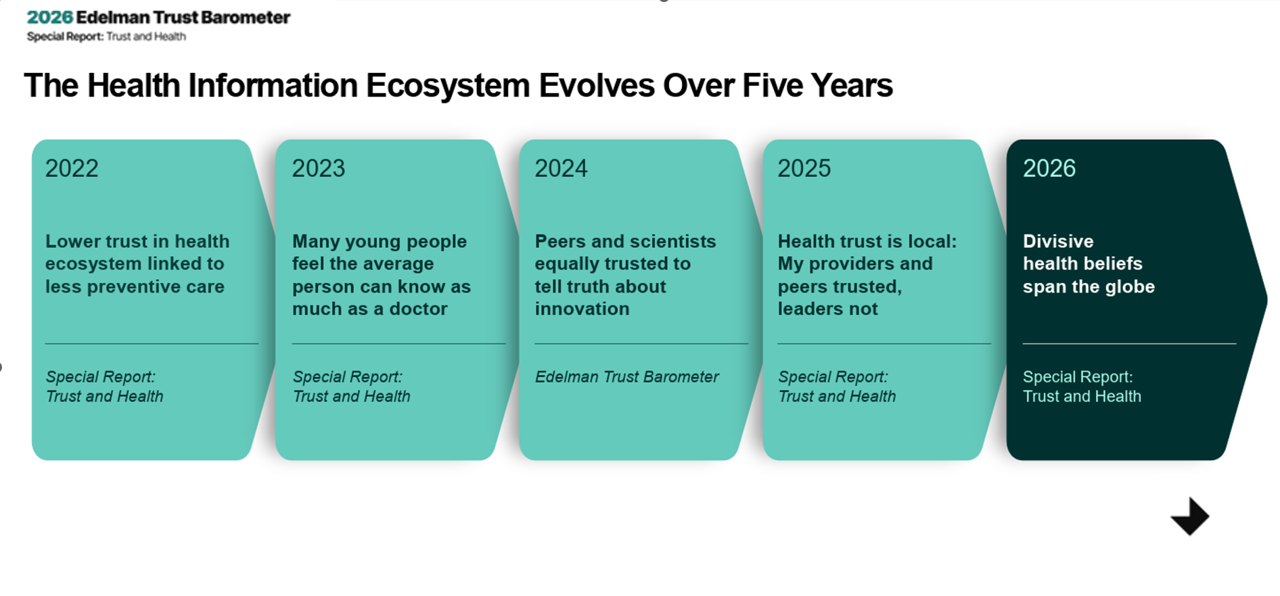
Richard Edelman, company President and CEO, introduced the program with a historical perspective on how the study’s findings have evolved over the past five years: the COVID-19 pandemic demonstrated to the mainstream health citizen that health systems were not working well on peoples’ behalf. That was the observation in 2022. In 2023, evidence grew that younger people believed they could access information (especially via social media) putting their knowledge on par with a doctor’s. This expanded in 2024, when people placed their peers as sources of information as important as doctors and scientists. In 2025, the health trust-information convergence localized, with close-by sources more trusted than national governments and media. Last year, Edelman coined as the “Year of Grievance.” This year the top-line was the Age of Insularity.
Thus Edelman summarized the evolution has gone from “polarization to insularity,” with the key call-to-action to address trust on a hyper-local level, expanding trusted voices beyond “experts” to and through other trusted touchpoints in local communities, from doulas and community health workers to pastors and pharmacists operating on Main Streets in neighborhoods. 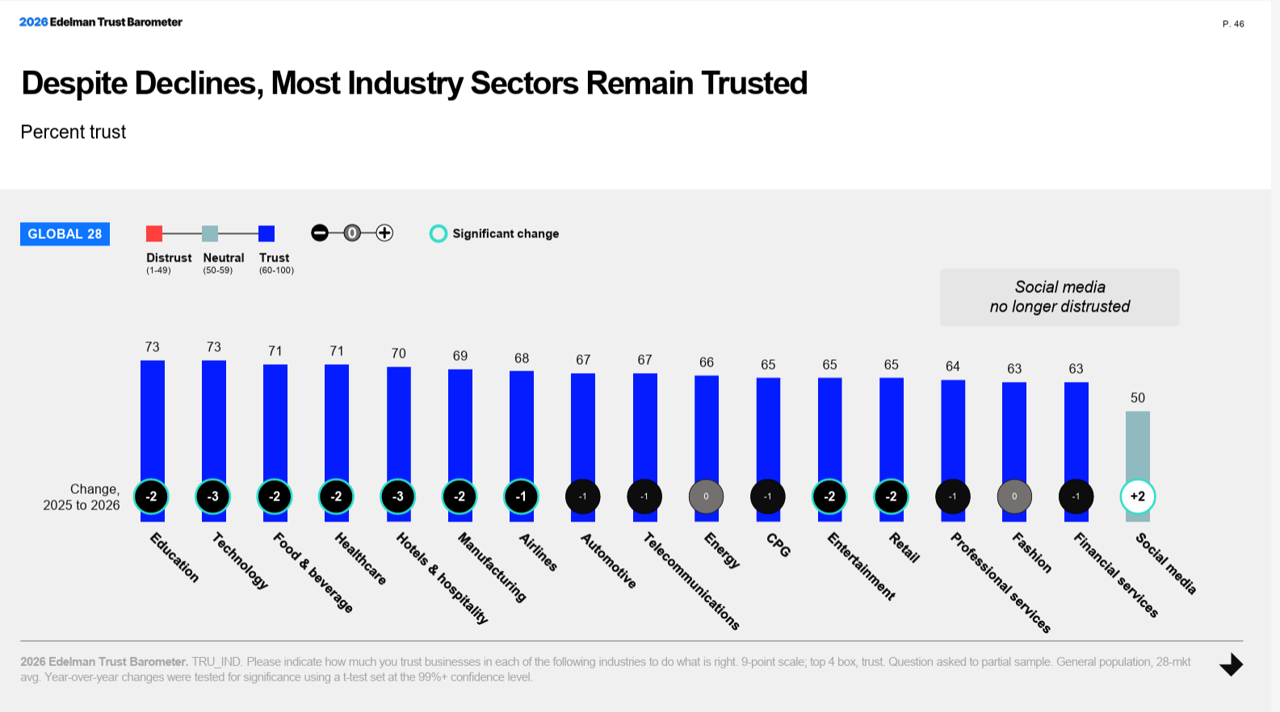
With that context in mind, let’s see where health care fits on the industry table of trust compared with other sectors. Here’s a key chart from the January 2026 global Trust Barometer report comparing health care with other industries.
Globally, the proportion of people who trusted the health care industry in 2026 ranked quite close to the top 3 most-trusted industries including education, technology, and food & beverage, with hotels and hospitality closing following health care. However, every industry’s level of consumers’ trust-equity fell in the year on a global basis.
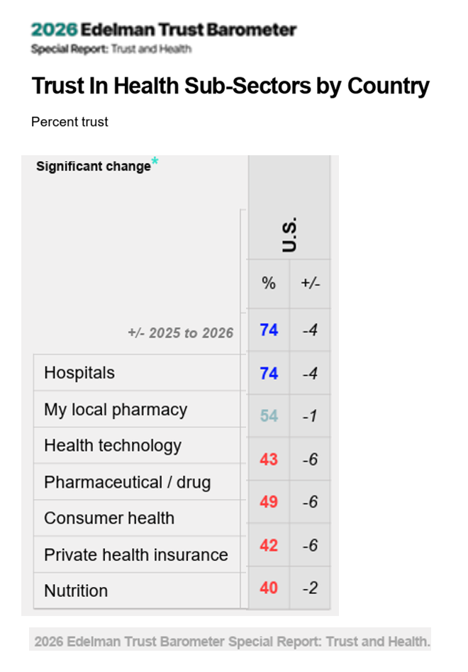
In the U.S., Americans’ trust in subsectors of the macro healthcare industry has fallen by as much as six percentage points for pharma and drug companies, consumer health (think: OTC drugs like Tylenol and Advil), and private health insurance (e.g., UnitedHealthcare et. al.). Hospitals lost 4 percentage points of trust equity among U.S. consumers. and nutrition 2 percentage points. “My local pharmacy” dropped just one point in this trust sector analysis.
Americans’ trust in institutions also eroded over the year — with only My Employer being in the trusted institution club albeit losing 1 percentage point in the proportion of U.S. consumers saying they trusted employers to “do what is right in addressing my health needs and concerns.”
Otherwise, trust in business, government, NGOs, and media fell by between 1 and 3 points, all four of which are in the “red” untrustworthy institutions in the Trust Barometer.
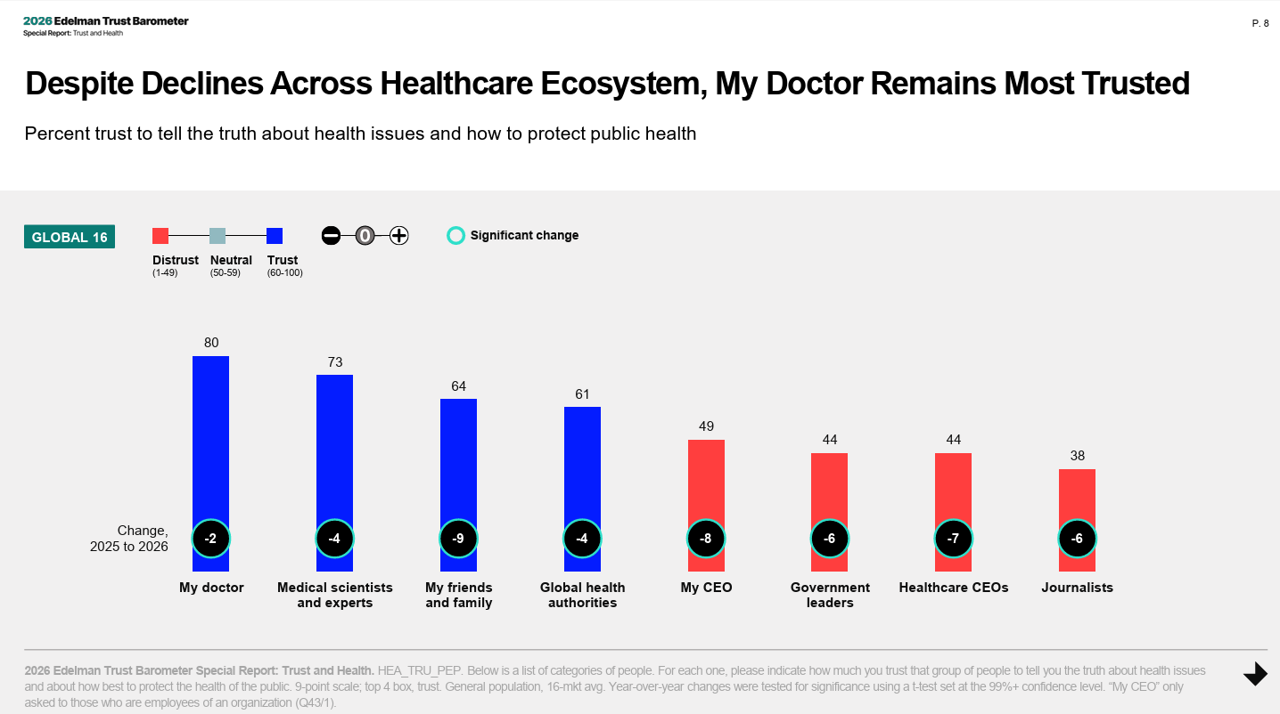
Across the health/care ecosystem, there is one most-trusted entity who tracks tops in health equity over the past several years: that is “my doctor,” on a global basis trusted by 80 percent of people.
Medical scientists rank second in line with 73% of folks trusting them to tell the truth about health issues, and 64% of health citizens around the world trust their friends and family — slightly more than the 61% of global consumers who trust global health authorities (such as the World Health Organization, United Nations, and so on).
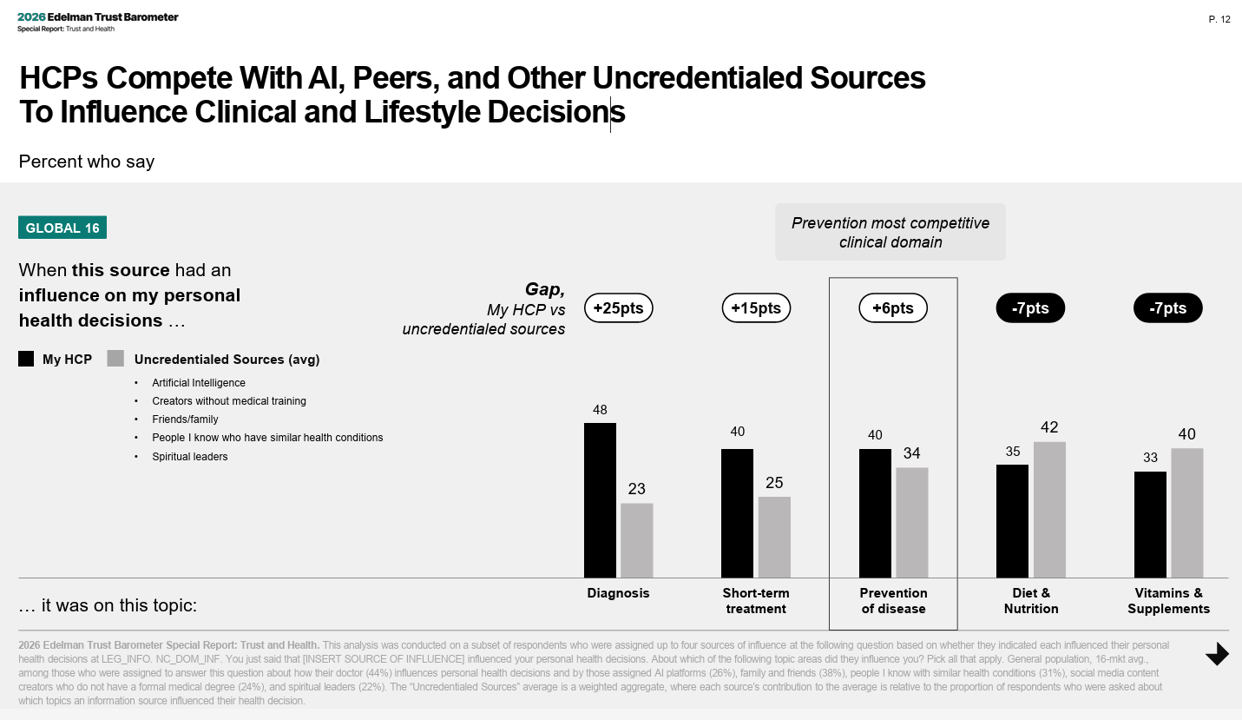
But there are surprising competitors for the health care provider (HCP) in Trust Town when it comes to information sources global citizens are looking to for information in that cornucopia of health info abundance: those are AI, peers, friends and family, and creators without medical training.
While clinicians like “my doctor” continue to be trusted by more consumers for diagnosis and short-term treatment (shown on the left side of the chart), the emerging other information sources are trusted by more consumers for diet & nutrition advice and information on vitamins and supplements. See in the middle of the bar graph that prevention is not the sole trusted turf for health care providers, which Edelman terms “the most competitive clinical domain” on this point.
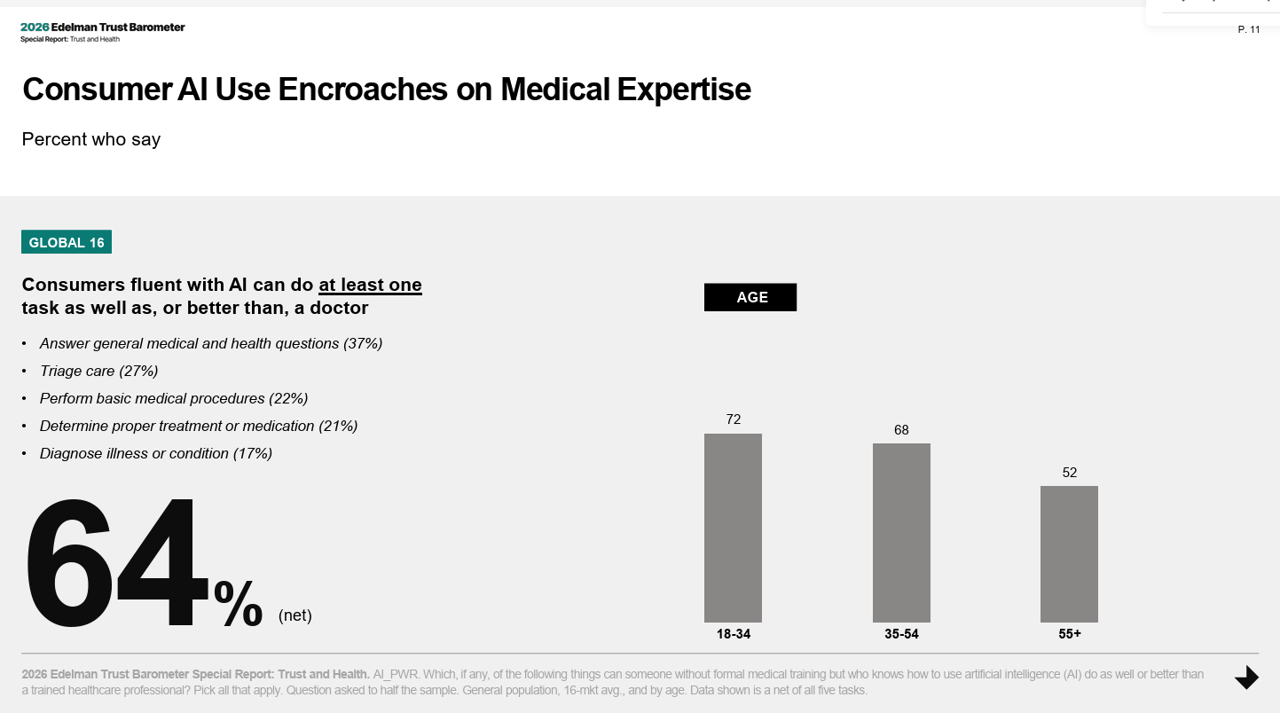
Here’s a big and perhaps surprising number coming out of the study: that 2 in 3 global citizens who have used AI fluently say they are doing at least one health care task as well or better than a doctor.
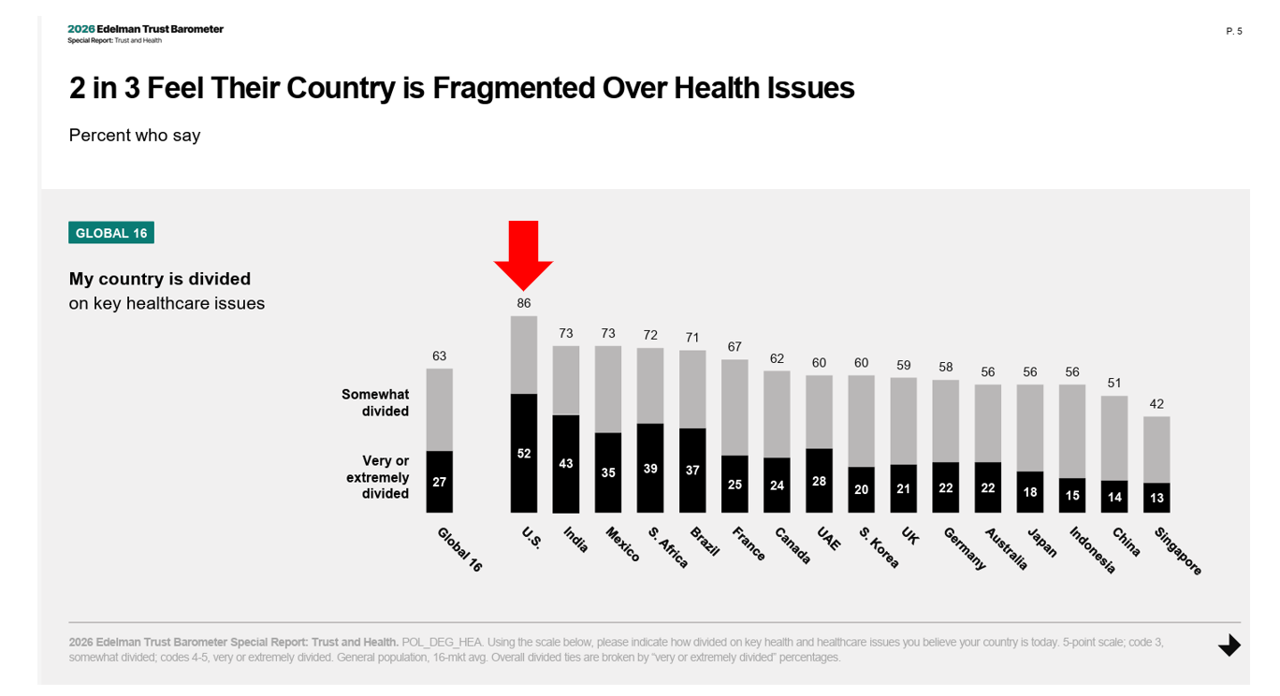
Given the fragmented and “abundant” portfolio of health information sources more consumers, globally, turn to inform their personal health decision making, it is understandable that citizens have divided views on whether key health claims are true — from whether animal protein is healthier than plant-based sources of protein, whether fluoride in water is harmful to health, and whether vaccines are used for population control. Among the six key health claims the Edelman study polled including these three, 70% of global citizens believe at least one of the claims.
Interestingly, and perhaps counterintuitive, those people who hold more divisive health beliefs also consult more health information sources to get answers to health questions. And that tells us that with these divisive health believes, “credentials beyond formal training become more important,” in Edelman’s conclusion. 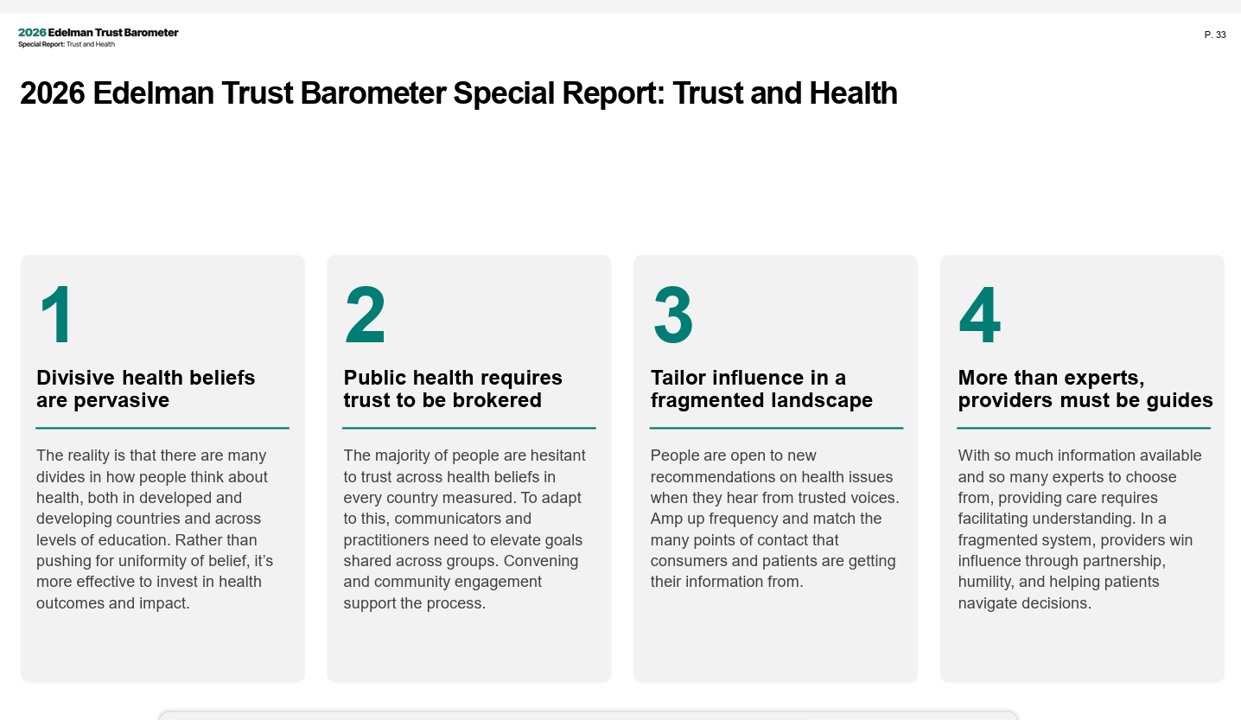
Among the Edelman team’s recommendations for calls-to-action to address the divisiveness, information abundance, and fast-growing role of AI as a convenient and immediate channel for accessing answers to personal health questions, these four points help to inform choices health-focused enterprises can make to help solve the information-trust crisis in health care.
The panel discussion helped unearth pragmatic and proven tactics speaking to these points, informed by Dr. Uché Blackstock, Founder and CEO of Advancing Health Equity; Dr. Garth Graham, Director and Global Head of Healthcare and Public Health at Google/YouTube; Sreejit Mohan, VP and Global Head of Communications for Specialty Care at Sanofi; and, Dr. Megan Ranney, Dean of the Yale School of Public Health.
Here are some of my favorite key points made by this group….
Dr. Blackstock cited the opportunity where trust is built in small moments, noting that time in the clinician’s workflow is a challenging issue. Nonetheless, health citizens want that personal connection when they talk about health issues, so seeking shared experience and peer-to-peer health care support is a rational decision. Clinicians must assure that in these small moments, to re-build trust, they recognize that patients bringing more self-found information to bear in the exam room is “not a rejection of (the doctor’s) expertise but a reflection of gaps, access, time, and connection” in the process.
Sreejit Mohan from Sanofi is a systems thinker and brought that perspective to bear in this conversation. I loved his observation that, “divisiveness doesn’t cause disengagement, it inspires it.” The super-information seekers who may have a greater number of divisive views are also reaching across the political spectrum, looking at multiple stakeholders for trusted info – and have an openness to conversation. Sreejit asked, “How do we accelerate the shift in our engagement approach to more dialogue and guides and conveners and less speechmaking and broadcast?” As I work with pharma and life science companies, this should be a call-to-question-and-answer for that community.
Dr. Ranney from Yale sees the divisiveness and eroding trust trends on “a daily basis,” she confessed. “This reinforces what we see on the ground where trust is the #1 public health crisis globally,” a macro above public health issues of violence, vaccines and nutrition. “People are on one hand hungry for prevention information and confused on where to go.” As a public health educator, Ranney is focusing Yale’s curriculum to expand work on how to set up more effective systems – especially on how to “go hyper-local” where trust is built in communities.
Dr. Graham noted like Dr. Ranney that the trends shown through the Edelman Trust data were consistent where things have been going for a long time. In his career with Google and YouTube, his team seeks peoples’ engagement and works to provide evidence-based information. Beyond the credential expertise factor, Dr. Graham called out that “no one likes to be spoken down to,” with each of us on journey for our own and our kids’ health. “People just want you to care about them…that is the best credential you can bring instead of ‘fancy shmancy’ degrees.” A key lesson from Dr. Graham came from his Mother — who has said that, “hearing is one thing, listening is another.” Interestingly, Dr. Ranney talked about one of the introductory courses at Yale’s Public Health school that teaches what active listening is.
To move ahead, Dr. Ranney described the Edelman recommendation of broadening the tent of informed voices to build trust on a local basis as an “All of Society” approach with creators, scientists, and clinicians working together with communities and the people who have the health questions….the power of having everyone in the community working together.
Health Populi’s Hot Points: Many questions in the survey research looked into the growing role of AI in health information seeking and health consumer empowerment. In a follow-up post, I’ll go more granular on these issues and specific calls-to-action required in an era where global health citizens are fast-adopting AI on-ramps to health information for immediate, convenient, and viscerally empowering agency.
 Jane will be working with EU- and UK-based clients in September and October 2026, collaborating with stakeholders in digital health, public/community health, retail health, and growing opportunities for health-at-home. Stay tuned to her updates here on Health Populi on-the-ground as she lives the digital nomadic work-life in Italy, Belgium, the Netherlands, and in London.
 I was grateful to be Jasmine's first conversation-guest on her new podcast,
  Jane joined host Dr. Geeta "Dr. G" Nayyar and colleagues to brainstorm the value of vaccines for public and individual health in this challenging environment for health literacy, health politics, and health citizen grievance.