

If you had an extra $38K to spend, what would be on your list? If you’re a parent of a college-aged son or daughter, paying for college would be a lovely idea. If you’re in need of a new car, then that money could get you a mid-sized SUV.
If you valued being covered by a health plan through your employer, then you’d be sharing in that cost to the tune of over $14,000 for your family of 4, based on the annual forecast in the 2026 Milliman Medical Index.
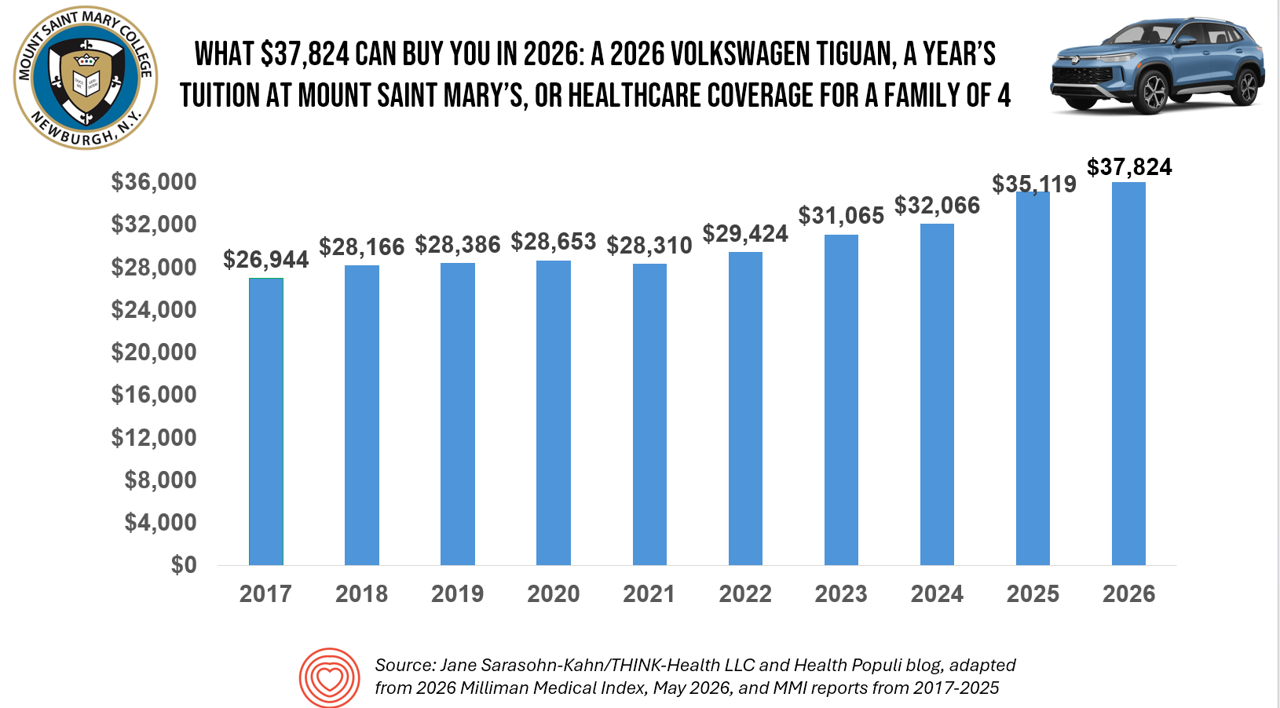
The actuaries and health analysts at Milliman have been working on the Milliman Medical Index (MMI) for over twenty years, each year modeling a theoretical “average” family of four with two parents and two young children. While this concept of “the average American family” may be outdated or otherwise not so typical in 2026, tracking the MMI each year gives us the directional indication of healthcare costs in the U.S. borne by employers and workers and their families. I’ve tracked this here in the Health Populi blog for many years, and each year construct a graph akin to the one here where I identify “what else” you could purchase for the MMI nest-egg. This year, it’s one tuition year and expenses at the Mount Saint Mary College in Newburgh, NY, as well as a new 2026 Volkswagen Tiguan. 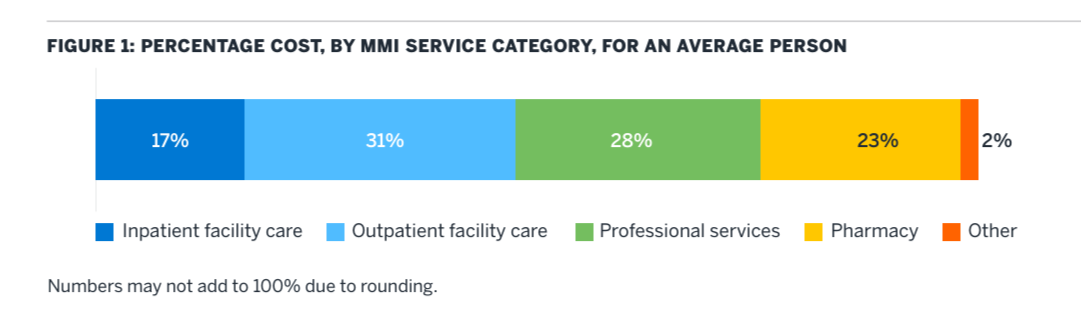
I construct the bar chart this way to communicate what that level of investment or spending means to a family’s household budget, as increasingly Americans tradeoff kitchen table issues especially in light of the chronic inflationary economy in which people live, drive to their jobs, pay for doctor visits, and endeavor to feed families.
By category, outpatient care eats up most of the average person’s healthcare dollar, followed by professional services, pharmacy (prescription drugs), and finally inpatient facility care (led by hospital costs).
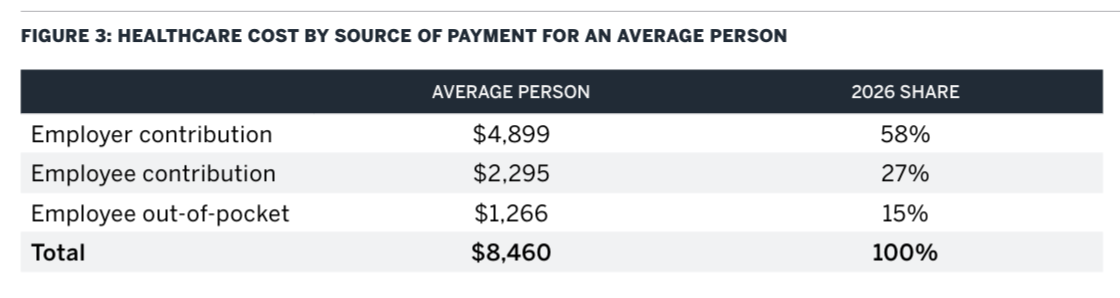
The patient is the payor when it comes to their own cost-sharing portion of health care: the 2026 MMI calculates that employees will pay on average about $2300 for contribution to the health plan, and another $1266 out-of-pocket — that is times 4 for the family, thus, about $14,244. 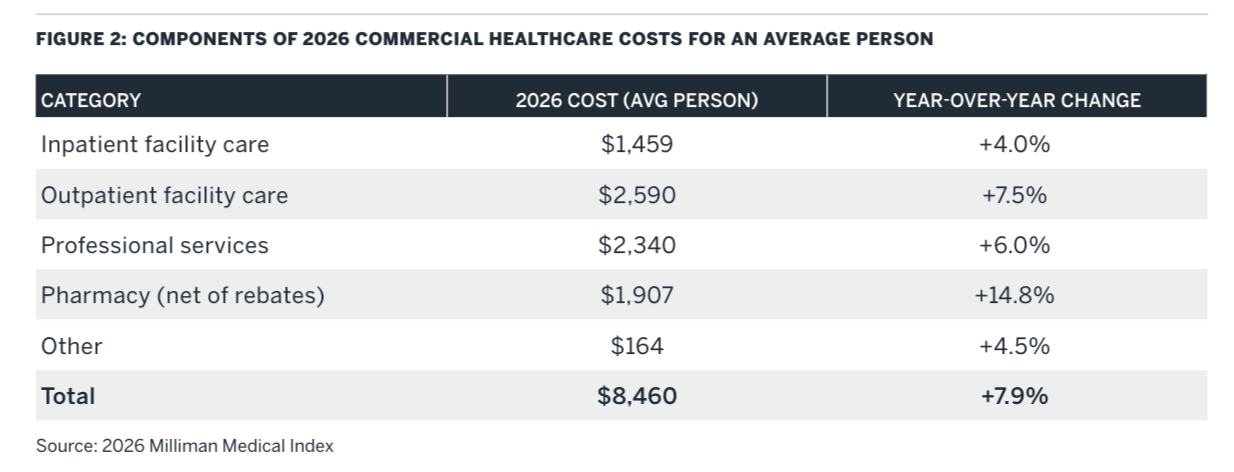
Check out the year’s cost-growth for each medical cost segment shown in Figure 2 from the report: the fastest cost increase, or call it personal medical inflation, from 2025-26 is pharmacy cost net of rebates, increasing nearly 15%. The next-fastest growth rate is calculated at 7.5%, for outpatient facility care, followed by 6.0% for professional services (say, doctors’ visits). The slowest growth is calculated for inpatient care at 4.0%.
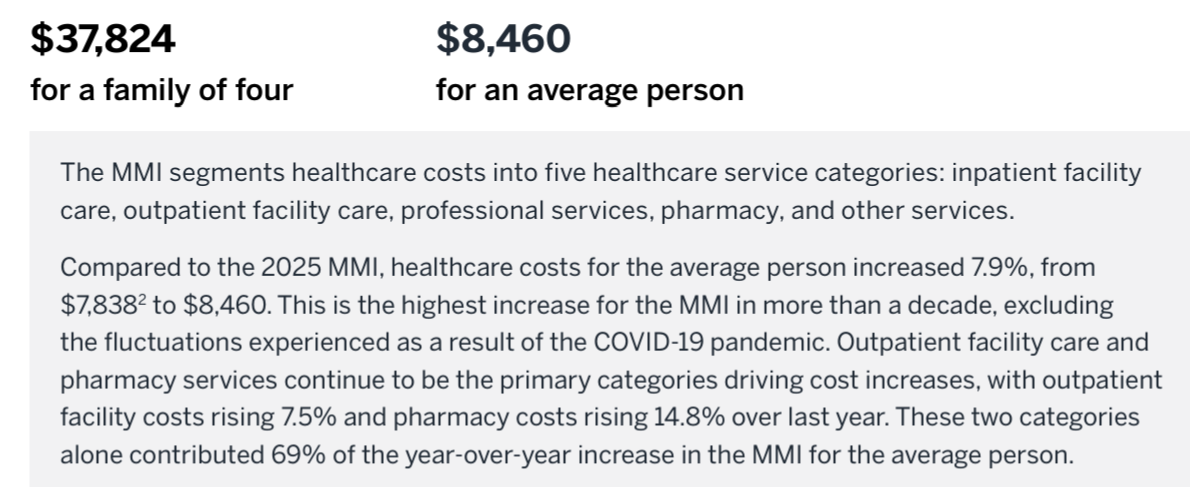
Health Populi’s Hot Points: MMI calculated overall healthcare cost growth of 7.9% for the average person in the methodology of this annual study. As this summary paragraph from the report calls out, this is the highest increase in the Index in over a decade (putting aside the anomalous fluctuations in the COVID-19 era).
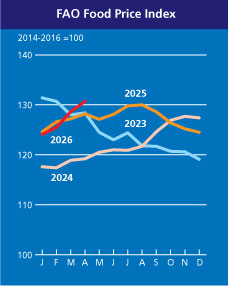
I recently called out medical bills and household debt as a public health crisis. As peoples’ premium co-shares with their companies and out-of-pockets continue to grow as one of the fastest inflationary categories of household spending, we have further evidence of this public health crisis of medical costs playing out in 2026 and beyond. My read this week of the FAO’s report (Food Agriculture Organization) impact of the closure of the Strait of Hormuz on agri-food costs within six to twelve months further exacerbates and challenges American families’ ability to cover the food/nutrition line item for families, competing with and crowding out other forms of spending like housing, filling car tanks with petrol, and paying heating and cooling utility costs.
 Jane will be working with EU- and UK-based clients in September and October 2026, collaborating with stakeholders in digital health, public/community health, retail health, and growing opportunities for health-at-home. Stay tuned to her updates here on Health Populi on-the-ground as she lives the digital nomadic work-life in Italy, Belgium, the Netherlands, and in London.
 I was grateful to be Jasmine's first conversation-guest on her new podcast,
  Jane joined host Dr. Geeta "Dr. G" Nayyar and colleagues to brainstorm the value of vaccines for public and individual health in this challenging environment for health literacy, health politics, and health citizen grievance.