

ss Last year’s “shared reality” was a culture of trust and a crisis of grievance: this year, it’s trust and insularity, we learn from the Edelman Trust Barometer for 2026, launched this week during the World Economic Forum in Davos, Switzerland.
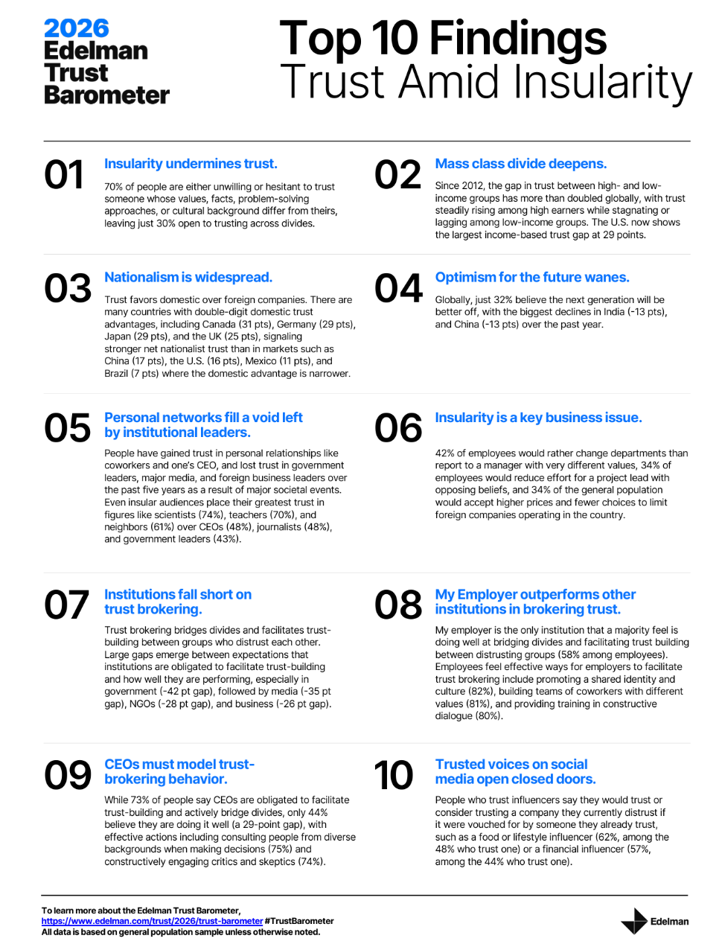
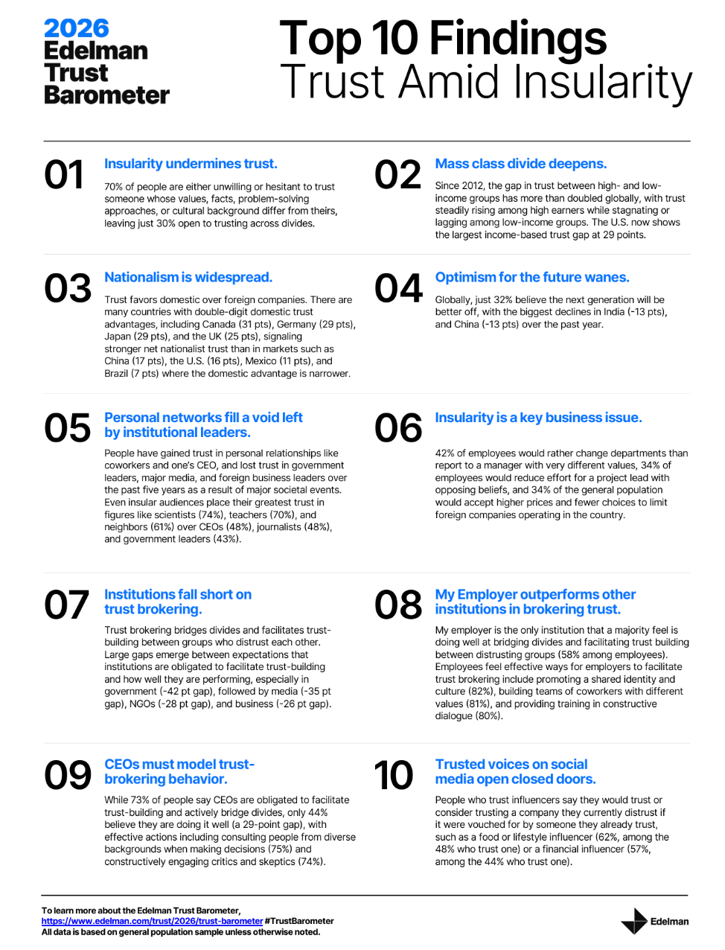
Here are the Top 10 findings from the annual study, which Edelman conducted among nearly 34,000 citizens in 28 countries in October and November 2025:
- Insularity undermines trust
- The mass class divide deepens
- Nationalism is widespread
- Optimism for the future wanes
- Personal networks fill a void left by institutional leaders
- Insularity is a key business issue
- Institutions fall short on trust brokering
- “My Employer” outperforms other institutions in brokering trust
- CEOs must model trust-brokering behavior, and,
- Trusted voices on social media open closed doors.
Given peoples’ retreat into insularity, it is not surprising that only 1 in 3 global citizens in the study believe the next generation will be better off than they are.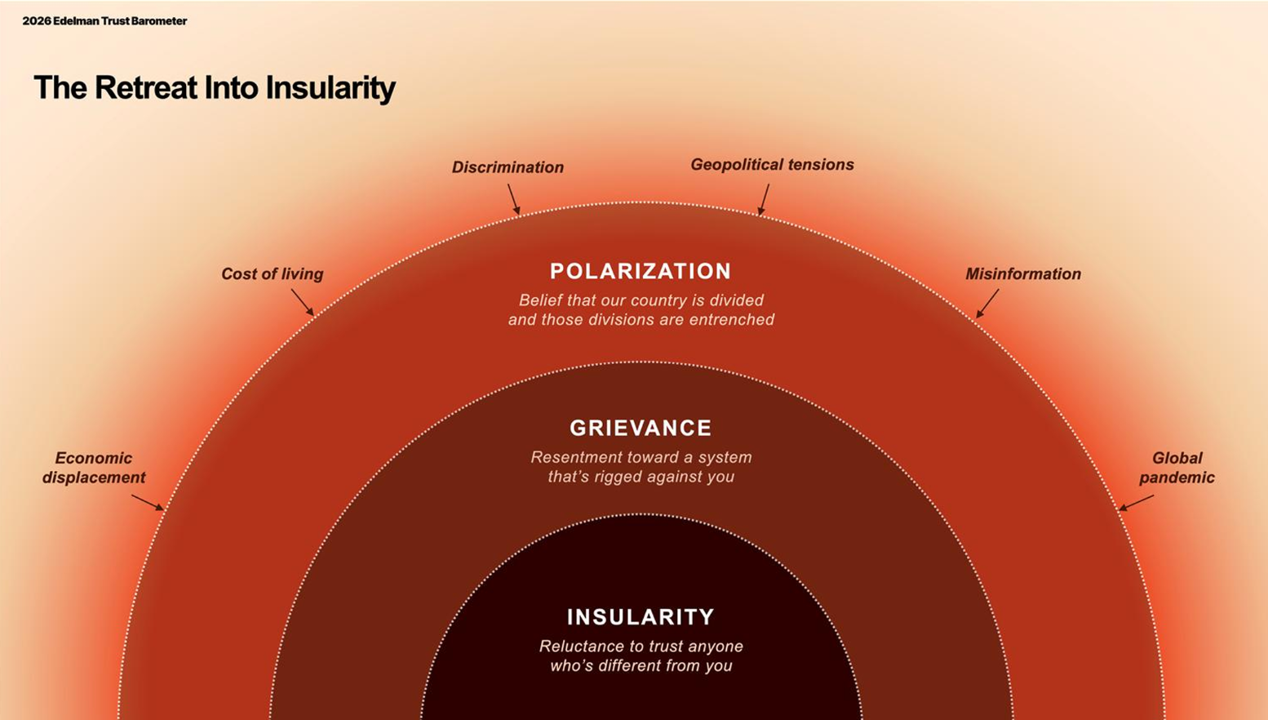
In Richard Edelman’s initial essay on the 2926 Barometer, he called insularity “the next crisis of trust.”
“We are choosing a closed ecosystem of trust that mandates a limited worldview, a narrowing of opinion, intellectual stasis, and cultural rigidity….We are withdrawing from dialogue and compromise. We opt for the safety of the familiar over the perceived risk of innovation. We prefer nationalism to global connection. We choose individual benefit over common advancement, the Me over the We,“ Edelman explained.
The diagram illustrates the retreat into insularity , which is the reluctance to trust anyone who is different from us. That comes out of grievance, last year’s Barometer theme, which is resentment toward a system that is rigged against us. Then grievance evolves out of polarization, the 2024 Barometer (eroding) trust-theme.
The driving forces underlying the erosion of trust globally are,
- Economic displacement and income disparities
- The cost of living
- Discrimination
- Geopolitical tensions
- Misinformation, and,
- The global pandemic.
How to remedy this dire situation?
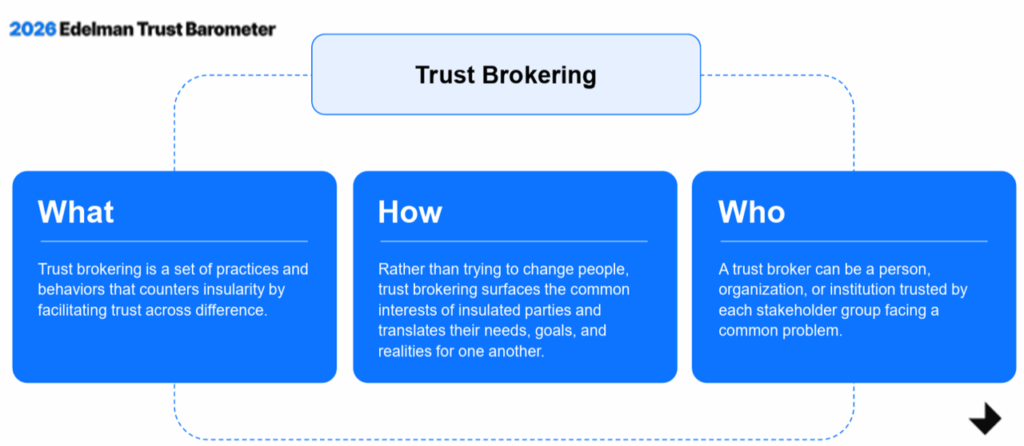
Edelman offers a prescription this year: leveraging Trust Brokers — agents that can be people, organizations, or institutions which are trusted by those facing a common problem. Brokering surfaces those commonalities, listens to aggrieved citizens’ needs, and surfaces solutions for the greater good.
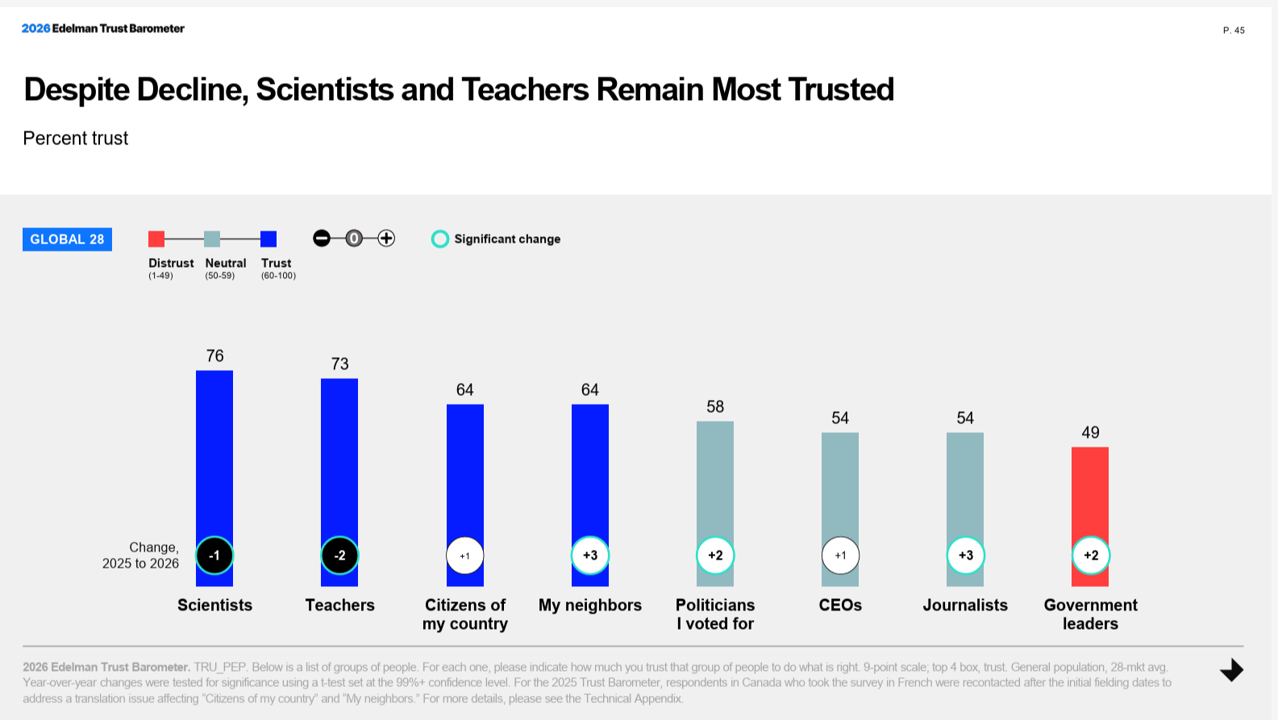
In this year’s Barometer, scientists and teachers are by far the most trusted roles in society — albeit each slightly declining in trust levels in the past year.
“My neighbors” gained in trust by 3 percentage points, pointing to the local-ness of trust.
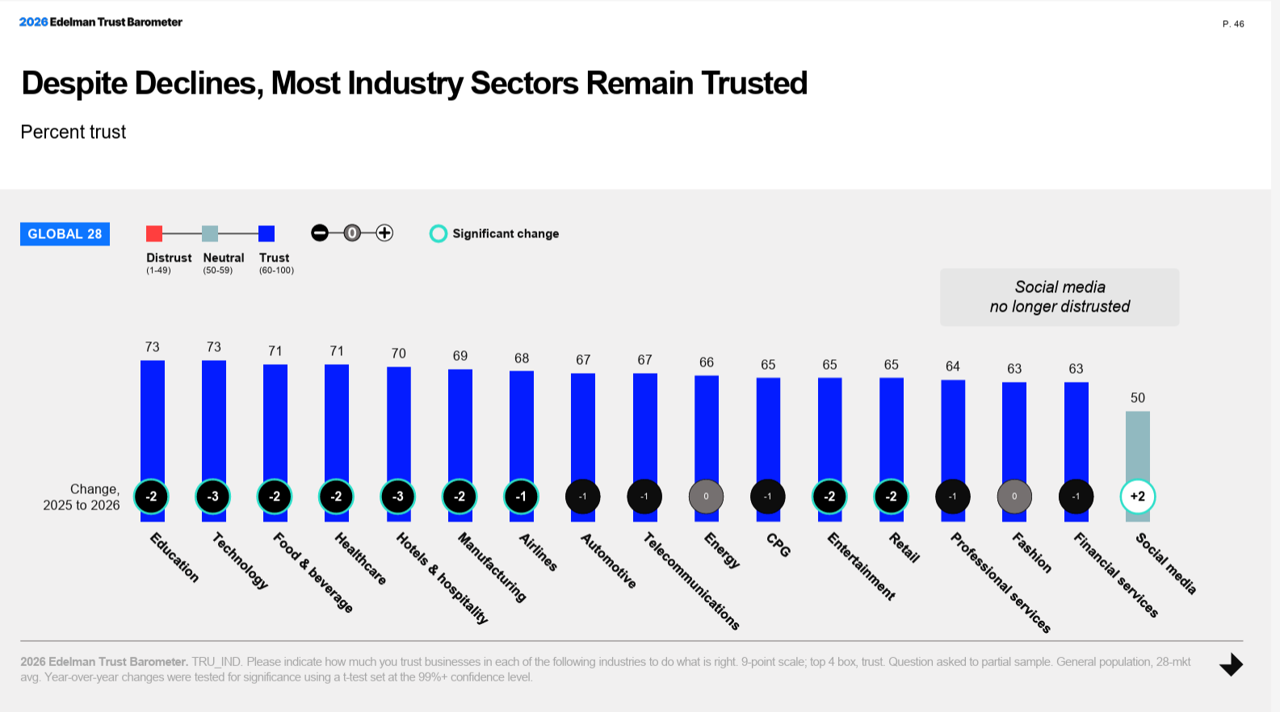
Health Populi’s Hot Points: Health care ranked toward the top of the trusted industry list, following education (e.g., teachers as noted above) and technology, and tied with food & bev for 3/4th place just ahead of hotels and hospitality.
In weeks to come, we can expect the Edelman Trust team to serve up data on specific industries and citizen sentiments, including health care. Given what we know thus far from the 2026 Barometer, we can divine a few key implications for the health care industry….
- Local is the citizen’s favored geography for trust, so local health systems and providers can leverage trust equity in their target markets.
- Employers, still the most-trusted institution/organization in the Barometer’s findings, have the opportunity to bolster trust through health benefits, employee communications, and team-building.
- With AI a key theme at the World Economic Forum and in workplaces around the world, Edelman warns that most citizens globally do not trust AI at this time — top concern being loss of jobs (especially “my” job), For health care stakeholders, it will be crucial to be transparent, empathetic, and design-ful as AI gets embedded in operations, clinical decision making, and personalized treatments.
- Thinking and planning our way through and out of insularity is Trust Brokering, Edelman explains. So beyond My Employer, who else might be Trust Brokers for citizens’ health care? In local communities, trusted health collaborators could be grocery stores, pharmacies and pharmacists, farms and farmers’ markets, YMCAs and other community convening locales, faith-based institutions, community colleges and academia, and libraries, among many other touchpoints. Think beyond medical care to the social drivers of health and well-being (as this launch of the Nature Health journal published this week details).
- Channel the trust-equity held by scientists and teachers (education) when messaging about medical care issues — such as vaccinations and evidence-based public health strategies, self-care recommendations, and decision-making support for, say, surgical procedures or prescribed medications.
As health citizens, local, national, and global, we are at great risk if we do nothing to bolster and broker trust — especially for health care.
As Edelman cautioned in his essay, “We are becoming inflexible, intolerant, and incoherent in our cocoons. The risks to society from manic swings in popular sentiment and rejection of innovation are real.”
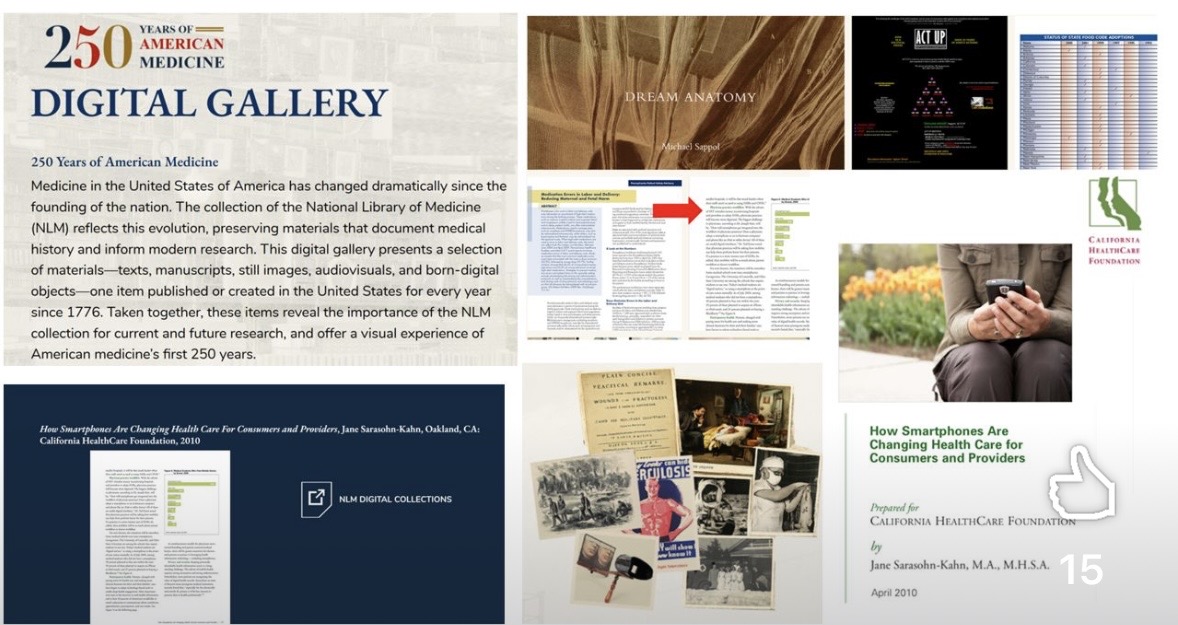 I’m celebrating America’s 250th birthday both patriotically and professionally, honored that the NLM included my 2010 paper, “How Smartphones Are Changing Healthcare for Consumers and Patients” as one of 250 items curated for the digital archive of 250 Years of American Medicine.
 I'm grateful to be part of the Duke Corporate Education faculty, sharing perspectives on the future of health care with health and life science companies. Once again, I'll be brainstorming the future of health care with a cohort of executives working in a global health care enterprise.
 Jane joined host Dr. Geeta "Dr. G" Nayyar and colleagues to brainstorm the value of vaccines for public and individual health in this challenging environment for health literacy, health politics, and health citizen grievance.