

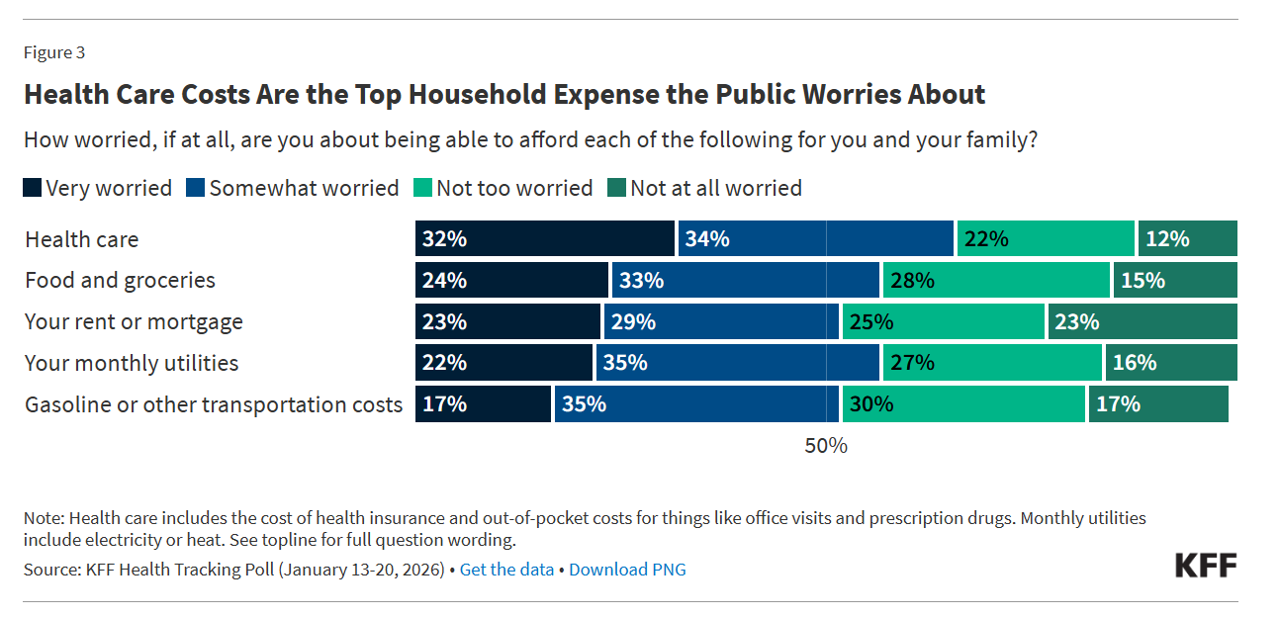
The title of KFF’s press release launching the Foundation’s January 2026 Health Tracking Poll clearly observes, “Health Care Costs Tops the Public’s Economic Worries as the Runup to the Midterms Begins.”
I’ve pulled out the key details to share my lens on the 2026 midterm and 2028 Presidential election forecast, which I believe will turn out to be (in part) The Patients’ Elections. 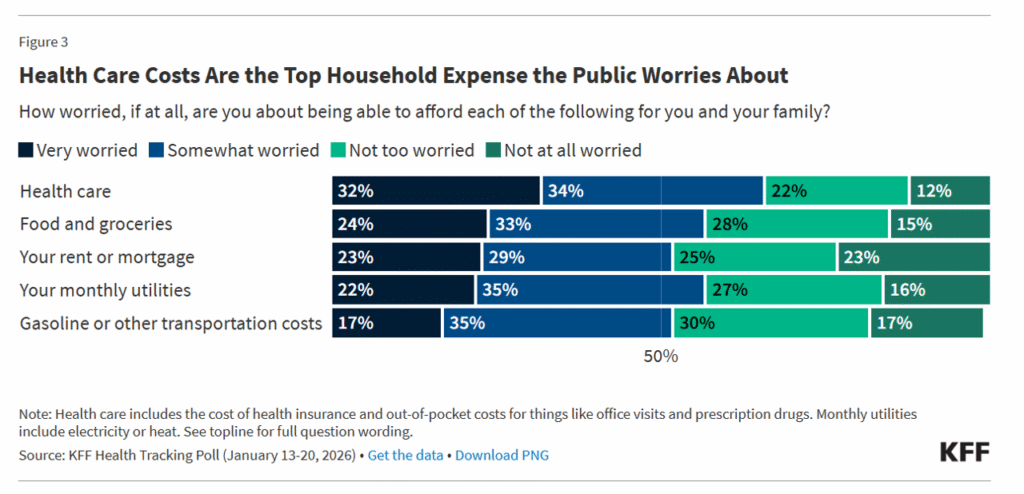
Here’s the top-line title finding — where most people in the U.S. — 2 in 3 people (66%) — are worried more about health care costs compared with other major household expenses. That means people cite health care expenses above food and groceries, housing costs (rent, mortgage), utilities and energy costs, and gas or other transportation costs. 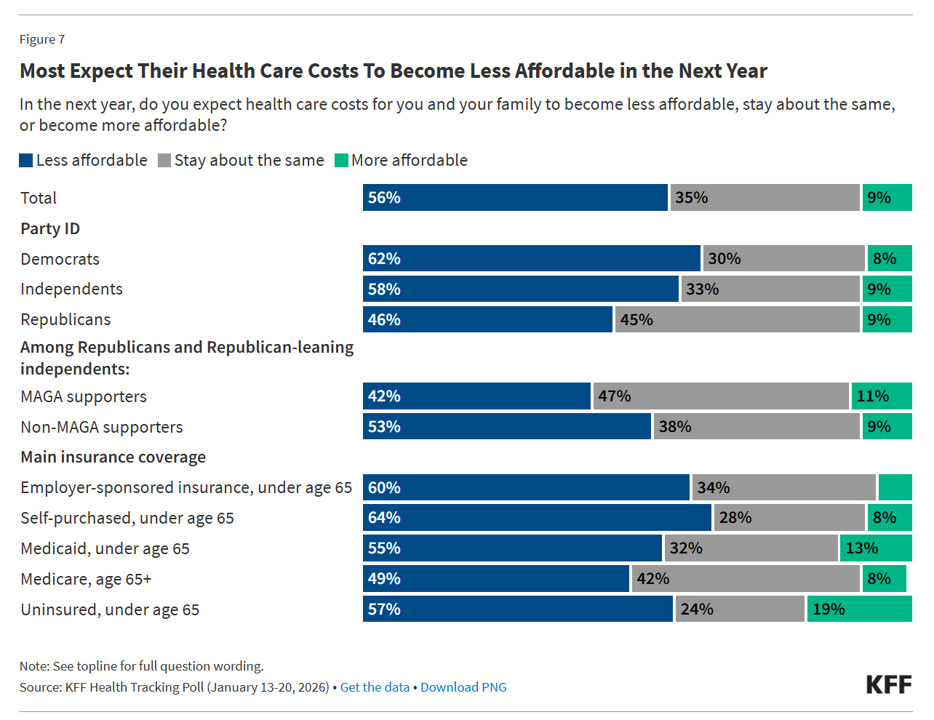
And Americans don’t expect their household challenges with health care affordability to improve in the next year. 56% of U.S. adults expect health care to become less affordable in the next year — most Democrats and Independents, and 46% of Republicans. On the GOP front, see that most non-MAGA supporters expect health care affordability problems to continue to challenge in the next year, compared with 42% of MAGA supporters. 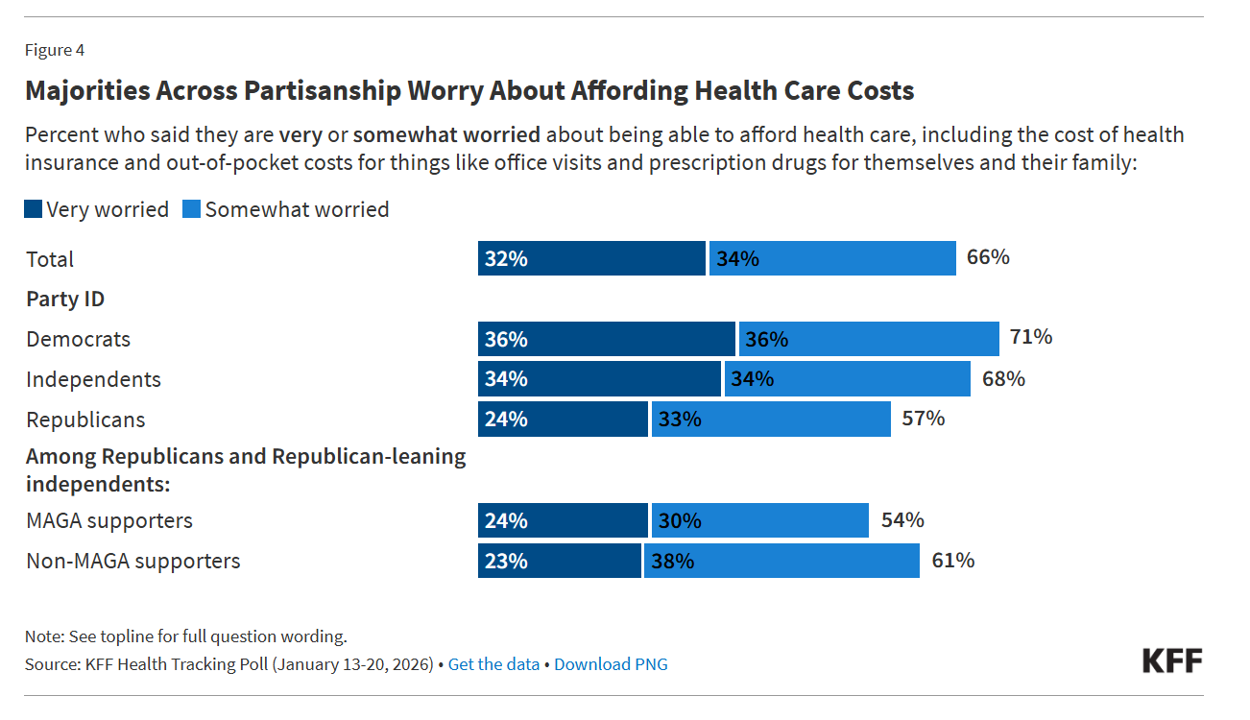
Health Populi’s Hot Points: Worries about affording health care cross political party ID in the U.S. While 7 in 10 Democrats and Independents worry about their ability to afford health care, over one-half of Republicans do, too — at 57% of those identifying with the GOP.
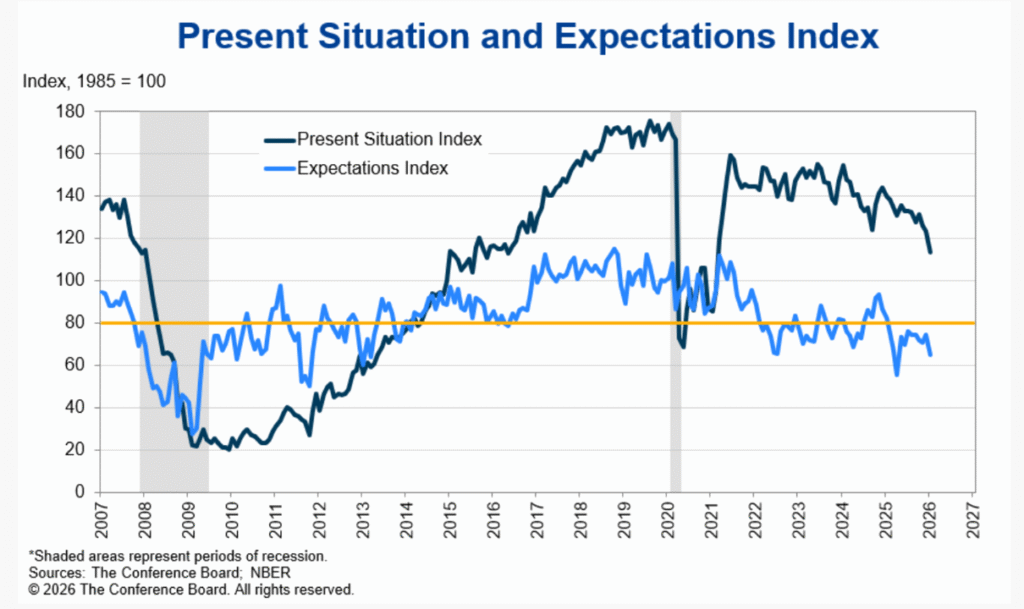
U.S. consumers’ confidence in the economy fell to a low not seen since May 2014, announced earlier this week by The Conference Board.
All components of the Index fell, with an emphasis on negative perceptions for jobs and business; as The Conference Board’s press release explained,
“The Present Situation Index fell, as net views on current business conditions dwindled to just barely positive, at +0.1%. Perceptions of employment conditions also edged lower, with the labor market differential—the share of consumers saying jobs are “plentiful” minus the share saying jobs are “hard to get”—continuing to flag. All three Expectations Index components also weakened in January. Expectations for business and labor market conditions six months from now fell further into negative territory. The outlook for household incomes became less positive.”
Consumers overall are also health consumers — so looking to fill the breach between covered-care and spending out-of-pocket for self-care and primary care, many health-and-wellness-engaged consumes look to retail health channels for medicines (over-the-counter and discount coupons at the point-of-purchase pharmacy), food-as-medicine and for well-being at the grocery store, and immunizations at retail. We’ve been witness the hockey-stick growth of direct-to-patient platforms for medicines and virtual care (such as the uptake of self-driven GLP-1s to tele-mental health).
This week, Walmart announced plans to increase pay for pharmacists to address this shifting demand, and also joined a collaboration with CVS Health, Kroger Health, Giant Eagle, Ahold Delhaize, and the National Community Pharmacists Association to #fillhealthcaregaps to support pharmacist-led health care. Here’s a video to fill in your knowledge about this promising program:
We are now in an era where most health spending feels like retail (but much less enchanting) given peoples’ sense of lack of affordability — driving more U.S. patients and health citizens to vote with health care on their minds, in 2026 midterms and in 2028.
 Jane will be working with EU- and UK-based clients in September and October 2026, collaborating with stakeholders in digital health, public/community health, retail health, and growing opportunities for health-at-home. Stay tuned to her updates here on Health Populi on-the-ground as she lives the digital nomadic work-life in Italy, Belgium, the Netherlands, and in London.
 I was grateful to be Jasmine's first conversation-guest on her new podcast,
  Jane joined host Dr. Geeta "Dr. G" Nayyar and colleagues to brainstorm the value of vaccines for public and individual health in this challenging environment for health literacy, health politics, and health citizen grievance.