

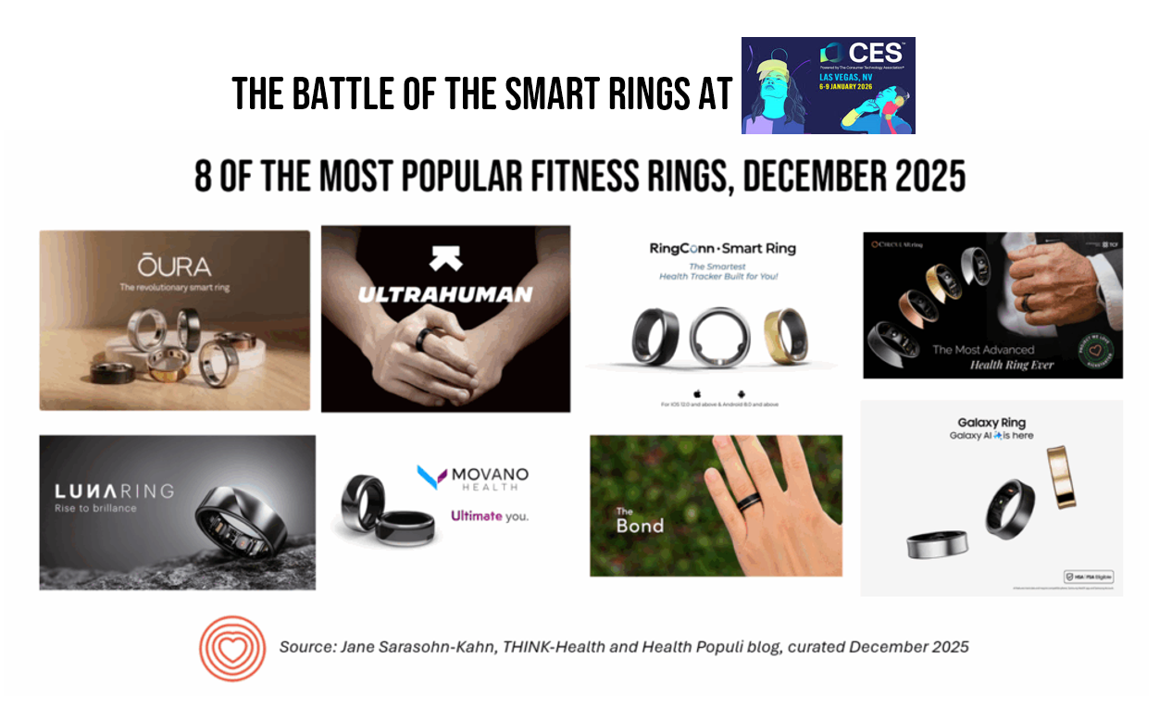
For well over a decade, wearable technologies have been developed for humans from head-to-toe — from forehead-worn bands to address stress and headaches to smart shoes with sensor-embedded soles that assess our gait and posture.
In 2013, my CES coverage had a focus on “The Battle of the (Wrist)Bands.” This year, the #wearabletech category feels like a fierce competition for the human real estate of the finger — that is, a battle of the smart rings.
Twelve years later, smartwatches are mainstream trackers for health embedded with sensors that are gaining clinical evidence for use in medical care well beyond step-tracking. But what if you use your phone as a watch with mobile apps, and want to conserve your wrist real estate for, say, jewelry, or a preference for a less-intrusive device, or simply nothing in your way of typing on your laptop computer?
Enter the smart ring. 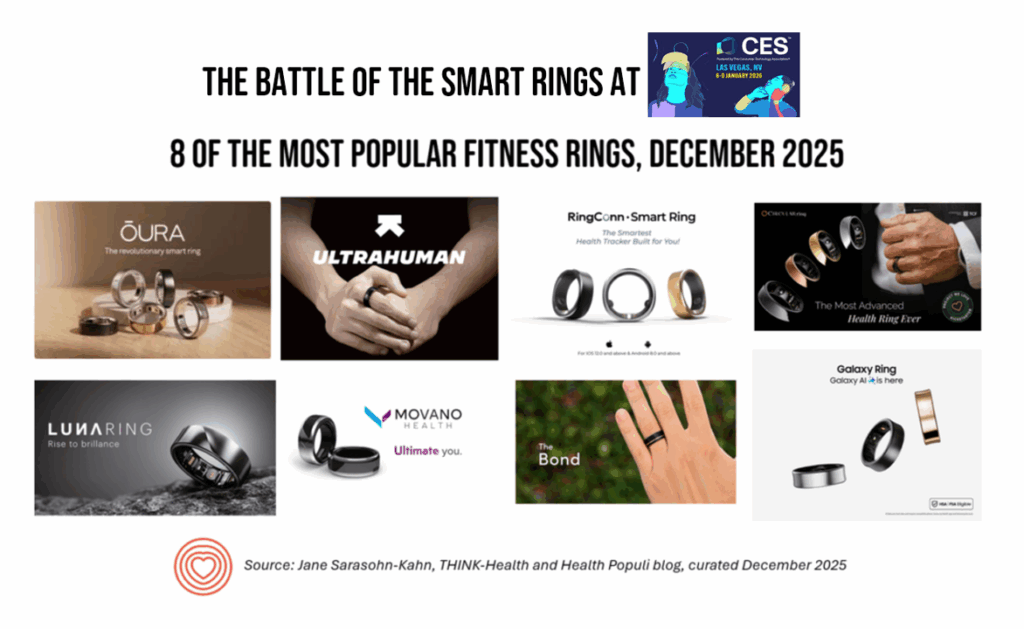
In anticipation of #CES2026, I wrote up my view on digital health at the conference would be a lens on our future personal “health operating systems.”
And smart rings would be one physical on-ramp to generating data for greater personalized medical and health advice, with a future of health care platforms enabling that new-fangled OS.
I created this graphic featuring eight of the brands I’ve looked into in 2025, anticipating new offerings I’ll see in Las Vegas on the convention floor digital health aisles.
The Consumer Technology Association (CTA) run CES, and as the leading technology membership organization conducts ongoing research into market trends. In CTA’s 2025 U.S. Consumer Technology Ownership & Market Potential report, “wearable tech” was a key category focus.
CTA noted that the category was diversifying and evolving, expecting “potential for households to own multiple wearable tech products” serving specific needs.
Beyond the smartwatch, the most-favored wearable tech among consumers. CTA looked at VR and AR headsets and glasses, as well as smart ring and wristband activity trackers.
Smart rings are less mature than these other wearable tech segments, as of 2025 with 12% U.S. household penetration. That equates to about 15 million U.S. households with an installed base of 26.1 million rings.
The most visible brand of smart ring right now is Oura. It’s interesting to note that a keynote speaker at CTA’s Leaders in Technology Dinner on Wednesday during CES 2026 is Oura’s CEO, Tom Hale. One piece of data to know about Oura is that the company recently raised over $900 million in a funding round which raised their valuation to $11 billion (FYI Fitbit was valued some $10 bn in 2015 after its IPO).
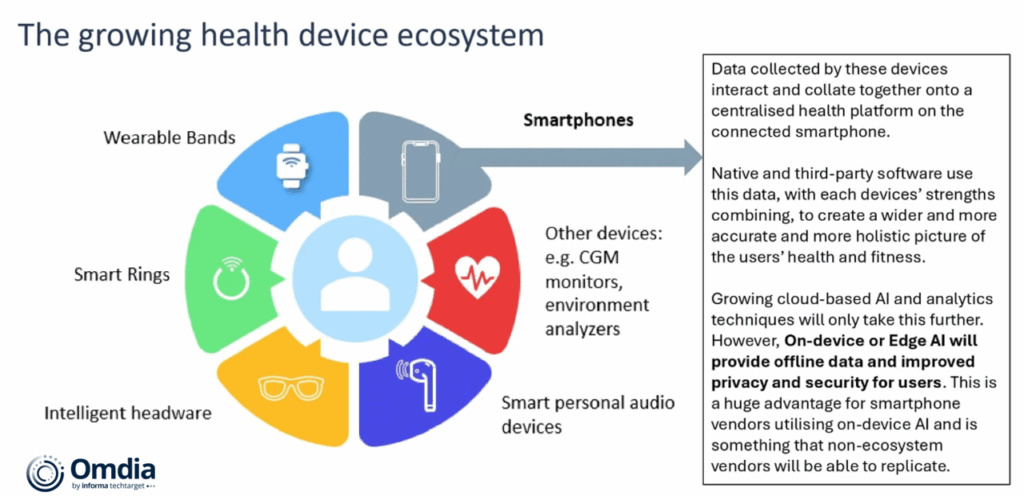
As we continue to appreciate and track the growth of smart rings in wearable tech, it’s important to place them in a larger health device ecosystem as the smart folks at Omdia have characterized the segments of wearable tech for health and well-being.
There will be a (useful) tension and dynamic with smartwatches and phones, and other devices — which together, when developed through standards and user-centered design principles (including privacy- and security-by-design especially crucial for healthcare adoption in consumer-trust framework), we hope to be able to benefit from an ecosystem where clinically-valid data will flow through algorithms that fairly, equitably, and smartly guide citizens in their personal health operating systems.
Stay tuned for more wearable tech/health update during #CES2026.

 I'm once again pretty gobsmackingly happy to have been named a judge for
  Stay tuned to Health Populi in early January as I'll be attending Media Days and meeting with innovators in digital health, longevity, and the home-for-health during
  Jane collaborated on