

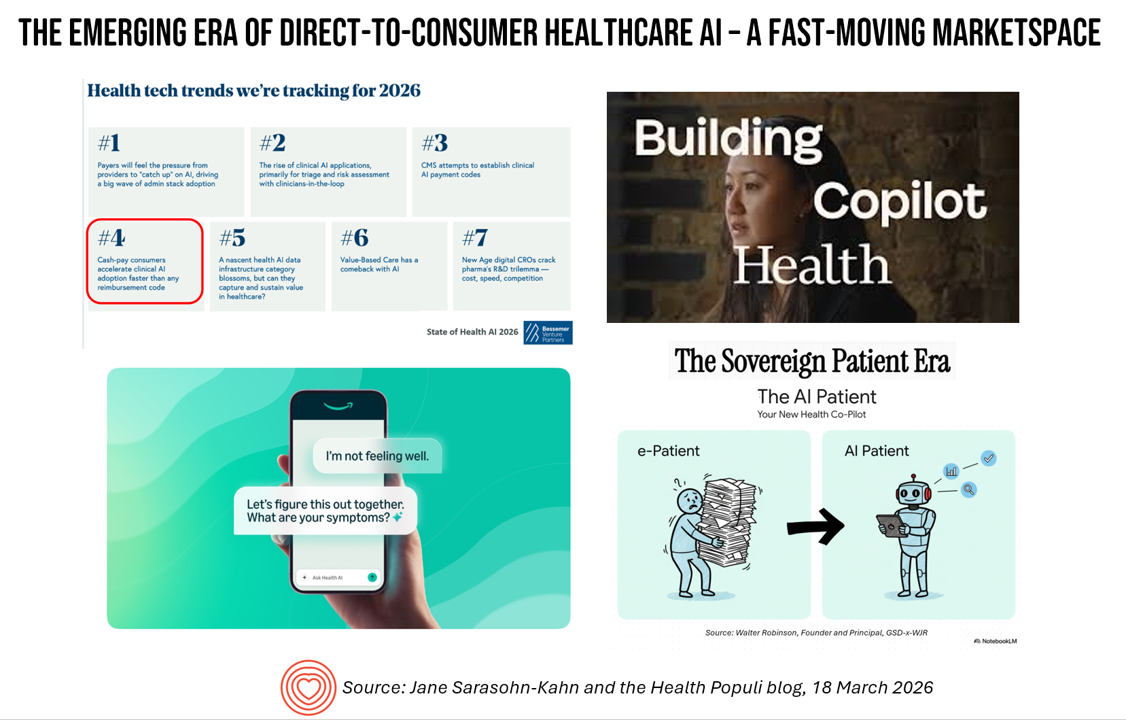
The announcements of consumer-focused AI for health are coming Fast and Furious. As we are coming off of the 2026 Oscars broadcast, it inspires me to quote another movie title, Everything, Everywhere, All at Once. In the moment, it feels like consumer health-focused AI is indeed in a fast-and-furious launch phase. It’s time for me to provide an update on this fast-moving-consumer service, discussing the latest vendor announcements and the ongoing concerned embrace of AI among early adopting citizen-users of AI for health/care.
For context, let’s start with long-time AI-medical expert Dr. Eric Topol’s view on the current state. Registering his concern in this fast-and-furious phase of DTC AI launches, Dr. Eric Topol told the LA Times, “The fact that they’re putting these out without enough anchoring in safety and quality and consistency concerns me. They need much tighter testing. The problem I have is that these efforts are largely stemming from commercial interests — there’s furious competition to be the first to come out with an app for patients, even if it’s not quite ready yet,” Dr, Topol warned.
One of those commercial interests, Comcast, voiced its bullish position on AI in health care in a recent report looking at Healthcare Technology Trends for 2026 and Beyond, The media-tech company observed that, “On the patient-facing side, agentic AI is being leveraged to autonomously assist patients with tasks like triage, appointment scheduling, or medication refills…Consumers are becoming more comfortable with using generative AI for basic health needs, with 39% of younger adults reporting being okay with using generative AI tools to evaluate symptoms.” (That statistic comes from Forrester’s Predictions 2026; The year AI Tests The Heart of Healthcare).
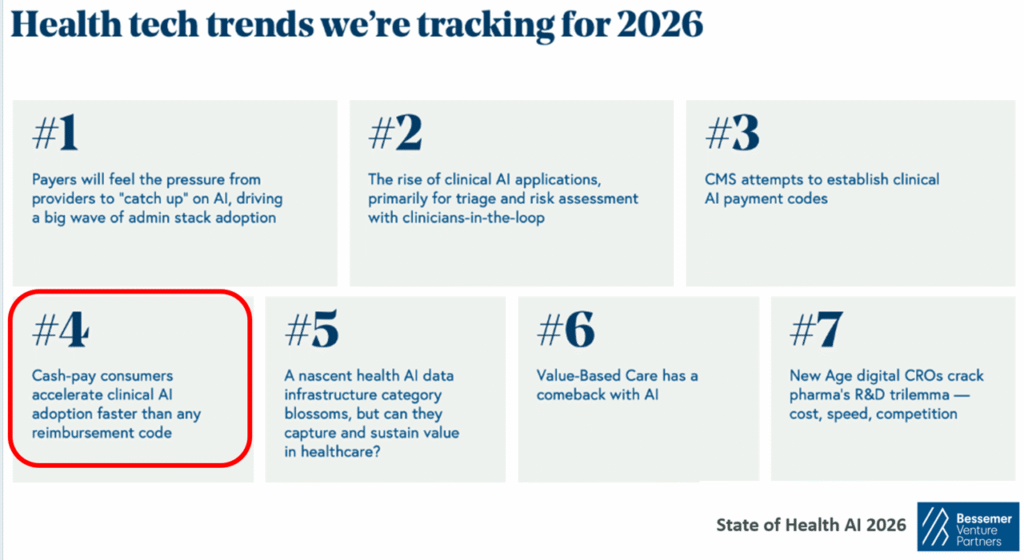
What’s behind the adoption of AI among health-focused consumers? One underlying motivation is that patients are now exercising their consumer muscles for health care — as noted by Bessemer Venture Partners (BVP) who forecasted that, “cash-pay consumers (will) accelerate clinical AI adoption faster than any reimbursement code.”
Consumers aren’t waiting for AI payment codes and payers to debate reimbursement, BVP wrote: patients-as-payors are keen to take AI in their self-care hands for health guidance. One compelling data point: a study from RadNet found that 36% of women opted to pay $40 out-of-pocket for AI-enhanced mammography screening (and that was in a study presented at RSNA in 2024). 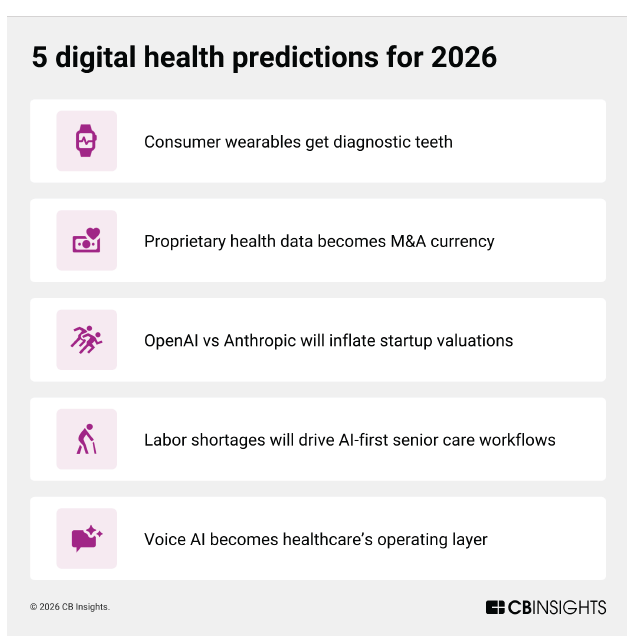
For additional market context, check out CB Insights’ analysis of 5 digital health predictions for 2026. Here’s the list, pictured to the right: I’ll focus on the third which is an aperture into two of the most prominent early players in health-focused AI: OpenAI and Anthropic.
CB Insights wrote, “When OpenAI acquired Torch on Jan 12 for $100mm…the message was clear: when you’re moving fast and need critical infrastructure, buying it can be faster than building it. The acquisition was the first to come out of a head-to-head healthcare race OPENAI and Anthropic kicked off January 2026.”
The competitors’ products ChatGPT Health and OpenAI for Healthcare vs Claude for Healthcare launched what CBI called “dueling medical record integration partnerships” within 4 days of each other.
A short Rough Guide to consumer-facing health/care AI
Within days and weeks of the OpenAI and Anthropic announcements, many more followed — including AI health updates from Amazon Health, Microsoft, CVS Health with Google, and Verily — among others. Here is a bit about each of these four DTC-AI health developments noting the details for these are current snapshots and bound to change given the nature of the “fast-and-furious” marketspace.
Earlier this month, Amazon launched the company’s Health AI agent on the app and website available for free to Prime members. With this agentic AI service, Amazon aims to deliver personalized medical advice to the millions of Prime members eligible for the program.
“Once you give permission to Health AI to access your health information,” Amazon says, “it can explain your lab results, diagnoses, and medical records, and it can provide more accurate, personalized answers to questions about your symptoms and medication. When you need professional care, Health AI connects you directly to One Medical providers through message, video, or in person. It can also help manage prescription renewals with Amazon Pharmacy or your pharmacy of choice, sending requests to your One Medical provider, and will provide relevant health care product recommendations from Amazon.com when you ask for them.” Then health AI can assess a user’s medical records and explain lab results, as well as communicate personalized responses to a person’s queries into symptoms and medicines. 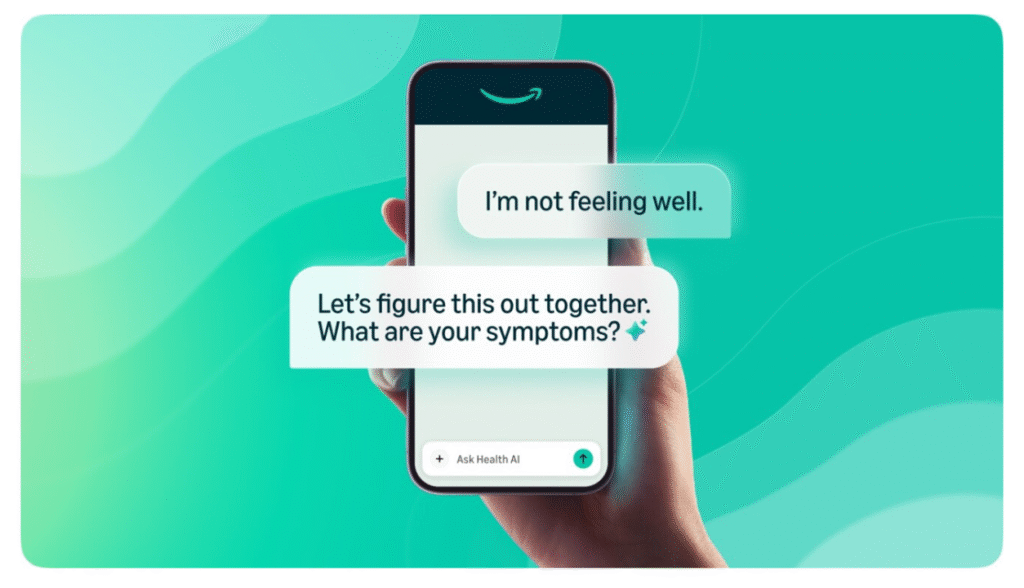
Amazon piloted this with members of One Medical, the company’s primary care company (acquired in 2022). Prime members can now sign up for Health AI on the website.
This landing page promises, “Personalized insights, human powered care.”
In terms of Prime member eligibility, Amazon calls this “an introductory offer” for U.S.-based Prime members to receive up to five Direct Message Care treatments from a One Medical provider at no cost. (These are usually priced at $29 per treatment).
Microsoft‘s consumer-facing AI health office is Copilot Health, following last autumn’s launch of Copilot for Health. The company sees this new version as competing with OpenAI ChatGPT Health. Like the Amazon program, Microsoft Copilot Health users can opt into linking their medical records as well as data generated from wearable devices (e.g., Fitbit, Oura ring) to the information hub. 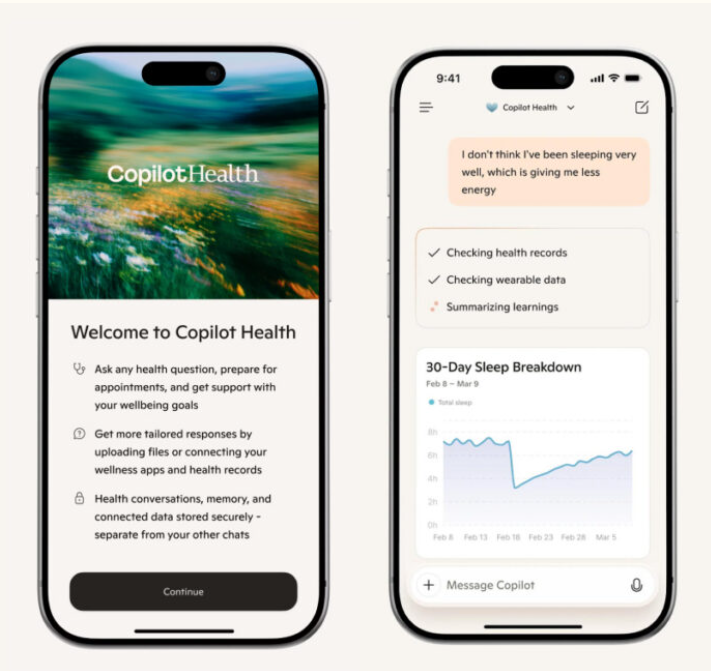
Microsoft has shared that it has been dealing with over 50 million health questions each day via Copilot and other consumer-directed AI on-ramps.
The launch site explains, “Today, we’re launching Copilot Health, a separate, secure space within Copilot where medical intelligence makes sense of your information and delivers personalized health insights that you can act on. Copilot Health doesn’t replace your doctor. It makes every minute you have with them count more. You arrive prepared, with the right questions, the right context, and the confidence that comes from better understanding your own body.”
As of today, interested users can sign onto a waitlist to join the “community” of Copilot Health consumers.
Let’s add CVS Health + Google to this mix. On 5th March, CVS Health and Google Cloud announced their partnership to, in the partners’ words, “reimagine healthcare consumer engagement and experiences.” How, you ask? Via an agentic-AI platform called Health100.
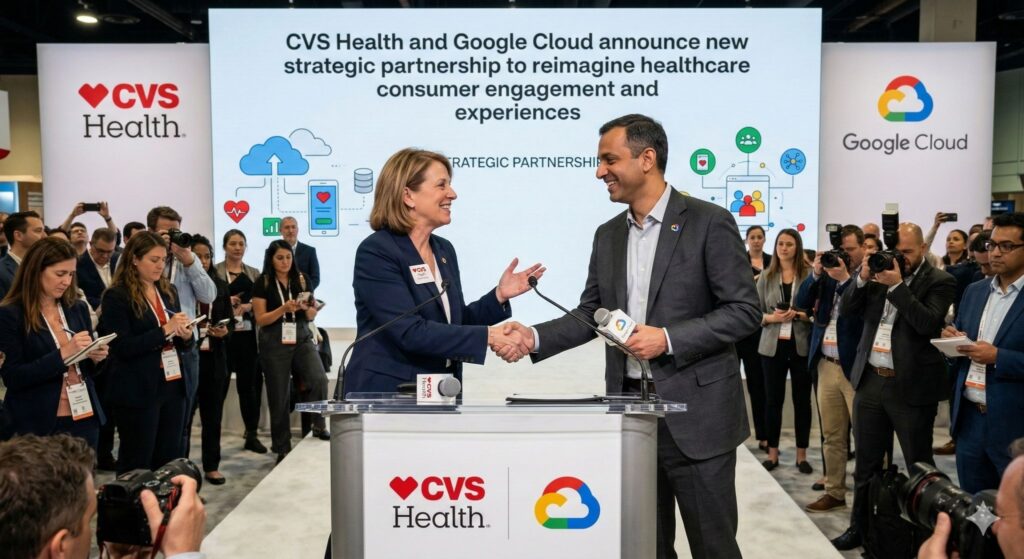
As we should expect from a retail health company like CVS Health, the platform is envisioned as omnichannel, meeting people how and where they are and want to be met. A different message accompanies this press release — which speaks a bit to the BVP forecast that cash-paying health consumers will be the vanguard of AI-health adoption: from the press release,
“The platform is being developed to enable consumers to take full ownership of their health and care, provide real-time proactive support to stay on track to achieve better health, offer faster and expanded access to care, empower them with cost transparency and ways to reduce out-of-pocket spend, and eliminate stressful health care homework.” And, as this is CVS Health after all, note that, “Health100 also will serve as the conduit to pharmacist-led care management to leverage an integral, underutilized and trusted clinical touch point.”
We have to add Verily to the mix of Big Tech companies involved in this bullish phase of consumer-AI health. Verily Me, Alphabet’s “free” program that stars Violet, a chatbot, which can respond to questions about the consumer’s medical records. The user can opt-in to Verily Me’s HIPAA authorization link which then allows the company to access the user’s personal health information (PHI) — then enabling Verily to share the person’s PHI with, quote, “health and wellness companies that provide products, services, and technologies that may be of interest to you.”
I’ve not been exhaustive here with these snippets on big-tech consumer AI platforms — you will be able to find many more in your own research, but my intent is to give you a rough guide to what’s happening in early 2026.
A growing evidence and experience base – for better, for worse
A current topic in this marketspace concerns a study published in Nature Medicine that found Open AI’s ChatGPT Health chatbot did not uniformly perform well in the case of patient emergencies. In replicating the initial study test, OpenAI learned that, “in over 80% of the apparently concerning cases, the model asked for additional context so it could produce a better informed response.” Clearly, triage is an important use for consumer-focused health AI and so remains a work-in-progress as a rational user should expect — but not always be aware of.
This gets to the question of what’s the low-hanging, lower-risk fruit for a consumer using healthcare AI tools in self-care. Epstein Baker Green, the legal experts with a strong focus on health care law, provided advice that, “Some use cases may be relatively low-risk, such as explaining what a lab value means, helping users prepare questions for an upcoming appointment, or tracking fitness metrics over time. Other use cases are more problematic, including interpreting complex symptoms, managing chronic conditions, or addressing mental health concerns. As millions of users interact with these platforms, patterns will emerge about where consumer health AI adds value, where it falls short, and where clinician involvement remains necessary.”
Another caveat, which I hinted at in the Verily paragraph above, deals with privacy: the EBG lawyers call out that, for these sorts of patient-driven AI platforms, “Privacy protections operate largely outside HIPAA, relying instead on state privacy laws, consumer protection frameworks, and emerging AI transparency requirements. Cybersecurity risks are real, and the use of conversational AI in sensitive contexts like mental health has already led to litigation alleging harmful outcomes.”
I like how Phil Alexander, founder and CEO of AnswerMyQ, put this issue forward in an interview with Fortune magazine; he asserted, “In healthcare, the risk isn’t lack of information, it’s uncontrolled interpretation. If AI is answering benefit or clinical workflow questions, those responses have to be compliant, auditable, and role aware. Otherwise, you’ve just moved the confusion upstream.”
In closing, for now, I’ll point us back to the LA Times column which kicked off this post with Dr. Topol’s concerns. The article is titled, “AI isn’t ready to be your doctor yet—but will it ever be?”
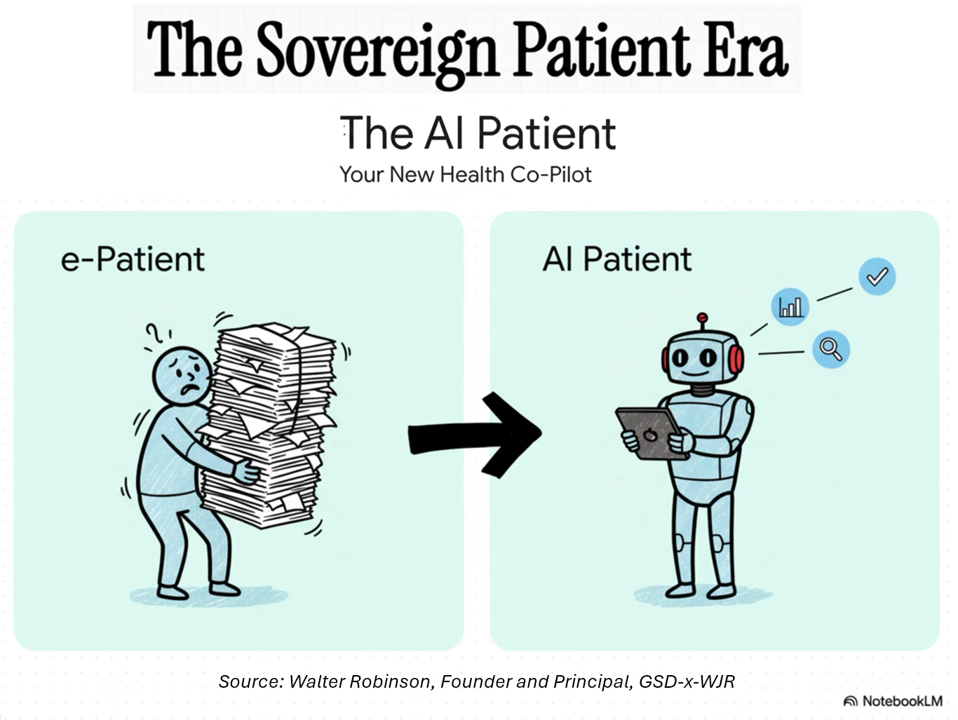
Clearly we postpone a final-final answer on this. For the time being, the increasingly “Sovereign Patient” is arming herself with AI to research symptoms, sort out various potential diagnoses, and enter the exam room with their personal physicians with information beyond their previous proverbial pile of Paging Dr. Google printouts as Walter Robinson has envisioned here in his explanation of The Sovereign Patient Era.
This gets to the health consumer’s role as The CEO of her Health — requiring a focus on health literacy, including AI-and-digital literacy, and a strong sense of agency and empowerment.
 Thank you
  Jane joined host Dr. Geeta "Dr. G" Nayyar and colleagues to brainstorm the value of vaccines for public and individual health in this challenging environment for health literacy, health politics, and health citizen grievance.
  I'm grateful to be part of the Duke Corporate Education faculty, sharing perspectives on the future of health care with health and life science companies. Once again, I'll be brainstorming the future of health care with a cohort of executives working in a global pharmaceutical company.