

A new survey from RevSpring, a healthcare payments company, measures consumers’ feelings of friction with healthcare in America — where people feel frustration “at every level,” the topline reads.
The title of the paper, The Cost of Confusion: How Friction Shapes the Healthcare Experience, reminded me of one of my favorite songs from Motown growing up, “Ball of Confusion.” This Temptations hit was written by the great Motown songwriters, Norman Whitfield and Barrett Strong (who interestingly and to the point of this post, recorded the first hit single for Motown, the fabulous song “Money [That’s What I Want],” in 1960). “Ball of Confusion” spoke to Americans’ deep frustration with society at the time, with allusions to the Vietnam War, racism, and political corruption — public grievance put to “a psychedelic soul track,” one reviewer wrote — with a strong theme of distrust of information. 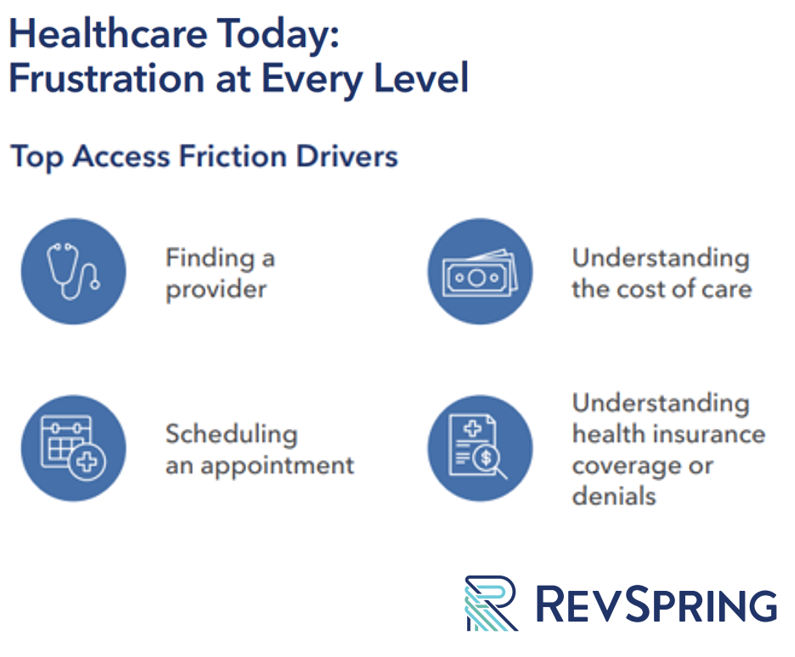
Cue “The Cost of Confusion.” RevSpring polled 2,024 U.S. adults for the study, finding that health consumers face friction across a range of patient-tasks – finding providers, scheduling appointments, and knowing their personal medical costs as well as understanding their insurance coverage and often denials for service.
At the top line, 94% of consumers said healthcare needs to be made easier so people know what to expect — which inspires more confidence and the feeling of being “seen.”
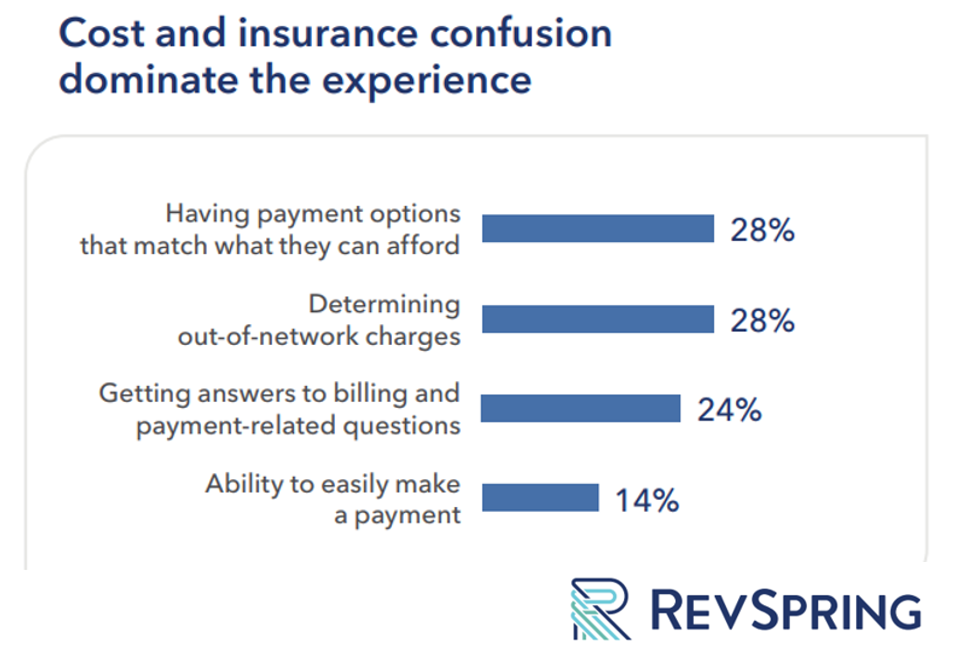
Specifically, confusion regarding costs and insurance “dominate” the patient experience, RevSpring found.
One-fourth of consumers want payment options that match what they can afford. Another one in four people want to know out-of-network charges in advance of receiving services. And one in four patients also had challenges getting answers to billing and payment-related questions.
The opportunity RevSpring calls out is to reduce uncertainty earlier in the patient-financial process.
Not having these questions answered has a cost to both patient and provider: that 50% of consumers in this research said they had to cut back on medical care due to cost.

Health Populi’s Hot Points: When the cost of care and coverage details are clearly communicated on a statement, most consumers report positive satisfaction with the process.
When this doesn’t happen, the quote here from the report says everything: “In other words, communication shapes trust.”
And the trust-in-health deficit continues to grow between U.S. health citizens and the stakeholder touchpoint organizations that provide care — health insurance plans, hospitals, and pharmaceutical companies along with PBMs.
See more about grievance and health in the Edelman Trust Barometer’s recent focus on the issue here.
“Trust communications” are “a loyalty driver,” RevSpring concludes and recommends as a key opportunity to reduce friction — and gain patient retention and loyalty. And may I add, help to reduce health consumers’ sense of grievance with the health system by sector and overall.
Here’s a video of the Temptations singing “Ball of Confusion.” Check out the first few stanzas of the song’s lyrics below, and you’ll see why I had this deja vu moment. Citizens’ grievance to various aspects of social chaos and challenge is not a new thing, to be sure. But dealing with it effectively, especially related to health care and trust rebuilding, can’t come soon enough.
People movin’ out, people movin’ in
Why? Because of the color of their skinRun, run, run, but you sure can’t hideAn eye for an eye, a tooth for a toothVote for me and I’ll set you freeRap on, brother, rap on
Well, the only person talkin’ ’bout “Love thy brother”Is the preacherAnd it seems nobody’s interested in learnin’But the teacher
Segregation, determination, demonstration, integrationAggravation, humiliation, obligation to our nation
Ball of confusionOh, yeahThat’s what the world is todayWoo, hey, hey
The sale of pills are at an all-time highYoung folks walkin’ ’round with their heads in the skyCities aflame in the summertimeAnd oh, the beat goes on
Evolution, revolution, gun control, the sound of soulShooting rockets to the moon, kids growin’ up too soonPoliticians say more taxes will solve everythingAnd the band played on
So ’round and around and around we goWhere the world’s headed, said, nobody knows…


 Jane joined host Dr. Geeta "Dr. G" Nayyar and colleagues to brainstorm the value of vaccines for public and individual health in this challenging environment for health literacy, health politics, and health citizen grievance.
  I'm grateful to be part of the Duke Corporate Education faculty, sharing perspectives on the future of health care with health and life science companies. Once again, I'll be brainstorming the future of health care with a cohort of executives working in a global health care enterprise.
 Jane will be working with EU- and UK-based clients in September and October 2026, collaborating with stakeholders in digital health, public/community health, retail health, and growing opportunities for health-at-home. Stay tuned to her updates here on Health Populi on-the-ground as she lives the digital nomadic work-life in Italy, Belgium, the Netherlands, and in London.