

The forecasts for wearable tech for health range from a state of “war” innovators to a consumer-led bull market for quantifying selves across a range of measures. There is a growing array of options for health-driven consumers across a spectrum of goals and applications, and varying levels of clinical evidence.
In this post, I’ll discuss the current (fast-moving and -morphing) state of the wearable tech-health market, following up with implications for consumers, caregivers, and health citiznes-at-large.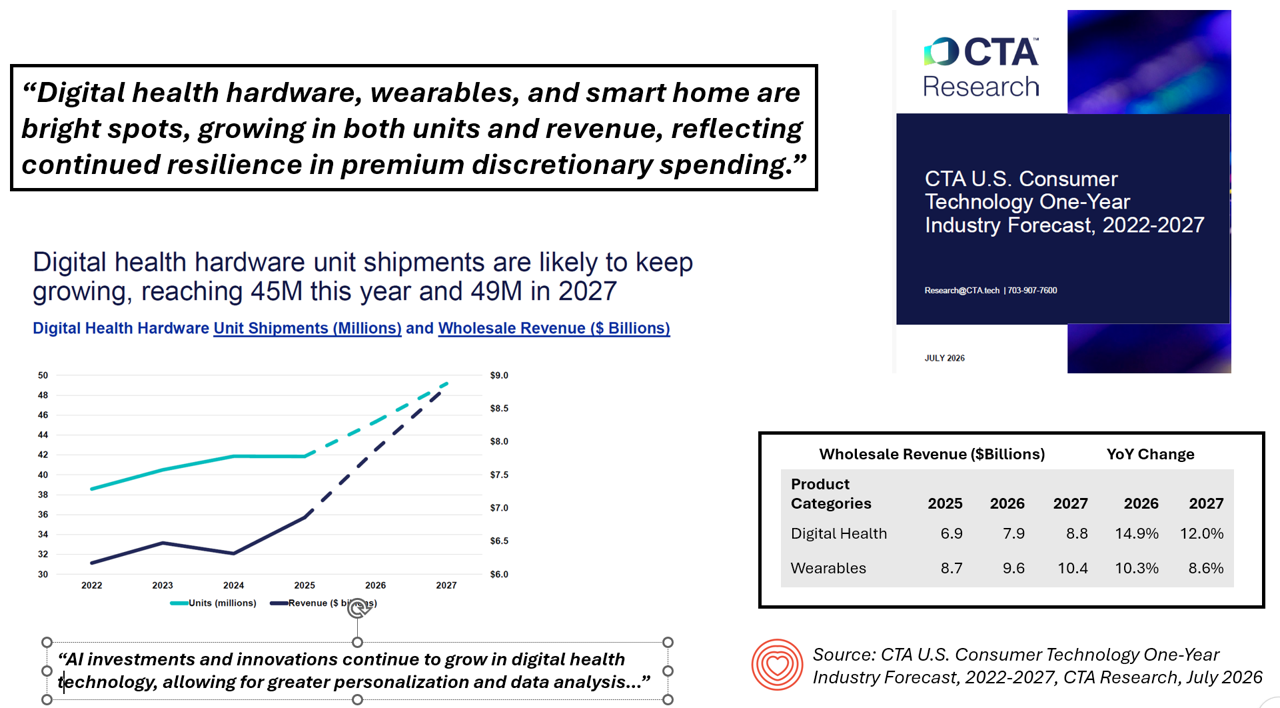
Let’s start with the forecast from the Consumer Technology Association (CTA), which held a webinar on their latest annual outlook on consumer-facing devices and tech services.
I selected these key data points to share from CTA’s one-year forecast report, the CTA U.S. Consumer Technology One-Year Industry Forecast, 2022-2027 published in July 2026. FYI I provided input into this forecast based on my work in the digital health, smart rings and things, smart homes, and wearable technology segments.
As Savannah Littlejohn of CTA mentioned in discussing the forecast for the digital health segment, AI is adding value to consumers’ perceptions of and utility for these innovations (say, remote health monitoring) and wearable tech, bolstering sales optimism. In fact, Digital Health as a CTA category of analysis is among the few areas that expect double-digit growth, with the curve of that growth shown on the graph on the left.
The report notes that, “AI investments and innovations continue to grow in digital health technology, allowing for greater personalization and data analysis for users.” There are other bright spots of growth in the CTA forecast relating to consumer-driven health and wellbeing, such as fitness activity bands (e.g., Garmin, Google, and Whoop among them) and smart rings which I’ve noted in the past here on Health Populi are finding relatively strong consumer adoption as a category for folks who still like wearing traditional wrist-worn watches as well as people (like me) doubling up on both a smartwatch and a smart ring for different health applications and goals. Gil Levitan of CTA also noted that some consumers are keen to use smart rings to track and manage sleep, a big objective for many consumers (globally) in and beyond 2026-7.
Connected health devices are going beyond glucose monitoring, again a growing category among consumers managing diabetes as well as those seeing greater understanding of metabolic function.
Adding to the insights gleaned through the CTA research, I note a plethora of mainstream and trade publications taking deep dives in the wearable and digital health market in just the past few weeks. Here, I’ll point to writings in The New York Times and the Wall Street Journal, along with an informative piece in ATN (Athletech News).
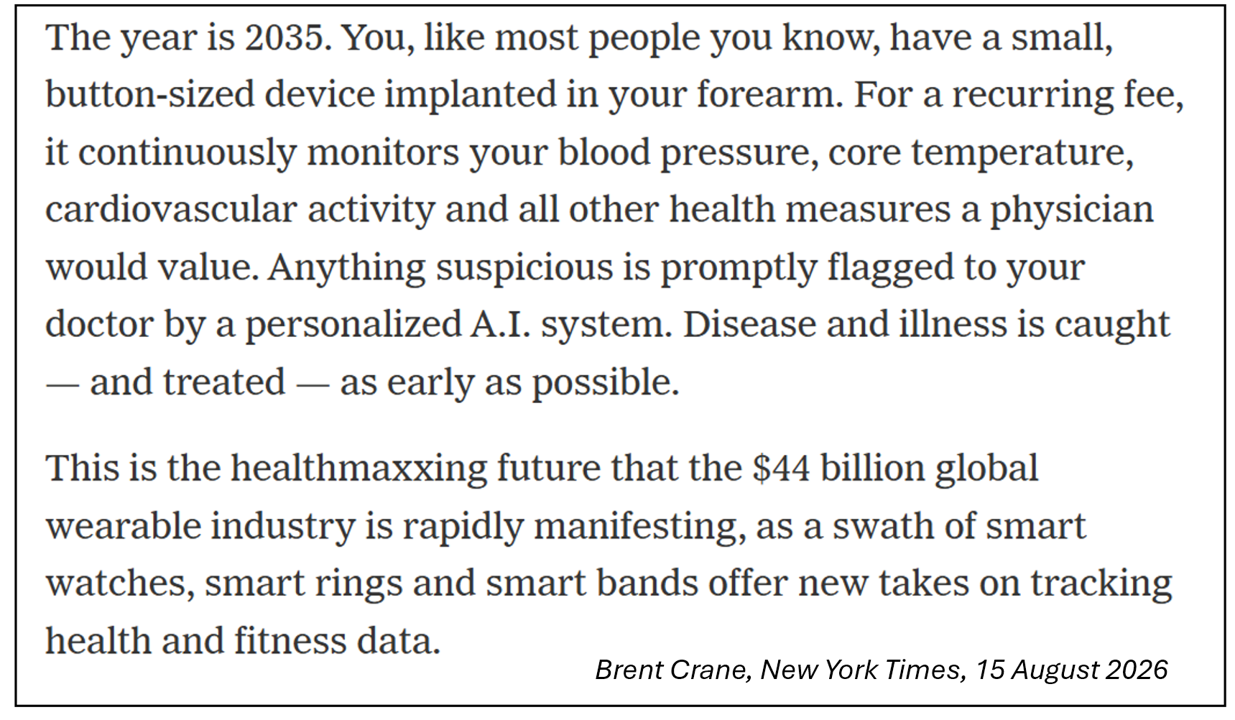
“The Cutthroat Wearables Battle Is About More Than Tracking Your Fitness,” Brent Crane wrote in the Deal Book newsletter of The New York Times August 15th, calling out Google, Apple, Samsung, and newer entrants like Oura “racing” to integrate data from wearable tech into the health care system.
As you can read in this sidebar from Brent’s fantastic assessment, his forecast goes into the future to 2035, imagining we are armed and embedded with sensors generating data that feeds into an AI-powered system. This is the sort of personalization that the CTA forecast talked about.
While Brent recognizes that, “Full-on health care integration is still in utero,” he also smartly notes that, “Health care is where the real money lies.”
Thus the title of this excellent analysis cites “the cutthroat wearables battle,” with companies innovating and positioning to meet the increasingly integrating health care data ecosystem….again, underpinned and accelerated through smart use of AI.
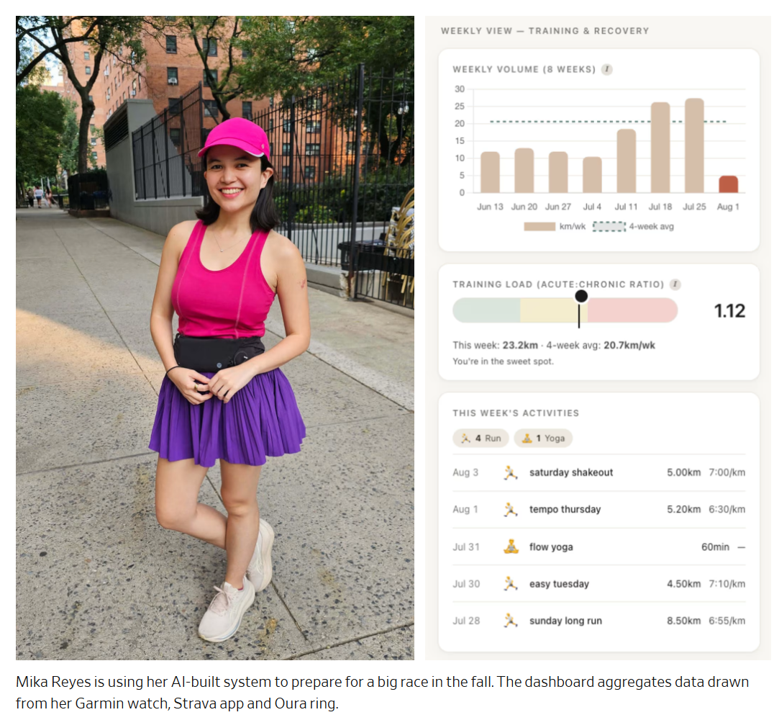
Moving from “healthmaxxing,” we move to “datamaxxing:” similarly in the Wall Street Journal on August 11, Tina Li and Natalie Kaufman discuss “The Datamaxxers Feeding Their Every Health Move to AI,” discussing the consumer-driven side of the digital health-wearable marketspace.
Meet Mika Reyes, whom Tina and Natalie introduce us to, featured in their column. Mika is a “datamaxxer,” preparing to run and optimize performance through gathering personal data from several devices, including a Garmin watch, an Oura ring, and the popular Strava app.
The authors write that, “Health obsessives often monitor workouts, step counts, sleep metrics, heart rates and nutrition data, cross-referencing the information with their calendars, meeting transcriptions, emails and clinical records. Now, they are supercharging their habits with AI systems that serve as hyperpersonalized health trainers and assistants. While fretting over such minutiae is far from mainstream practice—many doctors recommend simplicity in fitness and nutrition—a growing number of so-called datamaxxers have finally found their version of nerd Valhalla.”
Health Populi’s Hot Points: I’ve been part of the digital health community since the advent of the Internet in health care, as my career has tracked the evolution pretty much from the start.
I’ll amend Tina and Natalie’s observation on datamaxxers finding “nerd Valhalla” by my own observation and work that these trends are mainstreaming to Main Street, not just to Quantified-Self-Land. The CTA data and annual CES show in Las Vegas, which I’ve attended for nearly 20 years, has demonstrated growing square feet in exhibition halls there and content driving out past the Digital Health Summit onto main stages throughout the event — crossing over into media, gaming, kitchen technology, and last year a growing scene on equity (here on Health Populi translating to “health equity”).
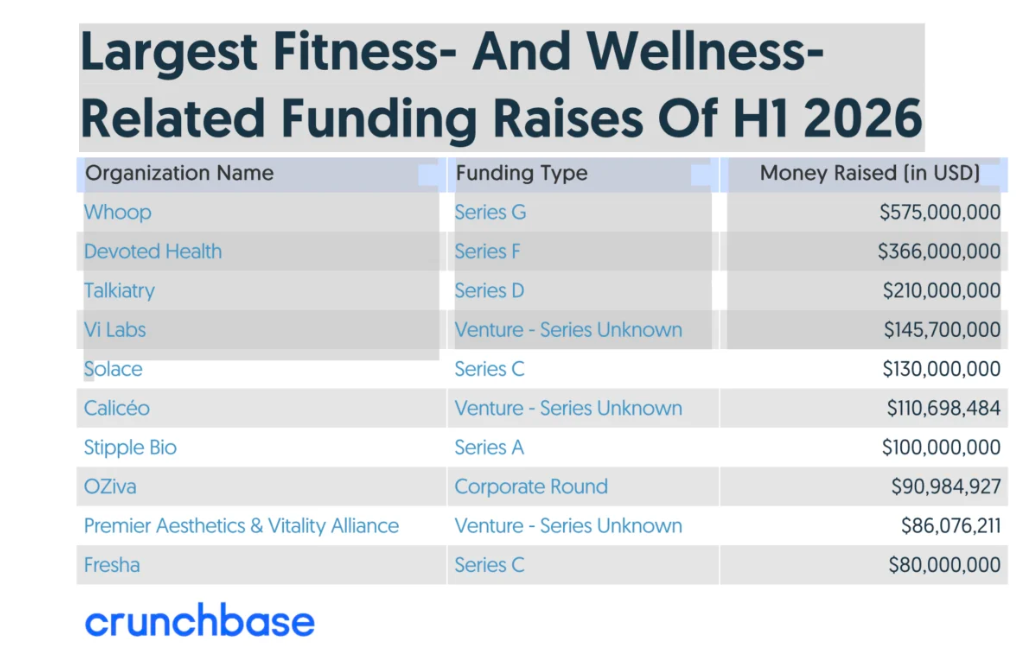
Adding in the market analysis published in ATN, I liked this take and table from Courtney Rehfeldt on the market situation, “Fitness & Wellness Startups Have Raised $3.6B This Year – but Not Everyone’s a Winner.” Here are examples of companies in the digital health, connected health, and wearable tech for health space funded in the first half of 2026. You don’t know many of these names yet, but eventually some will show up on the shelves of Target and Walmart’s fitness areas along with Amazon’s expanding marketplace for digital health.
What’s driving consumers’ adoption of these technologies are growing senses of financial stress at home across all spending — including health care and medical bills competing with kitchen table issues of food (security and access), energy (at home utilities and running an auto), and housing. In the deepest COVID-era, more consumers repurposes home and hearth into health hubs, people added fitness spaces to their homes, and more added Internet-of-Things for health devices at home — again, “things” featured at CES and other health conferences.
While the supply-side of this may be cutthroat, consumers’ growing demand and taste for self-care and control will continue to accelerate across ages and stages of life — for those people who have access to discretionary income. I’ll watch this space for new models of access from vendors and health systems who could bundle tech and services as part of holistic health plans either direct-to-patient and -consumer or through employers and health plan sponsors.
Postscript, 19 August 5 pm ET – Check out Leonard Rinser’s just-in-time write-up on his LinkedIn channel about Google’s evolving approach to integrating personal health data, built on the Fitbit chassis.


 Jane will be working with EU- and UK-based clients in September and October 2026, collaborating with stakeholders in digital health, public/community health, retail health, and growing opportunities for health-at-home. Stay tuned to her updates here on Health Populi on-the-ground as she lives the digital nomadic work-life in Italy, Belgium, the Netherlands, and in London.
 I was grateful to be Jasmine's first conversation-guest on her new podcast,
  Jane joined host Dr. Geeta "Dr. G" Nayyar and colleagues to brainstorm the value of vaccines for public and individual health in this challenging environment for health literacy, health politics, and health citizen grievance.