

Consumers have placed their personal physicians above all health care touchpoints in their lives when it comes to trust stewards of and for health care information and data protection.
More consumers have adopted the use of AI in every day life across many life flows, including their health care. The latest riff from the annual Edelman Trust Barometer 2026 highlights a look into health and trust in concert with the Yale School of Public Health.
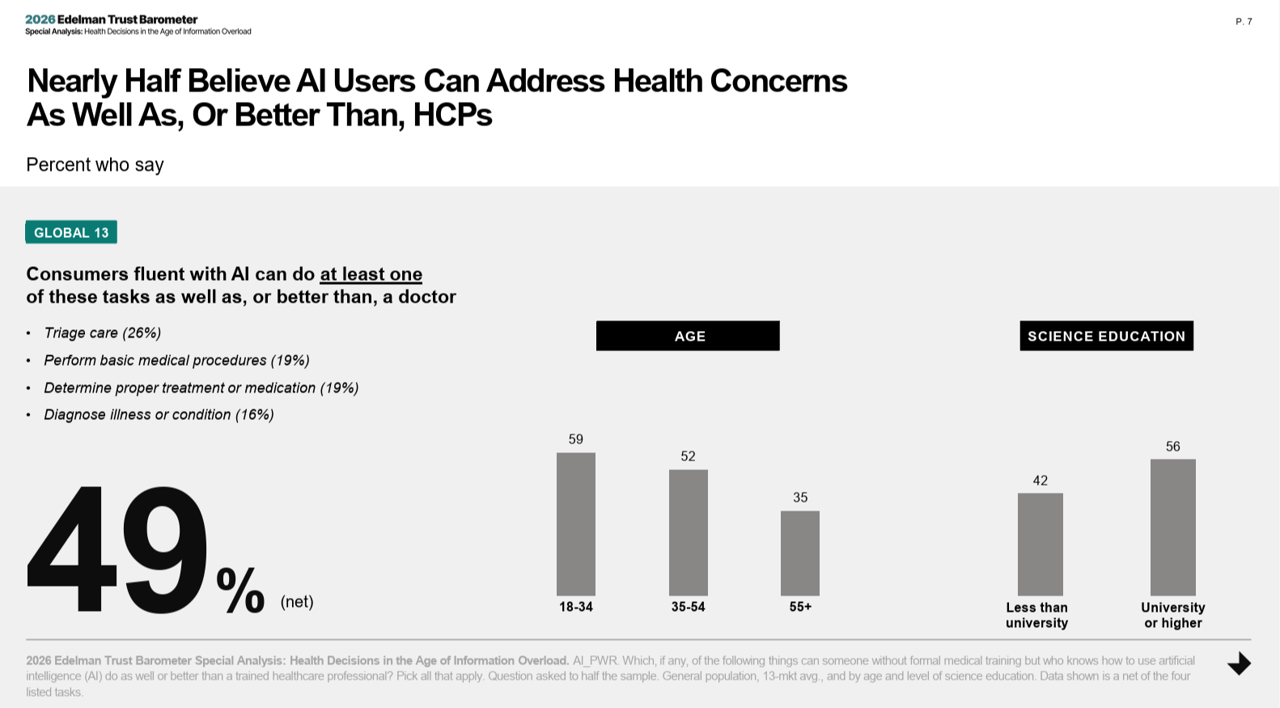
And they found that among AI users, one-half think AI can address their health concerns at least as well as doctors can. 
To gain global health citizens’ perspectives on trust, health, and AI, the Edelman team polled 12,998 adults in 13 countries between late February and mid-March 2026. Countries covered included Australia, Brazil, Canada, France, Germany, India, Indonesia, Japan, Mexico, S. Africa, S. Korea, the UK and the United States.
The first chart reveals that 1-in-2 AI users’ views on using the technology for health concerns in general. However, more granularly, consumers believe AI can handle particular tasks at least as well as a doctor such as 19% who cite triage care (that is, to assess whether and when they need to seek further medical advice), 19% to perform basic medical procedures or determine proper treatment or medication, and 16% to diagnose an illness or condition.
The younger the population, the more likely health citizens are to feel AI can accomplish these health tasks at least as well as a doctor — believed by 59% of those 18 to 34 years of age compared with only 35% of people 55 and over. Formal education also makes a difference in this perspective, with 56% of those with at least a university education believing AI for health concerns can be at least as good as a physician compared with 42% of those with less than a university education.
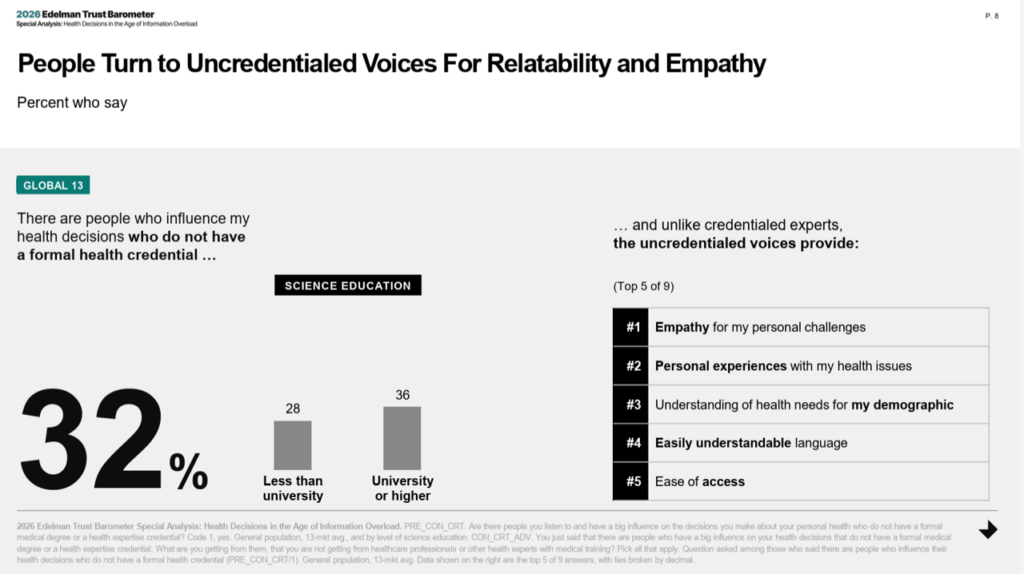
Looking more deeply into the categories consumers deal with for their personal health decisions, the data also revealed that people more highly value their health care provider’s (HCP’s) source of truth for diagnoses, long-term treatments, and disease prevention than for diet and nutrition, and wellness and longevity. For these latter two areas of health decisions, global health citizens more favorably see uncredentialed sources compared with licensed physicians.
Those uncredentialed sources include artificial intelligence (AI), creators without medical training (think: Tik-Top influencers without an MD or RN after their name), family and friends, people they know who have similar health conditions (such as Susannah Fox’s community of peer-to-peer health care), and spiritual leaders.
Health Populi’s Hot Points: People are turning to AI in health care for a range of reasons: in the work I do at the intersection of consumers, technology, home economics, and health, more folks are likely to adopt AI for values of convenience, immediacy, attention, agency, access, and costs — which can be time costs, medical bill costs, and psychological stressors of disease taboos (say, for mental health, sextually transmitted diseases, gender, among others).
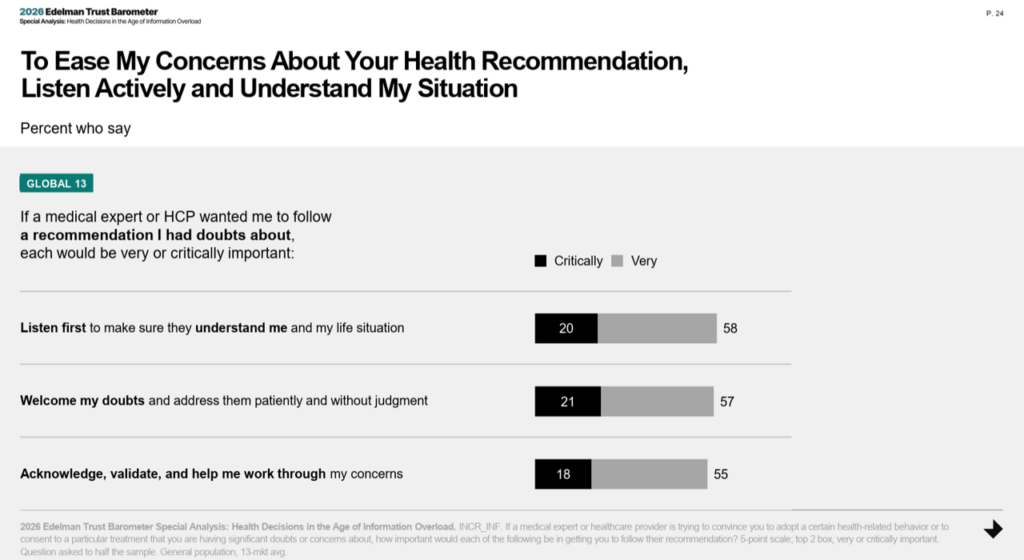
Some of the Edelman data in this round of reporting and analysis points to the consumer’s perception of whether the information source — focusing on the physician here — showing they are “listening actively” and “understanding my situation.”
Over one-half of the global health citizens Edelman polled said that if a medical expert or HCP wanted me to follow a recommendation about which I had doubts, it would be important for them to,
- Listen first to make sure they understand me and my life situation;
- Welcome my doubts and address them patiently and without judgment; and,
- Acknowledge, validate, and help me work through my concerns.
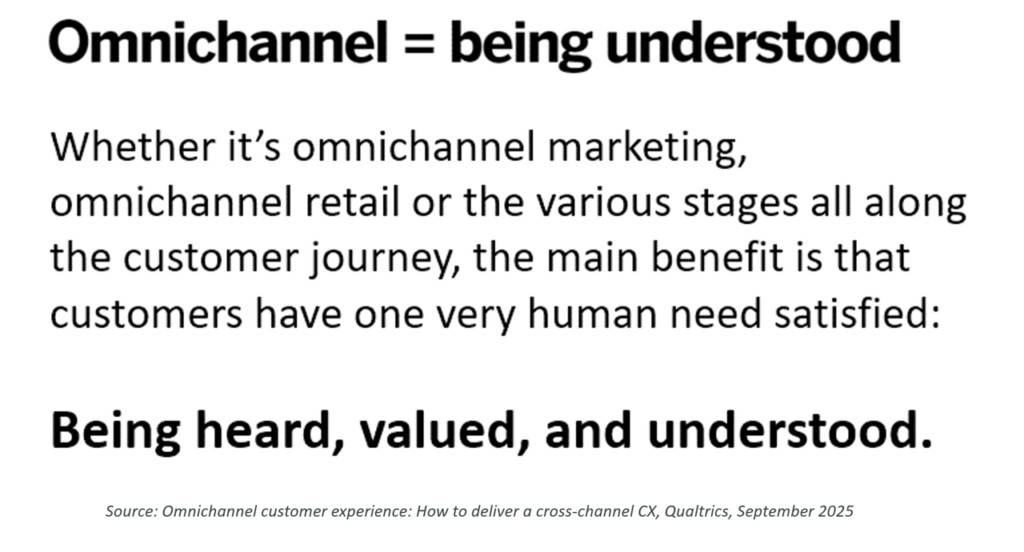
In my work teaching health care corporate executives and client teams on engaging with patients, caregivers, and retail health consumers, I’ve been citing this slide from a recent Qualtrics report on the omnichannel customer experience. I love this statement because it reflects what the 2026 Edelman Trust data reveals in the previous graphic: that “omnichannel = being understood” in the customer journey. In this case, the customer is the patient who yearns to be heard, valued, and understood.
As we all continue in our journeys adopting and using AI for work and living our lives, we are the humans in this loop who need to stay engaged — and to demand relevance and empathy from those with whom we interact for our full lives — at work, in our communities, in our families, and to be sure, in our health care.
 I'm grateful to be part of the Duke Corporate Education faculty, sharing perspectives on the future of health care with health and life science companies. Once again, I'll be brainstorming the future of health care with a cohort of executives working in a global health care enterprise.
 Jane joined host Dr. Geeta "Dr. G" Nayyar and colleagues to brainstorm the value of vaccines for public and individual health in this challenging environment for health literacy, health politics, and health citizen grievance.
  Jane will be working with EU- and UK-based clients in September and October 2026, collaborating with stakeholders in digital health, public/community health, retail health, and growing opportunities for health-at-home. Stay tuned to her updates here on Health Populi on-the-ground as she lives the digital nomadic work-life in Italy, Belgium, the Netherlands, and in London.