

From GLP-1s to longevity and new views on self-care for healthcare, the people are taking their health in-hand, at-home, and via-tech to complement and sometimes replace the legacy health system touchpoints which are the traditional categories for care: hospitals, doctors, rehab centers, diagnostics and labs, and health care financing and plans — some opting out of plans and going full-risk (cash, out-of-pocket) truly self-insuring against future medical risks.
As I prepare to publish my Year-End/New Year TrendCast for 2026, I felt like front-ending next week’s annual long post with details on the demand side of the forecast — a focus on the consumer, patient, caregiver, health citizen. Consider this post the context-setting for the 2026 Health Populi TrendCast which you’ll see next week.
In the past two years, I’ve spent time assessing and working with and through the phenomenon of GLP-1s in health care through the consumer lens — and how this category of prescription drugs are profoundly impacting many segments of the U.S. consumer economy beyond medical care.

The ultra-prescient Scott Galloway predicted in late 2023 that GLP-1s would be “bigger than GPT (#AI)” — and that ripple effects would affect the likes of Walmart and McDonalds.
As usual Professor Galloway has been worthwhile following as he informed me early in the GLP-1 adoption curve to pay attention to what has gone beyond a medical trend to a cultural and economic phenomenon.
Beyond GLP-1s’ positive clinical impacts on diabetes and weight loss, we’re not well into a direct-to-patient (DTP) transformation that I believe is reshaping patients as health consumers in more proactive ways than we’ve seen before in the DTC era.
With the phenomenon of direct-to-patient DTP and programs like Lilly Direct, Hims and Hers (and other disrupters) compounding, and a growing roster of telehealth-style channels expanding the retail health ecosystem, the GLP-1 phenomenon has led to a broader mainstream passion for empowerment and self-care – with more people aware of the opportunity of taking responsibility and action for themselves.
This is another form of health care transformation, fueled by cost and convenience and self-awareness and technology, all these things all at once. 
U.S. consumers’ adoption of weight loss injectable drugs more than doubled in less than two years, rivalling the new-technology adoption curves of some of Americans’ favorite new-new things. The Gallup Poll found that overall, use of semaglutide medicines or liraglutides doubled from nearly 6% in the first quarter of 2024 to over 12% in Q2 + Q3 in 2025.
By comparison, it took statins 17 years to reach this level of market penetration, Henry Dimbleby reported in the Financial Times.
Furthermore, women’s use of these medicines grew more quickly than men’s, shown in Gallup’s data here.

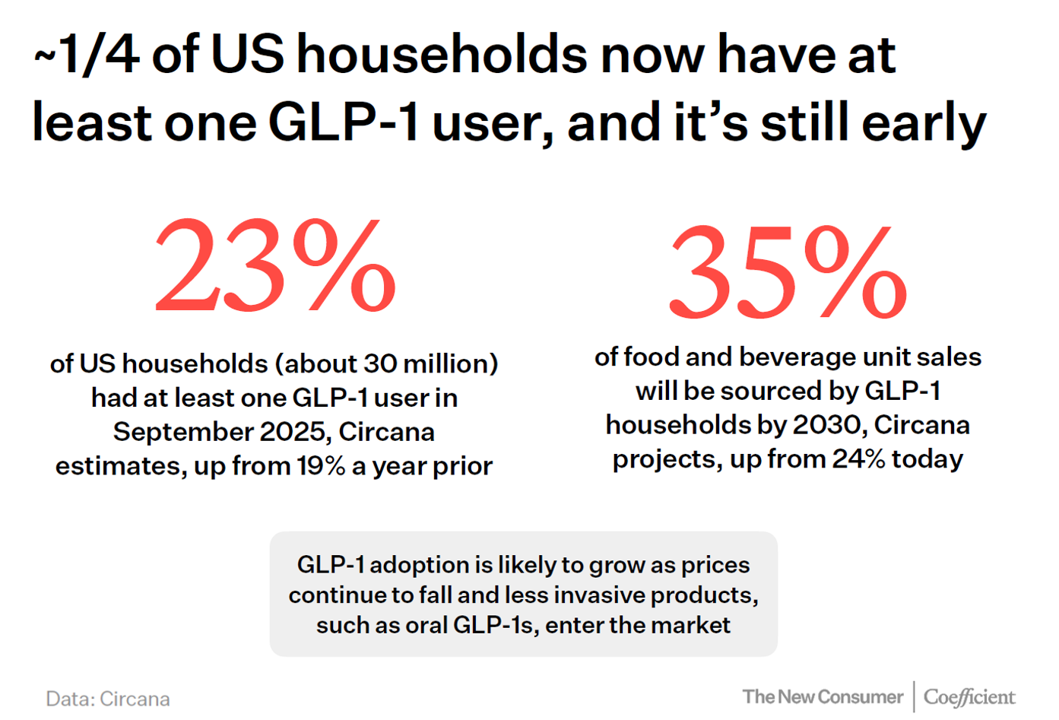
With such a bullish growth rate, o=ne in four U.S. households had at least one GLP-1 user in the family as of September 2025.
Circana’s research expects that GLP-1 adoption will grow as the prices of the medicines continue to fall for both the diabetes- and the weightloss-focused medications. This will result in over one-third of food and beverage sales being bought by GLP-1 using households by 2030, a nearly 50% increase from today.

GLP-1s have reached mainstream, and Main Street, status: two in three U.S. consumers are aware of Ozempic, well ahead of peoples’ recognition of the names of fellow semaglutides Wegovy, Mounjaro, Zepbound, and other related medicines.
I discussed Ozempic as a sort of “cultural shorthand” earlier this year in Health Populi.
The brand ranked #7 on a list of Gen Z consumers’ top-rated, shown in the table here with Poppi soda and Timberland apparel, among other favored products.

As Justin Pincus, Managing Director of The Harris Poll’s QuestBrand group observed,
““Ozempic has crossed over….It’s no longer just a clinical drug, it’s a cultural shorthand.”
I asked him, “what do you mean, ‘cultural shorthand’ for a prescription drug?”
His response:
“We’ve seen it before—Viagra for sex, Ambien for sleep, Xanax for anxiety. Ozempic has joined that elite group where the brand name doesn’t just sell the product… it’s become synonymous with its entire category.”

Two-thirds of Americans now say they want to lose weight, Dan Frommer notes in his Consumer Trends deck for 2026.
Weight loss and balancing metrics like glucose and blood pressure play into consumers’ growing interest in longevity, which Dan covers as a key movement to watch for the coming year.
Over one-half of people see themselves as someone actively trying to live longer, the bar chart illustrates. The active engagement in longevity goals varies by generation, though, which is important for technology and consumer products developers to understand. See that younger folks are more focused on active longevity engagement than older folks — and that fewer people earning under $100,000 a year are less focused on longevity. [Sidebar discussion: is there a market to develop products and services for the longevity economy to meet the needs of people who are less affluent, older, etc.? Clearly, yes.].

As in so many aspects of health care access and equity, there is a longevity-support divide the Toluna data reveals here….of which people are well aware cross age cohort and financial situation.
Most Americans believe being healthy and fit is one of the current status symbols — particularly shared by Millennials. But even 50% of Boomers see being healthy and fit as a status symbol, with only 14% of this oldest age cohort disagreeing. 
In his Financial Times essay, Henry Dimbleby talked about food companies having to change their business model mindset of “value per bite,” given many food category purchases declined in 2025. For health-minded consumers, it’s about “trading up” in various categories, shown in the bar chart.
We can expect other fast-moving consumer good categories and industries adapting to this transformation of body, mind, and spirit for many health-focused consumers and their households. You can see clothing here in the bar chart, beverages, and the restaurant industry. But watch for hospitality (hotels, airlines) and travel, financial services, automotive, and other surprising areas to morph their value propositions toward more convenient, supportive, and health-inspiring products and services.
Stay tuned next week on 23rd December for the full 2026 Health Populi TrendCast with a focus on digital health trends we anticipate will set the stage for CES 2026. I’ll be reporting live from Las Vegas between 2nd – 9th January 2026 from the show floor covering all aspects of health, well-being, and smarter homes for health. You can check out my hashtags at #CES2026, #digitalheatlh, #selfcare, #retailhealth, and so on….and frequent LinkedIn updates as well as Health Populi posts.
In the meantime….we in the Sarasohn-Kahn family wish you and your loved ones a healthy, joyful, peaceful and loving holiday season and 2026….JSK
 I'm once again pretty gobsmackingly happy to have been named a judge for
  Stay tuned to Health Populi in early January as I'll be attending Media Days and meeting with innovators in digital health, longevity, and the home-for-health during
  Jane collaborated on