

The growing adoption of GLP-1 medications has already begun to transform society and industry sectors, along with helping many patients effectively deal with managing diabetes and obesity, and other conditions. There is growing evidence that this group of medicines is also bending the actuarial curves for life expectancy, we learn in the report, The future of metabolic health and weight loss drugs from Swiss Re.
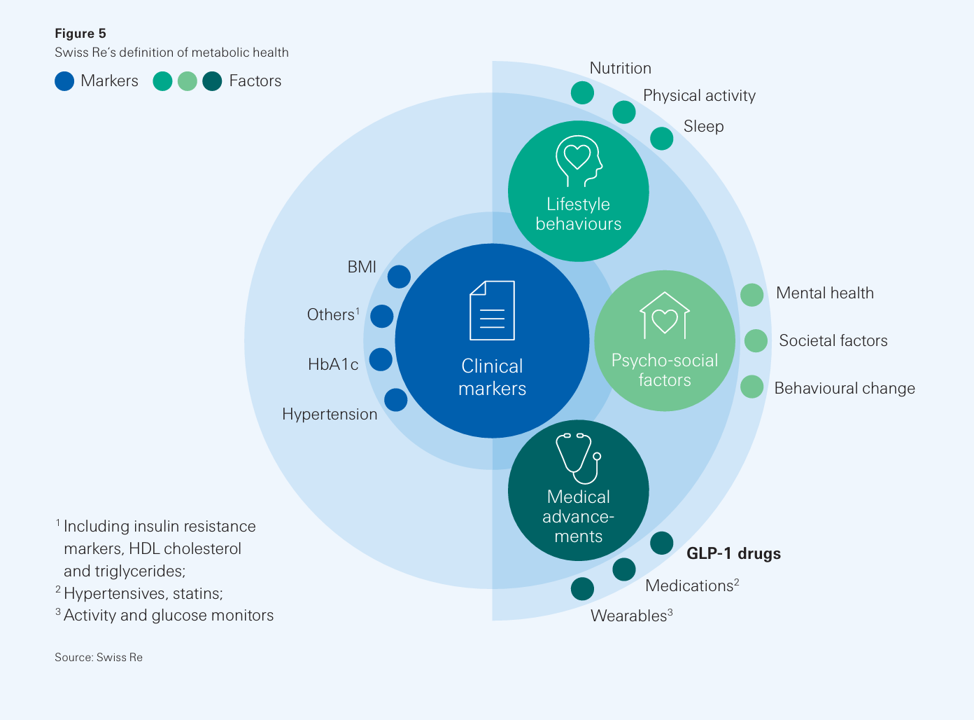
In the report, Swiss Re shares the company’s vision of metabolic health, a graphic for which is shown here. The company (smartly) takes a broad ecosystem view with three pillars addressing lifestyle behaviors, psycho-social factors, and medical advancements (GLP-1 drugs [focused on insulin resistance, HDL cholesterol and triglycerides], medications [hypertensives, statins), and wearable technologies (namely activity and glucose monitors).
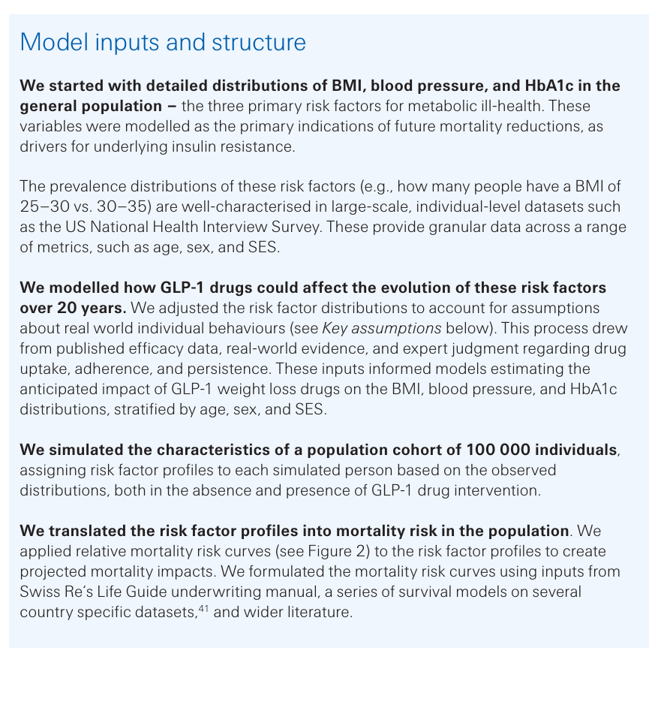
To assess GLP-1 drugs’ impact on peoples’ life expectancies, Swiss Re created models looking at the three primary risk factors for metabolic ill-health: measures for BMI, blood pressure, and HbA1c, examining populations in the U.S. and the UK. The models looked twenty years out, estimating the outcomes for the 3 metrics stratified by age, sex, and socioeconomic strata, across a population base of 100,000 people.
As Swiss Re is one of the world’s largest reinsurance and insurance companies, the researchers could leverage the company’s mortality risk curves from their underwriting manual and the firm’s institutional knowledge and access to other information. 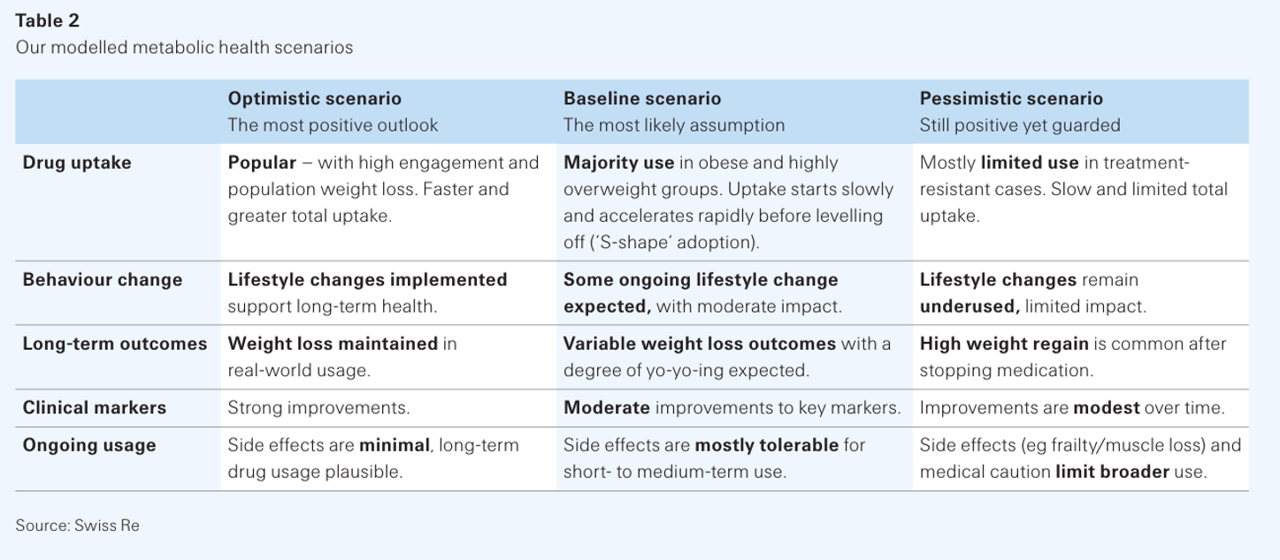
The study then explored three scenarios: an optimistic one assuming consumers’ high engagement and uptake, adoption of lifestyle changes, and strong improvement of the 3 clinical markers; a baseline scenario considered “most likely,” with moderate improvements and impacts’ and, a pessimistic scenario, “positive yet guarded,” where drug uptake was limited, lifestyle behavior change under-adopted, and gains in clinical markers modest.
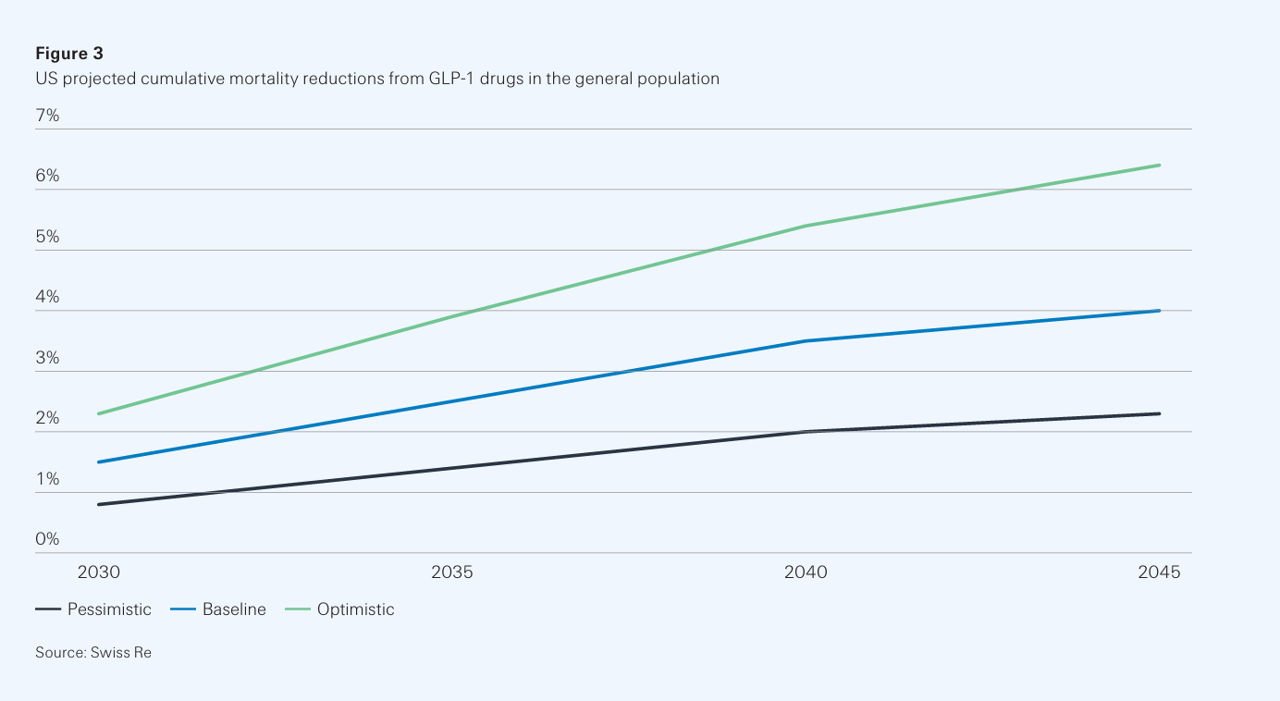
This line graph illustrates the 3 scenarios by impact on mortality reduction in the U.S., illustrating the optimistic green line yielding over 6% in life expectancy improvement, and about 4% under the baseline modest scenario.
The ultimate impacts in how this translates into reality will depend on peoples’ access to the medicines and other factors the ecosystem diagram sets out above. “Larger mortality reductions may be expected in an insured population with high obesity rates and a suitable age distribution,” Swiss Re comments, with “costs…likely to be a prohibitive factor for the uptake of GLP-1 drugs in the short term. Individuals from higher socioeconomic brackets will likely have both better access to GLP-1 medications, with the ability to try alternative medications, seek support for side effects, and the means to implement lifestyle changes.”
Health Populi’s Hot Points: As Swiss Re noted in the previous paragraph here, the health access and equity impacts on a population will vary depending on insurance coverage and a person’s individual circumstances vis-a-vis socioeconomic status, local environment, health system access, food security, and other factors that support or militate against sustainable lifestyle behavior changes that bolster a patients’ success on GLP-1s.
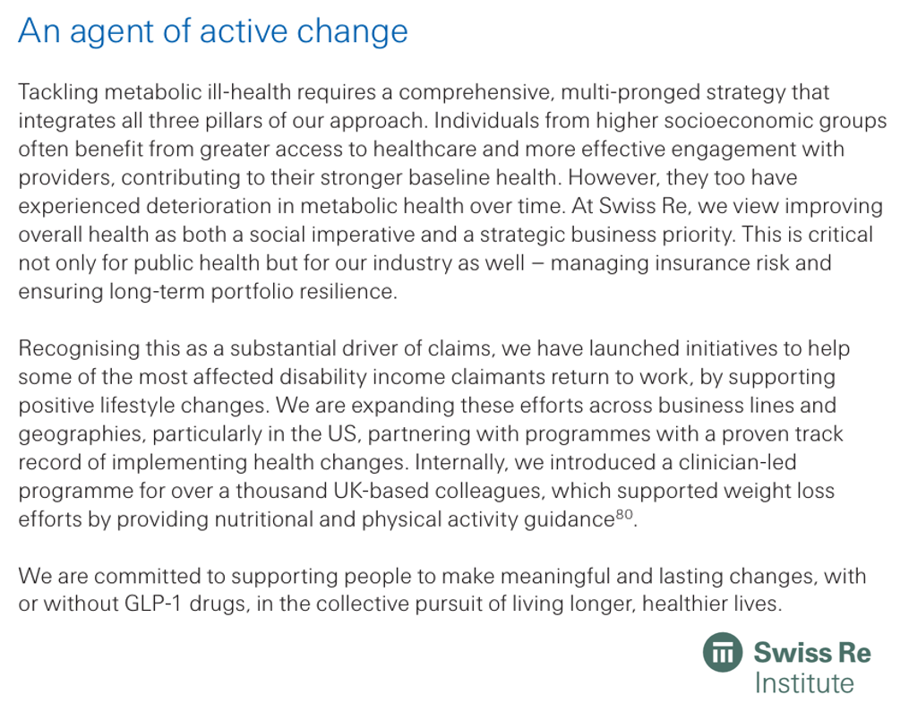
This last graphic from the report states Swiss Re’s own call-to-action as “an agent of active change.” As they assert,
“At Swiss Re, we view improving overall health as both a social imperative and a strategic business priority. This is critical not only for public health but for our industry as well – managing insurance risk and ensuring long-term portfolio resilience.”
The firm commits at the end to supporting people to make meaningful and lasting changes….in the collective pursuit of living longer, healthier lives.
In my ongoing work across the health/care ecosystem, collaboration is key to transforming individuals’ and communities’ health outcomes across industry sectors and siloes. It is encouraging and inspiring to explore Swiss Re’s research into the state of GLP-1s through the reinsurer’s point-of-view beyond a transactional focus — instead, for the company to envision their role in helping people and communities make health, broadly, as a win-win for both the business and the public’s health.
 Jane will be working with EU- and UK-based clients in September and October 2026, collaborating with stakeholders in digital health, public/community health, retail health, and growing opportunities for health-at-home. Stay tuned to her updates here on Health Populi on-the-ground as she lives the digital nomadic work-life in Italy, Belgium, the Netherlands, and in London.
 I was grateful to be Jasmine's first conversation-guest on her new podcast,
  Jane joined host Dr. Geeta "Dr. G" Nayyar and colleagues to brainstorm the value of vaccines for public and individual health in this challenging environment for health literacy, health politics, and health citizen grievance.