


The Bathroom’s Role in the Home as Health Hub: Catching Up with Kohler Health’s CEO at CES 2026

A key Tech Trend to Watch at CES 2026 is consumers’ re-imagining and fitting out their homes as sites for bolstering health and well-being. I’ve been tracking this concept as far back as 2011 when I wrote this post from the 2011 Consumer Electronics Show. A decade-and-a-half later, in déjà vu spirit, the concept is no longer theoretical or futures-thinking. Fast forward from 2011 to the COVID-19 pandemic, when everyone’s home spaces became re-purposed for health, for medical care, for well-being, for fitness and exercise, for cooking up nutritious food, for
Tech Trends to Watch at CES 2026 – For Health, It’s About Longer Living, Smarter Living, and Better Living
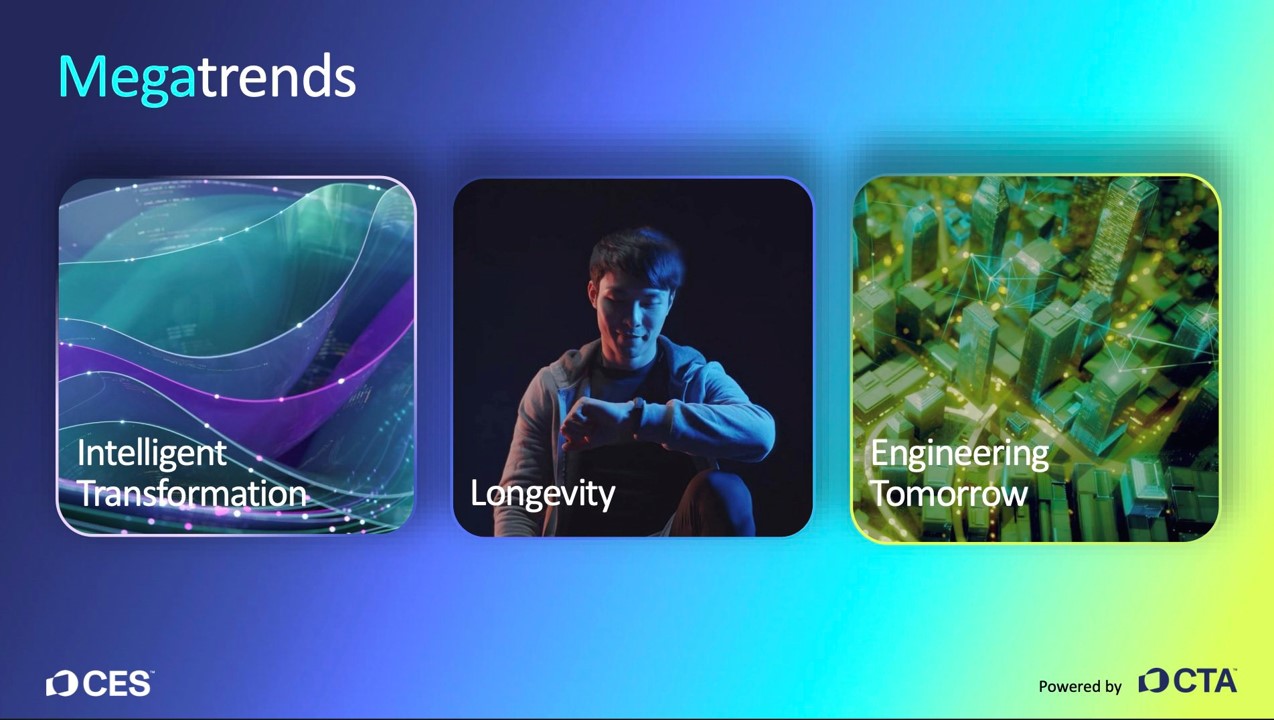
Live from CES 2026 in Las Vegas…the first day of CES Media Days preceding the big show always covers a context-setting report on Tech Trends to Watch. This is one of my annual go-to programs which helps orient media and industry analysts with a lens on CES’s key tech categories and some hard data on market size and growth expectations. While I’ll focus on the health/care specifics in the trend forecast, let me first update you on the overall technology market revenues for the U.S. which are estimated at $565 billion for 2026.
Health Tracking Wrapped Around Your Finger: All About Wearable Tech’s Growing Smart Rings Category at CES 2026
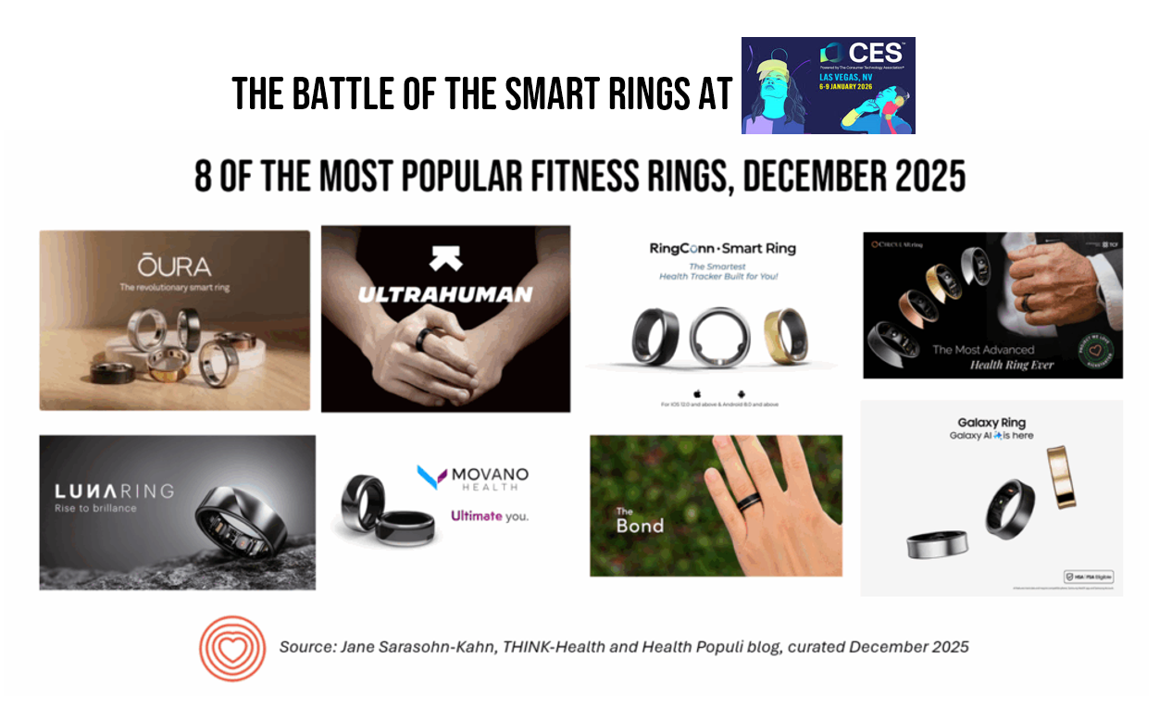
For well over a decade, wearable technologies have been developed for humans from head-to-toe — from forehead-worn bands to address stress and headaches to smart shoes with sensor-embedded soles that assess our gait and posture. In 2013, my CES coverage had a focus on “The Battle of the (Wrist)Bands.” This year, the #wearabletech category feels like a fierce competition for the human real estate of the finger — that is, a battle of the smart rings. Twelve years later, smartwatches are mainstream trackers for health embedded with sensors that are gaining clinical evidence for use in medical care well beyond
Exercise is Health Care, and Consumers Are Willing to Pay – Context for #CES2026
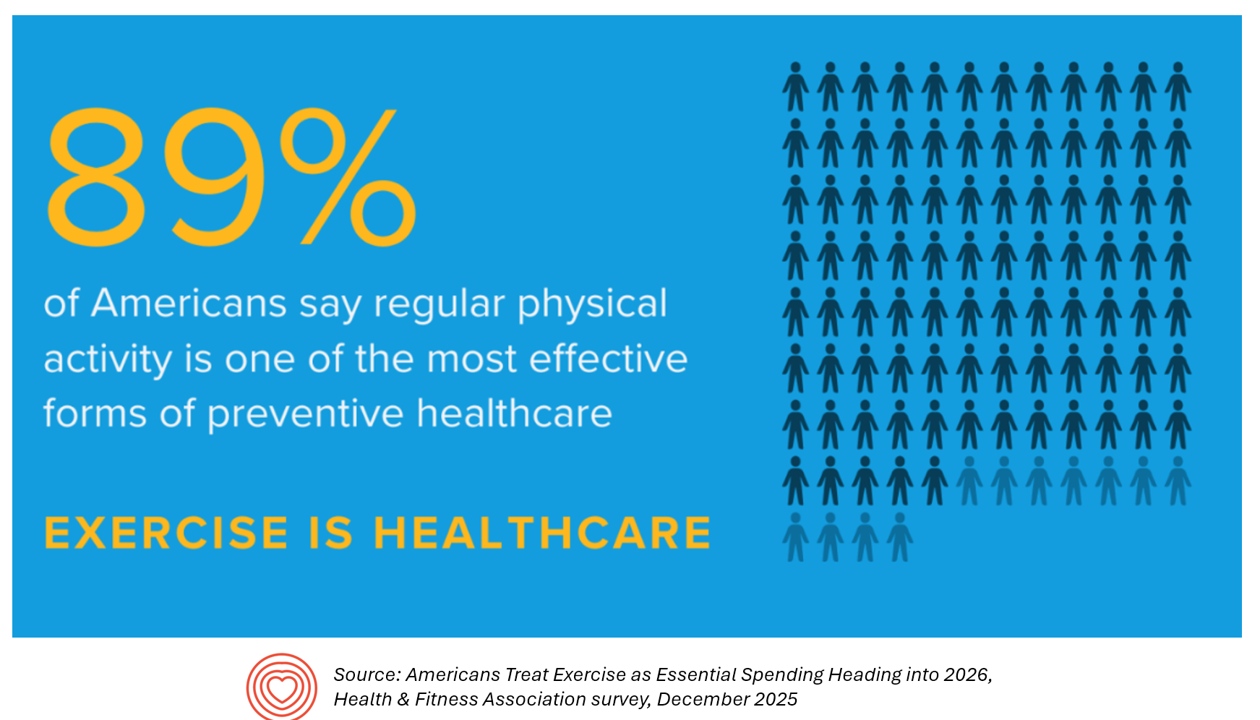
“Americans are not just setting fitness goals; they are budgeting for them,” Liz Clark, President and CEO of the Health & Fitness Association observed. “People increasingly see exercise as an essential investment in their long-term health. Even in a challenging economic environment, Americans are prioritizing physical activity as a proactive form of preventive healthcare.” Americans see exercise as healthcare — and health — according to a survey from the Health & Fitness Association (HFA). HFA commissioned Kantar to conduct the online survey among 2,000 U.S. adults 18 and over in December 2025 — well-timed for the
A Primer on Health Consumers for CES 2026 – How Macro Consumer Trends Will Shape Healthcare Consumers in 2026
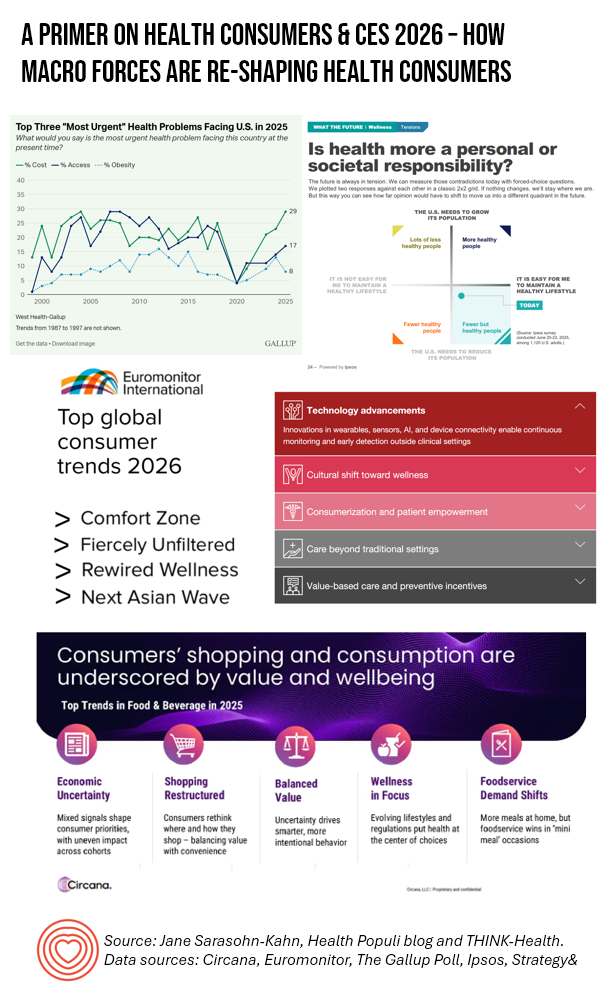
Increasingly, people are engaging more in health care decision making due to many factors impacting their personal medical choices — from the cost and access to health insurance to co-payments for prescription drugs and the supply of primary care doctors, more patients developed and exercised their health consumer muscles in 2025, For 2026, the health consumer muscle-building will grow as people will be re-shaped by macro market factors we are currently gleaning from forecasts looking into the new year: for personal finances, social issues, technology adoption, views on AI and privacy, and other issues. Here are some data points to
Navigating a Constellation of Uncertainties: Health/Care in 2026 (My Un-Forecast)
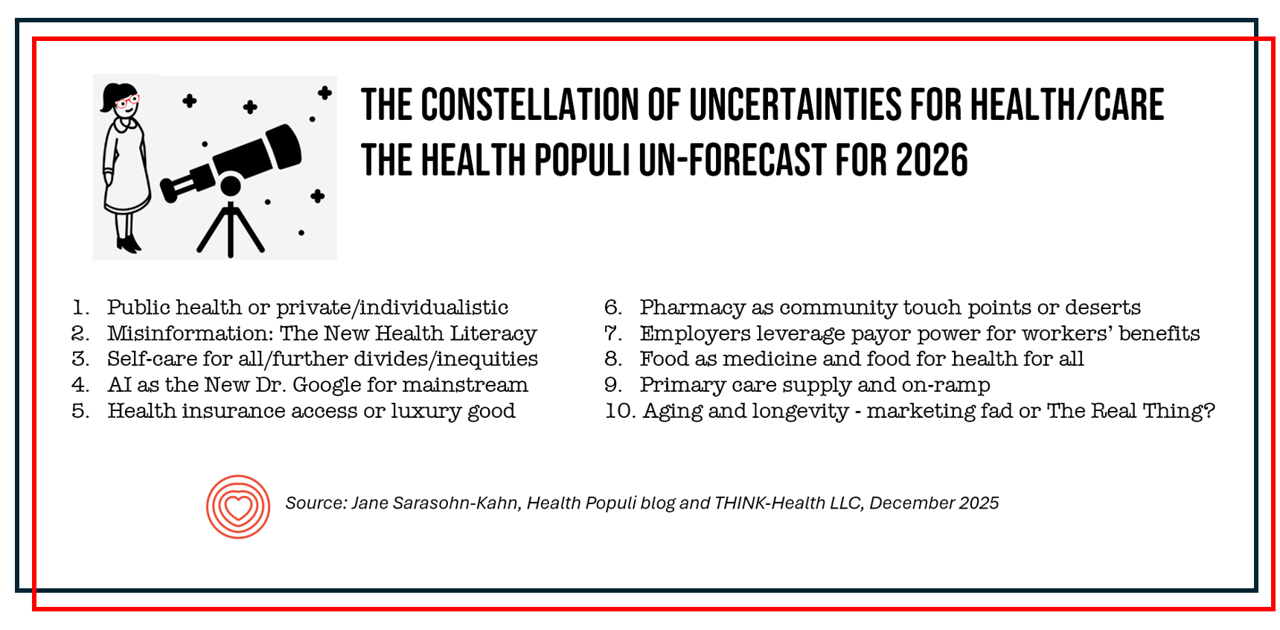
Almost from the first year of launching Health Populi in 2007, I’ve written a “TrendCast” for the coming year of health care. Over many years, there weren’t so many blogs devoted to health care which featured such prognostications, and so readers could divine signal from noise and move forward into new years with manageable lists of What To Expect Next Year in Healthcare. Here’s one from ten years ago that brings a sense of déjà vu: most of the findings are consistent with what we know for sure about 2026 and it’s useful to look back with today’s eyes to
The New Health Consumer Mindset and Wallet: From GLP-1s to Trading Up for Health & Longevity
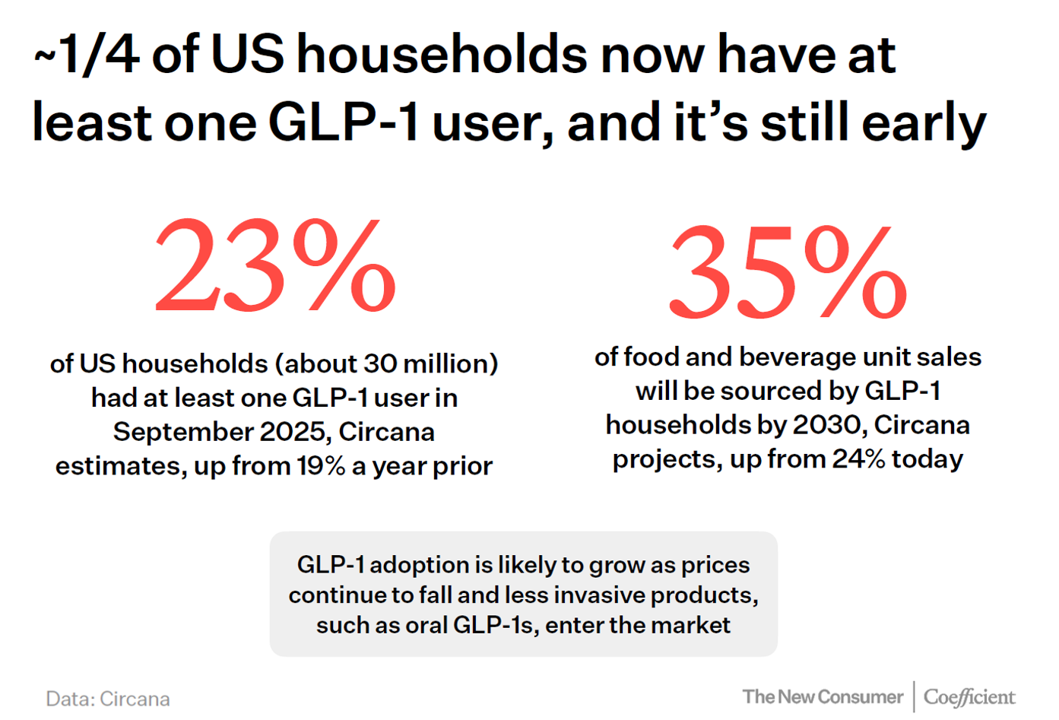
From GLP-1s to longevity and new views on self-care for healthcare, the people are taking their health in-hand, at-home, and via-tech to complement and sometimes replace the legacy health system touchpoints which are the traditional categories for care: hospitals, doctors, rehab centers, diagnostics and labs, and health care financing and plans — some opting out of plans and going full-risk (cash, out-of-pocket) truly self-insuring against future medical risks. As I prepare to publish my Year-End/New Year TrendCast for 2026, I felt like front-ending next week’s annual long post with details on the demand side of the forecast — a focus
Men’s Fertility Feelings – The Influence of Trust and Social Media (My Progyny Post #3)

Trust is a key enabler for people’s health engagement. As the American Medical Colleges’ Center for Health Justice defines it, trustworthiness is “rooted in honesty and honors lived experience….. key to a successful patient-provider partnership.” In his book, Notes On Being A Man, Scott Galloway calls out that men’s fertility issues are formed as part of a larger societal context and crisis point, exacerbated by economic pressures and lack of opportunities for male bonding and in-person social touchpoints. In the second post in this series of three, we discussed those economic pressures Galloway notes, and the financial stressors that shape
Trust and AI in Healthcare: At a Crossroads, Edelman Finds
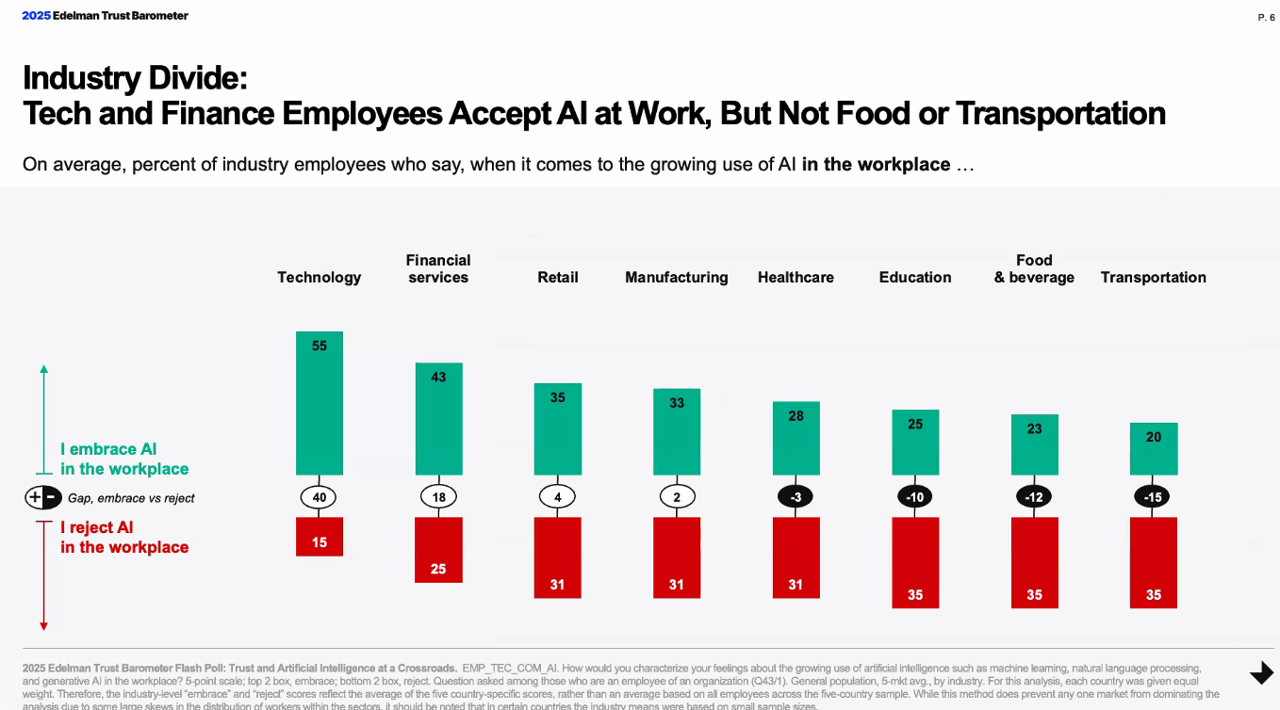
Enthusiasm for innovation is not a guaranteed thing; furthermore, trust in AI lags trust in the overall technology sector, we find in the 2025 Edelman Trust Barometer research through a Flash Poll: Trust and Artificial Intelligence at a Crossroads, discussed in a webcast on 3 December. People in the U.S. are more than twice as likely to reject the growing use of AI than embrace it, with the embrace of AI much lower than peoples’ enthusiasm for it. Edelman conducted the poll in five countries — Brazil, China, Germany, the UK and the US — with sample sizes at least 1,000+
A Month Until #CES2026 – The Journey to Our Personal Health Operating Systems

In a month, I’ll board a plane for Las Vegas to spend a week at CES 2026, the annual electronics conference that last year brought together over 140,000 global technology stakeholders to display, demonstrate, and sell the latest in consumer-facing tech. This will be my fourteenth CES (including the virtually convened meeting held in 2021). If you want to time travel, here’s a link to an early CES post featuring “The Battle of the (Wrist)bands.” Indeed, the digital health aisle at the time had many wrist-worn activity trackers, largely amped-up pedometers, with the likes
The Home Economics of Family and Fertility: Men’s Financial Views on Their Fertility Journeys (My Progyny Post #2)
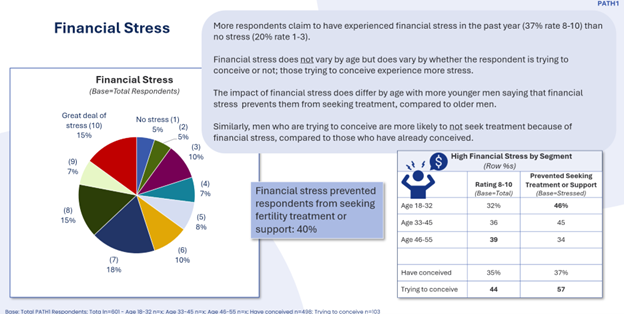
Cost is a leading reason why people say they could not obtain the fertility care they need. But the costs of IVF and other forms of fertility care lie within a larger home economics framework of family-building and -raising. The context and costs of raising a child in America. Consider the layers of a household budget starting with the home’s “macro”-economics of income. Then within that circle, especially in the U.S., the factor of whether that household is covered by employer-sponsored health insurance. The next layer of more health micro-economics in the family is the
Giving Thanks for Pinksocks Today and Every Day….celebrating the book!
As today is Thanksgiving in America, my tradition here on Health Populi is to express gratitude for some aspect of life and living, Most often, I’ve referred to the Engage With Grace Project which reminds us to be mindful of our and our loved ones’ end-of-life wishes as we convene around the big table today with our families and friends over big food and drink. See here for more on Engage With Grace, a project for which I’m most grateful for launching by Alexandra Drane and Matthew Holt For today’s gratitude message,
Feeling Under-Served and Overlooked: Men’s Views on Their Fertility Journeys (My Progyny Post #1)
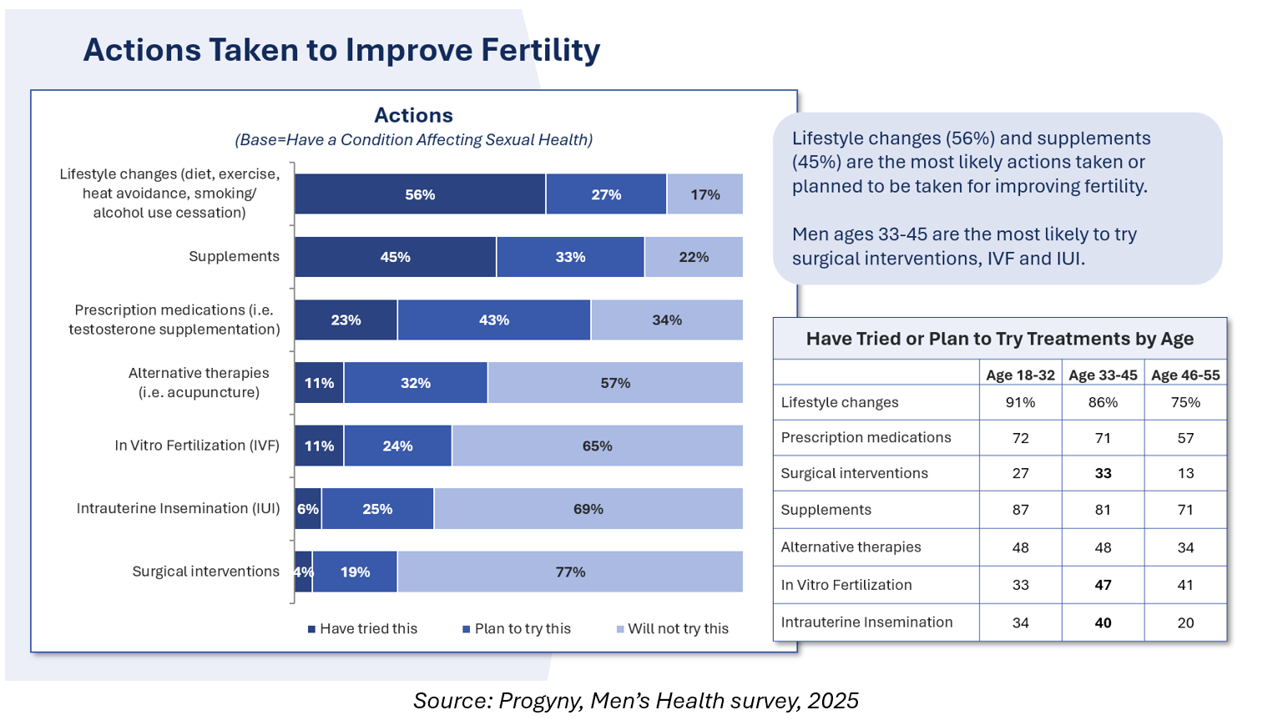
In his latest book, Notes on Being a Man, Scott Galloway discusses his personal fertility journey in the larger social context of what it means to be a man in modern America. Galloway’s infertility challenges shared with his wife inform his views on men’s health across all dimensions — physical, mental health, social health, financial well-being — and how, of course, men’s overall health is also a women’s and children’s issue. Men can feel “left out” of infertility discussions, based on results from the first and largest multi-national study into men’s feelings about their infertility revealed. “How men feel about
Where Health Meets Beauty, Mental Health, and Faith: Learning from the Farmaceutica di Santa Maria Novella
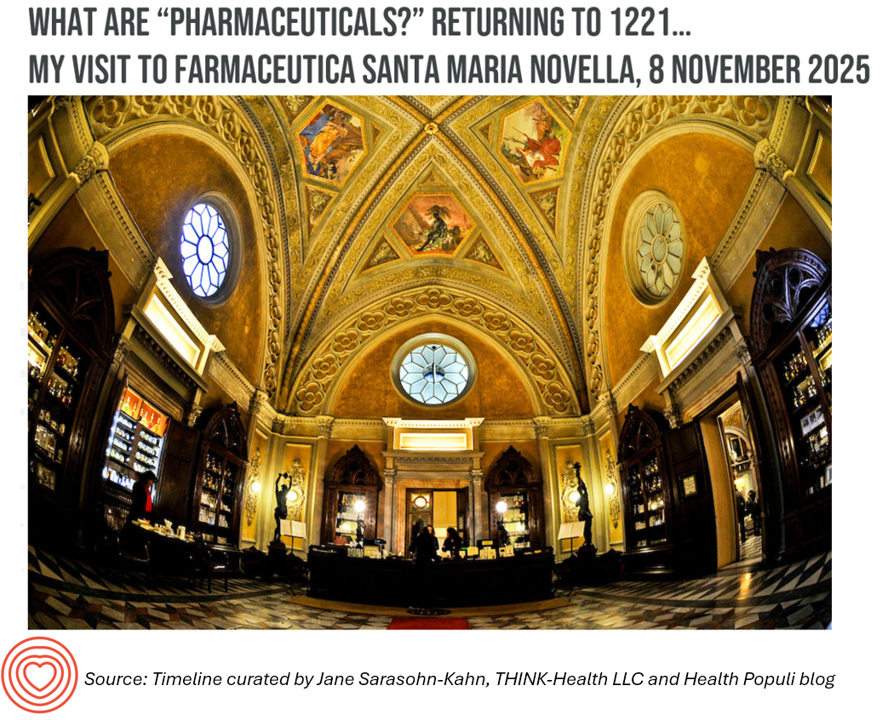
What is a pharmacy? And what are “medicines?” I’ve been thinking about this question for some time, and had the opportunity to consider this in real-time in a sort of back-to-the-past-to-the-future moment when I spent time at the glorious Farmaceutica of Santa Maria Novella (SMN) in Florence, Italy (in longhand, the “Officina Profumo-Farmaceutica di Santa Maria Novella)” on 8th November. This meet-up at this 800+ year old institution is one of many touchpoints in my work and personal life between late October and late November, where I’m working on health/care issues in 4 Euro cities: starting with London in week
As SNAP Benefits Were Threatened to be Cut in the U.S., Eli Lilly’s Obesity Drugs Rose to the World’s Best-Selling Drug
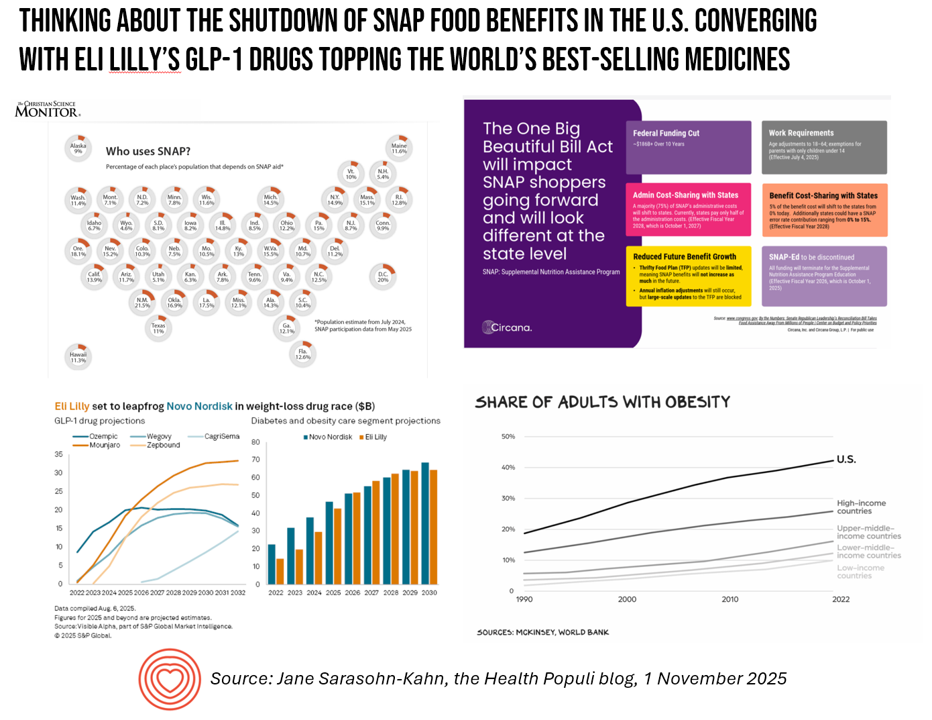
Today, 1 November, the Supplemental Nutrition Assistance Program (SNAP) was to be shuttered and unfunded in at least 25 states until the U.S. Congress agreed to re-open the Federal government and fund this safety net for food security that covers 42 million people in America. Those 42 million people included 16 million children, about 39% of SNAP program beneficiaries. Then last night, a Federal judge intervened to order President Trump’s administration to reinstate funding for food assistance just-in-time. At this moment, I cannot tell you what the exact timing nor the amounts beneficiaries will receive will be.
The Real Face of Men’s Health in America: Years of Life Lost, Yearning for Social Connection, and Eroding Trust in Health Care

In 2023, more than one-half of male deaths in the U.S. were premature: this is The Real Face of Men’s Health in America, a new report analyzing 2025 U.S. data from the Movember Foundation. The report was published as we approach November which the project chose for Men’s Health Month when launching in Australia over 20 years ago. Compared with the rest of the economically-developed world, Movember found that the “U.S. stands out for the sheer number of years of life lost (YLL), as well as the enormous toll of men’s early deaths
A Chasm Between U.S. Health Citizens: Is Vaccination a Personal Choice, or for the Benefit of All?

One of the only uniting factors in U.S. health care across political parties is that most of the nation’s health citizens, cross-party ID, trust doctors and their professional associations for reliable information on vaccines. Pediatricians in particular are mostly-trusted for vaccine facts, according to the KFF Tracking Poll on Health Information and Trust: Tylenol-Autism Link and Vaccine Policies, the latest in the Kaiser Family Foundation’s series on Health Information and Trust Tracking Polls. The biggest trust-chasm when it comes to sources for vaccine information is Americans’ split views on Robert F. Kennedy Jr., the Secretary
The Shorter-Term Future of Healthtech is AI for Administration – Silicon Valley Bank Reads the Tea Leaves
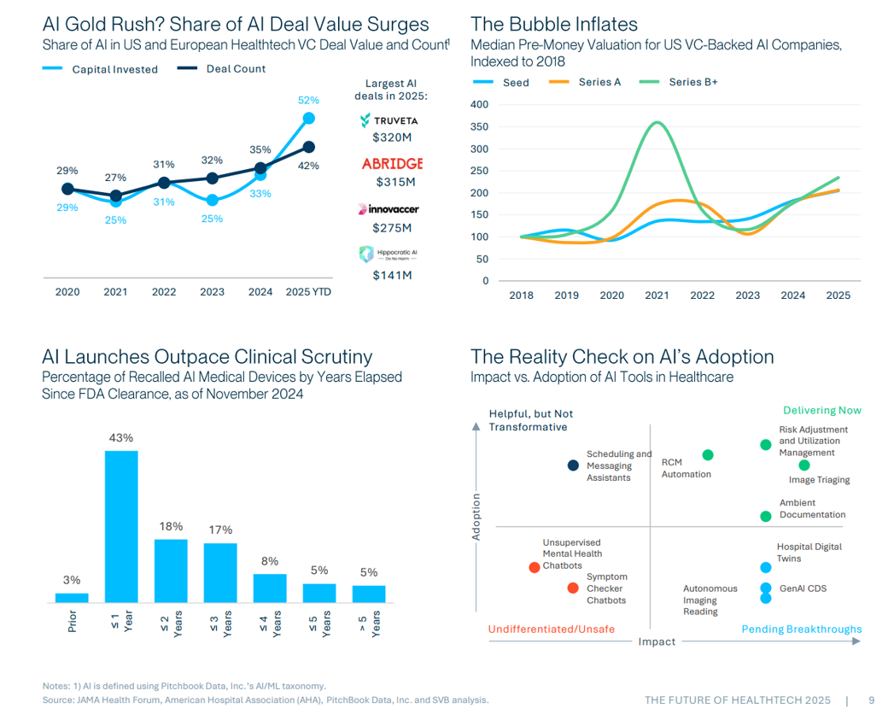
Too much money is going into too many untested AI applications in health care, we learn in The Future of Healthtech 2025 from Silicon Valley Bank (SVB). While “the new healthtech is here” in the form of AI-everything, SVB points out that it’s “Provider Ops” and the back office that’s driving the sector. “Healthtech is now definitively an administrative sector, not a clinical one,” SVB asserts in the first of three key themes plot-lining the report. What sets the stage for context are these four important
Why I Love The LEGO MRI Scanner
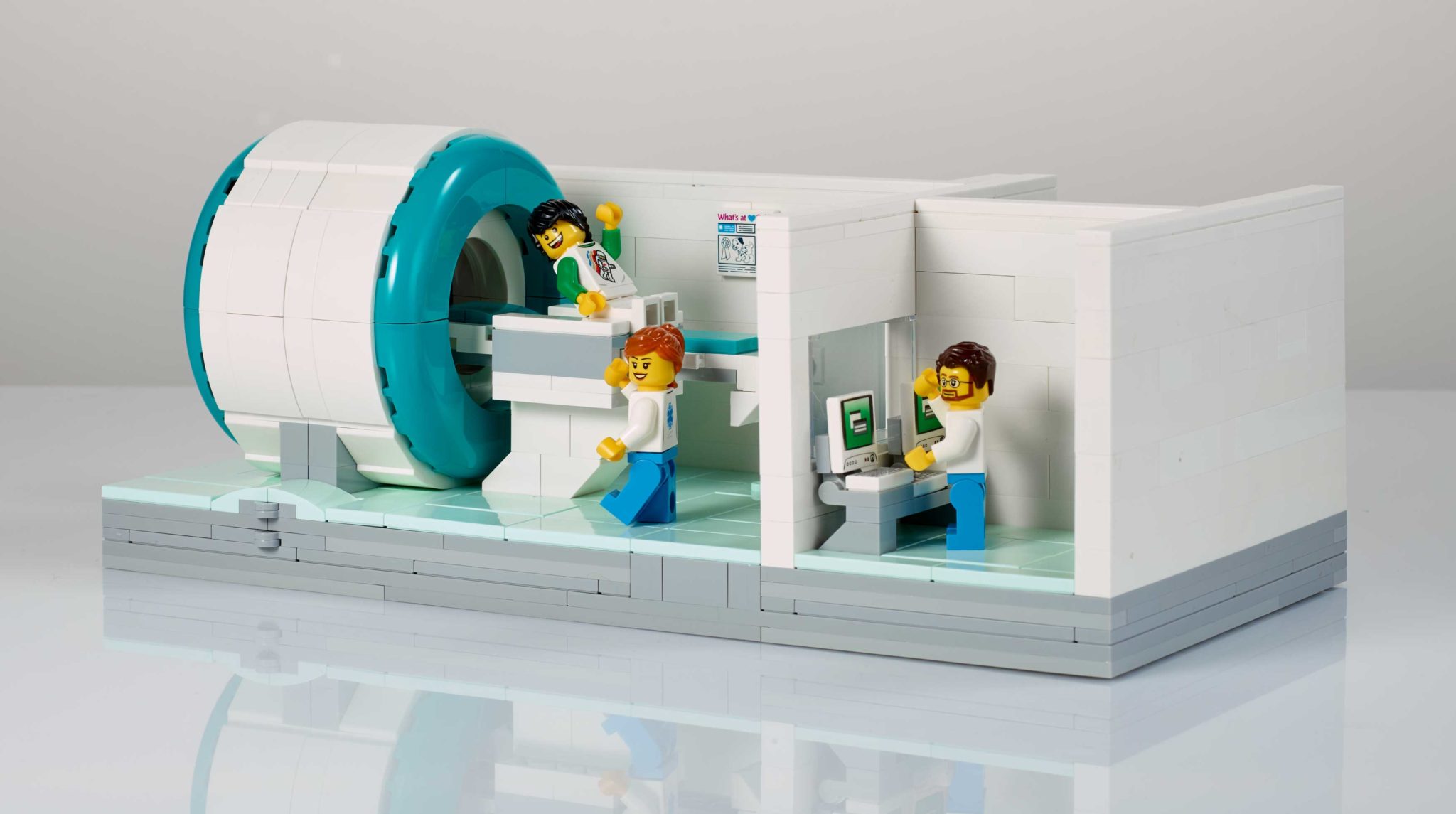
Over one million children around the world have played with an MRI building set from LEGO, which has reduced the young patients’ feelings of anxiety pre-scan along with reducing levels of need for anaesthesia to prep for the MRI procedure, according to the company’s October 13 press release. The LEGO MRI set is a project of The LEGO Foundation and its commitment to ESG — Environmental, Societal, and Governance goals. “Since 2023, more than 10,000 LEGO MRI Scanner sets have been donated to hospitals and health professionals around the world as part of the LEGO
Paging Dr. Verily – What Consumers Want from Health Tech: Personalization, Control, Privacy, and Ease
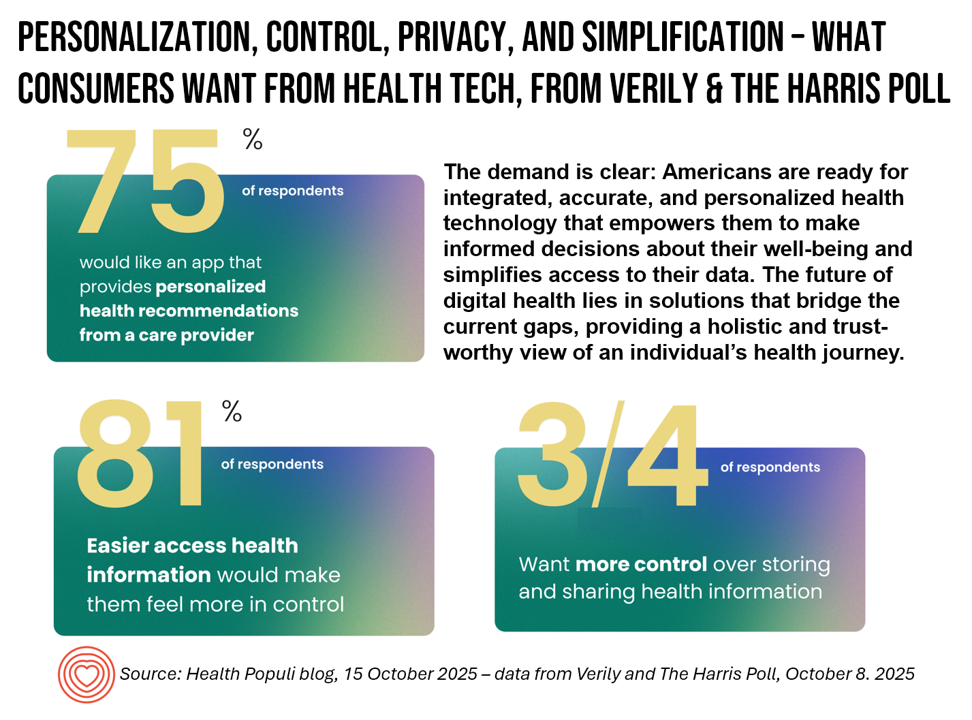
“What do consumers want from their health technology?” wondered a poll conducted among smartphone-owning health care decision makers. Greater control and engagement in health care, assurance of privacy and security for their health data. and greater personalization of advice coming out of the analysis of that shared personal health information. Welcome to the Consumer Survey on Personal Health Technology, market research conducted by Verily with The Harris Poll among 2,000 U.S. adults 18 and older in July 2025. The screening criteria used to include a survey respondent were two-fold: whether they owned a smartphone, and made the majority of their
 Thank you Aaron Strout for hosting our conversation on the Reaching Higher Podcast, now live on Apple, Spotify, and YouTube. We covered a lot of ground addressing health care and health citizenship, the growing prospects for our homes as our health hubs, and how our humanity is a key ingredient in health-making for all.
 Jane joined host Dr. Geeta "Dr. G" Nayyar and colleagues to brainstorm the value of vaccines for public and individual health in this challenging environment for health literacy, health politics, and health citizen grievance. Click onto the Pfizer Value of Vaccines site and you can watch four episodes covering the challenges with adult vaccination, the employer and health plan member's journey to vaccination, reimbursement, and collaborating for proactive prevention.
 I'm grateful to be part of the Duke Corporate Education faculty, sharing perspectives on the future of health care with health and life science companies. Once again, I'll be brainstorming the future of health care with a cohort of executives working in a global pharmaceutical company.