


The Connected Consumer – she loves her iPad, and she’ll be able to Connect for Health
She’s likely to be female, Facebooking, smartphoning, and digitally shopping. She’s the Connected Consumer, and she’s a lot older than you might expect: on average, 40 years of age, and with a mean household income of $63,000. And Connected she is: in addition to having a PC or laptop computer, 43% have a smartphone, and 16%, a tablet. Meet the Connected Consumer is a report from Zmags, a digital design company. Zmags surveyed 1,500 U.S. adults in November 2012 who owned a tablet, a smartphone and/or a computer, asking people their views on shopping, apps and the digital lifestyle. Connected
On the road to retail health: healthcareDIY and primary care, everywhere
At the ConvUrgent Care Symposium in Orlando, attendees from the worlds of clinics, ambulatory care, hospital beds, pharmacies, medical devices, life sciences, health information, health IT, health plans, academic medical centers and professional medical societies came together to share and learn about the morphing landscape of retail health. The topline message: primary care is everywhere, and based on the response to my keynote talk this morning, every stakeholder segment gets it. My mantra, courtesy of the U.S. Surgeon General Regina Benjamin: don’t look at health in isolation, that is, where the doctor and hospital are. Health happens wherever the person
Stop SOPA
Health Populi’s Hot Points: Please stop censorship in the United States of America. Click on this hyperlink to easily contact your Congressional representatives and express your opinion on SOPA and PIPA – two laws that would limit basic freedom in the marketplace of ideas and commerce.
Hey, Big Spender: 1% of US health citizens consume 20% of costs
Cue up the song “Hey Big Spender” from the Broadway hit, Sweet Charity, when you read the January 2012 AHRQ report with the long-winded title, The Concentration and Persistence in the Level of Health Expenditures over Time: Estimates for the U.S. Population, 2008-2009.” The report’s headline is that 1% of the U.S. population consumed 20% of all health costs spent in the U.S. in 2008 and 2009, illustrated by the chart. These Big Health Spenders tend to be in poor or fair health, older, female, non-Hispanic whites and people with only publicly-provided health insurance. Their mean expenditure was $90,061. The top 10%
Health IT in 2012: a dynamic sector in the context of a fiscally-challenged health system
2012 will be a dynamic year for health information technology (health IT) in the U.S., which I outline in my annual health IT forecast in iHealthBeat, the online publication on technology and health care published by the California HealthCare Foundation. The full forecast can be found here. The key headlines for you Reader’s Digest abridged fans are that: The Health IT sector will continue to grow jobs in the ongoing Great Depression, particularly in key competencies in data security, analytics, integration, and EHR implementation. There will be more data breaches, and consumers will be justifiably concerned about data security. Government will more consistently
Consumers are at the center of the business of health and wellness
The market for health and wellness has traditionally included over-the-counter medicines, gym memberships, and vitamins/minerals/supplements. In 2012, the boundaries of health/wellness are blurring beyond these line items toward preventive medical services and consumer electronics. This morphing market is discussed by Cambridge Consultants in their report on the disruptions driving The Business of Health & Wellness: Engaging consumers and making money. Cambridge correctly introduces this analysis by saying that economics, the growing prevalence of chronic diseases, an aging population, and demand consumers are shaping health/wellness, “recharacterizing” the market as one driven by “life events.” Cambridge sees that health consumers are changing their spending
UK finds telehealth reduces mortality by 45%; telehealth’s tipping point in 2012
As we approach 2012, we health prognosticators like to forecast what we’ll likely see in 2012. One of the for-certain trends will be the uptake of telehealth programs, which will be publicly, privately, and jointly-funded. The business case is clear for telehealth, both in the U.S. and globally. Jon Linkous, CEO of the American Telemedicine Association, told the mHealth Summit last week that, the “shift in the way healthcare is paid will put providers in driver’s seat when it comes to choosing the best way to deliver healthcare and whether or not to use telemedicine.” The forces are converging for telehealth
Designing health technology for people at home
The Internet, broadband, mobile health platforms, and consumers’ demand for more convenient health care services are fueling the development and adoption of health technologies in peoples’ homes. However, designing products that people will delight in using is based on incorporating human factors in design. Human factors are part of engineering science and account for the people using the device, the equipment being used, and the tasks the people are undertaking. The model illustrates these three interactive factors, along with the outer rings of environments: health policy, community, social, and physical. Getting these aspects right in the design of health technologies meant for
Primary care, everywhere: how the shortage of PCPs is driving innovation – especially for patient participation in their own care
The signs of the primary care crisis in America are visible: A growing number of visits to the emergency room for treating commonplace ailments Waiting lists for signing up with and queuing lines to see primary care doctors Fewer med students entering primary care disciplines Maldistribution of primary care practitioners (PCPs) in underserved areas, rural, exurban and urban. The implementation of the Affordable Care Act will (try to) enroll at least 30 million newly-insured health citizens into the U.S. health system. That’s the objective: whether being insured will actually provide people access to needed primary care is a big question given the current supply of
Tech fast forward families are ripe for health care self-care
Kids lead their parents in the adoption of digital technologies; that’s why the youngers are called Digital Natives. An intriguing survey of adults’ use of technologies finds that those who do so like “childlike play,” and at the same time, for kids, make them feel more grown up. The trend, Ogilvy says, is blurring generational lines: market to adults as kids, and kids as adults. This convergence is leading families to become more “units” — parents and kids increasingly on the same page in purchase decisions. In Tech Fast Forward: Plug in to see the brighter side of life, from
Health is a team sport: the 2011 Edelman Health Barometer
Lifestyle, nutrition, the environment and the health system are four key factors that people globally say have the most impact on their health. Underlying these influences, its friends and family who most shape our health, followed by government and business. Welcome to the 2011 Edelman Health Barometer, the third year the communications firm has polled health citizens around the world on their views on health, behavior change, and the use of information and digital tools. Edelman conducted 15,165 interviews 12 countries in North America, Asia and Europe to gather health citizens’ perspectives. The top-line, globally, is that there is a knowledge-action
Telemedicine is an enabler of health reform
Globally, in developed economies, the challenges of increasing health care costs, access to quality health care, aging citizens and the supply of clinicians are universal. CSC says telemedicine can address these challenges as part of reforming health care delivery and financing throughout the world. In Telemedicine: An Essential Technology for Reformed Healthcare, CSC sees telemedicine as an enabler for health reforms’ goals the world over. In the U.S., telemedicine is explicitly mentioned in the Affordable Care Act. In April 2011, the Federal Register included language about health financing reform that said, “The ACO shall define processes to promote evidence-based medicine and patient engagement, report
Doctors using tablet-based EMRs like portability, productivity and patient communication
The past year has seen a huge jump in the number of hours that physicians spend online; at the margin, the increase is due to physicians’ use of online via mobile platforms. Meredith Abreu-Ressi, President of Manhattan Research, shared her insights into the firm’s study, Taking the Pulse (v. 11), with me today. The top-line finding of the annual survey is that health professionals have quickly adopted mobile platforms in health — with special attention paid to Apple products, the iPhone and the iPad. Manhattan Research has tracked physicians’ use of online health resources for over a decade. They’ve found
A long-term care crisis is brewing around the world: who will provide and pay for LTC?
By 2050, the demand for long-term care (LTC) workers will more than double in the developed world, from Norway and New Zealand to Japan and the U.S. Aging populations with growing incidence of disabilities, looser family ties, and more women in the labor force are driving this reality. This is a multi-dimensional problem which requires looking beyond the issue of the simple aging demographic. Help Wanted? is an apt title for the report from The Organization of Economic Cooperation and Development (OECD), subtitled, “providing and paying for long-term care.” The report details the complex forces exacerbating the LTC carer shortage, focusing
Verizon expanding into remote and mobile health for senior living – what it means for healthy aging and medical costs
The announcement that Verizon, the telecommunications giant, will partner with Healthsense, a home health monitoring company, indicates that the adoption of telehealth services beyond project pilots and government-funds required to bolster the market is real. Verizon is upgrading the FiOS network, which it will extend to senior housing and assisted living communities that would use Healthsense’s suite of remote health monitoring, personal emergency response systems, wireless nurse call, and wellness monitoring products. The broadband FiOS network is upgradeable to 100 megabits per second, which would enable the bandwidth required by home health technologies that require high performance and reliable network connectivity. These
Are health innovation and cost-reduction mutually exclusive? Insights from West Wireless’s Health Care Innovation Day DC
Representatives from eight U.S. Federal government agencies, including the FDA and Veterans Administration, among others; health financiers (VCs, angels); health tech start-ups; providers, life science companies, and analysts, attended the Health Care Innovation Day DC sponsored by West Wireless Health Institute on April 28, 2011. The meeting had the tagline, A Discussion with the FDA, setting the stage for a day-long consideration of the role of regulation vis-a-vis health innovation. The $2.5+ trillion question (annual spending on health care in the U.S.) is: can innovation drive making health care “cheaper?” This was the underlying theme of the panel on which I sat
Retail health options expand with American Well and Activ Doctors going direct
The traditional venues for retail health are found in pharmacies, grocery chains, and on the ground floor storefronts in hospitals. Joining these bricks-based models are digital, online health ventures that are expanding the definition and space of retail health. This week, two announcements illustrate this phenomenon, from American Well and Active Doctors. American Well, which launched in 2008, is an online physician consultation service in the U.S. that has successfully worked with health plans to channel consults to patients in Hawaii, Minnesota, and New York, among other local programs. Last year, American Well went live with the Rite Aid pharmacy chain in Pennsylvania. This week, American
While BlackBerry will hold largest share of health market, iPhone and Android adoption will grow in next 2 years
Nearly 1 in two mobile phone platforms in hospitals had a BlackBerry brand in the fourth quarter of 2010. However, within 2 years, more mobile phones will be labeled iPhone or Android, eroding the Blackberry share of the market as health workers abandon their cell phones for smartphones and switch away from their BlackBerry devices. Still, 1 in 3 hospital workers will be using a BlackBerry in 2013, as the chart illustrates. Amcom Software conducted a survey of 300 hospitals and health systems in October 2010 to assess their views on smartphones and the emergence of tablets in hospital settings. While paging (job-related alerts)
What telehealth can do for the Health of Nations
Health care cost increases are unsustainable the world over; in developed nations, the forecast is even more dire given exploding demand for health services as citizens age. Cisco polled senior leaders in health systems globally to gauge their views on the challenging state of health care in their respective nations, and prospects for health system improvement. The triple-mantra for senior health leaders is access, efficiency, and quality. Access takes the form in this survey in maldistribution and insufficient number of health professionals. Efficiency looks like patients referred for unnecessary care coupled with long lines (queues) for needed services. Quality measurement continues to
Increasing smartphone uptake will drive higher use of mHealth apps globally
Adoption of mobile health (mHealth) apps will increase by 23% as a compound annual growth rate. according to a forecast from Arthur D. Little (ADL), featured in their report published in April 2011, Capturing Value in the mHealth Oasis. What is this mHealth Oasis? ADL notes that mobile network operators (MNOs — mobile phone companies) see gold in them thar’ health hills given unsustainable health economies the world over. However, ADL rightly points out that mobile health is just about as easy to conquer as any other aspect of health technology, full of minefields. ADL lays out the success factors for MNOs who want to engage
Telemonitoring for health must be patient-centered and participatory
In December 2010, an article describing a telehealth remote monitoring program for heart failure patients concluded that telemonitoring did not improve patient outcomes. The paper, Telemonitoring in Patients with Heart Failure, written by Sarwat I. Chaudhry, M.D, and nine other authors, analyzed 1,653 CHF patients, 826 of whom participated in a remote health intervention: a telephone-based interactive voice-response system that patients dialed into on a daily basis to report symptoms and weight; this was designed to occur every day over six months. These data were then reviewed by patients’ clinicians who could contact patients when data pointed to the clinical need to adjust patients’ medications and other parameters.
The Connected Patient: some forces converging in the market, but barriers remain
Remote health monitoring, which enables people to track health and daily living metrics when they are in one place and communicate those measures to another node via some communications platform, is not a new concept. Telehealth, telemedicine, consumer-facing health electronics like USB-ported blood pressure monitors, and some mobile apps can all fall under the broad umbrella of remote health monitoring. There are strong market forces converging to enable health citizens to connect to their providers, institutions, payors, health coaches, caregivers, and each other. Still, a balanced look under the remote health monitoring hood reminds us that old saw taught to me by colleagues
The home health hub is digital, mobile and personal
Bet on it, live from Las Vegas at this week’s Consumer Electronics Show (CES): the new home health hub is digital, mobile and personal. More consumers are morphing TV and video watching from the “set” to the computer and mobile platforms, and DIYing more activities of daily living. Health (for both wellness and sickness care) is transforming in this process. This transformation is enabled through consumers’ adoption of technologies that they’re using in their daily lives for entertainment, household management, and communications. Broadband and wireless provide the infrastructure for health care to move beyond the doctor’s office and the hospital, so engaged patients who choose to do
New year, new you, new health apps
As health citizens the world over vow to lose N zillion pounds in this first week of 2011, they’ll go beyond buying into Weight Watchers’ tempting offer to join “for free” (not really, folks), purchasing Home Shopping Network’s “Today’s Special” Earth brand Exer-Trainer sneaker, and getting motivated by Jillian Michaels gut-busting workouts on The Biggest Loser (her last season, by the way). People wanting to lose weight will adopt mobile health apps in record numbers in 2011. This category of mHealth apps is among the largest and most downloaded apps available. By the fourth quarter of 2011, most phones on the street
What health care IT holds for 2011: politics vs. market realities
The one issue in health politics that’s got bipartisan support is health care IT. While Republicans in the House may try to pick away parts of the Affordable Care Act, the HITECH Act — part of the 2009 stimulus package formally known as the American Recovery and Reinvestment Act — will stay intact, according to most industry analysts (including me). However, political agreement doesn’t equal market adoption. So forecasting what 2011 will mean for health information technology requires some deeper analysis of additional issues. For today’s Health Populi, take a look at my annual health IT forecast in California HealthCare Foundation‘s
When with the “Future of Health” happen?
It’s year-end, so the forecasts abound whether we’re talking about trends in technologies, products and services. Gartner says cloud and mobile computing are hot, but managing customer expectations will require heavy lifting On the food front, Epicurious predicts that food halls will be all the rage (think Harrods in London or Takashimaya in Tokyo), Korean cuisine in demand, and sweet potatoes crowned the vegetable of 2011. For colors, Pantone is Queen and they see that honeysuckle (a salmon-pink) is the new black. In health technology, there’s no better list to read than CSC’s The Future of Healthcare: It’s Health, Then Care, which offers up top 10 technologies
Are Influentials less keen on connecting health? Practice Fusion says ‘yes’
I posted here yesterday on Practice Fusion‘s survey on consumers’ views of remote health monitoring, discussing a key finding that older Americans are less keen on the idea than younger people. The company sent me more detailed survey data which I’ve dug into, and discovered a counter-intuitive finding worth exploring: “Influential” people appear less interested in remote health monitoring than the mainstream American. Who are these “Influentials?” GfK Roper, who conducted the study on behalf of Practice Fusion, bases this consumer segment on an index built on political and social activities engaged in over the past year: writing a letter to
Dis-connected health – interest in remote health monitoring falls with age
The majority of Americans generally like the idea of remote home monitoring for health. 3 in 5 adults (62%) across all age groups say communication with doctors via home monitoring devices would improve their health. However, only 35% of people age 65 and over are interested in home health monitoring. Interest in remote home health monitoring decreases with age. The disconnect is that 90% of Americans age 65 and older have at least one chronic health condition, according to the Centers for Disease Control. Practice Fusion commissioned a survey from GfK Roper in November 2010 through the GfK Omnibus survey among 1,008 adults
Broadband: part of the prescription for people with disabilities
6 in 10 U.S. households connected to the Internet via broadband in 2009, rising from 9% in 2001. In the U.S., the gap in the adoption of broadband between lower-income households and higher-income people is 33% — 61% of people with $25,000 to $50,000 household income connect to the Internet at home via broadband; that proportion is 94% for households with over $100,000 a year. Adoption gaps in broadband persist in the U.S. based on income, urban/rural location, race, education, and level of disability. Differences in socio-economic and geographic characteristics explain much of the broadband adoption gap associated with disability
iPhone health apps fast-growing – but chronic care and med adherence still small segments
“If more than 5 billion people in the world have access to mobile phones (not TVs or PCs), then content delivered to or accessed from mobile phones is the best mass media pick for sharing health information,” asserts a report released in November 2010 from MobiHealthNews, The Fastest Growing and Most Successful Health & Medical Apps. Overall, health and medical apps grew by 66%. However, growth rates by categories vary: medication adherence, still a small category, was the single fastest-growing category of iPhone health apps between February and August 2010 growing by 131%, followed by three areas with similarly high growth rates
Can GE, Intel and Mayo bring good things to home monitoring?
Three major consumer and health industry brand names are coming together to launch a telehealth home monitoring project: GE, Intel and the Mayo Clinic. Each organization has a deep bench and history in the health vertical, covering different segments of the market. With this project, 3 industry leaders partner to learn about home health monitoring’s challenges and opportunities in real-life, with real people. The project goal is to evaluate the effectiveness of daily in-home monitoring technology measured in 2 ways: reduced hospital admissions and reduced visits to the emergency room. For the project, Intel brings its Health Guide into the
Anytime, anywhere health: 2 new reports from CHCF
A very smart doctor told me, “there’s been a realization that the exam room is wherever the patient is.” That simple, elegant and insightful remark was offered by Dr. Jay Sanders, one of the godfathers of telehealth. I quote him here from my report published this week by the California Health Care Foundation. It’s called Right Here Right Now: Ten Telehealth Pioneers Make It Work. This report is coupled with another by Forrester, Delivering Care Anytime, Anywhere: Telehealth Alters the Medical Ecosystem. My colleagues at Forrester, Carlton Doty and Katie Thompson, have assembled a very current look into
The Future of Telehealth, according to Philips
While fiscal, billing and back office technologies universally proliferate home care, only 17% of agencies use some type of telehealth systems. However, 32% of agencies with over $6mm in annual revenue provide telehealth services. Thus, size matters when it comes to home health adopting telehealth technologies. These are just a couple of many important benchmarks published in the National Study on the Future of Technology and Telehealth in Home Care. Billed as the largest telehealth study in the history of home care, Philips unveiled this report in conjunction with the 13th annual American Telemedicine Association conference in Seattle. Philips partnered
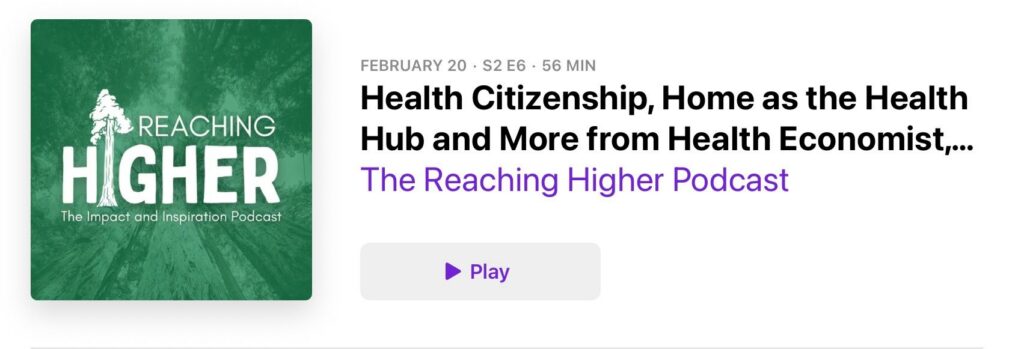 Thank you Aaron Strout for hosting our conversation on the Reaching Higher Podcast, now live on Apple, Spotify, and YouTube. We covered a lot of ground addressing health care and health citizenship, the growing prospects for our homes as our health hubs, and how our humanity is a key ingredient in health-making for all.
 Jane joined host Dr. Geeta "Dr. G" Nayyar and colleagues to brainstorm the value of vaccines for public and individual health in this challenging environment for health literacy, health politics, and health citizen grievance. Click onto the Pfizer Value of Vaccines site and you can watch four episodes covering the challenges with adult vaccination, the employer and health plan member's journey to vaccination, reimbursement, and collaborating for proactive prevention.
 I'm grateful to be part of the Duke Corporate Education faculty, sharing perspectives on the future of health care with health and life science companies. Once again, I'll be brainstorming the future of health care with a cohort of executives working in a global pharmaceutical company.