


Profiles of older health care consumers: living longer, longing for technology
Older Americans are healthier and more prosperous than previous generations. Furthermore, older people want to adopt technologies that will help them age well in their homes. Two new reports together provide a new look into aging in America. Older Americans 2008: Key Indicators of Well-Being is a wide-reaching data compendium which paints a current profile on aging in America through 38 measures that depict the well-being of older Americans. Measures include demographics, economics, health status, health risks and behaviors, and the cost and use of health services. The Chartbook is well worth reviewing to gain insights into this fast-growing population
Mother-Power online
4 in 5 moms go online at least once a month, according to My Mommy’s Online. The report is based on 2007 data from Simmons Consumer Research Survey published by eMarketer. “Being a parent makes going online almost a necessity,” according to eMarketer. 40% of all women who go online in the US are mothers with kids under 18. There are 35 million of them (including me). Intriguingly, virtually all women who are pregnant (94%) use the Internet, and half of the mothers surveyed use the Internet more since having a child. What do Moms do online? 94% visit portals
A View from the UK: Is Preventive Care "Worth It?"
I’m enjoying a weekend with London-based friends who travel the world and know what’s what. Today, we spent hours relishing (literally) the Borough Market in Southwark, located south of the Thames. This is London’s oldest food market, established when the Romans built the first London Bridge. The Market in its current state has been around for a quarter of a millenium. The Market boasts and hosts a glorious array of green grocers, bread bakers, Spanish food purveyors, brownie makers, organic tofu purveyors, and parmigiano reggiano vendors in one spot I’ve seen, perhaps ever. It is foodie heaven and a
When health becomes beautiful, consumers will pay
Or, The Lovely Bones (health care version). I have an acquaintance whose bone density scan told her she is at high risk for osteoporosis. No surprise: the condition runs in her family. For several years, she has been paying a luxury-segment department store counter $300 every two months for her skin creme, which promises that she will be ageless as she ages into her fifties, sixties, and beyond. But she has not yet filled her prescription for an osteoporosis-preventing drug. She doesn’t have prescription drug coverage. She thinks the drug is too high-priced. It’s about $300 for
Target marketing: no pink guns left behind?
In 2004, 20% of homicides were directly associated with intimate partner conflict (i.e., one in which an intimate partner killed another partner). Intimate partner violence resulting in death was most common among victims aged 40-44 years. Murder is the leading cause of death for pregnant women, according to the National Organization of Women. The National Center for Injury Prevention and Control, part of the Centers for Disease Control and Prevention, spends about $43 million a year on ways to reduce deaths and injuries from drowning, poisoning, suicide, industrial accidents, house fires and domestic violence. Of that sum, only $2.3 million
Purchasing Pink
Pink is all around. It’s October 1st. The annual proliferation of pink products promoting breast cancer awareness pervades purchasers’ prospective pickings. This year, there are lots of cosmetics to choose from, along with a Filofax, a vacuum cleaner, kitchen appliances, an iPod and various accessories to dress it up, foods, a Swiss army knife, and a set of pink knitting needles. Prevention Magazine online has several suggestions for “Beauty that Gives Back,” cosmetic companies offering products with some percentage of proceeds going to a variety of breast cancer charities. For example, La Mer Skin Creme can be purchased for
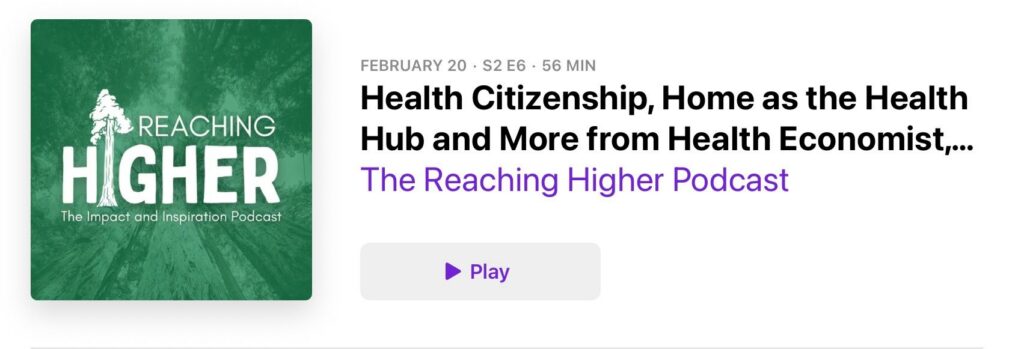 Thank you Aaron Strout for hosting our conversation on the Reaching Higher Podcast, now live on Apple, Spotify, and YouTube. We covered a lot of ground addressing health care and health citizenship, the growing prospects for our homes as our health hubs, and how our humanity is a key ingredient in health-making for all.
 Jane joined host Dr. Geeta "Dr. G" Nayyar and colleagues to brainstorm the value of vaccines for public and individual health in this challenging environment for health literacy, health politics, and health citizen grievance. Click onto the Pfizer Value of Vaccines site and you can watch four episodes covering the challenges with adult vaccination, the employer and health plan member's journey to vaccination, reimbursement, and collaborating for proactive prevention.
 I'm grateful to be part of the Duke Corporate Education faculty, sharing perspectives on the future of health care with health and life science companies. Once again, I'll be brainstorming the future of health care with a cohort of executives working in a global pharmaceutical company.