


The part-time medical home: retail health clinics
The number of retail health clinics will double between 2012 and 2015, according to a research brief from Accenture, Retail medical clinics: From Foe to Friend? published in June 2013. What are the driving market forces promoting the growth of retail clinics? Accenture points to a few key factors: Hospitals’ need to rationalize use of their emergency departments, which are often over-crowded and incorrectly utilized in cases of less-than-acute care. In addition, hospitals are now financially motivated under the Affordable Care Act (ACA, health reform) to reduce readmissions of patients into beds (particularly Medicare patients with acute myocardial infarction [heart attacks],
The emerging economy for consumer health and wellness
The notion of consumers’ greater skin in the game of U.S. health care — and the underlying theory of rational economic men and women that would drive people to greater self-care — permeated the agenda of the 2nd annual Consumer Health & Wellness Innovation Summit, chaired by Lisa Suennen of Psilos Ventures. Lisa kicked off the meeting providing a wellness market landscape, describing the opportunity that is the ‘real’ consumer-driven health care: people getting and staying well, and increasing participation in self-management of chronic conditions. The U.S. health system is transforming, she explained, with payors beginning to look like computer
Wellness at work – Virgin tells it all
Health, happiness and engagement among employees are closely-linked and drive productivity in the workplace. But there’s a gap between the kind of wellness services employers offer workers to bolster health, and the programs that people actually want. The current state of employer wellness programs is described in a survey conducted by Virgin HealthMiles and Workforce, The Business of Healthy Employees: A Survey of Workplace Health Priorities, published in June 2013. There’s a gap between what workers want for wellness and what employers are offering. Most-demanded by workers are health on-site food choices desired by 79% of employees; but, only 33%
Most employers will provide health insurance benefits in 2014…with more costs for employees
Nearly 100% of employers are likely to continue to provide health insurance benefits to workers in 2014, moving beyond a “wait and see” approach to the Affordable Care Act (ACA). As firms strategize tactics for a post-ACA world, nearly 40% will increase emphasis on high-deductible health plans with a health savings account, 43% will increase participants’ share of premium costs, and 33% will increase in-network deductibles for plan members. Two-thirds of U.S. companies have analyzed the ACA’s cost impact on their businesses but need to know more, according to the 2013 survey from the International Foundation of Employee Benefit Plans (IFEBP).
Angelina and Abercrombie: connecting the dots for healthy body image
This has been a week of shocking contrasts for women’s body image: from the triumphant, empowering public health role model of Angelina Jolie, whose op-ed column, My Medical Choice, appeared in the New York Times on May 14th, to the marketing message snafu of Abercrombie & Fitch. First, the Abercrombie affair: Mike Jeffries, CEO, said the following in a 2006 Salon interview that virally surfaced: “Because good-looking people attract other good-looking people, and we want to market to cool, good-looking people. We don’t market to anyone other than that,” identifying the “cool kids” as the company’s target market. “A lot of
The decline and fall of pharmaceutical spending…short- or long-term phenomenon?
The prescription drug cost curve is bending…for the time being. Spending on medicines fell by 3.5% in 2012 and will continue to fall below overall health spending over the next five years to 2017. But different from general health spending, there’s a new game in town called specialty medicines, and they cost a whole lot more than the generics and the aging brands that bent the cost curve in 2012. The declining Rx spending story is only part of a complicated tale told in great detail in a comprehensive report from the IMS Institute for Healthcare Informatics, Declining Medicine Use
Un-directed Americans in a consumer-directed healthcare world
U.S. employers have been implementing various flavors of consumer-directed health plans for the better part of a decade. But consumers feel neither “directed” nor especially competent in managing their way through these plans. It appears that employers also have their own sort of health plan illiteracy when it comes to understanding health reform — the Affordable Care Act — according to the 2013 Aflac WorkForces Report (AWR) based on a survey of 1,900 benefits managers and over 5,200 U.S. workers conducted in January 2013. While you might know the Aflac Duck, you may not be aware that Aflac is the
Bending the cost-curve: a proposal from some Old School bipartisans
Strange political bedfellows have come together to draft a formula for dealing with spiraling health care costs in the U.S. iin A Bipartisan Rx for Patient-Centered Care and System-Wide Cost Containment from the Bipartisan Policy Center (BPC). The BPC was founded by Senate Majority Leaders Howard Baker, Tom Daschle, Bob Dole, and George Mitchell. This report also involved Bill Frist, Pete Domenici, and former White House and Congressional Budget Office Director Dr. Alice Rivlin who together work with the Health Care Cost Containment Initiative at the BPC. The essence of the 132-page report is that the U.S. health system is
The need for a Zagat and TripAdvisor in health care
Patient satisfaction survey scores have begun to directly impact Medicare payment for health providers. Health plan members are morphing into health consumers spending “real money” in high-deductible health plans. Newly-diagnosed patients with chronic conditions look online for information to sort out whether a generic drug is equivalent to a branded Rx that costs five-times the out-of-pocket cost of the cheaper substitute. While health care report cards have been around for many years, consumers’ need to get their arms around relevant and accessible information on quality and value is driving a new market for a Yelp, Travelocity, or Zagat in
U.S. Health Costs vs. The World: Is It Still The Prices, and Are We Still Stupid?
Comparing health care prices in the U.S. with those in other developed countries is an exercise in sticker shock. The cost of a hospital day in the U.S. was, on average, $4,287 in 2012. It was $853 in France, a nation often lauded for its excellent health system and patient outcomes but with a health system that’s financially strapped. A routine office visit to a doctor cost an average of $95 in the U.S. in 2012. The same visit was priced at $30 in Canada and $30 in France, as well. A hip replacement cost $40,364 on average in the
The Not-So-Affordable Care Act? Cost-squeezed Americans still confused and need to know more
While health care cost growth has slowed nationally, most Americans feel they’re going up faster than usual. 1 in 3 people believe their own health costs have gone up faster than usual, and 1 in 4 feel they’re going out about “the same amount” as usual. For only one-third, health costs feel like they’re staying even. As the second quarter of 2013 begins and the implementation of the Affordable Care Act (ACA, aka “health reform” and “Obamacare”) looms nearer, most Americans still don’t understand how the ACA will impact them. Most Americans (57%) believe the law will create a government-run health plan,
The Rationale for CVS “Sticking” (vs. “Carroting”) It To Employees for Wellness
The Boston Herald was one of the first newspapers talking about CVS requiring workers to disclose personal health information…”or pay a $600 a year fine,” as the LA Times succinctly put the situation. The story is that CVS Caremark, the pharmacy and Rx benefits management company, is implementing a health screening program to measure height, weight, body fat, and blood pressure. These metrics are commonly collected in the process known as health risk appraisals (HRAs), which most large employers have begun to implement to help employees prevent the onset of chronic disease (think: “metabolic syndrome,” diabetes combined with overweight, for
Most consumers will look to health insurance exchanges to buy individual plans in 2013
As the Affordable Care Act, health reform, aka Obamacare, rolls out in 2013, American health insurance shoppers will look for sources of information they can trust on health plan quality and customer service satisfaction — as they do for automobiles, mobile phone plans, and washing machines. For many years, one of a handful of trusted sources for such insights has been J.D. Power and Associates. J.D. Power released its 2013 Member Health Plan Study (the seventh annual survey) and found that most consumers currently enrolled in a health plan have had a choice of only “one” at the time
The lights are still out on health prices for Americans – #healthcost transparency limits consumerism in health
Only two U.S. states have comprehensive health care price transparency regulations that ensure citizens’ access to clear and open health price information. While those two states, Massachusetts and New Hampshire, earn an “A” in the Report Card on State Price Transparency Laws, an addition five state earn a “B,” with the remainder of the United States garnering a “C” or less. The map illustrates that most states are red states, earning the lowest score of “F.” With the growth of high-deductible health plans (under the umbrella of so-called “consumer-directed” plans) where health consumers pay thousands of dollars to meet a spending
A health economics lesson from Jonathan Bush, at the helm of athenahealth
At HIMSS13 there are the equivalent of rock stars. Some of these are health system CIOs and health IT gurus who are driving significant and positive changes in their organizations, like Blackford Middleton, Keith Boone, Brian Ahier, and John Halamka. Others are C-level execs at health IT companies. In this latter group, many avoid the paparazzi (read: health trade reporters) and stay cocooned behind closed doors in two-story pieces of posh real estate on the exhibition floor. A few walk the floor, shake hands with folks, and take in the vibe of the event. We’ll call them open-source personalities. The
Digital health investment: greenhousing innovation and the accelerator
Traditional venture capital in health care is so 2010: welcome to The Greenhouse Effect: How Accelerators Are Seeding Digital Health Innovation, explained in a new report from California HealthCare Foundation written by Aaron Apodaca. Aaron clearly explains the growing interest in and influence of health accelerators, which grew out of the first era of the Internet (read: dot-com bust v 1.0) and the founding of the Y Combinator, an internet incubator that made relatively small investments in exchange for equity positions in start-ups. Health accelerators emerged around 2011, first with Rock Health in San Francisco, which was quickly followed by
The Accountable Care Community opportunity
“ACOs most assuredly will not…deliver the disruptive innovation that the U.S. health-care system urgently needs,” wrote Clay Christensen, godfather of disruptive innovation, et. al., in an op-ed in the Wall Street Journal of February18, 2013. In the opinion piece, Christensen and colleagues make the argument that Accountable Care Organizations (ACOs) as initially conceived won’t address several key underlying forces that keep the U.S. health care industry in stasis: Physicians’ behavior will have to change to drive cost-reduction. Clinicians will need “re-education,” the authors say, adopting evidence-based medicine and operating in lower-cost milieus. Patients’ behavior will have to change. This requires
Lower calories are good business
The restaurant chain business employs 10% of U.S. workers and accounts for $660 bn worth of the national economy. Where restaurant chains are growing fastest is in serving up lower-calorie meals, and it’s been a boon to the bottom-line. The case for lower calories leading to better business is made in Lower-Calorie Foods: It’s Just Good Business from the Hudson Institute‘s Obesity Solutions Initiative, published February 2013. In the report, researchers analyzed nitty-gritty restaurant chain data on servings and traffic from 2006-2011 to sort out whether sales of so-called lower-calorie menu items in 21 chains led to improved business. The chains
The more engaged a patient is, the lower their costs
There are many ways to measure and express “patient engagement.” One such metric is “patient activation,” innovated by Dr. Judith Hibbard, long affiliated with the University of Oregon. Dr. Hibbard has written extensively about the Patient Activation Measure, PAM, first described in 2004. She and a team of researchers have determined that the higher a patient’s PAM score, the lower their health costs. Hibbard et. al. published these findings in the February 2013 issue of Health Affairs, which is entirely devoted to patient engagement – a top topic in Health Populi. The team analyzed the medical records of 33,163 patients
Health reform, costs and the growing role of consumers: PwC’s tea leaves for 2013
PwC has seen the future of health care for the next year, and the crystal ball expects to see the following: Affordable Care Act implementation, with states playing lead roles The role of dual eligibles Employer’s role in health care benefits Consumers’ role in coverage Consumers’ ratings impact on health care Transforming health delivery Population health management Bring your own device Pharma’s changing value proposition The medical device industry & tax impact. In their report, Top health industry issues of 2013: picking up the pace on health reform, PwC summarizes these expectations as a “future [that] includes full implementation of
Health and consumer spending may be flat, but consumers hard hit due to wage stagnation & self-rationing
There’s good news on the macro-health economics front: the growth rate in national health spending in the U.S. fell in 2011, according to an analysis published in Health Affairs January 2013 issue. Furthermore, this study found that consumers’ spending on health has fallen to 27.7% of health spending, down from 32% in 2000, based on three spending categories: 1. Insurance premiums through the workplace or self-paid 2. Out-of-pocket deductibles and co-pays 3. Medicare payroll taxes. A key factor driving down health spending is the growth of generic drug substitution for more expensive Rx brands. Generics now comprise 80% of prescribed
We are all health deputies in the #digitalhealth era: live from the 2013 Consumer Electronic Show
Reed Tuckson of UnitedHealthGroup was the first panelist to speak at the kickoff of the Digital Health Summit, the fastest-growing aspct of the 2013 Consumer Electronics Show (#2013CES). Tuckson implored the spillover audience to all, “self-deputize as national service agents in health,” recognizing that technology developers in the room at this show that’s focused on developers building Shiny New Digital Things have much to bring to health. As Andrew Thompson of Proteus Medical (the “invisible pill” company) said, “we can’t bend the health care cost curve; we have to break it.” This pioneering panel was all about offering new-new technologies
Call them hidden, direct or discretionary, health care costs are a growing burden on U.S. consumers
Estimates on health spending in the U.S. are under-valued, according to The hidden costs of U.S. health care: Consumer discretionary health care spending, an analysis by Deloitte’s Center for Health Solutions. Health spending in the U.S. is aggregated in the National Health Expenditure Accounts (NHEA), assembled by the Department of Health and Human Services (DHHS) Centers for Medicare and Medicaid Services (CMS). In 2010, the NHEA calculated that $2.6 trillion were spent on health care based on the categories they “count” for health spending. These line items include: Hospital care Professional services (doctors, ambulatory care, lab services) Dental services Residential
Prescription brand drug prices grew 6x the rate of inflation in past year
Consumer price inflation grew 2% between September 2011 and September 2011. The price of branded drugs increased over 13% in the same period according to the Express Scripts 2012 Q3 Drug Trend Quarterly report, issued in November 2012. But the overall trend, including generics, was flat — 0.1%. This, due to the use of generics, now comprising 80% of prescription drug utilization. Since 2008, the brand prescription price index grew from a base of 100 to 163; the generic index fell from 100 to 61. The CPI index grew from the 100 base to 110. Generics have proven to be a
Another call for transparency in health care from employers and unions for consumers
In the wake of Hurricane Sandy, there are strange bedfellows coming together this week. First strange bedfellow moment for me this week was the video of Governor Chris Christie and President Barak Obama embracing and working together in storm-turn New Jersey yesterday. Saints be praised! to see a Republican and Democrat coming together, working together, consoling citizens together. In health care this week, another welcome strange bedfellow event is the statement issued by Catalyst for Payment Reform (CPR), an advocacy group of business, labor unions (notably, the AFL-CIO), and consumer advocates promoting broadly available information for consumers about the price and quality
Small business says stress is the #1 wellness need for employees
Nearly 50% of business start-ups view health and wellness as crucial to employee recruitment and retention. 31% of start-ups under 10 years of age have adopted wellness programs. Furthermore, 3 in 4 small companies that offer wellness programs say they positively impact the businesses’ bottom-lines. Nonetheless, more than one-half of small business — companies with fewer than 100 employees — say that there isn’t enough information available that focuses squarely on wellness in small business. These findings come from Workplace Wellness Programs in Small Business: Impacting the Bottom Line, a report from the National Small Business Association (NSBA) and Humana, details findings
Consumers blame insurance and pharma for health costs, but love their primary care doctors
The 78% of U.S. adults with primary care physicians (think: medical homes) are very satisfied with their doctors’ visits. The main reasons for this high level of satisfaction include communication (listening, talking), customer service (caring, personable), and clinical (good diagnosis and treatment). More women than men have a primary care physician relationship, more college grads do, and more people with incomes of $75,000 a year or more do, as well. 90% of those 55 and over have a primary care doctor – a stat heavily influenced by the fact that Medicare coverage kicks in for older people. This consumer profile
In sickness and in health: consumers expect doctors to be wellness coaches, too
4 in 5 health consumers expect doctors not only to treat them when they’re sick, but to keep them healthy. “In sickness and in health” now morphs over to the doctor-patient relationship, beyond the marriage vow. Better Health through Better Patient Communications, a survey from Varolii, finds that people are looking for health, beyond health care, from their physicians. Varolii is a customer interaction company that claims to have interacted with 1 in 3 Americans through some sort of company communication: they work with major Fortune 1000 companies, including banks, airlines, retail, and, yes, health care. They recently attracted a
From fragmentation and sensors to health care in your pocket – Health 2.0, Day 1
The first day of the Health 2.0 Conference in San Francisco kicked off with a video illustrating the global reach of the Health 2.0 concept, from NY and Boston to Mumbai, Madrid, London, Tokyo and other points abroad. Technology is making the health world flatter and smarter…and sometimes, increasing problematic fragmentation, which is a theme that kept pinching me through the first day’s discussions and demonstrations. Joe Flowers, health futurist, offered a cogent, crisp forecast in the morning, noting that health care is changing, undergoing fundamental economic changes that change everything about it. These are driving us to what may
U.S. health insurance updates from Kaiser, EBRI and the Census Bureau; uninsurance related to poor health
The average annual premiums for employer-sponsored health insurance in 2012 are double what they were a decade ago in terms of both total premium and worker contribution increases. The picture shows the story, according to the 2012 Employer Health Benefits Survey from the Kaiser Family Foundation (KFF). This annual survey polls small, mid-size and large employers to assess their updates for providing health insurance and prescription drug coverage to active and retired employees. The percentage growth of health costs in the past year were a “modest” 4%, according to KFF. Modest is a relative term: this single digit increase is indeed much
Consumerism growing in health care, says Altarum
Patients are morphing into health care consumers with growing use of technology for medical shopping and health engagement, according to a survey conducted by Altarum, the health services research organization. Virtually all (99%) of U.S. health citizens want to play a role in medical decisions about their care. However, consumers vary in just how much of that responsibility they want to assume: – 35% want to make the final decision with some input from doctors and other experts – 29% want to be completely in charge of their decisions – 28% want to make a joint decision with equal input
The U.S. health consumer is health-finance illiterate, and resistant to linking wellness to health plan costs
Two in 3 employees (62%) can’t estimate how much their employers spend on health benefits. Of those who could estimate the number (which is, on average, about $12,000 according to the 2012 Milliman Medical Index), most weren’t very confident in their guess. Some 23% calculated the monthly spend by employers was less than $500 a month — less than 50% the actual contribution. Thus, most U.S. health consumers don’t fully value the amount of cash their employers spend on their health care, according to a poll from the National Business Group on Health, Perceptions of Health Benefits in a Recovering
Converging for health care: how collaborating is breaking down silos to achieve the Triple Aim
On Tuesday, 9 July 2012, health industry stakeholders are convening in Philadelphia for the first CONVERGE conference, seeking to ignite conversation across siloed organizations to solve seemingly intractable problems in health care, together. Why “converge?” Because suppliers, providers, payers, health plans, and consumers have been fragmented for far too long based on arcane incentives that cause the U.S. health system to be stuck in a Rube Goldbergian knot of inefficiency, ineffectiveness and fragmentation of access….not to mention cost increases leading us to devote nearly one-fifth of national GDP on health care at a cost of nearly $3 trillion…and going up.
Why we now need primary care, everywhere
With the stunning Supreme Court 5-4 majority decision to uphold the Patient Protection and Affordable Care Act (ACA), there’s a Roberts’ Rules of (Health Reform) Order that calls for liberating primary care beyond the doctors’ office. That’s because a strategic underpinning of the ACA is akin to President Herbert Hoover’s proverbial “chicken in every pot:” for President Obama, the pronouncement is something like, “a medical home for every American.” But insurance for all doesn’t equate to access: because 32-some million U.S. health citizens buy into health insurance plans doesn’t guarantee every one of them access to a doctor. There’s a
Employers who offer more flexibility yield healthier workforces
The most flexible workplaces are good for worker’s health: they yield the most engaged workforces, greater job satisfaction, increased commitment to the firm, better mental health and lower indicators of depression. But not all firms are all that flexible, which is the top line of the Family and Work Institute‘s 2012 National Study of Employers (NSE), funded by The Alfred P. Sloan Foundation. What makes this survey different from others polling employers is that the NSE looks at the comprehensive array of total benefits offered to employees and their changing needs in terms of family, finance, and social lives. In the past seven years,
For those with health insurance, a growing bounty of benefits
For those employees fortunate enough to receive health insurance from work, there’s a bountiful array of health care services that are still covered by plans. The International Foundation of Employee Benefit Plans (IFEBP) polled its membership in late 2007 and found that employers are not only continuing to cover a broad range of services, but also new services the likes of which weren’t covered even two years ago…from medical tourism to biofeedback. These results are documented in IFEBP’s publication, Health Care Benefits: Eligibility, Coverage and Exclusions. The usual suspects are covered by well over 97% of employers, such as ER
The Future of Retail – Implications for Health
I’ve been looking at health care through a retail lens for some time. Perhaps it’s that I’m a rag trader’s daughter, or that I’ve been known to like shopping, that I have clients in consumer goods, or that I understand how tiered drug pricing impacts the consumption of medicines (answer: it’s all of the above). I’ve just reviewed the latest trend report from PricewaterhouseCoopers and TNS Retail Forward on the future of retailing. My mind is connecting the dots between the future of retail and the American health care consumer. Four future retail trends are already embedding in health care
Steel, Coffee Beans and Health Care
The UAW and GM have been debating health care as Friday’s deadline for their national contract approaches. This round of negotiation is about survival. Yesterday, I covered the rising costs of employer-sponsored health insurance. Today, let’s visit the intimately-related topic of retiree health benefits. These are eroding even faster than health benefits for employed workers. Many employers have significantly scaled back health benefits for retirees. Currently, one in three large employers offers retire benefits, compared with two in three in the late 1980s. Consider the predicament of the company ranked #3 on the 2006 Fortune 500 list, General Motors. Retirees
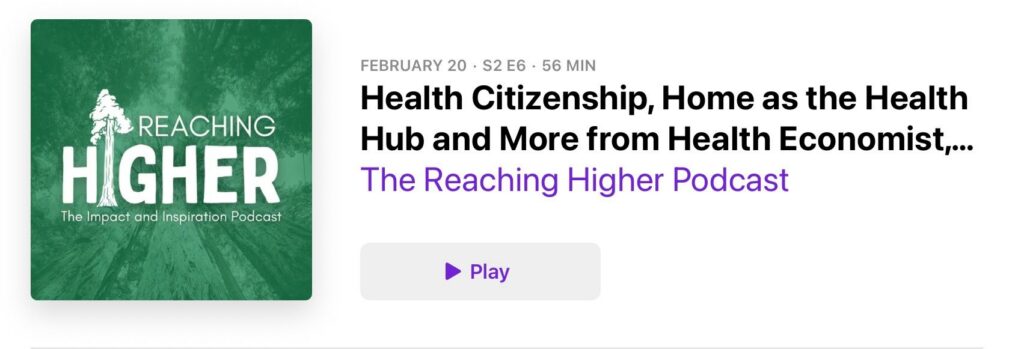 Thank you Aaron Strout for hosting our conversation on the Reaching Higher Podcast, now live on Apple, Spotify, and YouTube. We covered a lot of ground addressing health care and health citizenship, the growing prospects for our homes as our health hubs, and how our humanity is a key ingredient in health-making for all.
 Jane joined host Dr. Geeta "Dr. G" Nayyar and colleagues to brainstorm the value of vaccines for public and individual health in this challenging environment for health literacy, health politics, and health citizen grievance. Click onto the Pfizer Value of Vaccines site and you can watch four episodes covering the challenges with adult vaccination, the employer and health plan member's journey to vaccination, reimbursement, and collaborating for proactive prevention.
 I'm grateful to be part of the Duke Corporate Education faculty, sharing perspectives on the future of health care with health and life science companies. Once again, I'll be brainstorming the future of health care with a cohort of executives working in a global pharmaceutical company.