


Mobile health apps – opportunity for patients and doctors to co-create the evidence
There are thousands of downloadable apps that people can use that touch on health. But among the 40,000+ mobile health apps available in iTunes, which most effectively drive health and efficient care? To answer that question, the IMS Institute for Healthcare Informatics analyzed 43,689 health, fitness and medical apps in the Apple iTunes store as of June 2013. These split into what IMS categorized as 23,682 “genuine” health care apps, and 20,007 falling into miscellaneous categories such as product-specific apps, fashion and beauty, fertility, veterinary, and apps with “gimmicks” (IMS’s word) with no obvious health benefit. Among the 23,682 so-called
Getting to health engagement will require more than a patient portal
Patient and health engagement is the flavor du jour in health circles these days, from the corridors of hospitals to the caffeinated marketing meetings in Big Pharma’s east coast meet-ups. But there’s no standard agreement on what we mean by peoples’ health engagement, whether by patient or well consumer. In Market Insights: The Evolution of Consumer Engagement in Health Care, Porter Research endeavors to deepen our understanding of this important concept. In the introductory section of the paper, “Understanding Engagement,” Porter proffers that industry – providers, payers and employers – consider engagement as “changing consumer behavior through increased participation in consumers’ own health
A new medical side-effect: out-of-pocket health care costs
When we say the phrase “side effects,” what do we think of? The FDA says that “all medicines have benefits and risks. The risks of medicines are the chances that something unwanted or unexpected could happen to you when you use them. Risks could be less serious things, such as an upset stomach, or more serious things, such as liver damage.” There’s a new risk in town in health care, and it’s the equivalent of an upset stomach when it comes to a co-pay for a branded on-formulary drug, or liver damage if it involves a coinsurance percent of “retail”
Delaying aging to bend the cost-curve: balancing individual life with societal costs
Can we age more slowly? And if so, what impact would senescence — delaying aging — have on health care costs on the U.S. economy? In addition to reclaiming $7.1 trillion over 50 years, we’d add an additional 2.2 years to life expectancy (with good quality of life). This is the calculation derived in Substantial Health And Economic Returns From Delayed Aging May Warrant A New Focus For Medical Research, published in the October 2013 issue of Health Affairs. The chart graphs changes in Medicare and Medicaid spending in 3 scenarios modeled in the study: when aging is delayed, more people qualify
Economics of obesity and heart disease: We, the People, can bend the curves
The “O” word drives health costs in America ever-upward. Without bending the obesity curve downward toward healthy BMIs, America won’t be able to bend that stubborn cost curve, either. The Economic Impacts of Obesity report from Alere Wellbeing accounts for the costs of chronic diseases and how high obesity rates play out in the forms of absenteeism, presenteeism, and direct health care costs to employers, workers and society-at-large. Among the 10 costliest physical health conditions, the top 3 are angina, hypertension and diabetes — all related to obesity and amenable to lifestyle behavior change. The top-line numbers set the context:
7 Women and 1 Man Talking About Life, Health and Sex – Health 2.0 keeping it real
Women and binge drinking…job and financial stress…sleeplessness…caregiving challenges…sex…these were the topics covered in Health 2.0 Conference’s session aptly called “The Unmentionables.” The panel on October 1, 2013, was a rich, sobering and authentic conversation among 7 women and 1 man who kept it very real on the main stage of this mega-meeting that convenes health technology developers, marketers, health providers, insurers, investors, patient advocates, and public sector representatives (who, sadly, had to depart for Washington, DC, much earlier than intended due to the government shutdown). The Unmentionables is the brainchild of Alexandra Drane and her brilliant team at the Eliza
Health care and survey taking at the Big Box Store
Where can you shop the health and beauty aisles, pick up some groceries and a prescription, get a flu vaccine, and weigh in on Obamacare and what digital health tools you like? Why, at one of several thousand retail stores where you can find a SoloHealth kiosk. As of yesterday afternoon, over 32 million encounters were recorded on SoloHealth kiosks, based on an app I saw on the company CEO Bart Foster’s smartphone. Kiosks are locatted around the United States in retailers including Walmart and Sam’s Clubs, along with major grocery chains like Schnuck’s and Publix, and the CVS pharmacy
Taking vitamins can save money and impact the U.S. economy – and personal health
When certain people use certain dietary supplements, they can save money, according to a report from the Council for Responsible Nutrition and Frost and Sullivan, the analysts. The report is aptly titled, Smart Prevention – Health Care Cost Savings Resulting from the Targeted Use of Dietary Supplements. Its subtitle emphasizes the role of dietary supplements as a way to “combat unsustainable health care cost growth in the United States.” Specifically, the use of eight supplements in targeted individuals who can most benefit from them can save individuals and health systems billions of dollars. The eight money-saving supplements are: > Omega-3 > B
Defining Mobile Health – the blur between health and health care
Mobilising Healthcare, a new report from Juniper Research, segments the mobile health sector into “healthcare” and “health & fitness” segments. The research summary notes that fitness is a relatively new market compared with health “care,” which has been around for eons. Fitness, the analysts say, “is exempt from government intervention.” Mobile healthcare (“mHealth”) applications explored include SMS health messaging, remote health provision such as cardiac monitoring, electronic health records and personal health records. In mFitness, Juniper looks into mobile tech for athletes and fitness conscious people, and activity tracking including heart function, distance, respiration, and perspiration, among other parameters. mHealth
Health information search online, an hour a week. Time with a doctor? An hour a year.
In game-scoring unit terms, 52 is the number of hours an average American spends seeking health information online each year. The 1 (hour) is roughly equivalent to the approximate total time a patient spends with a physician (an average of 3 visits, with an average time per vision of 20 minutes). Thus, 52:1. This means that the average U.S. health consumer spends much more time DIYing her health using digital information resources than speaking face-to-face with their physician in the doctor’s office. Still, the physician continues to be a go-to source for health information, according to Makovsky, a health communications
Chief Health Officers, Women, Are In Pain
Women are the Chief Health Officers of their families and in their communities. But stress is on the rise for women. Taking an inventory on several health risks for American women in 2013 paints a picture of pain: of overdosing, caregiver burnout, health disparities, financial stress, and over-drinking. Overdosing on opioids. Opioids are strong drugs prescribed for pain management such as hydrocodone, morphine, and oxycodone. The number of opioid prescriptions grew in the U.S. by over 300% between 1999 and 2010. Deaths from prescription painkiller overdoses among women have increased more than 400% since 1999, compared to 265% among men.
Needing a new kind of tracker to track #mhealth investments in 2013
The news this week that Fitbit attracted $42 million investment capital follows Withings’ announcement of $30 million (including Euro11 million from BPIFrance, the French national investment fund), Jawbone’s recent acquisition of Bodymedia for $100 million in April 2013, and MyFitnessPal raising $13 million earlier this month. The quick arithmetic for these four companies alone adds to roughly $200 mm in a few months going to these brands, which are feverishly competing for the heartbeats and footsteps of people who are keen to track their steps and stay healthy. Can you keep up? You need a new kind of activity tracker to track
Eat fruits and vegetables: it’s worth $11 trillion to you and the U.S. economy
More than 127,000 people die every year in America from cardiovascular disease, accruing $17 billion in medical spending. Heart disease is a “costly killer,” according to the Union of Concerned Scientists, who has calculated The $11 trillion reward: how simple dietary changes can save lives and money, and how we get there, published in August 2013. That $11 trillion opportunity is equal to the present value of lives saved. The solution to bolstering heart (and overall health) and saving money (medical spending and personal productivity) is in food. We’re not talking about genetically engineering anything special or out-of-the-ordinary. We are talking
Healthways buys into Dr. Ornish’s approach: will “Ornish-inside” scale wellness in America?
People who live in U.S. cities with low levels of well-being have twice the rate of heart attacks as people who live in healthier America. That’s 5.5% of the population in sicker America versus 2.8% of the population living in healthy America. The first chart illustrates this disparity, taken from the Gallup-Healthways index that examined 190 metropolitan areas in 2012. Based on this study, it’s good to live in parts of Utah, Nebraska and Colorado, but not so healthy to be a resident in West Virginia, Alabama, and parts of Kentucky and Ohio. Heart disease and diabetes are killing a plurality
Health and wellness, the economy and the grocery store
Consumers in America are spending more, and especially at the grocery store. Most people say they want to eat healthy — but, although they’re spending more at the food store, one-half of supermarket shoppers say cost is the main obstacle for healthy eating. 2 in 3 U.S. grocery shoppers define health and wellness as being physically fit and active, and over half believe that feeling good about yourself is another facet of health. Not being overweight equals health for about one-half of U.S. shoppers. The Why? Behind the Buy, from Acosta Sales & Marketing, explores buying patterns among U.S. consumers
Cost prevents people from seeking preventive health care
3 in 4 Americans say that out-of-pocket costs are the main reason they decide whether or not to seek preventive care, in A Call for Change: How Adopting a Preventive Lifestyle Can Ensure a Healthy Future for More Americans from TeleVox, the communications company, published in June 2013. TeleVox surveyed over 1,015 U.S. adults 18 and over. That’s the snapshot on seeking care externally: but U.S. health consumers aren’t that self-motivated to undertake preventive self-care separate from the health system, either, based on TeleVox’s finding that 49% of people say they routinely exercise, and 52% say they’ve attempted to improve eating habits.
1 in 3 people is interested in doing mobile health, but they skew younger
The headline for the HarrisInteractive/HealthDay mobile health (mHealth) survey reads, “Lots of Americans Want Health Care Via Their Smartphones.” But underneath that bullish forecast are statistics illustrating that the heaviest users of health care services in America — people 65 and over — have the least interest in mHealth tools. Overall, 37% of U.S. adults are interested in managing health via smartphones or tablets: about 1 in 3 people. As the chart shows, the greatest interest in communicating with doctors via mobile phones and tablets is among people 25-49. Reminders to fill prescription and participate in wellness programs is also
The emerging economy for consumer health and wellness
The notion of consumers’ greater skin in the game of U.S. health care — and the underlying theory of rational economic men and women that would drive people to greater self-care — permeated the agenda of the 2nd annual Consumer Health & Wellness Innovation Summit, chaired by Lisa Suennen of Psilos Ventures. Lisa kicked off the meeting providing a wellness market landscape, describing the opportunity that is the ‘real’ consumer-driven health care: people getting and staying well, and increasing participation in self-management of chronic conditions. The U.S. health system is transforming, she explained, with payors beginning to look like computer
Marketing Digital Health to Mom 2.0 on Mother’s Day 2013
Mainstream media, both print and online, peppered their 2013 Mother’s Day gift suggestions including pod coffeemakers, bangle bracelets, candy-colored accessories and digital health devices. Say, what? In Parade magazine, Mother’s Day 2013 gift ideas included the Fitbit “smart pedometer,” linked to a “buy” site at REI. You can’t get much more mainstream than Parade. In Entertainment Weekly, Bronwyn Barnes, style maven for the magazine, wrote a one-page “Get Ready for Mom 2.0” and her recommendations included the Pebble Smartwatch, the Jawbone Up wristband, and the HoodieBuddie with earbuds built into the drawstrings. Men’s Health told sons and husbands to check
A physical activity shortage: Let’s Move!
Only 1 in 5 Americans got the minimum recommended amount of physical activity in 2011, based on guidelines offered by the U.S. Centers for Disease Control. More men than women met the standard: 23.4% of men versus 17.9% of women. There are wide variations across the 50 states, as the map shows, with the healthiest folks exercise-wise living in the west, Alaska, upper midwest, and New England. The range runs from a 12.7% low in West Virginia and Tennessee to 27.3 at the high end in Colorado. That bar is set at 150 minutes a week (that’s 2.5 hours) of
Dietitians provide a health bridge between food and pharmacy
The registered dietitian is an in-demand labor resource for grocery stores around the U.S. Advertising Age covered the phenomenon of the growing clout of dietitians in food chains (April 14, 2013). Let’s dig further into this phenomenon through the Health Populi lens on healthcareDIY and peoples’ ability to bend their personal health care cost curves. Stores such as Giant Eagle, Hy-Vee, Safeway and Wegmans are morphing into wellness destinations, with pharmacies and natural food aisles taking up valuable square footage to meet consumers’ growing demands for healthy choices. Some stores are formalizing their approach to food = health by formulating a
Food = Health for employers, hospitals, health plans and consumers
Food is inextricably bound up with health whether we are well or not. Several key area of the Food=Health ecosystem made the news this week which, together, will impact public and personal health. On the employer health benefits front, more media are covering the story on CVS strongly incentivizing employees to drop body mass index (BMI) through behavioral economics-inspired health plan design of a $50 peer month penalty. Michelin, whose bulky advertising icon Bibendum has more than one “spare tire,” introduced a program to combat health issues, including but not limited to BMI and high blood pressure, according to the
Gettin’ higi with it: Lupe Fiasco’s foray into public health
The latest in SoLoMo (Social, Local, Mobile) Health is a gamified tool coupled with a hardware kiosk, known as higi. The brainchild of Michael Ferro, a successful dotcom entrepreneur who now owns the Chicago Sun-Times, higi’s mission is to help people – particularly younger peeps – to take better care of themselves by scoring points and, as a result, social connections. Higi’s an African word for origin, so the health tool has some aspects relating to being in a tribe — a kind of health tribe. It also has a fun sound to it, Ferro noted, which sets the vibe
Health at SXSW13 vs. HIMSS13: the Yin, the Yang, and the Blur
I endured what very few people could (or would) do in the past ten days: I traveled to New Orleans to the annual conference of HIMSS, the Health Information Management Systems Society, which features hundreds of suppliers to the health care information technology industry. I returned home to kiss my family hello and goodbye, and a day later flew to Austin for the annual South-by-Southwest conference for music, movie and digital folks. The health track at SXSW has grown over the past five years, and provides a start contrast to “health care” as embodied at HIMSS, and “health” translated through
The Sitting Disease: health is growing at SXSW
If it’s March, it must be time for South by Southwest (SXSW), the annual conference weaving music, film and interactive tracks of speakers and conferees that overcrowds and excites Austin, Texas, with a cool vibe and even cooler ideas. I’ll be participating on Sunday 10 March 2013 at 5 pm on a panel, Sitting Will Kill You: Can Mobile Save Us?, featuring Fran Melmed, developer of the HotSeat app that nudges us to all Get Up Offa Our Things when living our typical sedentary lives; Peter Katzmarzyk, public health researcher who knows all about the relationship between too much sitting
Formally tracking health data changes health behavior and drives social health
Most of us keep track of some aspect of our health. Half of all people who track do so “in their heads,” not on paper, Excel spreadsheet, or via digital platform. Furthermore, 36% update their health tracking data at least once a day; but 16% update at most twice a month, and 9% update less than once monthly. Tracking for Health from the Pew Internet & American Life Project paints a portrait of U.S. adults who, on one hand are quantifying themselves but largely aren’t taking advantage of automated and convenient ways of doing so. Overall, 69% of U.S. adults track
Think about health disparities on Martin Luther King Day 2013
On this day celebrating Martin Luther King, Jr., I post a photo of him in Detroit in 1963, giving a preliminary version of his “I Have a Dream” speech he would give two months later in Washington, DC. As I meditate on MLK, I think about health equity. By now, most rational Americans know the score on the nation’s collective health status compared to other developed countries: suffice it to say, We’re Not #1. But underneath that statistic is a further sad state of health affairs: that people of color in the U.S. have lower quality of health than white
Battle of the (wrist)Bands at the Digital Health Summit, 2013 CES
One of the fastest-growing segments at the 2013 Consumer Electronics Show in Las Vegas this week is digital health. And within that segment, there’s a battle brewing for what technology companies seem to think is the most valuable part of real estate on the human body: the wrist. I counted at least fifty products as I cruised aisles 26000-27000 in the South Hall at the Las Vegas Convention Center that had wristbands, usually black, plastic or rubbery, and often able to click in and out of the band for use in-hand, in pocket, or in a few cases, on a
We are all health deputies in the #digitalhealth era: live from the 2013 Consumer Electronic Show
Reed Tuckson of UnitedHealthGroup was the first panelist to speak at the kickoff of the Digital Health Summit, the fastest-growing aspct of the 2013 Consumer Electronics Show (#2013CES). Tuckson implored the spillover audience to all, “self-deputize as national service agents in health,” recognizing that technology developers in the room at this show that’s focused on developers building Shiny New Digital Things have much to bring to health. As Andrew Thompson of Proteus Medical (the “invisible pill” company) said, “we can’t bend the health care cost curve; we have to break it.” This pioneering panel was all about offering new-new technologies
One-third of U.S. consumers plan to buy a new fitness tech in 2013, but most buyers are already healthy
Over one-third of U.S. consumers plan to buy a new fitness technology in the next year, especially women. They’ll buy these at mass merchants (females in particular, shopping at Target and Walmart), sporting goods retailers (more male buyers here), online and at electronics stores like Best Buy. These potential buyers consider themselves in good or excellent physical health. They’ll see the latest applications on retail store shelves in pedometers, calorie trackers, fitness video games, digital weight scales, and heart rate monitors that will be launched this week at the 2013 Consumer Electronics Show in Las Vegas. In advance of the
Food and health: information is not doing the job as the U.S. continues its obesity march
Notwithstanding the fact that most phones on U.S. streets are “smart” ones, most adults surf the net for health information, and most people try to change a health habit each year, Americans haven’t adopted healthier long-term relationships with food. The International Food Information Council has conducted the Food & Health Survey: Consumer Attitudes Toward Food, Safety, Nutrition & Health poll since 2006, thus enabling us to track peoples’ attitudes and behaviors over the past several years. The latest polling results appear in Is it Time to Rethink Nutrition Communications? A 5-Year Retrospective of Americans’ Attitude toward Food, Nutrition, and Health online in
Free statins at the grocery: retail health update
I spotted this sign yesterday at my local Wegmans, the family-owned grocery chain founded in upstate NY and growing down the northeast corridor of the U.S. Many months ago, a similar sign promoted “free antibiotics” at the store. What does a grocery chain’s pharmacy doling out “Free” [asterisked] generic Lipitor mean to the larger health ecosystem? On the upside, health is where we live, work, play and pray, as Dr. Regina Benjamin, the Surgeon General, has said. This has become a mantra for us at THINK-Health, and regular Health Populi readers may be tiring of my repeated use of this
Health costs will increase in 2013, and employees will bear more: can wellness programs help stem the rise?
Health spending will increase by 7.5% in 2013, with employees’ contributions rising for in-network deductibles, prescription drugs and emergency room visits. 3 in 4 employers, seeking to control rising health expenses, will offer wellness programs, even though a vast majority can’t yet measure an ROI on them. The Health and Well-Being: Touchstone Survey Results from PriceWaterhouseCoopers (PwC). PwC points out that the 7.5% medical cost increase is historically lower than in recent years, as a result of structural changes in the health care market including: A sluggish economy Growing focus on cost containment Lower utilization of health services by patients Employers’ efforts
Fruits, financial incentives and remote coaching: evidence for behavior change
Increasing intake of fruits and vegetables, coupled with remote health coaching and financial incentives, together help people adopt and maintain healthy behavior changes. This is the conclusion of a randomized controlled trial using mobile technology, published in the May 28, 2012, issue of Archives of Internal Medicine. Dr. Bonnie Spring of Northwestern University’s Department of Preventive Medicine led the study. The researchers developed the trial, called Make Better Choices, to sort out which behavior changes would enable people to reduce major risk factors for cardiovascular disease, cancer and diabetes. Four combinations were assessed in the intervention among 204 people: Increasing fruit
Statins, food and a mobile app: Pfizer and Eating Well partner up as generic Lipitor hits the market
On May 23, 2012, Pfizer announced its teaming with EatingWell magazine to launch a mobile app for patients on Lipitor. Eight days later, on May 31, 2012, generic versions of Lipitor will hit the market. Lipitor is the best-selling drug in pharmaceutical history, to-date. Sales of the product top $125 billion. While generic atorvastatin has been available in the U.S. since November 2011 from two manufacturers, low prices for the generic will drop to $10 or less for a month’s supply at the end of May. This is Pfizer’s first foray into a prescription drug-affiliated app. The free mHealth app,
It’s the prices and the technology, stupid: why U.S. health costs are higher than anywhere in the world
The price of physician services, proliferation of clinical technology and the cost of obesity are the key drivers of higher health spending in the U.S., according to The Commonwealth Fund‘s latest analysis in their Issues of International Health Policy titled, Explaining High Health Care Spending in the United States: An International Comparison of Supply, Utilization, Prices, and Quality, published in May 2012. The U.S. devotes 17.4% of the national economy to health spending, amounting to about $8,000 per person. The UK devotes about 10%, Germany 11.6%, France, 11.8%, Australia 8.7%, and Japan, 8.5%. On the physician pay front, primary care
Right-sizing food and healthcare
In our fast-texting, quick-thinking, Blink-ing society, Jason Riis talks about slowing down our relationship with food. At the Edelman Wellness Ignited meet-up on March 26, 2012, Jason riffed on food intervention and economics for healthy eating. Jason is a professor at Harvard Business School and among his many research interests is how to change culture to morph away from obesity and Type 2 diabetes toward health. The U.S. is a shopping nation: retail is destination, fun, entertaining, life, for millions of Americans. Jason’s asking what retailers can do about fast and food. This isn’t only about ‘fast food,’ which, of course,
Wellness Ignited! Edelman panel talks about how to build a health culture in the U.S.
Dr. Andrew Weil, the iconic guru of all-things-health, was joined by a panel of health stakeholders at this morning’s Edelman salon discussing Wellness Ignited – Now and Next. Representatives from the American Heart Association, Columbia University, Walgreens, Google, Harvard Business School, and urban media mavens Quincy Jones III and Shawn Ullman, who lead Feel Rich, a health media organization, were joined by Nancy Turett, Edelman’s Chief Strategist of Health & Society, in the mix. Each participant offered a statement about what they do related to health and wellness, encapsulating a trend identified by Jennifer Pfahler, EVP of Edelman. Trend 1: Integrative
Food = health: JWT foodspotting
35% of consumers who have been altering their food intake to lose weight are eating fewer processed foods, according to a recent Nielsen Global Survey. This percentage has grown from 29% in 2008. Health and wellness is one of three driving forces shaping food in 2012, according to JWT‘s What’s Cooking: Trends in Food. The other two forces, technology and foodie culture, combine with health/wellness and yield some interesting consumer trends in the milieu of food. JWT’s top food issues to watch are: – Fooducate – Nutrition scores – Fat taxes – Health and fresh vending machines – Gluten-free –
Consumer electronics comes to health care — but don’t overestimate consumer demand just yet
More people with higher levels of concern about their health feel they are in good health, see their doctors regularly for check-ups, take prescription meds “exactly” as instructed, feel they eat right, and prefer lifestyle changes over using medicines. And 40% of these highly-health-concerned people have also used a health technology in the past year. At the other end of the spectrum are people with low levels of health concern: few see the doctor regularly for check-ups, less than one-half take their meds as prescribed by their doctors, only 31% feel they eat right, and only 36% feel they’re in
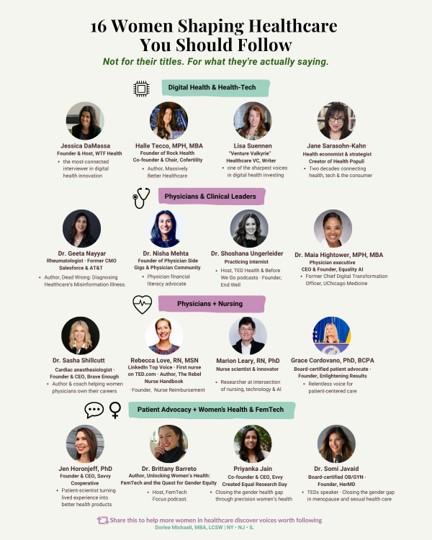 I'm gratified to be named on this updated list of 16 women's voices who are shaping health care. The curator of the list, Dorlee Michaeli, asked the question: "If someone wanted a smarter healthcare LinkedIn feed tomorrow, who should they follow today?" Glad to be one of these voices.
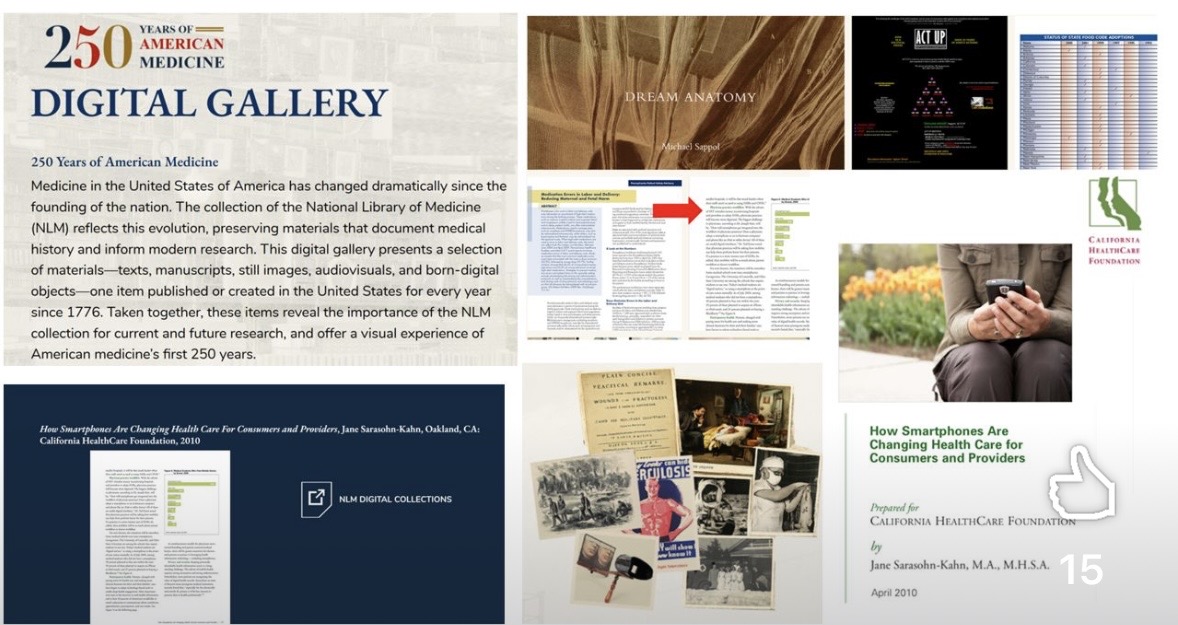 I’m celebrating America’s 250th birthday both patriotically and professionally, honored that the NLM included my 2010 paper, “How Smartphones Are Changing Healthcare for Consumers and Patients” as one of 250 items curated for the digital archive of 250 Years of American Medicine.
 I'm grateful to be part of the Duke Corporate Education faculty, sharing perspectives on the future of health care with health and life science companies. Once again, I'll be brainstorming the future of health care with a cohort of executives working in a global health care enterprise.