


Hey, Big Spender: 1% of US health citizens consume 20% of costs
Cue up the song “Hey Big Spender” from the Broadway hit, Sweet Charity, when you read the January 2012 AHRQ report with the long-winded title, The Concentration and Persistence in the Level of Health Expenditures over Time: Estimates for the U.S. Population, 2008-2009.” The report’s headline is that 1% of the U.S. population consumed 20% of all health costs spent in the U.S. in 2008 and 2009, illustrated by the chart. These Big Health Spenders tend to be in poor or fair health, older, female, non-Hispanic whites and people with only publicly-provided health insurance. Their mean expenditure was $90,061. The top 10%
US doctors less sanguine about the benefits of health IT
To doctors working in eight countries around the globe, the biggest benefit of health IT is better access to quality data for clinical access, followed by reducing medical errors, improving coordination of care across care settings, and improving cross-organizational workflow. However, except for the issue of health IT’s potential to improve cross-organizational working processes, American doctors have lower expectations about these benefits than their peers who work in the 7 other nations polled in a global study from Accenture‘s Eight-Country Survey of Doctors Shows Agreement on Top Healthcare Information Technology Benefits, But a Generational Divide Exists. Accenture polled over 3,700 doctors working in
Connected Health and obesity – will mObesity be able to mitigate the epidemic?
It’s January and the #1 most popular post-New Year’s resolution is to lose weight, get fit, and live well. The signs of this are manifested in ads featuring Janet Jackson promoting Nutrisystem, Jennifer Hudson dueting with her then-and-now selves pitching Weight Watchers, as well as the new Weight Watchers for Men promotion starring Charles Barkley. But there are new signs that losing weight and getting fit are going beyond “diets” and food plans: research shows that moving around and getting exercise can help people sustain hard-earned weight loss more than just changing food intake and “dieting.” So the Apple store
Make 2012 the year of living health-fully
When I would meet up with clients and friends during the latter half of 2011, people whom I hadn’t seen for months would do a double-take when they saw me. “What have you done?” they have asked. In this first post of 2012, I will share with Health Populi readers my story of 2011 — a year of living health-fully for me. One of the blessings of my work-life is that I have access to some of the great minds in health and health care. But not until I began to personally harness their wisdom, intentionally incorporating what they’ve learned into my own life-flow and
Welcome to Health Populi
You’re paying more out-of-pocket for health care co-payments and premiums. You are overwhelmed with health care choices. You search for health information online. You might be lucky enough to have health insurance covered by your employer, but you’re worried about losing it if you leave your job. You shop for healthy food, might do Pilates or Yoga, and spend money on health-oriented cosmeceuticals. You want to engage with the health system, and be empowered in your own health and health care. Welcome to Health Populi. As a health economist, I believe that health is a person’s most valuable asset. My
 Jane will be working with EU- and UK-based clients in September and October 2026, collaborating with stakeholders in digital health, public/community health, retail health, and growing opportunities for health-at-home. Stay tuned to her updates here on Health Populi on-the-ground as she lives the digital nomadic work-life in Italy, Belgium, the Netherlands, and in London.
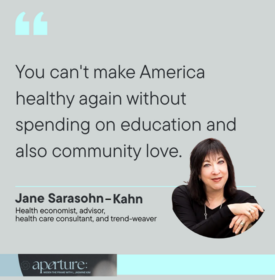 I was grateful to be Jasmine's first conversation-guest on her new podcast, "Aperture - Widen the Frame," where this expert in narrative medicine is bringing together the broad range of voices to sit at the table and address what health care needs: those humans in the health-system-loop who address health equity and empathy along with delivering evidence-based medicine for all.
 Jane joined host Dr. Geeta "Dr. G" Nayyar and colleagues to brainstorm the value of vaccines for public and individual health in this challenging environment for health literacy, health politics, and health citizen grievance. Click onto the Pfizer Value of Vaccines site and you can watch four episodes covering the challenges with adult vaccination, the employer and health plan member's journey to vaccination, reimbursement, and collaborating for proactive prevention.