


Bye-bye, Ward & June Cleaver; Hello, multi-cultural, digital-happy family
“Ward and June Cleaver have left the building,” observe analysts at Nielsen. “The white, two-parent, ‘Leave it to Beaver’ family unit of the 1950s has evolved into a multi-layered, multi-cultural construct dominated by older, childless households,” starts a report from The Nielsen Company, The New Digital American Family. Whatever ethnic flavor this Digital Family may represent, there’s one equalizer across all of them: the smartphone, which is owned by households across cultures and income levels. First, the socio-demographics paint a picture of increasingly multi-cultural households. Recent immigrants to the U.S. accounted for 90% of population growth from 2000-2010, over-indexing for Hispanic and
Women, Chief Household Officers, Like to Manage Health Via Smartphones
“The tipping point for smartphones is now,” claims BabyCenter, the mom-focused internet portal. Mothers are 18% more likely to have a smartphone than the average person, according to the 2011 Mobile Mom Report, a survey from BabyCenter. Why do moms like smartphones? According to BabyCenter, the smartphone is a mom’s “helping hand.” Nearly 1 in 2 say the smartphone helps them decrease stress, and 1 in 4 say it gives them a sense of calm. So is the smartphone in itself a health-promoting device? For readers of Health Populi, the answer is “yes” based on this poll. In the past
Patients want more informational support from their physicians
At least one-half of U.S. patients do not believe they have the information they need to manage their conditions once they leave the doctor’s office. Furthermore, most people feel their physicians don’t communicate with them enough about specific kinds of information, including online resources, information about prescription drugs and side effects, and diet. These insights come out of a survey conducted by MedTera, a patient education and marketing firm that serves the life sciences and health care industry. Key findings from the study illustrate the chasm between patients and their doctors when it comes to people feeling equipped to manage disease
Technology is pointless without people – especially in health
Technology without people is pointless, Sara Redin of J. Boye told an audience today at the J. Boye 2010 conference in Aarhus today. I am in the land of LEGO, Denmark, attending the J. Boye 2010 conference. This meeting focuses on the online world – social media, web design, emerging technologies, the internet, and digital strategy. I’m taking part in the online health track, kicking off with a talk on participatory health. Redin told a story that resonated with me on several levels, personal and professional. She recently took her son shopping for his birthday gift, and they made their way to
It’s not the media…it’s the social – reflections on health activists online
When four self-described health activists share their personal stories in the same physical (not virtual) room at the same time, in real time, it’s an exponentially moving and learning moment. WEGO Health convened a Socialpalooza event (#socialpalooza on Twitter) this week where an influential handful of health activists met face to face with some people who work in health industries. The result was a fruitful dialogue where both empowered patients and the suppliers who research, develop and market products serving those patients, learned a lot from each other. These Four Musketeers of health activism included Alicia Staley (@stales on Twitter), who passionately shares her hard-won experiences in beating
Is health care a blue or a red brand?
Google is heavily favored by Democrats; Fox News Channel, no surprise, by Republicans. Citizens affiliated with a particular political party favor certain consumer brands, according to YouGov’s BrandIndex survey. For Democrats (the blue folks), favored brands include Sony and Amazon. For Republicans (the red voters), top brands include the History Channel, Fox, and Lowe’s. The Google vs. Fox News Channel rift between the parties is huge: 66% of Democrats rank Google on top; 71% of Republicans rank Fox News #1. Google doesn’t even fall into the Republicans’ top ten brand names, according to Advertising Age. There’s some crossover in brand-loving across the two
Talk to me healthy, baby – Health 2.0 gets personal
Sex, drugs, rock and roll, Victoria’s secret bras manufactured with formaldehyde, motivating kids to move about more, and texting potential sex partners your latest STD test results: the 2010 Health 2.0 Conference in San Francisco was more about real, whole health and the person-patient than about cool new tech. Furthermore, the Health 2.0 Conference turned a lot of preconceptions on their head on October 7 and 8, 2010, in a standing-room–only ballroom at the Hilton Union Square. Who could have predicted that government employees would light the room up with high energy and innovative thinking more than a panel of illustrious
Health is a growing business for Nestlé
Their website now talks about it being the “Nutrition, Health and Wellness Company.” Most of us still think of it as the biggest food company in the world. It’s spending one-half billion dollars to expand in health. Nestlé, which brings baby food, bottled water, bars of chocolate and breakfast cereal to kitchen tables is now bringing us Health. The new group will be known as Nestlé Health Science. The company’s existing health business is already valued at about $1.6 billion. “The combination of health economics, changing demographics and advances in health science show that our existing health care systems, which focus on treating
Service First, But Cost Increasingly Drives Consumers’ Pharmacy Satisfaction
Cost-competitiveness is driving overall consumer satisfaction with pharmacies in 2010, 2.5 times the importance that cost had in 2009. But even so, customer service and convenience still trump price in the pharmacy. For brick-and-mortar pharmacies, the key factors driving consumer satisfaction are: Prescription order and pick-up process (convenience) The condition of the store Cost competitiveness Non-pharmacist staff The pharmacist. In 2010, cost competitiveness accounts for 24% of overall satisfaction among brick-and-mortar Rx shoppers; that number was 9% in 2009. The retail pharmacy chains garnering highest satisfaction nationally are the Good Neighbor Pharmacy, Health Mart, and The Medicine Shoppe Pharmacy, all awarded
Cause branding permeates all industries, including health
8 in 10 people want companies to help them make changes to their own behavior, including getting more physical activity, eating healthier, and reducing their impact on the environment, according to the 2010 Cone Cause Evolution Study. Even more moms — 9 in 10 — are looking for this kind of support from companies with which they do business. Health is top-of-mind when it comes to cause marketing. 8 in 10 people think that companies should support health and disease. Cone’s study shows that cause marketing hasn’t just gone mainstream: it’s been absorbed into shoppers’ consciousness and figures into personal spending
Physicians stick with professional health content sites online in 2010
The fact that physicians access health information digitally is not big news; but, where they’re going online may surprise some health marketers who are shifting educational and promotional resources to online portals. 4 in 5 physicians access health care professional sites, the most visited online sources for physician seeking health information online; these sites get nearly one-half of physicians’ time online, and 1/3 of total visits among all health categories, according to a report from the comScore/ImpactRx Physician Behavioral Measurement database. However, one of the long-standing sources of information for doctors — medical journals — only reaches 30% of physicians, and doctors spend
Pharma-economics: retail drug prices rice, and consumers react
Two reports, from Consumers Union and the AARP, put the pharmaceutical industry in the spotlight again this week, and not in a good way. First, Consumer Reports polled U.S. adults who take prescription drugs and found that 39% took some action to reduce costs. 27% didn’t take the Rx as prescribed: 16% didn’t fill the prescription, 12% took a drug past its expiration date, and 4% shared a prescription with someone else. These and other survey findings are discussed in Consumers say big pharma influence on docs is concerning, published in the Consumer Reports Health Blog on August 24, 2010. Second, the AARP calculated
Mayberry RFDHHS
Now showing in a 60-second spot during the 6 o’clock news: Andy Griffith’s got the starring role in promoting the peoples’ use of the Patient Protection and Affordable Care Act of 2010 (PPACA). Here is the announcement of the ad in The White House blog of July 30 2010. In the ad, Andy, now 84, recalls the signing of Medicare by President Johnson and moves into some details about the good things PPACA brings to seniors in the U.S. The Christian Science Monitor covers the story and shows the video here. This has caused quite a stir among Republicans who say
Consumers go generic, both in and outside of health care
1 in 2 Americans are purchasing more generic brands, and 2 in 3 are brown-bagging lunch, according to a HarrisInteractive survey into consumers’ buying patterns 30 months into the recession. Titled, Americans Still Cutting Back on the Little Things to Save Money, Harris’s poll discovered that U.S. consumers are making a lot of micro-changes on a daily basis to deal with the economic downturn. Besides migrating toward generic products and away from branded ones, and not buying as many lunches out, they’re switching to refillable water bottles, using the hairdresser and barber less, cancelling media subscriptions (including magazines, newspapers and cable TV), and
The road to meaningful use has many bumps along the way, CIOs say
While 1 in 2 health CIOs say they’ll be prepared to apply for stimulus funding to adopt electronic health records in 2011, 80% are concerned about their ability to meet the requirements of meaningful use (MU). This lack of confidence on the road to MU is based on a host of challenges, from reporting requirements and lack of clarity of MU criteria to availability of IT talent and worries about access to capital. PricewaterhouseCoopers’ Health Research Institute (PwC) surveyed 120 health care CIOs and IT executives and published the detailed findings in the report, Ready or not: On the road to
Hospital marketing and Mad Men: national brands go direct-to-consumer
This week’s issue of Advertising Age magazine dated June 28, 2010, includes cover stories about fast food advertising buoying cable TV revenues, car companies changing ad agencies, the Cannes advertising festival focusing on creativity and ROI, and…hospitals and health reform? Why do hospitals and health reform appear on the cover page of Ad Age? It’s the “new front of medical marketing,” Rich Thomaselli, Ad Age editor, calls it. With upwards of 30 million Americans gaining health insurance coverage under the Patient Protection and Affordability Act (PPACA, or “health reform” broadly writ), hospitals are competing for new business, along with aging baby
The pharmacy as health hub – what the Rite Aid/American Well alliance means
As Rite Aid partners up with American Well, here’s another example of the further retail-ization of health in the U.S. The subtext of this arrangement is the fact that the pharmacy is a touch-point for health consumers who seek trust, convenience, access, and an understandable market channel for health. Rite Aid will be the first pharmacy to test the American Well service that enables patients to interact online with providers. In this program, consumers will interact live online via Internet or phone with Rite Aid pharmacies from both their homes and private consultation rooms at select Rite Aid pharmacies. The consults will
Every company’s in the health business
Health is not just the purview of health care companies. It’s the job of all industries, according to consumers who live in 11 countries the world over. The headline finding of the 2010 Edelman Health Engagement Barometer is that Health is the New Green. As green has been a sustainability strategy for business these past several years, Health is following in Green’s footsteps, as Nancy Turett, Global President-Health for Edelman says, “to both propel and protect businesses.” Look at the chart: while nearly all consumers believe that bio/pharma, health providers, and the over-the-counter (OTC) and personal care industry should engage in health
Trust and authenticity are the enablers of health engagement
Without trust, health consumers won’t engage with organizations who want to cure them, sell to them, promote to them, help them. Here’s what I told a group of pharmaceutical marketers at The DTC Annual Conference in Washington , DC, on April 9, 2010. Let’s start with the World Health Organization’s definition of health: that is, the state of complete physical, mental and social wellbeing, and not just the absence of disease. This definition is being embraced by health citizens long before the silos in the health industry – including pharma – get it. That’s an important mindset to take on as
Taco Bell does nutrition at the drive-thru window – pondering Pollan’s Food Rules
1 in 2 Americans visits so-called quick service restaurants (QSR) twice a month, 29% visit 3-5 times a month, and 16% visit 6 or more times a month. Taco Bell sponsored the America’s Drive-Thru Survey and found that 7 in 10 Americans think having better choices in drive-thru’s would encourage them to eat better. Only 50% of Americans believe they can stick to a low-calorie diet while ordering through drive-thru’s. 9 in 10 would try better choices of their favorite menu items if they were offered. Taco Bell generates 70% of its business via drive-thru. This press release explains the
Embarrassing bodies – preventing people from dying of embarassment in the UK
“Don’t be embarrassed by your body. Learn to love it,” the voice on the video positively commands. Comcast, are you listening? Channel 4 in the United Kingdom hosts the television show, Embarrassing Bodies. There’s also a website providing health information that is detailed, audacious, graphic, and absolutely engaging. On it, you’ll see close-ups of breasts, testicles, vulvae, and most other body parts in Grey’s Anatomy that are suitable for self-examination. The show launched in April 2008 and was watched by over 12 million people. Since there, Embarrassing Bodies has seen countless downloads of health videos, page views on
Health workers are most trusted profession – except for HMO managers
Who do you trust the most in America? Nurses, pharmacists, doctors, and police officers. Who’s least trusted? Elected officials in Congress, car salesmen, stockbrockers, and…HMO managers. Gallup‘s annual Honesty and Ethics of Professions poll is out and finds that health providers and front-line health workers rank highest in the nation. Nearly 9 in 10 Americans say nurses have the highest integrity, followed by 2 in 3 Americans ranking pharmacists and doctors as high or very high. Integrity grades aren’t so high, though, for chiropractors and psychiatrists, ranked very high or high in ethics among 34% and 33% of Americans, respectively.
Functional foods play a role in consumer-driven health care
Americans spend nearly $30 billion on functional foods, according to Leveraging growth in the emerging functional foods industry, from PricewaterhouseCoopers (PwC). Functional foods are those that contain supplements beyond food that’s consumed for basic nutrition. They incorporate additional ingredients that target specific health benefits. PwC believes that the U.S. represents the largest functional foods market in the world, up to one-half of global sales. 20 companies account for 70% of the U.S. market. Many of these names are very familiar, such as PepsiCo (with Gatorade and Quaker), Coca-Cola (Vitamin Water and Odwalla), General Mills (Cheerios and Yoplait), Kellogg (Kashi and
Demand for health products and services is down in the recession; thinking about value and self-care in health
What is value in health care? Every year we spend more and seem to get less, John Seng, Founder of Spectrum, told attendees of a webinar on the Spectrum Health Value Study on 12th May 2009. As we consumers spend more of our own money, we’ll be looking for greater value and “health ROI” from our health spending. Measuring value across a population is confounded by the fact that what one person decides to spend on ‘health’ can be different from another’s health spending choices. In other words, our personal health “marketbaskets” for health spending vary from person to person.
Health care in every pot – what we can learn from Costco

And the pot will be from Costco, not Williams-Sonoma. The most telling point about health reform in President Obama’s budget is that, “Some researchers believe that healthcare costs could be reduced by a stunning 30 percent — or about $700 billion a year — without harming quality if we moved as a nation toward the proven and successful practices adopted by the lower-cost areas and hospitals.” That sentence gives us some grist for forecasting some of the elements of health reform — in particular, the last phrase which talks about moving from higher-cost, unproven health practices to lower-cost proven approaches.
Don’t cross Baby Mama — McNeil Will Need More Than Motrin For This New Headache
It all started with a baby, a baby carrier, and Motrin. Oh, and an advertising agency who probably got their Mommy-messaging more than a little bit wrong. Twitter, the social networking software, helped fuel this uproar in a matter of hours. In what is to-date among the fastest viral campaigns in consumer health — that backfired –well over a hundred of mommy blogs and countless Twitter messages expressed emotions on a continuum from outrage to insult about a new campaign targeted to Moms who carry their babies in on-the-body carriers. The ad begins, “Wearing your baby seems to be
Who do you trust? Edelman’s Trust Barometer says “people like me,” tech, life science, and banks — not insurance, media, or government
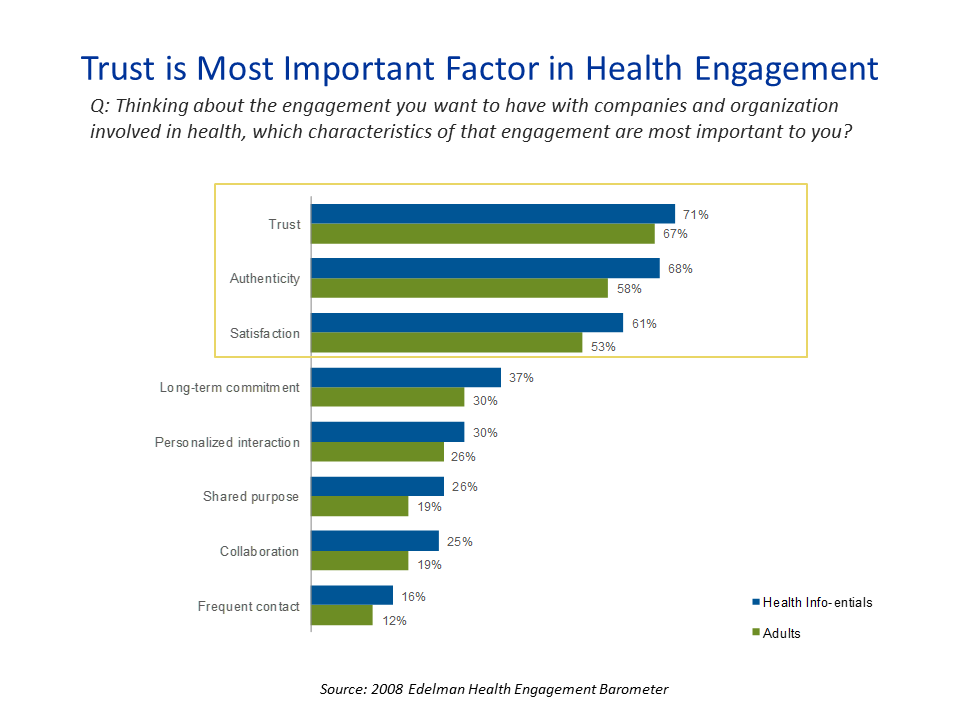
The 2008 Edelman Health Engagement Barometer is out alongside the company’s annual Trust Barometer, and more than ever, people are trusting “people like me” more than they do institutions. This is the ninth iteration of the Trust survey. The toplines of the past four years show an important change in peoples’ trust perspectives. In 2005, Edelman found that trust in ‘established institutions’ and figures of authority began shifting to peers. By 2006, “A person like me” was the most credible spokesperson for companies. That year, people trusted employees significantly more than company CEOs. Edelman defines “a person like me” as
Health, the New Status Symbol
We’d rather be healthy than wealthy, according to a new survey from Manning Selvage & Lee (MS&L), the PR firm that’s part of the global communications company, Publicis. MS&L polled Americans’ beliefs on health and self-esteem. Three-quarters (72%) of Americans say that being physically healthy is a symbol of personal success. 91% of Americans said they’d rather be described ads “healthy” than “wealthy.” 71% said they’d rather be seen as someone who “looks really healthy” vs. someone who’s nicely “put together or well-dressed.” These will be glad tidings for MS&L’s client base. MS&L serves a global health clientele which includes
Virgin grows in health care
A new brand of clinic is entering the health care market…aligning itself in a public/private partnership with none other than the largest health system in the world, the National Health Service in the UK. Richard Branson is a master brander, having started up Virgin records in 1970 and Virgin airlines in 1984,. When he took on the Old School airlines, he was seen as the enfant terrible of the industry. But he re-imagined the airline business model and made it fun to fly. Can he do the same for health in the United Kingdom? Here’s the deal: Virgin Healthcare will
Happy birthday, Prozac!
The Financial Times celebrates the 20th birthday of Prozac in the newspaper’s Nov 17/18th issue. It’s valuable to look at the rise and fall of Prozac, the brand; the rise of its generic equivalent; and how the drug has profoundly impacted one consumer’s life. Prozac Market. Before it treated depression, Prozac was thought to be an anti-hypertensive. When that didn’t seem to work, Eli Lilly considered it for an anti-obesity treatment. Strike two, clinical-wise. Finally, Lilly took the drug to market to fight depression after it was approved by the FDA on December 29, 1987. In two years, Prozac became
Target marketing: no pink guns left behind?
In 2004, 20% of homicides were directly associated with intimate partner conflict (i.e., one in which an intimate partner killed another partner). Intimate partner violence resulting in death was most common among victims aged 40-44 years. Murder is the leading cause of death for pregnant women, according to the National Organization of Women. The National Center for Injury Prevention and Control, part of the Centers for Disease Control and Prevention, spends about $43 million a year on ways to reduce deaths and injuries from drowning, poisoning, suicide, industrial accidents, house fires and domestic violence. Of that sum, only $2.3 million
Plastic’s growing role in health care
There are many forms of plastic in health care. No, I’m not talking about new polymers used for medical implants. I’m talking about financial services. A new card from Humana and Republic Bank illustrates the continuing integration of consumer personal finance and health care. The new VISA card, private labelled as the HumanaAdvance card, will be offered to Humana’s employer groups for enrollees to use at hospitals, doctor and dentist offices, drugstores and other locations providing health-related products and services. Of course, as with all plastic, this card comes with its own fine print: 0% interest rate (APR) on
The Future of Retail – Implications for Health
I’ve been looking at health care through a retail lens for some time. Perhaps it’s that I’m a rag trader’s daughter, or that I’ve been known to like shopping, that I have clients in consumer goods, or that I understand how tiered drug pricing impacts the consumption of medicines (answer: it’s all of the above). I’ve just reviewed the latest trend report from PricewaterhouseCoopers and TNS Retail Forward on the future of retailing. My mind is connecting the dots between the future of retail and the American health care consumer. Four future retail trends are already embedding in health care
The grocery store as health destination
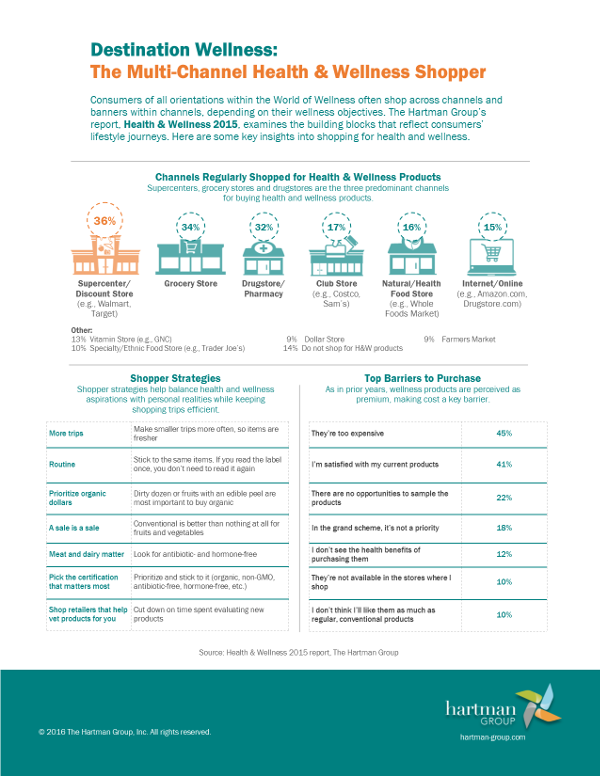
We love new food products, as evidenced by the ever-growing array and permutation of new goodies at our grocery stores. Among those who say new food products are important to them, the top reason why they buy new food products is health. Open your eyes when you’re next grocery shopping and look around you — your favorite grocer is morhping into a health destination. Whole Foods has launched its Whole Body store-within-a-store concept. Wegmans offers their Eat Well Live Well program. Even Wal-Mart, home of the $4 generic drug price-point, has begun to offer organic food based on demand according
 Thank you Aaron Strout for hosting our conversation on the Reaching Higher Podcast, now live on Apple, Spotify, and YouTube. We covered a lot of ground addressing health care and health citizenship, the growing prospects for our homes as our health hubs, and how our humanity is a key ingredient in health-making for all.
 I'm grateful to be part of the Duke Corporate Education faculty, sharing perspectives on the future of health care with health and life science companies. Once again, I'll be brainstorming the future of health care with a cohort of executives working in a global pharmaceutical company.
 Jane joined host Dr. Geeta "Dr. G" Nayyar and colleagues to brainstorm the value of vaccines for public and individual health in this challenging environment for health literacy, health politics, and health citizen grievance. Click onto the Pfizer Value of Vaccines site and you can watch four episodes covering the challenges with adult vaccination, the employer and health plan member's journey to vaccination, reimbursement, and collaborating for proactive prevention.