


Lower calories are good business
The restaurant chain business employs 10% of U.S. workers and accounts for $660 bn worth of the national economy. Where restaurant chains are growing fastest is in serving up lower-calorie meals, and it’s been a boon to the bottom-line. The case for lower calories leading to better business is made in Lower-Calorie Foods: It’s Just Good Business from the Hudson Institute‘s Obesity Solutions Initiative, published February 2013. In the report, researchers analyzed nitty-gritty restaurant chain data on servings and traffic from 2006-2011 to sort out whether sales of so-called lower-calorie menu items in 21 chains led to improved business. The chains
The more engaged a patient is, the lower their costs
There are many ways to measure and express “patient engagement.” One such metric is “patient activation,” innovated by Dr. Judith Hibbard, long affiliated with the University of Oregon. Dr. Hibbard has written extensively about the Patient Activation Measure, PAM, first described in 2004. She and a team of researchers have determined that the higher a patient’s PAM score, the lower their health costs. Hibbard et. al. published these findings in the February 2013 issue of Health Affairs, which is entirely devoted to patient engagement – a top topic in Health Populi. The team analyzed the medical records of 33,163 patients
The interoperability of consumer mHealth – reflecting on Jawbone + Massive Health + Visere
Consumers want multiple functions on single devices, smooth transitions from one screen to another, and value-laden experiences in the post-recession economy. I wrote about this phenomenon during the week of the 2013 Consumer Electronics Show, highlighting Accenture’s survey on consumer attitudes toward technology — the connected home as consumer medical home. In the fast-evolving mobile health (mHealth) era, the consumer-facing suppliers are fast-responding to these customer demands. This is fostering consumer-centered interoperability in mHealth. On the health care system and professional side of health IT, getting to interoperability remains elusive and slow-going, with a customer base (hospitals, physicians) that’s not
The flu shot economy
4 in 10 Americans got flu shots in this epidemic season, and most of these didn’t receive their immunization in their doctor’s office. The Flu Vaccination Survey from Ipsos Public Affairs, conducted in January 2013, paints a picture of U.S. health consumers who are project managing their personal approaches to preventing the flu in this historically hard-hitting flu season. The most expressed demand for flu shots has been among people 55 and over, one-half of whom have received vaccinations, with the lowest use been in the 25-35 year age group. Geographically, the most covered health citizens live in New England
Most women want to be healthy, buy healthy
Health and wellness motivations among women cross all generations, driving them to purchase products that bolster health as they define it…not how media and stereotyping advertising have typically portrayed it, according to a survey report from Anthem Worldwide, What Women Really Want From Health and Wellness. Over all generations, 3 in 4 women say they make choices to benefit their health and wellness. Anthem asked women about the “external voices” of health/wellness messaging versus their “internal voice.” The external represent societal expectations: over 80% of women expect to take responsibility for their family’s health, and about 70% of women say the
Formally tracking health data changes health behavior and drives social health
Most of us keep track of some aspect of our health. Half of all people who track do so “in their heads,” not on paper, Excel spreadsheet, or via digital platform. Furthermore, 36% update their health tracking data at least once a day; but 16% update at most twice a month, and 9% update less than once monthly. Tracking for Health from the Pew Internet & American Life Project paints a portrait of U.S. adults who, on one hand are quantifying themselves but largely aren’t taking advantage of automated and convenient ways of doing so. Overall, 69% of U.S. adults track
Think about health disparities on Martin Luther King Day 2013
On this day celebrating Martin Luther King, Jr., I post a photo of him in Detroit in 1963, giving a preliminary version of his “I Have a Dream” speech he would give two months later in Washington, DC. As I meditate on MLK, I think about health equity. By now, most rational Americans know the score on the nation’s collective health status compared to other developed countries: suffice it to say, We’re Not #1. But underneath that statistic is a further sad state of health affairs: that people of color in the U.S. have lower quality of health than white
The connected home as consumer medical home
Consumers are looking for electronic devices that do many things, don’t care much about what platforms they use, like the convenience that cloud computing enables, and are bringing their own devices to the workplace for productivity, conference calls, and communication. Accenture has studied the wired consumer and developed this infographic, which illustrates these four key findings. Accenture says it’s “an open playing field” when it comes to consumer technology: there are many suppliers who can develop products and sell into this market, where consumers seem pretty agnostic relative to operating systems and even brands — as long as the devices
The Internet as self-diagnostic tool, and the role of insurance in online health
1 in 3 U.S. adults have enough trust in online health resources that they’ve gone online to diagnose a condition for themselves or a friend. “For one-third of U.S. adults, the Internet is a diagnostic tool,” according to Health Online, the latest survey on online health from the Pew Internet & American Life Project. Nearly one-half of these people eventually sought medical attention. One-third did not. Women are more likely to do online medical diagnoses than men do, as do more affluent, college-educated people. When people perceive they’re ‘really’ sick, 70% get information and care from a health professional and
Battle of the (wrist)Bands at the Digital Health Summit, 2013 CES
One of the fastest-growing segments at the 2013 Consumer Electronics Show in Las Vegas this week is digital health. And within that segment, there’s a battle brewing for what technology companies seem to think is the most valuable part of real estate on the human body: the wrist. I counted at least fifty products as I cruised aisles 26000-27000 in the South Hall at the Las Vegas Convention Center that had wristbands, usually black, plastic or rubbery, and often able to click in and out of the band for use in-hand, in pocket, or in a few cases, on a
We are all health deputies in the #digitalhealth era: live from the 2013 Consumer Electronic Show
Reed Tuckson of UnitedHealthGroup was the first panelist to speak at the kickoff of the Digital Health Summit, the fastest-growing aspct of the 2013 Consumer Electronics Show (#2013CES). Tuckson implored the spillover audience to all, “self-deputize as national service agents in health,” recognizing that technology developers in the room at this show that’s focused on developers building Shiny New Digital Things have much to bring to health. As Andrew Thompson of Proteus Medical (the “invisible pill” company) said, “we can’t bend the health care cost curve; we have to break it.” This pioneering panel was all about offering new-new technologies
One-third of U.S. consumers plan to buy a new fitness tech in 2013, but most buyers are already healthy
Over one-third of U.S. consumers plan to buy a new fitness technology in the next year, especially women. They’ll buy these at mass merchants (females in particular, shopping at Target and Walmart), sporting goods retailers (more male buyers here), online and at electronics stores like Best Buy. These potential buyers consider themselves in good or excellent physical health. They’ll see the latest applications on retail store shelves in pedometers, calorie trackers, fitness video games, digital weight scales, and heart rate monitors that will be launched this week at the 2013 Consumer Electronics Show in Las Vegas. In advance of the
New Year’s Resolutions for health, and the 2013 Consumer Electronics Show
When it comes to taking on personal responsibility, the #1 New Year’s Resolution is to engage in fitness and exercise, cited by 43% of U.S. adults, followed by healthy eating, noted by 37% of people. Other resolutions involving personal responsibility are Family (26%) Spirituality and faith (22%) Managing personal finances (22%. This survey was undertaken as part of Liberty Mutual’s The Responsibility Project (RP), which is taglined: “Explore what it means to do the right thing.” Launched in 2008, Liberty Mutual’s RP has been diving into the many aspects of daily living for which we, each of us, could take responsibility…including
Consumers want digital communications from providers, from payment reminders to patient care via email
85% of U.S. health consumers say that emails, text messages, and voicemails are at least as helpful as in-person or phone conversations with health providers, according to the TeleVox Healthy World study, Technology Beyond the Exam Room. The study was based on surveys conducted with over 2,200 health providers across specialties, and 1,015 U.S. adults over 18. Furthermore, one in 3 consumers admit to being more honest when talking about medical needs via automated voice response systems, emails or texts than face-to-face with a health provider. And 3 in 10 consumers believe that receiving digital health communications from providers such
Physicians’ growing use of the Internet: where trust and value drive information search
“The Internet will have a profound effect on the practice and business of medicine. Physicians, eager to provide high-quality care and forced by competition to offer online services, will introduce e-mail and patient-friendly Web sites to improve administrative services and manage common medical conditions. Patients will identify more helath information online and will take more responsibility for their care. The doctor/patient relationship will be altered. Some aspects of electronic communication will enhance the bond, and others will threaten it. Patients will have access to vast information sources of variable validity. Many physician organizations are preparing for the electronic transformation, but
Call them hidden, direct or discretionary, health care costs are a growing burden on U.S. consumers
Estimates on health spending in the U.S. are under-valued, according to The hidden costs of U.S. health care: Consumer discretionary health care spending, an analysis by Deloitte’s Center for Health Solutions. Health spending in the U.S. is aggregated in the National Health Expenditure Accounts (NHEA), assembled by the Department of Health and Human Services (DHHS) Centers for Medicare and Medicaid Services (CMS). In 2010, the NHEA calculated that $2.6 trillion were spent on health care based on the categories they “count” for health spending. These line items include: Hospital care Professional services (doctors, ambulatory care, lab services) Dental services Residential
Mobile is the new black in health care
Mobile technology will change the delivery of health care, according to 2 in 3 health IT execs polled in the 2nd Annual HIMSS Mobile Technology Survey, sponsored by Qualcomm Life. Only 2% of health IT management says mobile won’t impact the delivery of health care in the future. This week finds the mHealth Summit convening in Washington, DC, hosting some 3,000 interested stakeholders looking at the intersection of mobile devices and platforms and health and health care. The 2012 theme is Connecting the Mobile Health Ecosystem, and the exhibitor area of the Summit speaks to the broadening of that ecosystem, including
Food and health: information is not doing the job as the U.S. continues its obesity march
Notwithstanding the fact that most phones on U.S. streets are “smart” ones, most adults surf the net for health information, and most people try to change a health habit each year, Americans haven’t adopted healthier long-term relationships with food. The International Food Information Council has conducted the Food & Health Survey: Consumer Attitudes Toward Food, Safety, Nutrition & Health poll since 2006, thus enabling us to track peoples’ attitudes and behaviors over the past several years. The latest polling results appear in Is it Time to Rethink Nutrition Communications? A 5-Year Retrospective of Americans’ Attitude toward Food, Nutrition, and Health online in
The impossibility of being an expert: empowering physicians with new-new information
The godfather of evidence-based medicine, Dr. David Sackett, said that the practice of evidence-based medicine integrates: Individual clinical expertise A patient’s values and expectations The best available external clinical evidence. If a physician’s got the first issue covered, and a patient is very engaged in their health in full collaboration with their physician, there’s still the third issue to deal with: the proliferation of medical information and keeping up with the literature. It’s impossible to be an expert, claimed two Welsh med school professors in the British Medical Journal in an honest appraisal of the “avalanche of information.” Today, med
Most smartphone owners seek health information online via mobile
The ubiquity of mobile phones, increasingly smart ones (one-half of all mobile phones in the U.S. ), means people are walking around, working, playing and driving with self-tracking devices and ultra-mini computers in their pockets and totebags. 52% of smartphone owners seek health information on their phones, and overall 1 in 3 people seek health information on all mobile phones — nearly doubling the percent of those seeking health info via mobile in 2010 (17%). People who are sicker, caregivers, and those who have had a big change in health are also more prone to using phones for health, as
Elsevier’s ClinicalKey Hits the Road – a mobile healthcare search tour
There are many definitions of mobile health, and Elsevier is adding another to the list. The world’s largest medical publisher has taken its new clinical search tool, ClinicalKey, on the road. Coined the ClinicalKey Experience Tour, Elsevier is coming to a medical center near you to enable clinicians, medical librarians, and health care administrators to give ClinicalKey a spin in their hospital’s parking lot. The challenge: the amount of new medical information doubles every 5 years, while 4 in 5 physicians say they have less than five hours a month to keep up with this, according to a DoctorDirectory survey. At the same time, health care providers feel hard-pressed
Wired health: living by numbers – a review of the event
Wired magazine, longtime evangelist for all-things-tech, has played a growing role in serving up health-tech content over the past several years, especially through the work of Thomas Goetz. This month, Wired featured an informative section on living by numbers — the theme of a new Wired conference held 15-16 October 2012 in New York City. This feels like the week of digital health on the east coast of the U.S.: several major meetings have convened that highlight the role of technology — especially, the Internet, mobile platforms, and Big Data — on health. Among the meetings were the NYeC Digital Health conference, Digital
In sickness and in health: consumers expect doctors to be wellness coaches, too
4 in 5 health consumers expect doctors not only to treat them when they’re sick, but to keep them healthy. “In sickness and in health” now morphs over to the doctor-patient relationship, beyond the marriage vow. Better Health through Better Patient Communications, a survey from Varolii, finds that people are looking for health, beyond health care, from their physicians. Varolii is a customer interaction company that claims to have interacted with 1 in 3 Americans through some sort of company communication: they work with major Fortune 1000 companies, including banks, airlines, retail, and, yes, health care. They recently attracted a
From fragmentation and sensors to health care in your pocket – Health 2.0, Day 1
The first day of the Health 2.0 Conference in San Francisco kicked off with a video illustrating the global reach of the Health 2.0 concept, from NY and Boston to Mumbai, Madrid, London, Tokyo and other points abroad. Technology is making the health world flatter and smarter…and sometimes, increasing problematic fragmentation, which is a theme that kept pinching me through the first day’s discussions and demonstrations. Joe Flowers, health futurist, offered a cogent, crisp forecast in the morning, noting that health care is changing, undergoing fundamental economic changes that change everything about it. These are driving us to what may
What Jerry the Bear means for Health 2.0
A teddy bear in the arms of a child with diabetes can change health care. At least, Jerry the Bear can. Yesterday kicked off the sixth autumn mega-version of the Health 2.0 Conference in San Francisco. Co-founded by Matthew Holt and Indu Subaiya, a long-time health analyst and physician, respectively, this meeting features new-new tools, apps and devices aimed at improving individual and population health, as well as health processes and workflows for physicians, hospitals, pharma, and other stakeholders in the health care ecosystem – even health lawyers, who met on October 7 to discuss up-to-the-minute e-health law issues. Yesterday was
Patients want to see the notes their doctors write about them: the power of transparency in health care
Transparency in health care can bring greater empowerment and enable more rational decision making for health consumers. Physicians acknowledge this: “We believe that increasing transparency in the health care system can be beneficial to both patients and physicians,” said J. Fred Raslton, Jr., MD, FACP, president of the American College of Physicians. There’s an indication that patients will embrace transparency in the form of accessing their physicians’ notes about them, based on the OpenNotes project research published in the Annals of Internal Medicine this week. The objective of the study was to measure the impact on doctors and patients of extending
Aetna finds consumers aren’t very empowered in health
Americans find health insurance decisions the second most difficult major life decision only behind saving for retirement (36%) and slightly more difficult than purchasing a car (23%), via Aetna’s Empowered Health Index Survey. Why are health insurance choices so tough? Consumers told Aetna that the available information is confusing and complicated (88% percent), there is conflicting information (84%) and it’s difficult to know which plan is right for them (83%). Based on this survey’s findings, millions of Americans indeed feel dis-empowered by health care decision making. Who is empowered? Aetna says the empowered are likely to be more affluent, insured, married, take
Nordstrom and Amazon, where are you in health care service?
When it comes to customer service, retail, banks, airlines and hotels are tops. Health care? Not so good. This sobering finding comes via PwC’s report, Customer experience in healthcare: The moment of truth. PwC pulled data from the company’s Customer Experience Radar survey of 6,000 consumers across industries. This particular analysis looks at consumers’ service views on banking, hospitality, airline, retail vs. health care providers and insurance companies. The chart shows consumers’ answers to a question of whether they are willing to report positive interactions about a customer experience. The graph shows that people are more likely to share opinions
Target gets into the Quantified Self biz: could this be the mainstreaming of self-monitoring?
Target, the beloved retail channel for many design-minded value-conscious consumers, has opted in to mobile health through its purchase of SMARTCOACH mobile health coaching devices. SMARTCOACH is part of a growing category of wearable devices that monitor health behaviors like walking and calories consumed. What differentiates SMARTCOACH is the “coach” element, which provides real-time feedback throughout the day. Most other devices in the market simply track and record data. And it’s feedback loops that more experts say are key to sustaining health behavior change. Target will bring the device into stores for purchase in the fall. Like some other wearable
The U.S. health consumer is health-finance illiterate, and resistant to linking wellness to health plan costs
Two in 3 employees (62%) can’t estimate how much their employers spend on health benefits. Of those who could estimate the number (which is, on average, about $12,000 according to the 2012 Milliman Medical Index), most weren’t very confident in their guess. Some 23% calculated the monthly spend by employers was less than $500 a month — less than 50% the actual contribution. Thus, most U.S. health consumers don’t fully value the amount of cash their employers spend on their health care, according to a poll from the National Business Group on Health, Perceptions of Health Benefits in a Recovering
Lab tests and knowing our numbers can inspire patient engagement
One-half of the members of Kaiser Permanente use the plans’ personal health record system, MyHealthManager. The most-used function of MyHealthManager is accessing lab results, according to KP. Now that Quest, the lab and health information company, has launched the mobile phone app, Gazelle, more health citizens will have access to lab test results. This could be a health-activating opportunity inspiring patient engagement. While Gazelle is a fully functional personal health record (PHR), it’s the connection to lab test results that’s the lightbulb moment. PHRs have been available to health consumers for over a decade. There are millions of users of
Consumer ambivalence about health engagement – will OOP costs nudge us to engage?
In some surveys, U.S. consumers seem primed for health engagement, liking the ability to schedule appointments with doctors online, emailing providers, and having technology at home that monitors their health status. The chart illustrates some of these stats from a 2011 survey by Intuit. However, organizations that develop quality report cards on providers and plans, and developers of mHealth apps, will point out that consumers aren’t rushing to use the quality reports or sustain use of apps: in fact, most downloaded health apps aren’t used after one try, according to PwC’s research. How do we make sense of these different
Our social network schizophrenia: how “reluctant individualism” impacts health care
While 2 in 3 U.S. adults are active on social media, we are skeptical about trustworthiness of the content we find there. Welcome to the 13th quarterly Heartland Monitor Poll from Allstate and National Journal, surveying how U.S. adults look at social media, trust, and the political future of the nation. The Poll surveyed, by landline and cell phone, 1,000 U.S. adults over 18 in May 2012. The most common social network used is Facebook, among 51% of U.S. adults, followed by Google+ (28%), Twitter (13%), LinkedIn (12%), Pinterest (6%), and MySpace (5%). While Americans are drawn to using social
Thinking about Dad as Digital “Mom”
What is a Mom, and especially, who is a “Digital Mom?” I’ve been asked to consider this question in a webinar today hosted by Enspektos, who published the report Digging Beneath the Surface: Understanding the Digital Health Mom in May 2012. I wrote my review of that study in Health Populi here on May 15. In today’s webinar, my remarks are couched as “Caveats About the Digital Mom: a multiple persona.” Look at the graphic. On the left, the first persona is a mother with children under 18. Most “mom segmentations” in market research focus on this segment. But what
Patients in emerging countries value mHealth, but sustaining mHealth behaviors is tough
Half of patients globally expect that mobile health will improve health care. These health citizens expect that mobile health will help them manage their overall health, chronic conditions, how they manage their medications and measure and share their vital health information. Welcome to the new mobile health world, a picture captured in PwC’s report, Emerging mHealth: Paths for growth, published in June 2012 and written by the Economist Intelligence Unit. Patients’ views on mHealth are bullish, and while most doctors and payors share that vision, they also expect mHealth to come into focus more slowly, recognizing the institutional, cultural and
Health and Digital Moms – getting underneath the hood of the Mobile Mom
Mom is the Chief Health Officer of her family, she’s mobile, and seeking health information and community on-the-go. But underneath the persona of the Mobile Mom, she’s consuming information and sharing perspectives on many other ‘screens,’ too. And that’s the challenge for marketers seeking to grab the attention of this key player in the health ecosystem. There are new survey data from Enspektos‘s report, Digging Beneath the Surface: Understanding the Digital Health Mom, that are must-reading for health industry stakeholders who seek to motivate health behaviors among women, who are at once nurturing wellness, caregiving for sick people, and sharing
Social media in health help (more) people take on the role of health consumer
One in 3 Americans uses social media for health discussions. Health is increasingly social, and PwC has published the latest data on the phenomenon in their report, Social media ‘likes’ healthcare: from marketing to social business, published this week. PwC polled 1,060 U.S. adults in February 2012 to learn their social media habits tied to health. Among all health consumers, the most common use of social media in health is to access health-related consumer reviews of medications or treatments, hospitals, providers, and insurance plans, as shown in the graph. Social media enables people to be better health “consumers” by giving them peers’
Leverage the American DIY attitude for health
As I leave Asia, where I’ve been for the past two weeks, for the U.S. today, I am reading the daily newspaper, the Korea Joongang News. On today’s op-Ed age is The Fountain column titled, Embracing the do-it-yourself attitude. In it, Lee Na-ree writes, “Making something with your own hands is part of the American pioneer spirit.” He describes the Maker Faire events and the project of Caine’s Arcade, a game developed by a Los Angeles boy who used auto parts from his dad’s shop. Na-ree observes that Americans are ‘regretting’ mass consumption. Health Populi’s Hot Points: I happened upon
Right-sizing food and healthcare
In our fast-texting, quick-thinking, Blink-ing society, Jason Riis talks about slowing down our relationship with food. At the Edelman Wellness Ignited meet-up on March 26, 2012, Jason riffed on food intervention and economics for healthy eating. Jason is a professor at Harvard Business School and among his many research interests is how to change culture to morph away from obesity and Type 2 diabetes toward health. The U.S. is a shopping nation: retail is destination, fun, entertaining, life, for millions of Americans. Jason’s asking what retailers can do about fast and food. This isn’t only about ‘fast food,’ which, of course,
Wellness Ignited! Edelman panel talks about how to build a health culture in the U.S.
Dr. Andrew Weil, the iconic guru of all-things-health, was joined by a panel of health stakeholders at this morning’s Edelman salon discussing Wellness Ignited – Now and Next. Representatives from the American Heart Association, Columbia University, Walgreens, Google, Harvard Business School, and urban media mavens Quincy Jones III and Shawn Ullman, who lead Feel Rich, a health media organization, were joined by Nancy Turett, Edelman’s Chief Strategist of Health & Society, in the mix. Each participant offered a statement about what they do related to health and wellness, encapsulating a trend identified by Jennifer Pfahler, EVP of Edelman. Trend 1: Integrative
The life-cycle costs of obesity in health and financial terms: the true math
About 50% of women and men in the U.S. are projected to be obese by 2030. The majority of people in America concur that the nation has an obesity problem. What’s been unknown and underestimated is just how much the epidemic is costing the nation in both health and financial terms. On a life-cycle basis, the cost is much greater than previously estimated. Assessing the Economics of Obesity and Obesity Interventions from the Campaign to End Obesity looks at the evidence on the size of the obesity challenge, spending, and interventions available to combat this public health behemoth. “Obesity is not just
Michael Graves: architect-turned-health designer at Social Media Week
Michael Graves is one of the greatest architects of our, or any, time. He is now dedicating himself to re-imagining what the patient’s experience in a hospital room can be: not just less humiliating and frustrating, but in fact a healing experience in an aesthetically comforting and user-friendly environment. Graves, longtime affiliated with Princeton University, is famous among mainstream consumers as one of Target’s first designers of home products for the past 13 years, from teapots and cooking gear to kitchen cleaning accessories. Sadly for us mass consumers, this will be his last year of designing for Target. He told the
Moving from operational efficiency to personalized healthcare value – IBM on redefining success in healthcare
A health system that’s built to last: this is the latest sound-bite echoing through health policy circles. The theme of sustainability is permeating all matters of policy, from education and business to health care. Enter IBM, with a rigorous approach to Redefining Value and Success in Healthcare: Charting the path to the future, from the group’s Healthcare and Life Sciences thinkers. What’s inspiring about this report is the team’s integrative thinking, bridging the relationship between operational effectiveness built on a robust information infrastructure that enables team-based care (the “collaboration” aspect in the middle of the pyramid), which then drive personalized healthcare
We are all health illiterates: navigating the health system in a sea of paper and financial haze
“Older patients, caregivers, and family members face growing challenges in understanding and navigating the nation’s increasingly complex healthcare system,” begins a well-articulated column called Why Consumers Struggle to Understand Health Care, in U.S. News & World Report dated January 27, 2012. Health literacy isn’t just about understanding clinical directions for self-care, such as how to take medications prescribed by a doctor, or how to change a bandage and clean an infected area. Health literacy is also about how to effectively navigate one’s health system. The first graphic is a schematic published in the New Republic in 2009 which illustrates the arcane Trip-Tik
On the road to retail health: healthcareDIY and primary care, everywhere
At the ConvUrgent Care Symposium in Orlando, attendees from the worlds of clinics, ambulatory care, hospital beds, pharmacies, medical devices, life sciences, health information, health IT, health plans, academic medical centers and professional medical societies came together to share and learn about the morphing landscape of retail health. The topline message: primary care is everywhere, and based on the response to my keynote talk this morning, every stakeholder segment gets it. My mantra, courtesy of the U.S. Surgeon General Regina Benjamin: don’t look at health in isolation, that is, where the doctor and hospital are. Health happens wherever the person
help comes to health care: well-designed front-of-pharmacy DIY health products
Less is more when it comes to health care utilization and outcomes. The U.S. allocates too many resources to a huge line item of waste in the health system – administrative (in terms of too many paper processes and staff to deal with them) and clinically (especially involving duplicated tests and ineffective treatments that aren’t based on evidence based medicine). “Take less” is the tagline of the company called help which is found at the URL http://www.helpineedhelp.com/. This is a consumer-facing over-the-counter drug supplier. Their product line counts 7 mature products each packaged with the health complaint they target: “Help,” I have
Connected Health and obesity – will mObesity be able to mitigate the epidemic?
It’s January and the #1 most popular post-New Year’s resolution is to lose weight, get fit, and live well. The signs of this are manifested in ads featuring Janet Jackson promoting Nutrisystem, Jennifer Hudson dueting with her then-and-now selves pitching Weight Watchers, as well as the new Weight Watchers for Men promotion starring Charles Barkley. But there are new signs that losing weight and getting fit are going beyond “diets” and food plans: research shows that moving around and getting exercise can help people sustain hard-earned weight loss more than just changing food intake and “dieting.” So the Apple store
Consumers are at the center of the business of health and wellness
The market for health and wellness has traditionally included over-the-counter medicines, gym memberships, and vitamins/minerals/supplements. In 2012, the boundaries of health/wellness are blurring beyond these line items toward preventive medical services and consumer electronics. This morphing market is discussed by Cambridge Consultants in their report on the disruptions driving The Business of Health & Wellness: Engaging consumers and making money. Cambridge correctly introduces this analysis by saying that economics, the growing prevalence of chronic diseases, an aging population, and demand consumers are shaping health/wellness, “recharacterizing” the market as one driven by “life events.” Cambridge sees that health consumers are changing their spending
Value and values will drive the adoption of mobile health
This week’s mHealth Summit in Washington, DC, features scores of presentations, posters, and corporate announcements demonstrating the typical chaos of emerging technology markets: the Big Question at this stage on S-curves for new tech is always, “what’s the timing of the pace of change,” or for you mathematically-inclined readers, “what’s the slope of the mHealth adoption curve?” Before we address that question, let’s be transparent about the fact that there are several definitions of just what ‘mHealth’ is: purists may conceive it as covering only those health tools and applications that ‘go’ mobile–that is, that are deployed via mobile phones and
Designing health technology for people at home
The Internet, broadband, mobile health platforms, and consumers’ demand for more convenient health care services are fueling the development and adoption of health technologies in peoples’ homes. However, designing products that people will delight in using is based on incorporating human factors in design. Human factors are part of engineering science and account for the people using the device, the equipment being used, and the tasks the people are undertaking. The model illustrates these three interactive factors, along with the outer rings of environments: health policy, community, social, and physical. Getting these aspects right in the design of health technologies meant for
Consumer electronics comes to health care — but don’t overestimate consumer demand just yet
More people with higher levels of concern about their health feel they are in good health, see their doctors regularly for check-ups, take prescription meds “exactly” as instructed, feel they eat right, and prefer lifestyle changes over using medicines. And 40% of these highly-health-concerned people have also used a health technology in the past year. At the other end of the spectrum are people with low levels of health concern: few see the doctor regularly for check-ups, less than one-half take their meds as prescribed by their doctors, only 31% feel they eat right, and only 36% feel they’re in
Every picture tells a story, and nowhere more important than in health
A picture’s not only worth the proverbial thousand words, but can save a life. So can a t-shirt…er, TeachShirt. At the Unniched meeting held on 25 October 2011 in NYC, I spent a few minutes talking with two members of Zemoga‘s brain trust: Sven Larsen, Chief Marketing Office, and the firm’s Principal Design guru, Dan Licht. We discussed how design is so critical a factor in health, and in life — particularly, in DIY health, where we are all taking on more responsibility for our own health care — clinical, financial, mental, social. Among Zemoga’s colorful and uber-creative portfolio is its concept, the
Prospecting for gold: the role of data in the health economy
3 in 4 of the Fortune 50 companies are part of the U.S. health economy in some way. Only 1 in 3 of these is in traditional health industries like pharmaceutical and life science companies, insurance, and businesses in the Old School Health Care value chain. 2 in 3 of the Fortune 50 companies involved in health are in new-new segments. In their report, The New Gold Rush, PricewaterhouseCoopers (PwC) identifies four roles for “prospectors” in the new health economy which will represent 20% of the GDP by 2019: Fixers Connectors Retailers, and Implementers. These are the disruptive roles that will
A long-term care crisis is brewing around the world: who will provide and pay for LTC?
By 2050, the demand for long-term care (LTC) workers will more than double in the developed world, from Norway and New Zealand to Japan and the U.S. Aging populations with growing incidence of disabilities, looser family ties, and more women in the labor force are driving this reality. This is a multi-dimensional problem which requires looking beyond the issue of the simple aging demographic. Help Wanted? is an apt title for the report from The Organization of Economic Cooperation and Development (OECD), subtitled, “providing and paying for long-term care.” The report details the complex forces exacerbating the LTC carer shortage, focusing
Health care where we live, play, work and pray: how Ford & Toyota’s mhealth pilots fit into Whole Health
In an interview in March 2011 with the Los Angeles Times, Dr. Regina Benjamin, the U.S. Surgeon General, said, “We can’t look at health in isolation. It’s not just in the doctor’s office. It’s got to be where we live, we work, we play, we pray. If you have a healthy community, you have a healthy individual.” Ford’s announcement last week that the automaker would team up with WellDoc to incorporate mobile health sensors into the company’s SYNC connectivity system follows Toyota’s mhealth concept, the RiN, launched in 2007. Among various applications envisioned at this preliminary stage: Glucose monitors, from Medtronic, will
Health information gumbo: peoples’ health searches are mashed-up and increasingly mobile
Health professionals are go-to sources for medical diagnoses, information about prescription drugs and alternative treatments, and recommendations for doctors and hospitals. On the other hand, health information seekers turn to fellow patients, friends and family for emotional support in dealing with health issues, and quick remedies for everyday issues. And increasingly, those health information searches are going mobile, with 17% of U.S. adults having ever used their cell phone to look up health or medical information. This proportion nearly doubles for 18-29 year olds, and is also higher for wealthier people, Latino’s, college graduates, and urbanites. 1 in 10 people with a
Brand “Health:” where is it in the Top 100 most valuable brands?
Apple has supplanted Google as the world’s #1 most valuable brand, worth more brand-wise than Microsoft and Coca-Cola combined (#5 and #6). the other most valuable global brands are IBM, McDonalds, AT&T, Marlboro, China Mobile, and GE. Technology brands have significantly grown in value with consumers allocating more personal disposable income to products like tablet computers and smartphones, even in the face of recessionary economics the world over. Technology companies are now 1/3 of the top 100 brands. Millward Brown, the brand consultancy that is part of WPP, the global communications firm, has conducted the BrandZ top 100 most valuable
ePrescribing continues to challenge physicians – but can be a link for patient engagement
About 1.3 million people in the U.S. experience a medication error each year, which are preventable events that may cause or lead to inappropriate medication use or harm a patient, any preventable event that may cause or lead to inappropriate medication use or patient harm while the medication is in the control of the health care professional, patient, or consumer. Two very common causes of medication errors are illegible handwriting by prescribers and misplaced decimal points on prescription forms. Twenty percent of adverse drug events lead to life-threatening circumstances, according to The Leapfrog Group. The costs of medication errors has been
Are health innovation and cost-reduction mutually exclusive? Insights from West Wireless’s Health Care Innovation Day DC
Representatives from eight U.S. Federal government agencies, including the FDA and Veterans Administration, among others; health financiers (VCs, angels); health tech start-ups; providers, life science companies, and analysts, attended the Health Care Innovation Day DC sponsored by West Wireless Health Institute on April 28, 2011. The meeting had the tagline, A Discussion with the FDA, setting the stage for a day-long consideration of the role of regulation vis-a-vis health innovation. The $2.5+ trillion question (annual spending on health care in the U.S.) is: can innovation drive making health care “cheaper?” This was the underlying theme of the panel on which I sat
The Withings scale – building block for the self-powered home-health hub
In the “House & Home” section of last weekend’s Financial Times, an article titled ‘Domestic Science’ talked about internet-operated vacuum cleaners that feed pets, refrigerators that track emptying cartons of milk, and the $10 Savant TruControl iPad app that helps control home systems’ remotely (tied to a $6,000 home-based system). The article also touched on the Withings WiFi body scale. The Withings scale communicates wirelessly to a computer or mobile phone, transferring and automatically recording the user’s weight, BMI, body fat percentage and other parameters to a secure, password-protected online system. The user can choose to tweet their weight via Twitter if they choose
What the US health system can learn from mHealth expertise in emerging countries
There’s cameraphone hacking that morphs the phone into a blood test device. Embrace Labs in India builds an incubator for $25. Micro- mobile payments are financing health care on the ground in emerging economies. At SXSW in Austin, TX, on March 12, 2011, a globally experienced quartet of panelists shared their observations of working with highly constrained budgets in developing countries during the session, Mobile Health in Africa: What Can We Learn? The answer is: plenty. Doug Naegele of Infield Health moderated the panel, which included Patricia Mechael of the Center for Global Health and Economic Development at the Earth Institute, part of Columbia University; Josh
Health: is there really an app for that? A preview of our SXSW Health Panel
As we are in the midst of the Hype Cycle for mHealth, the answer to the question, Health – is there really an app for that? has a loaded answer. This will be evident during the panel on which I’m participating on Sunday 3/13/11, the first full day of health hosted as part of the legendary South by Southwest conference. I am absolutely gob-smacked thrilled to be sharing the stage with John DeSouza, President and CEO of MedHelp; BJ Fogg of the Stanford Persuasive Technology Lab; and, Margie Morris, clinical psychologist and senior researcher at Intel Labs. We’ll be shepherded by Gigi Peterkin of Edelman, who
Will providers be ready for patient-centricity in health IT?
In October 2012, Stage 2 of the HITECH Act’s meaningful use begins. That means that providers, both hospitals and physicians, who adopt electronic medical records systems and are looking to receive a financial incentive from the ARRA stimulus funds, must meet criteria defined as “meaningful use” (MU). Stage 2 will feature standards for providers to communicate health information to patients, based on the draft set of criteria issued by the U.S. Department of Health and Human Services. Will providers be ready to put patients in the center of the EMR? PricewaterhouseCoopers assesses the complex answer to this question in their report,
Med simple: how simplifying drug labels can bolster health literacy
If you don’t speak French and/or have aging eyesight, you might not understand the label on the medicine in the photo. When someone doesn’t understand the label placed on their prescription drug, they’re in a compromising position: this lowers health literacy and potentially endangers peoples’ health. As I monitor the tweets from today’s meeting of the Business Development Institute’s (BDI) Mobile Healthcare Communications conference, covering statistics and case studies about who’s using smartphones for accessing health information and how pharmaceutical companies can bolster adherence by developing mobile health apps, I’m struck by an important story in the health news that won’t get much coverage because it’s not about
The home health hub is digital, mobile and personal
Bet on it, live from Las Vegas at this week’s Consumer Electronics Show (CES): the new home health hub is digital, mobile and personal. More consumers are morphing TV and video watching from the “set” to the computer and mobile platforms, and DIYing more activities of daily living. Health (for both wellness and sickness care) is transforming in this process. This transformation is enabled through consumers’ adoption of technologies that they’re using in their daily lives for entertainment, household management, and communications. Broadband and wireless provide the infrastructure for health care to move beyond the doctor’s office and the hospital, so engaged patients who choose to do
An Rx for improving health care: lessons from Target
Target, fondly known as “Tar-zhay“ in my home, won the Design of the Decade award from the Industrial Designers Society of America for the innovation called ClearRx — a pill bottle. While a pill bottle might seem to be a commoditized sort of item, this bottle was designed to prevent medication mistakes committed by patients who take maintenance medications for chronic conditions. The National Coordinating Council for Medication Error Reporting and Prevention (NCCMERP) defines medication errors as preventable events that can cause or lead to inappropriate medication use or patient harm while the medication is in hands of patients or providers. The Institute of Medicine estimated that
Trust and authenticity are the enablers of health engagement
Without trust, health consumers won’t engage with organizations who want to cure them, sell to them, promote to them, help them. Here’s what I told a group of pharmaceutical marketers at The DTC Annual Conference in Washington , DC, on April 9, 2010. Let’s start with the World Health Organization’s definition of health: that is, the state of complete physical, mental and social wellbeing, and not just the absence of disease. This definition is being embraced by health citizens long before the silos in the health industry – including pharma – get it. That’s an important mindset to take on as
Designing for meaningful use
In the crush of crowds on the vendor floor at the HIMSS10 exhibition this week in Atlanta, booths are strategically designed with Pantone-matched colors and icons and clever taglines. Sales teams are festooned in corporate logo-emblazoned polo shirts (orange is popular this year). Colorful banners exclaim this year’s HIT mantras: lots of “HIE spoken here!” and “We are connectivity.” With all the thought and dollars allocated to health information technology sales and marketing, I wonder how much the line item known as “design” gets? As I spend a lot of time with pharmaceutical companies in the past two decades, I’m
Health, the new green: Toyota’s RiN
While health has blurred into a score of consumer product categories, here’s the latest crossover from Toyota: the first car to engineer health and wellness into its design, recently unveiled at the 2007 Tokyo Auto Show. The Toyota RiN is a concept car based on comfort and what Toyota’s PR calls, “serene, healthy living.” The RiN was one of 21 cars Toyota showed under the theme, “Harmonious Drive — a New Tomorrow for People and the Planet.” This isn’t high performance; it’s high-minded health by way of Dr. Weil, wrapped up in a golf cart-cum-Popemobile. Toyota’s press says the car’s
My Magazine, My Health Portal
U.S. News and World Report is well-known for its Top 100 “best” lists assessing hospitals, doctors, and health plans. Watch for it to further build its position as consumer health information provider for Americans by expanding into a comprehensive health portal online. U.S. News published this cover in November 2004. So the magazine is no newcomer to this role. However, the publication and its editors (and savvy financial management) recognize the opportunity to exploit their brand position in the consumer health information space. This isn’t just about arming Americans with health information to be ‘smart.’ This is a smart move
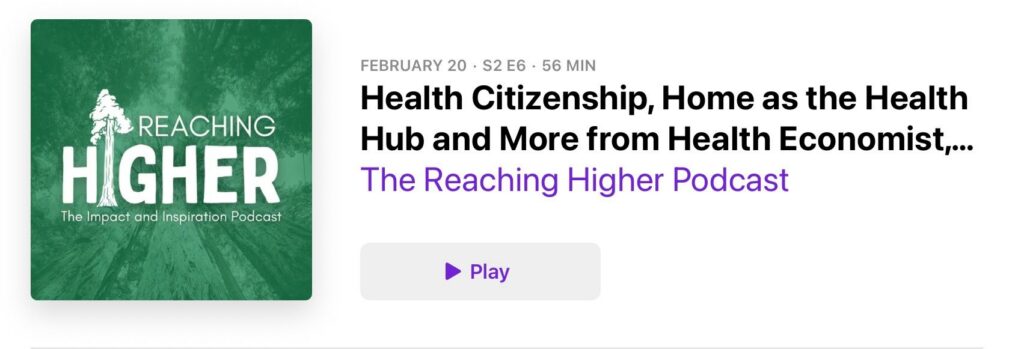 Thank you Aaron Strout for hosting our conversation on the Reaching Higher Podcast, now live on Apple, Spotify, and YouTube. We covered a lot of ground addressing health care and health citizenship, the growing prospects for our homes as our health hubs, and how our humanity is a key ingredient in health-making for all.
 Jane joined host Dr. Geeta "Dr. G" Nayyar and colleagues to brainstorm the value of vaccines for public and individual health in this challenging environment for health literacy, health politics, and health citizen grievance. Click onto the Pfizer Value of Vaccines site and you can watch four episodes covering the challenges with adult vaccination, the employer and health plan member's journey to vaccination, reimbursement, and collaborating for proactive prevention.
 I'm grateful to be part of the Duke Corporate Education faculty, sharing perspectives on the future of health care with health and life science companies. Once again, I'll be brainstorming the future of health care with a cohort of executives working in a global pharmaceutical company.