


Patient perspectives should be part of evidence-based medicine, Dr. Weil et al say
Randomized controlled trials (RCTs) have been the rational cornerstone of medical decision making for decades. RCTs demonstrate a drug or therapeutic course’s efficacy – that is, the extent to which a specific intervention, procedure, or regimen produces a beneficial result under ideal conditions. Of course, how a particular therapy works in an individual is highly personalized based not only on a body’s biochemistry, but personal preferences, perceptions, and personality. That’s why Dr. Andrew Weil and his colleagues, Dr. Scott Shannon and Dr. Bonnie Kaplan, say that medical decision making should take into account the patient perspective. In Medical Decision Making in
Health information gumbo: peoples’ health searches are mashed-up and increasingly mobile
Health professionals are go-to sources for medical diagnoses, information about prescription drugs and alternative treatments, and recommendations for doctors and hospitals. On the other hand, health information seekers turn to fellow patients, friends and family for emotional support in dealing with health issues, and quick remedies for everyday issues. And increasingly, those health information searches are going mobile, with 17% of U.S. adults having ever used their cell phone to look up health or medical information. This proportion nearly doubles for 18-29 year olds, and is also higher for wealthier people, Latino’s, college graduates, and urbanites. 1 in 10 people with a
The new health reform is online and mobile; talking at J. Boye 2011 in Philadelphia
With non-communicable diseases (NCDs) killing two-third’s of the Earth’s residents — not malaria, HIV or other infectious diseases — the World Health Organization calls lifestyle-borne chronic conditions a “slow-motion catastrophe.” The solution for addressing this global challenge isn’t just about deploying more doctors and medical technology in hospitals and bricks-and-mortar institutions. The real health reform is about infrastructure-independent care and feeding that bolsters peoples’ health where they live, work, play and pray, as characterized by the U.S. Surgeon General Dr. Regina Benjamin in the Los Angeles Times on March 13, 2011. Today I’ll be participating on the eHealth track at the J.
Patients’ health activation leads to better outcomes, but providers aren’t as engaging as they should be
Patient engagement improves health outcomes. But deploying patient empowerment and engagement tools involve many challenges, among them: privacy, security, integrity of medical records, liability, and payment. These have prevented health providers – doctors and hospitals – from adopting strategies to more closely engage patients. From the patient’s perspective, though, many patients have project-managed their own approaches to engagement with online and mobile health tools, such as participating in peer-to-peer health social networks, downloading and using mobile health apps, and monitoring calories, weight and sleep through devices like FitBit, Zeo, and the Withings scale. The Institute for Health Technology Transformation (iHT2) published the
Are health innovation and cost-reduction mutually exclusive? Insights from West Wireless’s Health Care Innovation Day DC
Representatives from eight U.S. Federal government agencies, including the FDA and Veterans Administration, among others; health financiers (VCs, angels); health tech start-ups; providers, life science companies, and analysts, attended the Health Care Innovation Day DC sponsored by West Wireless Health Institute on April 28, 2011. The meeting had the tagline, A Discussion with the FDA, setting the stage for a day-long consideration of the role of regulation vis-a-vis health innovation. The $2.5+ trillion question (annual spending on health care in the U.S.) is: can innovation drive making health care “cheaper?” This was the underlying theme of the panel on which I sat
Bye-bye, Ward & June Cleaver; Hello, multi-cultural, digital-happy family
“Ward and June Cleaver have left the building,” observe analysts at Nielsen. “The white, two-parent, ‘Leave it to Beaver’ family unit of the 1950s has evolved into a multi-layered, multi-cultural construct dominated by older, childless households,” starts a report from The Nielsen Company, The New Digital American Family. Whatever ethnic flavor this Digital Family may represent, there’s one equalizer across all of them: the smartphone, which is owned by households across cultures and income levels. First, the socio-demographics paint a picture of increasingly multi-cultural households. Recent immigrants to the U.S. accounted for 90% of population growth from 2000-2010, over-indexing for Hispanic and
The most engaged patients want “Social Media Liberación!”
Anyone attending a Health 2.0 or health IT meeting in the past 18 months has (hopefully) been exposed to the force known as Todd Park, Chief Technology Officer of the Department of Health and Human Services, and his mantra of “Data Liberación.” Data Liberación is the act of freeing data — in this instance, health data — locked within data silos, to be ‘liberated” allowing it to move about so that analysts can learn from it and develop strategies to better manage health for individuals and populations. Now there’s a force advocating for “Social Media Liberación” in Health: health activists, the most engaged patients
Women, Chief Household Officers, Like to Manage Health Via Smartphones
“The tipping point for smartphones is now,” claims BabyCenter, the mom-focused internet portal. Mothers are 18% more likely to have a smartphone than the average person, according to the 2011 Mobile Mom Report, a survey from BabyCenter. Why do moms like smartphones? According to BabyCenter, the smartphone is a mom’s “helping hand.” Nearly 1 in 2 say the smartphone helps them decrease stress, and 1 in 4 say it gives them a sense of calm. So is the smartphone in itself a health-promoting device? For readers of Health Populi, the answer is “yes” based on this poll. In the past
Mayo finds heart patients skip meds due to costs; self-rationing in health continues
If you are a person with heart disease and you have received treatment at the Mayo Clinic, you’re certainly a fortunate health citizen. The hospital was just ranked #2 best hospital in the U.S. by US News & World Report. However, if that’s you and the costs of post-op treatment — namely prescription drugs — are out of your financial reach, then you might skip them; thus, undoing your top-notch acute care. This scenario is discussed in the April 2011 issue of Mayo Clinic Proceedings, which describes a study by Mayo researchers among 209 patients with heart failure who were prescribed
One-half of U.S.health consumers want electronic access to doctors – including online medical records
Most U.S. health consumers would be keen to take advantage of alternative communications for their health care encounters. Of these 6 in 10 people, 72% would like nurse helplines, 60% email, and 1 in 3 would use a private online forum for their health. However, only 1 in 10 would use some form of social media for interacting with their providers, such as Facebook or Twitter, were it available to them in February 2011. Capstrat surveyed U.S. adults to learn about their perceptions and interactions with the health system. At least one-half of health consumers would use electronically-accessible applications offered by
Health: is there really an app for that? A preview of our SXSW Health Panel
As we are in the midst of the Hype Cycle for mHealth, the answer to the question, Health – is there really an app for that? has a loaded answer. This will be evident during the panel on which I’m participating on Sunday 3/13/11, the first full day of health hosted as part of the legendary South by Southwest conference. I am absolutely gob-smacked thrilled to be sharing the stage with John DeSouza, President and CEO of MedHelp; BJ Fogg of the Stanford Persuasive Technology Lab; and, Margie Morris, clinical psychologist and senior researcher at Intel Labs. We’ll be shepherded by Gigi Peterkin of Edelman, who
Welcome Migraine.com to the health care community
About 1 in 10 people in the U.S. suffer from migraine headaches. The direct cost to business for medical care and wage replacement is over $1 bn, but this underestimates the total economic impact of lost productivity to the economy and personal lives (for more on whole-health costs, read yesterday’s Health Populi, Lost Costs: Lost Productivity Represents One-Half of Health Costs for U.S. Employers). There are actually 14 kinds of headaches, as classified by the International Headache Society (IHS). Among these, there are four primary headache types: migraine, tension-type headaches, cluster headaches and trigeminal autonomic cephalagias, and a fourth
Reader’s Digest + Organized Wisdom = Wiser Patients
“Life well shared” is the tagline for Reader’s Digest. The publication began in 1922 and was, until 2009, the #1 best-selling magazine in the U.S. (losing its position to Better Homes and Gardens). How does a magazine that’s over eight decades old stay relevant? More digital offerings appeared in 2010. And, in 2011, Reader’s Digest is collaborating with one of the most well-used and -respected online health social networks, OrganizedWisdom (OW). How did this collaboration come to be? I spent some quality time in February 2011 with Unity Stoakes, co-founder of OW with Steven Krein, in New York City, the geographic HQ of OW.
Patients can handle the truth, and are looking for it: peer-to-peer health care
Most health consumers in the U.S. use the internet to seek health information, socialization and empowerment. Dig deeper, and you’ll find a growing cadre of people who go online to find people with the same conditions they have; 1 in 4 people (23%) among those living with chronic conditions have gone online to ID others like them, including people with high blood pressure, diabetes, heart disease, lung conditions, cancer, and other chronic health issues. The percentage of people looking for “people like me” drops to 15% of internet users with no chronic conditions seeking health-peers online. However, peers-in-health aren’t always seen as the ideal source
The Connected Patient: some forces converging in the market, but barriers remain
Remote health monitoring, which enables people to track health and daily living metrics when they are in one place and communicate those measures to another node via some communications platform, is not a new concept. Telehealth, telemedicine, consumer-facing health electronics like USB-ported blood pressure monitors, and some mobile apps can all fall under the broad umbrella of remote health monitoring. There are strong market forces converging to enable health citizens to connect to their providers, institutions, payors, health coaches, caregivers, and each other. Still, a balanced look under the remote health monitoring hood reminds us that old saw taught to me by colleagues
Success factor for mobile health: mash up the development team
With mobile health (“mhealth,” for short) at the top of the Gartner Hype Cycle, and the annual HIMSS meeting gearing up for next week’s countless announcements about mHealth solutions for health providers and patients, how can someone get a true read on the intersection of mobile and health? What’s practical, what’s real, and where are ‘we’ in mobile health in February 2011? If you can’t be in the room with me on the morning of Thursday 17 February 2011 in the small group meeting at unNiched in New York City, let me share with you one lesson learned just last week at the
Love, sex and what I tweeted
EURO RSCG has polled 1,000 online Americans’ views on romance through the lens of digital media, publishing results in a paper, Love (and Sex) in the Age of Social Media. This ‘digital love’ survey was conducted in January 2011. [It’s interesting to note that EURO RSCG won the business for the Durex condom line in November 2010.] In its introduction, EURO RSCG suggests that, “the Internet is the most powerful erogenous zone that the world has ever known.” There are five aspects to digital love, based on these findings: 1. Observing love online. As more people do more daily activities online like banking,
Meeker & Murphy on Mobile – through the lens of health
We technology market data junkies look to several thought leaders throughout the year for updates on their forecasts: one of these, for me, is Mary Meeker. Now with KPCB (who some of you know as Kleiner Perkins Caulfield & Myers, the Silicon Valley venture capital company), Meeker has surveyed the morphing field of mobile and finalized her snapshot in Top Mobile Internet Trends, along with her colleague Matt Murphy. Meeker’s Top 10 (drum roll, please) are that: 1. Mobile platforms have reached c4itical mass 2. Mobile is global 3. Social networking is accelerating growth of mobile 4. Time shifting is driving mobile use
The mobile health opportunity is connected health
February is American Heart Month. The month also features Eating Disorders Awareness Week, Duchenne Muscular Dystrophy Awareness, and National Condom Week. It also feels like mobile health month. I’ll be speaking three times this month at meetings featuring mobile health themes, in very different venues. On February 8, the Health|Tech|Food event will be held at the Paley Center for Media in New York City as part of Social Media Week. I’ll set the stage at the meeting for mobile health, sharing my perspective on the role of social media and mobile health, and how together these can combine to address health
The people who seek health information online aren’t always the ones who should
While 8 in 10 U.S. adult internet users seek health information online, they’re not the people you might assume would take advantage of the opportunity to do so. This lightbulb moment is brought to you by the Pew Internet & American Life Project’s latest survey analysis, Health Topics: 80% of internet users look for health information online. For example, while 2 in 3 U.S. adults with one or more chronic condition go online, only one-half of them are looking online for health information. Among the 54% of online adults with disabilities, only 42% of them seek health information online. Among the 88%
Health citizens in emerging countries seek health information online even more than their peers in developed economies
1 in 2 people who use the internet to seek health information do so to self-diagnose; this is highest in China, US, UK, Russia, and Australia. Furthermore, health citizens in emerging economies including India, Russia, China, Brazil, and Mexico, may rely more on online health searches than people in developed countries. In these regions, health seekers face high costs of face-to-face visits with medical professionals. These global findings come out of the report, Online Health: Untangling the Web, from Bupa. Bupa is a health company based in the UK that serves 10 million members in 190 countries, and another 20 million
What health care IT holds for 2011: politics vs. market realities
The one issue in health politics that’s got bipartisan support is health care IT. While Republicans in the House may try to pick away parts of the Affordable Care Act, the HITECH Act — part of the 2009 stimulus package formally known as the American Recovery and Reinvestment Act — will stay intact, according to most industry analysts (including me). However, political agreement doesn’t equal market adoption. So forecasting what 2011 will mean for health information technology requires some deeper analysis of additional issues. For today’s Health Populi, take a look at my annual health IT forecast in California HealthCare Foundation‘s
Social networks and life science companies: balancing regulation and risk aversion with opportunity
One in 3 managers in life science companies — including biotech, pharma, medical device and diagnostics firms — have no plans to engage with online social networks, according to a survey conducted by Deloitte. The key reasons for shying away from social networks include lack of guidelines offered by the Food & Drug Administration (FDA), concerns about consumer privacy, and low or uncertain return on investment. On the other hand, 41% of life science execs already use social networks, and another 21% plan to do so. There are many benefits for life science companies in using online social networks, including using them for
The social life of pharmaceutical companies
Exactly one year ago, health care companies, online portals (from Google to health advocacy sites), and advertising agencies serving the health industry convened in Washington, DC, to voice their positions to the Food & Drug Administration (FDA) concerning pharmaceutical promotion and social media. It was such a monumental meeting that a tweetstream was initiated at the event that has been ongoing for the past year at #FDASM on Twitter. Why would hundreds of individuals collectively spend thousands of hours airing their arguments, pro and con, on the issue of how pharmaceutical companies promote their products and services online? “The drug industry
Social media and health brands – find an advocate in Compliance
Federal Express and Ketchum, the communications firm, have benchmarked best practices in social media and brands and published their findings in Leading Brands and the Modern Social Media Landscape. Interviews with chief communications officers were conducted between August and October 2010. Four key insights were identified in the study for regulated industries, which include health care, financial services, energy, among others: Research the rules regarding disclosure and reporting Manage internal stakeholder expectations and identify internal champions from across the enterprise Establish a business case and ongoing management plan with Legal/Compliance teams In risk-averse cultures, consider focusing social media outreach on a specific
Be Thankful: Engage With Grace
Now that the turkey, champagne, stuffing and other glorious carbs have been consumed. the real dessert is whipped cream on the pumpkin pie: the gift of a conversation about Life and Grace. We each have our stories about how a loved one’s life has ended. If we’re lucky, that beloved person had a good death: in sleep, perhaps, or of simply old age with no hospital events or trauma. Then there are the Rest-of-Us who have the stories of long and painful endings. When you’re already in the situation of making tough health decisions, it’s tough, it’s emotional, it’s irrational,
Caregivers use online and social media for long-term care information
Most caregivers involved with home care services would be inclined to dialogue with other caregivers in an online forum or social networking site, according to a survey, How the Web and new social media have influenced the home care decision-making process, from Walker Marketing, Inc. Furthermore, 91% of caregivers would be likely to conduct research after receiving a provider referral by a professional source; while 78% would rely on a physician for recommendations, caregivers ultimately make their own decisions on long-term care providers. Websites are generally considered highly credible by caregivers, and are important sources of information for engaged caregivers on sources
Walgreens’ Wellness Wisdom – what it means for pharmacy’s role in health
Two weeks ago at the company’s AnalystDay conference, Greg Wasson, the CEO of Walgreens, told the audience that the pharmacy chain was on a mission to “own well.” In the New York Times magazine dated November 12, 2010, an article titled Fresh Approach talks about Walgreens work in low-income Chicago neighborhoods coupling with greengrocers to bring “food oases” to inner cities. Two weeks ago, I learned that Walgreens is teaming with Orbitz to provide travelers’ health services. Married to an international banker who travels globally, I am pleased to know he can get his esoteric inoculations in local, convenient retail mode. Walgreens’ data found that 25% of
Doctors and social media: the AMA weighs in
At least one-third of American adults use social media for some aspect of health. Most seek health information online, and increasingly via mobile platforms. While many physicians engage in social networks on a peer-to-peer basis in Sermo and Ozmosis, among others, most physicians have avoided social networks where their patients and health citizens interact. The American Medical Association (AMA) released guidelines to help physician members enter the social media fray. There are five areas of recommendations: Protect privacy: using settings to protect personal information and content on social networking sites Monitor internet persona: routinely monitor presence on the internet to ensure that information is accurate
Technology is pointless without people – especially in health
Technology without people is pointless, Sara Redin of J. Boye told an audience today at the J. Boye 2010 conference in Aarhus today. I am in the land of LEGO, Denmark, attending the J. Boye 2010 conference. This meeting focuses on the online world – social media, web design, emerging technologies, the internet, and digital strategy. I’m taking part in the online health track, kicking off with a talk on participatory health. Redin told a story that resonated with me on several levels, personal and professional. She recently took her son shopping for his birthday gift, and they made their way to
Using collaborative online tools for collaborative health care reduce costs
“Freeing health data from silos” and fostering collaboration between patients and providers can save costs and improve health quality for employers who sponsor health benefits. The bottom line: employers can benefit from using social media tools for employee health management, according to a report from Healthcare Performance Management in the Era of “Twitter” from the HPM Institute. As employer health care costs continue to annually escalate in the high single or low double digits, benefits managers have focused on tinkering with health plan design: looking into 2011 health plan strategies, employers are planning to implement Another prescription for dealing with runaway
It’s not the media…it’s the social – reflections on health activists online
When four self-described health activists share their personal stories in the same physical (not virtual) room at the same time, in real time, it’s an exponentially moving and learning moment. WEGO Health convened a Socialpalooza event (#socialpalooza on Twitter) this week where an influential handful of health activists met face to face with some people who work in health industries. The result was a fruitful dialogue where both empowered patients and the suppliers who research, develop and market products serving those patients, learned a lot from each other. These Four Musketeers of health activism included Alicia Staley (@stales on Twitter), who passionately shares her hard-won experiences in beating
Mobile health search is on the rise – but not yet at the tipping point
The oracle (and I use the word here in the classic sense) of health internet statistics, Susannah Fox (@susannahfox on Twitter), along with the Pew Internet & American Life Project and the California HealthCare Foundation, find that 17% of mobile phone users look up health information online — and nearly 1 in 3 young adults 18-29 do so, while between 5-6% of people 50 and seek health information via mobile. The Mobile Health 2010 report tells the story. Beneath these macro statistics are the ones shown in the chart: people who have used cell phones to look up health information, which is a larger base
Talk to me healthy, baby – Health 2.0 gets personal
Sex, drugs, rock and roll, Victoria’s secret bras manufactured with formaldehyde, motivating kids to move about more, and texting potential sex partners your latest STD test results: the 2010 Health 2.0 Conference in San Francisco was more about real, whole health and the person-patient than about cool new tech. Furthermore, the Health 2.0 Conference turned a lot of preconceptions on their head on October 7 and 8, 2010, in a standing-room–only ballroom at the Hilton Union Square. Who could have predicted that government employees would light the room up with high energy and innovative thinking more than a panel of illustrious
Patients 2.0 – the growing demographic of networked patients
In a ballroom at the Hilton Union Square in San Francisco on October 6, 2010, several hundred people shared ideas, debated, and painted a multi-faceted picture of the NewPatient: the networked patient. The meeting was convened, in “unconference” style, in conjunction between the Health 2.0 Conference and Gilles Frydman, founding father of ACOR, the Association of Cancer Online Resources. Gilles knows a lot about the NewPatient: he’s organized people focused on cancer for over 15 years through his organization, which has helped tens of thousands of health citizens connect to clinical trials, researchers, information, and each other – all seeking to
Patients’ use of online health tools will grow–especially for self-diagnosis, prevention, and treatment options
Most patients and doctors alike are currently using some type of online tool in the “understanding, management, and guidance” of health care, according to a survey from IMI Healthcare – Voice of the Market. Virtually all physicians, and 73% of patients, are using some kind of online health tool. Based on the IMI Healthcare survey methodology, these tools include health content sites, used by 57% of patients and 77% of doctors (e.g., WebMD, mayoclinic.com); general search sites (e.g., Wikipedia), used by 48% of patients and 68% of doctors; health association sites (e.g., American Heart Association), used by 19% of patients and
ePatients: a connected, collaborative, creating community
The ePatient Connections (ePC) conference convened this week in the City of Brotherly Love, my town, Philadelphia. And indeed, the eHealth love did flow between health citizens and organizations that seek to serve them: technology developers and health providers, alike. My flying fingers recorded nearly fifty pages of notes, and these don’t even include two tracks’ worth of presentations — social networks in health and health games — because I was the emcee for mobile health track. However, this gave me the opportunity to get to know the 11 mHealth presenters and their organizations up-close-and-personal and to brainstorm with track attendees
Healthcare unwired: nearly half of US consumers are willing to pay
40% of U.S. consumers are willing to pay for remote health monitoring devices and services that would send their medical data to doctors, according to PricewaterhouseCoopers’ Healthcare Unwired (PwC). 51% of consumers would not buy mobile health technology. The uses of mobile health most attractive to consumers are monitoring fitness and welling (cited by 20% of consumers), physician monitoring of health conditions (for 18% of people), and monitoring a previous condition (for 11%). 88% of physicians would like to see patients monitoring various parameters at home, their highest priorities being weight (65%), blood sugar (61%), vital signs like blood pressure (57%),
Physicians stick with professional health content sites online in 2010
The fact that physicians access health information digitally is not big news; but, where they’re going online may surprise some health marketers who are shifting educational and promotional resources to online portals. 4 in 5 physicians access health care professional sites, the most visited online sources for physician seeking health information online; these sites get nearly one-half of physicians’ time online, and 1/3 of total visits among all health categories, according to a report from the comScore/ImpactRx Physician Behavioral Measurement database. However, one of the long-standing sources of information for doctors — medical journals — only reaches 30% of physicians, and doctors spend
Pharma-economics: retail drug prices rice, and consumers react
Two reports, from Consumers Union and the AARP, put the pharmaceutical industry in the spotlight again this week, and not in a good way. First, Consumer Reports polled U.S. adults who take prescription drugs and found that 39% took some action to reduce costs. 27% didn’t take the Rx as prescribed: 16% didn’t fill the prescription, 12% took a drug past its expiration date, and 4% shared a prescription with someone else. These and other survey findings are discussed in Consumers say big pharma influence on docs is concerning, published in the Consumer Reports Health Blog on August 24, 2010. Second, the AARP calculated
So many health apps: is this a Field of Dreams?
“If you build it, he will come,” Shoeless Joe whispers to Ray in the baseball class movie, Field of Dreams. Ray then takes a leap of faith, building a baseball field on top of his corn fields there in the middle of Iowa, and miracles happen. Will it take a miracle for people to adopt health apps? A panel, now in the midst of PanelPicking as one of many Interactive sessions for South-by-Southwest 2011 (SXSW), will respond to that question. The panel is called, Health: Is There Really an App for That? Voting ends midnight CDT on Friday, August 27,
Broadband@home: one antidote to addressing health disparities
2 in 3 American adults use a broadband connection at home. Among those who don’t have high-speed access at home, most don’t go on the internet at home, and the others who do use dial-up connections (only 5% of adults). The Pew Internet & American Life Project knows more about Americans’ use of the internet than probably any other research organization, and their report, Home Broadband 2010, presents a comprehensive snapshot of how people in the U.S. are using the internet as of May 2010. The most striking statistic in Pew’s survey is that growth of broadband among African-Americans grew in double-digits
Partnering up for health @ home – the GE-Intel link-up
A decade ago, I was engaged by a consumer health company to lead a scenario planning exercise on the future of the health consumer. We developed four scenarios, one of which was called something like “MicrosoftMerckGEGenMills.” In that futureworld, several Big Organizations would come together to serve consumers in caring for themselves outside of traditional care settings, like hospitals, doctors’ offices, and nursing homes. The beauty of scenario planning when done well is that, if you’ve done it for a long time, you sometimes get one right. Witness the New Deal between GE and Intel, partnering up to develop solutions
Women are the digital mainstream – especially in health
Social networking is key to women’s experience with the Internet, according to comScore’s report, Women on the Web: How Women are Shaping the Internet. Women spend 39% more time on social networks online than men do. comScore studied the “Mars versus Venus” differences between men and women online, discovering that gender stereotypes only go so far. The chart shows the differences between women and men and their e-retail relationships. In stereotypical “men” categories of computer hardware and software, and sports/outdoor, for example, men and women aren’t all that different — only a couple of percentage points difference at most for these categories. Health has
Consumers trust pharma ads on TV more than online
Most consumers give thumbs-up to “fair and balanced” information on risks and benefits delivered in prescription drug ads on TV. But online? Not so much. This finding comes from one of the most highly anticipated surveys in the pharma business, the annual Prevention Magazine consumer survey on direct-to-consumer advertising (DTC). The FDA takes this survey seriously and its results inform FDA approaches to regulation. The 13th annual poll was published on July 15, 2010, titled, Consumer Reaction to DTC Advertising of Prescription Drugs. Most consumers find that “fair balance,” which is FDA required for presenting risks and benefits, is indeed “fair and balanced” on broadcast and in magazines. However,
Bienvenido, HolaDoctor!
Welcome, HolaDoctor, to the growing roster of consumer-facing health portals. La differencia, this time, is that HolaDoctor is an entirely Spanish-speaking website of comprehensive health information. The site focuses on health content and tools highly targeted to Hispanics and health issues of most concern. Known previously as DrTango, founded in 1999, HolaDoctor has at least 1.3 million Hispanic consumers who have registered on its site, and operates over 500 multilingual health websites under its corporate umbrella. The morphing from DrTango to HolaDoctor has to do with the organization’s launch of its consumer-focused health and wellness portal reaching out to Spanish speakers in the
Hospital marketing and Mad Men: national brands go direct-to-consumer
This week’s issue of Advertising Age magazine dated June 28, 2010, includes cover stories about fast food advertising buoying cable TV revenues, car companies changing ad agencies, the Cannes advertising festival focusing on creativity and ROI, and…hospitals and health reform? Why do hospitals and health reform appear on the cover page of Ad Age? It’s the “new front of medical marketing,” Rich Thomaselli, Ad Age editor, calls it. With upwards of 30 million Americans gaining health insurance coverage under the Patient Protection and Affordability Act (PPACA, or “health reform” broadly writ), hospitals are competing for new business, along with aging baby
Health consumers don’t understand their patient-power…yet
Most health consumers define the value of drugs in terms of safety and efficacy first, then quality of life and cost second. These priorities are similarly shared by both biopharma executives and managed care management. Where consumers diverge with the two health industry stakeholders, though, is with respect to their power: while about 1 in 3 biopharma and managed care execs believe that patients will be influential in the success or failure of new therapies over the next five years, only 11% of patients say that “people like me” will be influential over what new drugs will be available in the
Patient Power Through Data Liberación, and Private Sector to the Rescue – Health 2.0 DC Takeaways
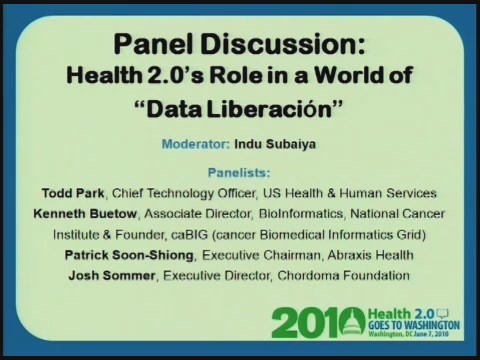
The Health 2.0 Conference convened its first meeting in Washington, DC, today, with public sector health leaders and private sector innovators coming together in a Great Big Kumbayah. This conference featured two prominent and key players absent from previous Health 2.0 Conferences: patients on every panel, and the Federal government punctuating the start, the middle, and the end of the day’s agenda. The over-arching message: Data Liberación! says Todd Park, the DHHS Technology Officer. This follows last week’s launch by DHHS of the Community Health Data Initiative (which Park wants to rename with your help here). [More about the CHDI herefrom Health Populi]
Our Technology, Ourselves
Health engagement is a trek, not an end-point
Parents demand ePediatrics services
1 in 2 parents is keen on going online with their kids’ pediatricians to refill prescriptions, get clinical advice, obtain lab results, and obtain immunization records. The National Poll on Children’s Health, conducted for the C.S. Mott Children’s Hospital at the University of Michigan, found that fewer than 10% of parents can currently go online for administrative tasks like scheduling an appointment or completing a form before going for a well-kid visit. But there’s pent-up demand for so-called ePediatrics, the poll discovered. The key obstacles to doctors engaging in ePediatrics, the survey researchers say, are doctors’ concerns about medical liability
Websites first, then doctors, support peoples' health care decisions
1 in 2 global health citizens looks first to the Internet for advice to make health decisions; then, they look to doctors. This virtual tie for ‘first place’ in health information that supports health decision making is the New Second Opinion for at least one-half of the population, according to data gleaned through PricewaterhouseCoopers‘s Health Research Institute’s Global Consumer Survey. Traditional media, including print (newspapers and magazines) and broadcast (TV, radio) are go-to health information sources for about 1 in 4 health consumers. Social networking websites were found to be useful health information decision-support sources by 17% (say, nearly 1 in 5 people). Health
Trust and authenticity are the enablers of health engagement
Without trust, health consumers won’t engage with organizations who want to cure them, sell to them, promote to them, help them. Here’s what I told a group of pharmaceutical marketers at The DTC Annual Conference in Washington , DC, on April 9, 2010. Let’s start with the World Health Organization’s definition of health: that is, the state of complete physical, mental and social wellbeing, and not just the absence of disease. This definition is being embraced by health citizens long before the silos in the health industry – including pharma – get it. That’s an important mindset to take on as
Diagnosis: sicker people have less Internet access
While 2 in 3 American adults with no chronic health conditions go online to access health information, only 1 in 2 chronically ill people seek health information online. This irony here is that those who most need access to online information, support and tools don’t use them as much as people who are healthy. “The Internet access gap creates an online health information gap,” say Susannah Fox and Kristen Purcell of the Pew Internet & American Life Project in their landmark report, Chronic Disease and the Internet. It’s not that sicker people aren’t interested in accessing health information; it’s that
Flipping cancer the bird: can pop culture cure cancer?
70,000 young Americans between 15 and 39 years of age are diagnosed with cancer every year. This population falls in a gap between pediatric and adult cancer. Newly-diagnosed young adults often find themselves in a no-patients’-land, confronting a lack of targeted clinical trials and knowledgeable clinicians in local health markets.The National Cancer Institute says that survival rates for this group of cancer patients haven’t improved in over 30 years.That’s definitely cause to flip cancer the bird, and that’s exactly what the young actor, Zac Efron, has done.Efron is photographed with a young cancer patient, Emily Hobson, to focus on Stupid
Health is contagious: the nature of connected-ness
The book Connected was recommended by my colleague, intellectual beacon and friend, Susannah Fox of the Pew Internet & American Life Project. In the midst of late nights analyzing health reform scenarios and medical microeconomics, I’ve made the time to read this book in its entirety. It’s been a worthwhile investment. Previously, the authors of Connected, Nicholas Christakis and James Fowler, found evidence on connectedness in health in the areas of obesity, smoking cessation, binge drinking, and other lifestyle behaviors that directly impact good or bad health. This week, another team of innovative thinkers led by John Caccioppo from the
Americans like mobile health, especially for exams, wellness, and monitoring
If mobile medical services were available to Americans today, 40% would use the service in addition to seeing their doctors.23% of people would replace the doctor with mobile medical services. 1 in 3 people wouldn’t use the service at all. Welcome to the era of “m”-everything — mobile-everything, 24×7. And health is a natural partner for “m.” These stats come from a survey released by CTIA-The Wireless Association, in conjunction with The Harris Poll. The poll was conducted among American adults in September 2009. The 23% of health citizens who would use mobile health services instead of going to the
Learning about social networks and health in Omaha
There’s a groundswell driving social media in health care in America, from Silicon Valley to Boston, Miami to…Omaha? Strategy& (former Booz and Company) and the Center for Health Transformation convened a roundtable discussion in Omaha, Nebraska, in March 2009 following up a discussion the company had in 2008 with stakeholders in diabetes. In that meeting, the opportunities generated by social media in the field of diabetes were explored, with respect to improving peoples’ access to information for health and wellness, as well as how to use social media to influence policy and positive health behaviors. As I pointed out in my
Demand for health products and services is down in the recession; thinking about value and self-care in health
What is value in health care? Every year we spend more and seem to get less, John Seng, Founder of Spectrum, told attendees of a webinar on the Spectrum Health Value Study on 12th May 2009. As we consumers spend more of our own money, we’ll be looking for greater value and “health ROI” from our health spending. Measuring value across a population is confounded by the fact that what one person decides to spend on ‘health’ can be different from another’s health spending choices. In other words, our personal health “marketbaskets” for health spending vary from person to person.
Nearly 1 in 2 women delayed health care in the past year due to costs – the economic impact on a woman’s physical, emotional, and fiscal health
Nearly 1 in 2 women put off seeking health care because the cost was too high. The kinds of services delayed included visits to the doctor, medical procedures, and filling prescription medications. The fourth annual T.A.L.K. Survey was released this week by the National Women’s Health Resource Center (NWHRC), focusing on the declining economy and its impact on women and three dimensions of their health — physical, emotional, and fiscal. 40% of women say that their health has worsened in the past five years due to increasing stress and gaining weight, according to the survey. One of the most interesting
Don’t cross Baby Mama — McNeil Will Need More Than Motrin For This New Headache
It all started with a baby, a baby carrier, and Motrin. Oh, and an advertising agency who probably got their Mommy-messaging more than a little bit wrong. Twitter, the social networking software, helped fuel this uproar in a matter of hours. In what is to-date among the fastest viral campaigns in consumer health — that backfired –well over a hundred of mommy blogs and countless Twitter messages expressed emotions on a continuum from outrage to insult about a new campaign targeted to Moms who carry their babies in on-the-body carriers. The ad begins, “Wearing your baby seems to be
Moving up the health care value chain: J&J in health services
Johnson & Johnson (J&J) has acquired the online health coaching company, HealthMedia. This will move the health supply company up the health care value chain further into the provision of health services. Nine years ago, I teamed with a Big Pharma on a scenario planning exercise about consumers and health care. One of our scenarios told the future-story of the consolidation/integration of information technology, pharma/life sciences, and health services to benefit consumer health. We now meet up with this future-story, and it’s J&J’s to tell. I’ve written here in Health Populi about Walmart’s move toward pharmacy benefits management and
Trusting strangers: implications for health
Welcome to the new influence landscape, says Universal McCann (UM), the global media agency. In When Did We Start Trusting Strangers: The How the Internet Turned Us All into Influencers, UM analyzed the online behaviors of thousands of Internet users in 29 countries. UM found that today, we trust strangers as much as close friends. Furthermore, “friendship is no longer local or face to face: it’s becoming distant and virtualized,” the report asserts. Most importantly, the power of social media affords everybody with access to the Internet to be an influencer. Social media adoption in this study includes: Read blogs/weblogs
Centenarians say a long life is all about staying connected
The key to longevity isn’t about taking vitamins or consuming health care or yogurt…it’s staying connected to family, friends, and world events. That news comes to us from the third Evercare 100 @ 100 Survey which details ultra-seniors’ views on politics and the good life. Evercare surveyed in-depth 100 centenarians. Collectively, their views challenge stereotypes of the oldest Americans alive today. There are 84,000 of them, according to the U.S. Bureau of the Census. For example, 19% of centenarians use cell phones, 7% email, and 3% online date. Google is a boon to looking for old, lost friends.
Aging, economics and consumer-generated media — implications for health
Advertising Age analyzes census data on aging and diversity in America, and comes up with some interesting conclusions for consumer marketers. Here at Health Populi, we’re all-health, all-the-time, so I’m going to discuss author Peter Francese’s findings through our health lens. In addition, McKinsey published its insights into aging boomers in the report, Talkin’ ‘Bout My Generation, which I will also discuss. Francese begins with the one-two punch that marketers in the U.S. are already faced with the economic downturn coupled with consumer-generated media (e.g., blogs, online videos, e-pinions.com, ad infinitum). The third challenge to add to these two market-shapers
How social media in health helped women in itchy bras
Renenber the hair product ad for Clairol Herbal Essence shampoo that ran in the 1980s where one woman tells another, who tells another, who tells another about the merits of the shampoo? Social media behaved in just this way when women share their personal stories about allergies they developed when wearing the same style of bra. Here’s the post from December 23, 2007, from Catherine145. She says, “I recently bought a Victoria Secret padded demi bra. I am also dieting so when my top began to itch I originally associated it with the fact that everything was shrinking.” She then spoke with
Searching vs. using health information: the "just looking" mode of health search
Consumers, at least Californians, do a lot of looking for health information on the Internet — but very little health management. California HealthCare Foundation (CHCF) has taken a snapshot of Californians’ use of the Internet in health care. The profile is presented in CHCF’s report, Just Looking: Consumer Use of the Internet to Manage Care. Topline: insured, more affluent, and younger people use the Internet in health searching. The most popular care-related uses on the Internet include searching for information about conditions and drugs, finding a physician, checking ratings, and looking for claims and benefit information online.
A profile of silver surfers: don’t discount older web-searchers
There’s a growing cadre of older people online, and they’re an attractive demographic, according to Focalyst, a joint venture of the AARP and Millward Brown, a market research and branding company. The researchers found that “matures” spend 750,000,000 minutes a day on the Internet (sounds like a song from Rent–the AARP version of 525,600 Minutes). Focalyst calls the group of people age 62 and over “Matures Online.” The Insight Report: April 2008 finds that matures are just as likely to be persuaded by an Internet ad as younger consumers. Is this what Martha would consider a “good thing” or not-so-good?
The Future of Telehealth, according to Philips
While fiscal, billing and back office technologies universally proliferate home care, only 17% of agencies use some type of telehealth systems. However, 32% of agencies with over $6mm in annual revenue provide telehealth services. Thus, size matters when it comes to home health adopting telehealth technologies. These are just a couple of many important benchmarks published in the National Study on the Future of Technology and Telehealth in Home Care. Billed as the largest telehealth study in the history of home care, Philips unveiled this report in conjunction with the 13th annual American Telemedicine Association conference in Seattle. Philips partnered
Profiles of older health care consumers: living longer, longing for technology
Older Americans are healthier and more prosperous than previous generations. Furthermore, older people want to adopt technologies that will help them age well in their homes. Two new reports together provide a new look into aging in America. Older Americans 2008: Key Indicators of Well-Being is a wide-reaching data compendium which paints a current profile on aging in America through 38 measures that depict the well-being of older Americans. Measures include demographics, economics, health status, health risks and behaviors, and the cost and use of health services. The Chartbook is well worth reviewing to gain insights into this fast-growing population
Who do you trust? Edelman’s Trust Barometer says “people like me,” tech, life science, and banks — not insurance, media, or government
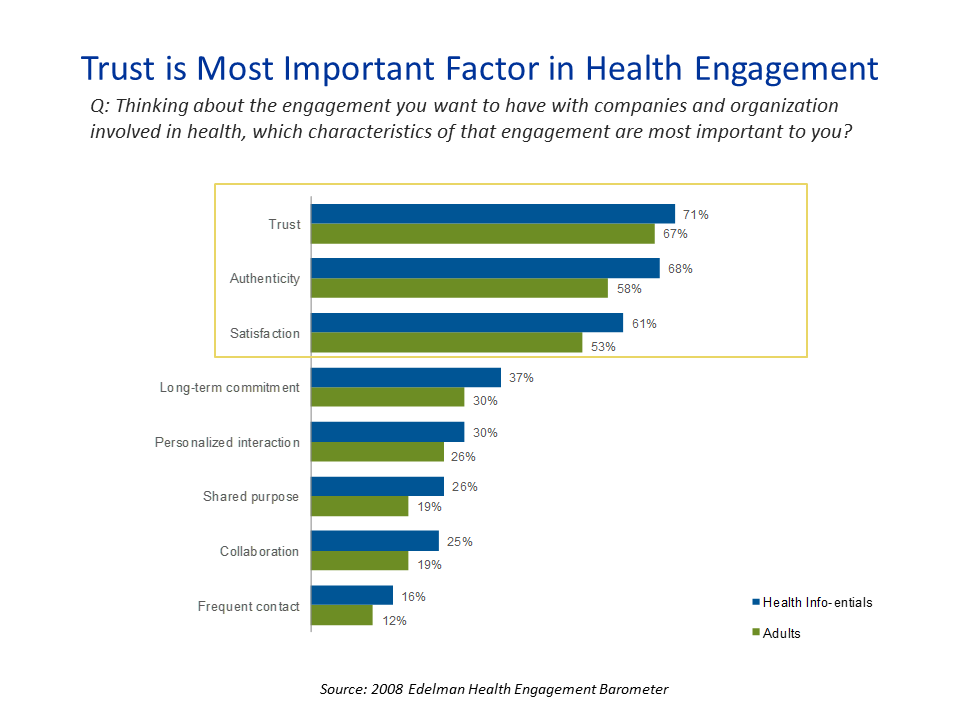
The 2008 Edelman Health Engagement Barometer is out alongside the company’s annual Trust Barometer, and more than ever, people are trusting “people like me” more than they do institutions. This is the ninth iteration of the Trust survey. The toplines of the past four years show an important change in peoples’ trust perspectives. In 2005, Edelman found that trust in ‘established institutions’ and figures of authority began shifting to peers. By 2006, “A person like me” was the most credible spokesperson for companies. That year, people trusted employees significantly more than company CEOs. Edelman defines “a person like me” as
 Jane joined host Dr. Geeta "Dr. G" Nayyar and colleagues to brainstorm the value of vaccines for public and individual health in this challenging environment for health literacy, health politics, and health citizen grievance. Click onto the Pfizer Value of Vaccines site and you can watch four episodes covering the challenges with adult vaccination, the employer and health plan member's journey to vaccination, reimbursement, and collaborating for proactive prevention.
 I'm grateful to be part of the Duke Corporate Education faculty, sharing perspectives on the future of health care with health and life science companies. Once again, I'll be brainstorming the future of health care with a cohort of executives working in a global health care enterprise.
 Jane will be working with EU- and UK-based clients in September and October 2026, collaborating with stakeholders in digital health, public/community health, retail health, and growing opportunities for health-at-home. Stay tuned to her updates here on Health Populi on-the-ground as she lives the digital nomadic work-life in Italy, Belgium, the Netherlands, and in London.