


Wellness takes hold among large employers – and more sticks nudge workers toward health
Employee benefits make up one-third of employers’ investments in workers, and companies are looking for positive ROI on that spend. Health benefits are the largest component of that spending, and are a major cost-management focus. In 2012 and beyond, wellness is taking center stage as part of employers’ total benefits strategies. In the 2012 Wellness & Benefits Administration Benchmarking study, a new report from bswift, a benefits administration company, the vast majority of large employers (defined as those with over 500 workers) are sponsoring wellness programs, extending them to dependents as well as active workers. Increasingly, sticks accompany carrots for
Aging in the US – seniors are health-confident, less financially so
Most seniors look forward to aging in place, and are confident in their ability to do so. Such is the top-line feel-good finding from the National Council on Aging‘s (NCOA) survey, The United States of Aging, sponsored by USA Today and United Healthcare. A majority of seniors have a sense of purpose and plans for their future. Three-fourths of older Americans say staying physically fit through exercise and proactively managing their health is important. However, only 36% of seniors say they exercise or engage in physical activity every day. 11% never do. The most common chronic conditions noted by seniors
Nordstrom and Amazon, where are you in health care service?
When it comes to customer service, retail, banks, airlines and hotels are tops. Health care? Not so good. This sobering finding comes via PwC’s report, Customer experience in healthcare: The moment of truth. PwC pulled data from the company’s Customer Experience Radar survey of 6,000 consumers across industries. This particular analysis looks at consumers’ service views on banking, hospitality, airline, retail vs. health care providers and insurance companies. The chart shows consumers’ answers to a question of whether they are willing to report positive interactions about a customer experience. The graph shows that people are more likely to share opinions
Target gets into the Quantified Self biz: could this be the mainstreaming of self-monitoring?
Target, the beloved retail channel for many design-minded value-conscious consumers, has opted in to mobile health through its purchase of SMARTCOACH mobile health coaching devices. SMARTCOACH is part of a growing category of wearable devices that monitor health behaviors like walking and calories consumed. What differentiates SMARTCOACH is the “coach” element, which provides real-time feedback throughout the day. Most other devices in the market simply track and record data. And it’s feedback loops that more experts say are key to sustaining health behavior change. Target will bring the device into stores for purchase in the fall. Like some other wearable
Only 1 in 4 US Health Consumers Wants a Digital Record, Xerox Says
While 87% of U.S. adults are familiar with health providers converting paper medical records into digital records, only 26% — 1 in 4 — say they want their own medical records to go digital. This sobering statistic comes as hundreds of thousands of doctors and hospitals are migrating to electronic health records (EHRs), motivated by the U.S. government’s HITECH act which provides incentives for the adoption and so-called meaningful use of EHRs. To gauge U.S. consumers’ views on digital medical records, Xerox polled 2,147 U.S. adults ages 18 and via an online survey in May 2012. The chart illustrates several key
Lab tests and knowing our numbers can inspire patient engagement
One-half of the members of Kaiser Permanente use the plans’ personal health record system, MyHealthManager. The most-used function of MyHealthManager is accessing lab results, according to KP. Now that Quest, the lab and health information company, has launched the mobile phone app, Gazelle, more health citizens will have access to lab test results. This could be a health-activating opportunity inspiring patient engagement. While Gazelle is a fully functional personal health record (PHR), it’s the connection to lab test results that’s the lightbulb moment. PHRs have been available to health consumers for over a decade. There are millions of users of
Good Housekeeping features Facebook for health: health social networks go mainstream
Using social networks for health is no longer a pioneering, first-wave adoption activity: Facebook has gone mainstream in health. What’s the indicator that says we’ve hit the tipping point in consumers going Health 2,0, beyond Paging Doctor Google? A story in the July 2012 issue of Good Housekeeping magazine titled, Miracle on Facebook. What’s powerful about this is that articles on health social networks have been largely focused in health IT trade publications, business magazines like Forbes (focusing on sustainbale business modeels) and technology channels such as Fast Company and Wired. Looking at Good Housekeeping’s ad pages, its readership is mostly
Consumer ambivalence about health engagement – will OOP costs nudge us to engage?
In some surveys, U.S. consumers seem primed for health engagement, liking the ability to schedule appointments with doctors online, emailing providers, and having technology at home that monitors their health status. The chart illustrates some of these stats from a 2011 survey by Intuit. However, organizations that develop quality report cards on providers and plans, and developers of mHealth apps, will point out that consumers aren’t rushing to use the quality reports or sustain use of apps: in fact, most downloaded health apps aren’t used after one try, according to PwC’s research. How do we make sense of these different
Converging for health care: how collaborating is breaking down silos to achieve the Triple Aim
On Tuesday, 9 July 2012, health industry stakeholders are convening in Philadelphia for the first CONVERGE conference, seeking to ignite conversation across siloed organizations to solve seemingly intractable problems in health care, together. Why “converge?” Because suppliers, providers, payers, health plans, and consumers have been fragmented for far too long based on arcane incentives that cause the U.S. health system to be stuck in a Rube Goldbergian knot of inefficiency, ineffectiveness and fragmentation of access….not to mention cost increases leading us to devote nearly one-fifth of national GDP on health care at a cost of nearly $3 trillion…and going up.
The gender gap in U.S. health economics
50% more women than men are worried about health care affordability and access in the U.S., revealed in a new Kaiser Opinion Poll, the Health Security Watch, based on interviews from May 2012. Overall, about the same proportion of men and women had problems paying medical bills in the past year — 26% vs. 27%, respectively. However, when it comes to self-rationing health care — delaying or skipping treatment due to cost — gender gap shows, with 52% of men and 64% of women delaying or skipping health care. Underneath these numbers are even greater gaps between men and women.
Self-service healthcare: patients like online and mobile access, but still want F2F time
The supply-side of healthcare DIY is growing, with the advancement of Castlight Health through its $100mm VC influx and Cakehealth’s new version for managing health spending online. Consumer demand is growing, too, for these services. But don’t get over-hyped by the healthcare, everywhere, scenario. Health citizens also demand face-to-face time with their physicians and clinicians, evidenced by a survey from Accenture titled, Is healthcare self-service online enough to satisfy patients? The answer is a clear, “no.” 90% of U.S. adults like the idea of digital health self-service, 83% want online access to personal health information, 72% want to book appointments
Trust and authenticity are the enablers of health engagement
Without trust, health consumers won’t engage with organizations who want to cure them, sell to them, promote to them, help them. Here’s what I told a group of pharmaceutical marketers at The DTC Annual Conference in Washington , DC, on April 9, 2010. Let’s start with the World Health Organization’s definition of health: that is, the state of complete physical, mental and social wellbeing, and not just the absence of disease. This definition is being embraced by health citizens long before the silos in the health industry – including pharma – get it. That’s an important mindset to take on as
Learning about social networks and health in Omaha
There’s a groundswell driving social media in health care in America, from Silicon Valley to Boston, Miami to…Omaha? Strategy& (former Booz and Company) and the Center for Health Transformation convened a roundtable discussion in Omaha, Nebraska, in March 2009 following up a discussion the company had in 2008 with stakeholders in diabetes. In that meeting, the opportunities generated by social media in the field of diabetes were explored, with respect to improving peoples’ access to information for health and wellness, as well as how to use social media to influence policy and positive health behaviors. As I pointed out in my
Demand for health products and services is down in the recession; thinking about value and self-care in health
What is value in health care? Every year we spend more and seem to get less, John Seng, Founder of Spectrum, told attendees of a webinar on the Spectrum Health Value Study on 12th May 2009. As we consumers spend more of our own money, we’ll be looking for greater value and “health ROI” from our health spending. Measuring value across a population is confounded by the fact that what one person decides to spend on ‘health’ can be different from another’s health spending choices. In other words, our personal health “marketbaskets” for health spending vary from person to person.
Nearly 1 in 2 women delayed health care in the past year due to costs – the economic impact on a woman’s physical, emotional, and fiscal health
Nearly 1 in 2 women put off seeking health care because the cost was too high. The kinds of services delayed included visits to the doctor, medical procedures, and filling prescription medications. The fourth annual T.A.L.K. Survey was released this week by the National Women’s Health Resource Center (NWHRC), focusing on the declining economy and its impact on women and three dimensions of their health — physical, emotional, and fiscal. 40% of women say that their health has worsened in the past five years due to increasing stress and gaining weight, according to the survey. One of the most interesting
Who do you trust? Edelman’s Trust Barometer says “people like me,” tech, life science, and banks — not insurance, media, or government
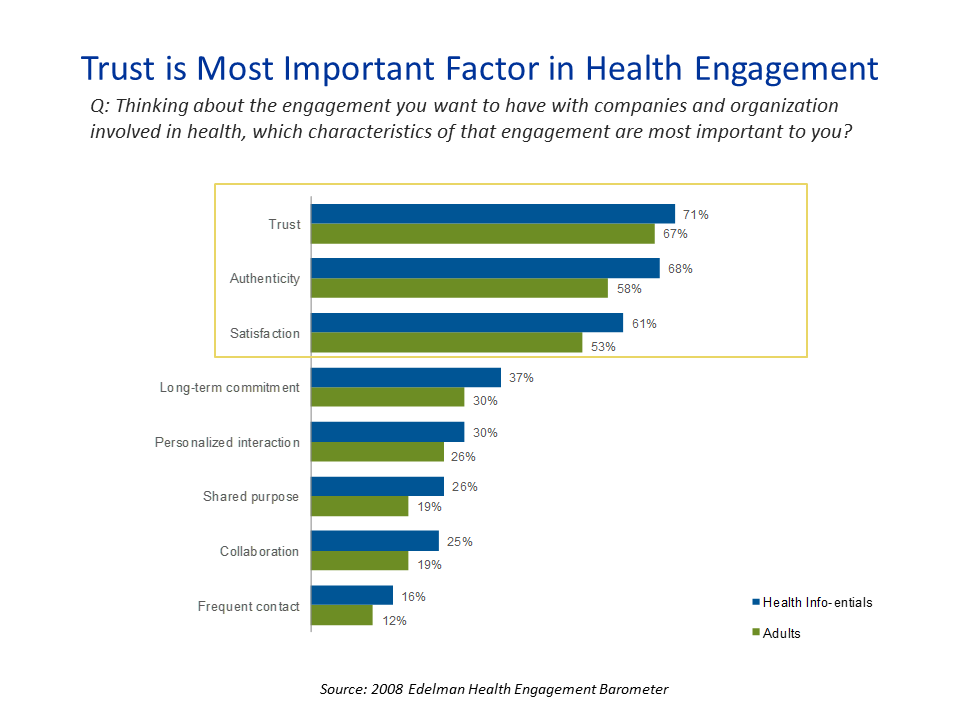
The 2008 Edelman Health Engagement Barometer is out alongside the company’s annual Trust Barometer, and more than ever, people are trusting “people like me” more than they do institutions. This is the ninth iteration of the Trust survey. The toplines of the past four years show an important change in peoples’ trust perspectives. In 2005, Edelman found that trust in ‘established institutions’ and figures of authority began shifting to peers. By 2006, “A person like me” was the most credible spokesperson for companies. That year, people trusted employees significantly more than company CEOs. Edelman defines “a person like me” as
 Jane will be working with EU- and UK-based clients in September and October 2026, collaborating with stakeholders in digital health, public/community health, retail health, and growing opportunities for health-at-home. Stay tuned to her updates here on Health Populi on-the-ground as she lives the digital nomadic work-life in Italy, Belgium, the Netherlands, and in London.
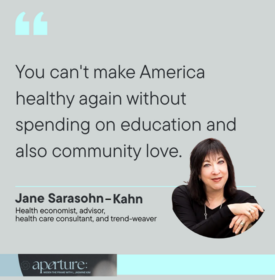 I was grateful to be Jasmine's first conversation-guest on her new podcast, "Aperture - Widen the Frame," where this expert in narrative medicine is bringing together the broad range of voices to sit at the table and address what health care needs: those humans in the health-system-loop who address health equity and empathy along with delivering evidence-based medicine for all.
 Jane joined host Dr. Geeta "Dr. G" Nayyar and colleagues to brainstorm the value of vaccines for public and individual health in this challenging environment for health literacy, health politics, and health citizen grievance. Click onto the Pfizer Value of Vaccines site and you can watch four episodes covering the challenges with adult vaccination, the employer and health plan member's journey to vaccination, reimbursement, and collaborating for proactive prevention.