


What the SCOTUS ACA ruling means for health consumers
Now that the Affordable Care Act is settled, in the eyes of the U.S. Supreme Court, what does the 6-3 ruling mean for health/care consumers living in America? I wrote the response to that question on the site of Intuit’s American Tax & Financial Center here. The top-line is that people living in Michigan, where the Federal government is running the health insurance exchange for Michiganders, and people living in New York, where the state is running the exchange, are considered equal under the ACA’s health insurance premium subsidies: health plan shoppers, whether resident New Yorkers or Michiganders, can qualify for
How digital ‘everything’ and consumer expectations are re-shaping health care
Two forces are converging to shape a new era of “living services,” Accenture posits: the digitization of “everything” and consumers’ “liquid” expectations — which are demands for personalized, engaging and adaptable experiences. Accenture’s report on this phenomenon, The Era of Living Services, spans the broad range of consumers’ daily lives where these services will impact: homes, families, transportation, shopping, leisure time, jobs, finances, education, cities, and above all for Health Populi readers, “our bodies.” Living services are physically close to us, as Accenture sees them, “wrapping themselves around the everyday things we do.” They are digital services that are aware
Employers go beyond physical health in 2015, adding financial and stress management
Workplace well-being programs are going beyond physical wellness, incorporating personal stress management and financial management. Nearly one-half of employers offer these programs in 2015. Another one-third will offer stress management in the next one to three years, and another one-fourth will offer financial management to workers, according to Virgin Pulse’s 2015 survey of workplace health priorities, The Busness of Healthy Employees. The survey was published June 1st 2015, kicking off Employee Wellbeing Month, which uses the Twitter hashtag #EWM15. It takes a village to bolster population health and wellness, so Virgin Pulse is collaborating with several partners in this effort
How Growing Income Inequality Hurts Everyone, and Especially Our Health
Income inequality has increased in most developed countries, and especially in the U.S., according to the OECD’s report, In It Together: Why Less Inequality Benefits All, published in May 2015. The red arrow in the first chart shows where the U.S. ranks versus other developed nations in income inequality, which is defined as the wealth gap between rich and poor people. The U.S. has the greatest income inequality in the developed world. The second chart shows data for the U.S. on benefits provided to low-wage workers (the bottom 25% of wage earners) versus high-wage workers (the top 25% of earners).
Avoiding Wrinkles: A World Without Tobacco
May 31st is World No Tobacco Day, heralded by the World Health Organization, and celebrated by the advocacy group Action on Smoking and Health (with the very appropriate acronym ASH). Smoking is one of the most addictive (anti-)health behaviors around, so persuading people to quit the habit continues to challenge public health advocates. Enter ASH’s engaging campaign called “The Wrinkler,” with the introductory question, “Ever notice how some people who are 25 look 45?” The video continues to explain how we can “expedite the aging process….Ladies, wish you were half your age? Don’t wait for him to look younger; make yourself
All women are health workers
The spiritual and emotional top the physical in women’s definition of “health,” based on a multi-country survey conducted in Brazil, Germany, Japan, the UK and the U.S. The Power of the Purse, a research project sponsored by the Center for Talent Innovation, underscores women’s primary role as Chief Medical Officers in their families and social networks. The research was sponsored by health industry leaders including Aetna, Bristol-Myers Squibb, Cardinal Health, Eli Lilly and Company, Johnson & Johnson, Merck & Co., Merck KGaA, MetLife, Pfizer, PwC, Strategy&, Teva, and WPP. The study’s summary infographic is titled How the Healthcare Industry Fails
Mental health at the workplace – US companies rank #1 for stress
People with anxiety, depression, interpersonal challenges, and substance abuse go to work every day. Together, these factors erode the mental health and wellbeing of workers, and this negatively impacts companies’ productivity, workplace morale, and profitability. Employers are increasingly taking notice of their role in promoting mental health on-the-job, a trend captured in the report Promoting Mental Well-being: Addressing Worker Stress and Psychosocial Risks, an international survey of employers published in May 2015 by Buck Consultants, part of Xerox. The survey polled 439 employers in 31 countries, and the report focuses on the results in four of those nations: Brazil, Singapore, the
Mourning the death of Elephant, the alternative pharmacy

Elephant Pharm, the six-year-old alternative pharmacy chain based in northern California, filed Chapter 11 bankruptcy papers two days ago. The vision of Elephant was to provide customers with both traditional medicines along with homeopathic treatments. The store’s footprint of 12,000 feet held space for both product and services. Practitioners were available in the store with whom consumers could consult on a range of issues, from Ayurvedic herbs to treat headaches to yoga. Note that a similar company, Pharmaca, shares Elephant’s commitment to integrative medicines, but is based on a much smaller design of about 5,000 square feet. Pharmaca has 23
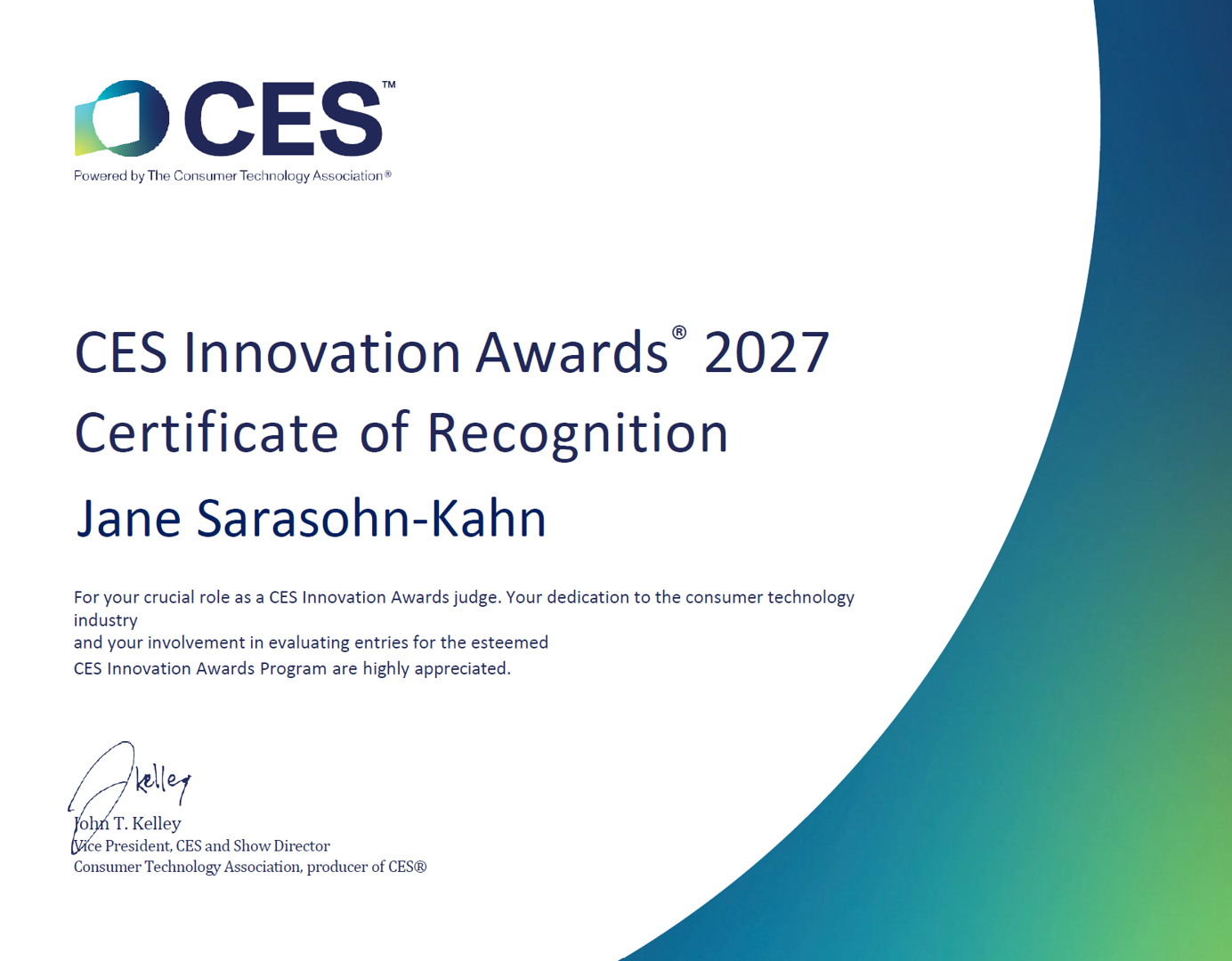 It was an honor to be a CES Innovation Awards 2027 judge once again for the digital health category. Based on the new-new things I reviewed in the process, we'll be seeing some amazing developments that should have positive impacts on peoples' health and well-being, from head and brain to toe. Viva Las Vegas, as usual, right after New Year January 2027!
 January 2027 is in our sights, and that means we're making plans for #CES2027. I've attended the largest consumer electronics show for nearly 20 years, tracking the evolution of digital health which enables people for greater self-care and health agency and literacy. I'm looking forward to collaborating on this webcast with fellow CES experts in their fields to brainstorm what we expect in this "All Things CES" Zoom session organized by the great Robin Raskin and the Virtual Events Group on December 10.
 Jane joined host Dr. Geeta "Dr. G" Nayyar and colleagues to brainstorm the value of vaccines for public and individual health in this challenging environment for health literacy, health politics, and health citizen grievance. Click onto the Pfizer Value of Vaccines site and you can watch four episodes covering the challenges with adult vaccination, the employer and health plan member's journey to vaccination, reimbursement, and collaborating for proactive prevention.