


7 Women and 1 Man Talking About Life, Health and Sex – Health 2.0 keeping it real
Women and binge drinking…job and financial stress…sleeplessness…caregiving challenges…sex…these were the topics covered in Health 2.0 Conference’s session aptly called “The Unmentionables.” The panel on October 1, 2013, was a rich, sobering and authentic conversation among 7 women and 1 man who kept it very real on the main stage of this mega-meeting that convenes health technology developers, marketers, health providers, insurers, investors, patient advocates, and public sector representatives (who, sadly, had to depart for Washington, DC, much earlier than intended due to the government shutdown). The Unmentionables is the brainchild of Alexandra Drane and her brilliant team at the Eliza
Health care and survey taking at the Big Box Store
Where can you shop the health and beauty aisles, pick up some groceries and a prescription, get a flu vaccine, and weigh in on Obamacare and what digital health tools you like? Why, at one of several thousand retail stores where you can find a SoloHealth kiosk. As of yesterday afternoon, over 32 million encounters were recorded on SoloHealth kiosks, based on an app I saw on the company CEO Bart Foster’s smartphone. Kiosks are locatted around the United States in retailers including Walmart and Sam’s Clubs, along with major grocery chains like Schnuck’s and Publix, and the CVS pharmacy
Taking vitamins can save money and impact the U.S. economy – and personal health
When certain people use certain dietary supplements, they can save money, according to a report from the Council for Responsible Nutrition and Frost and Sullivan, the analysts. The report is aptly titled, Smart Prevention – Health Care Cost Savings Resulting from the Targeted Use of Dietary Supplements. Its subtitle emphasizes the role of dietary supplements as a way to “combat unsustainable health care cost growth in the United States.” Specifically, the use of eight supplements in targeted individuals who can most benefit from them can save individuals and health systems billions of dollars. The eight money-saving supplements are: > Omega-3 > B
Defining Mobile Health – the blur between health and health care
Mobilising Healthcare, a new report from Juniper Research, segments the mobile health sector into “healthcare” and “health & fitness” segments. The research summary notes that fitness is a relatively new market compared with health “care,” which has been around for eons. Fitness, the analysts say, “is exempt from government intervention.” Mobile healthcare (“mHealth”) applications explored include SMS health messaging, remote health provision such as cardiac monitoring, electronic health records and personal health records. In mFitness, Juniper looks into mobile tech for athletes and fitness conscious people, and activity tracking including heart function, distance, respiration, and perspiration, among other parameters. mHealth
Food and the household health budget: one pocket, shrinking access
Over 1 in 5 people in the U.S. have not had enough money to buy food for themselves or their families in the past year, according to the August 2013 Gallup Healthways Index. This is as many consumers as those who couldn’t afford food during the deepest months of the last recession. Lack of access to food is a challenge for a cadre of Americans who lack access to other basic needs such as shelter and health care. Gallup’s Basic Access Index looks at this market basket, and has found that Americans’ access to basic needs at 81.4 in August
Health information search online, an hour a week. Time with a doctor? An hour a year.
In game-scoring unit terms, 52 is the number of hours an average American spends seeking health information online each year. The 1 (hour) is roughly equivalent to the approximate total time a patient spends with a physician (an average of 3 visits, with an average time per vision of 20 minutes). Thus, 52:1. This means that the average U.S. health consumer spends much more time DIYing her health using digital information resources than speaking face-to-face with their physician in the doctor’s office. Still, the physician continues to be a go-to source for health information, according to Makovsky, a health communications
Chief Health Officers, Women, Are In Pain
Women are the Chief Health Officers of their families and in their communities. But stress is on the rise for women. Taking an inventory on several health risks for American women in 2013 paints a picture of pain: of overdosing, caregiver burnout, health disparities, financial stress, and over-drinking. Overdosing on opioids. Opioids are strong drugs prescribed for pain management such as hydrocodone, morphine, and oxycodone. The number of opioid prescriptions grew in the U.S. by over 300% between 1999 and 2010. Deaths from prescription painkiller overdoses among women have increased more than 400% since 1999, compared to 265% among men.
Eat fruits and vegetables: it’s worth $11 trillion to you and the U.S. economy
More than 127,000 people die every year in America from cardiovascular disease, accruing $17 billion in medical spending. Heart disease is a “costly killer,” according to the Union of Concerned Scientists, who has calculated The $11 trillion reward: how simple dietary changes can save lives and money, and how we get there, published in August 2013. That $11 trillion opportunity is equal to the present value of lives saved. The solution to bolstering heart (and overall health) and saving money (medical spending and personal productivity) is in food. We’re not talking about genetically engineering anything special or out-of-the-ordinary. We are talking
People are growing their health-consumer muscles in 2013
Most Americans are concerned about their ability to for medical bills, even when they have health insurance. As a result, most are comfortable asking their doctor about how much their medical treatment will cost. People are becoming savvier health care shoppers largely because they have to: 37% of people in the U.S. have an annual health insurance deductible over $2,000, according to the Spring/Summer 2013 Altarum Institute Survey of Consumer Health Care Opinion, published on 11th July 2013. Many of the media stories coming out of the Altarum survey since its publication have been about people and their trust in
Healthways buys into Dr. Ornish’s approach: will “Ornish-inside” scale wellness in America?
People who live in U.S. cities with low levels of well-being have twice the rate of heart attacks as people who live in healthier America. That’s 5.5% of the population in sicker America versus 2.8% of the population living in healthy America. The first chart illustrates this disparity, taken from the Gallup-Healthways index that examined 190 metropolitan areas in 2012. Based on this study, it’s good to live in parts of Utah, Nebraska and Colorado, but not so healthy to be a resident in West Virginia, Alabama, and parts of Kentucky and Ohio. Heart disease and diabetes are killing a plurality
Google, your new-tritionist
Your new-nutritionist is now Google, which launched a nutrition utility through Google Search. “From the basics of potatoes and carrots to more complex dishes like burritos and chow mein, you can simply ask, ‘How much protein is in a banana?’ or ‘How many calories are in an avocado?’ and get your answer right away,” the official Google Search blog explains. Over 1,000 items – fruits, vegetables, meats, dairy items, and prepared meals like Chinese and Mexican take out, as mentioned in Google’s quote above – are searchable via web and mobile, powered by Google’s Knowledge Graph. The Knowledge Graph is the
Health and wellness, the economy and the grocery store
Consumers in America are spending more, and especially at the grocery store. Most people say they want to eat healthy — but, although they’re spending more at the food store, one-half of supermarket shoppers say cost is the main obstacle for healthy eating. 2 in 3 U.S. grocery shoppers define health and wellness as being physically fit and active, and over half believe that feeling good about yourself is another facet of health. Not being overweight equals health for about one-half of U.S. shoppers. The Why? Behind the Buy, from Acosta Sales & Marketing, explores buying patterns among U.S. consumers
How mobile phones bring good things to life (and health)
…and I’m not talking about GE here (or here). Most people (75%) still view phone calls as the communication mode that best bolsters their relationships compared with texting (66%), picture messaging (35%), sharing on social networks (31%), emailing (25%), , and video chatting (9%). U.S. Cellular, the mobile phone company, surveyed 527 customers in April 2013 to learn about how wireless communication can bring “Better Moments” to peoples’ lives. In particular, people say that mobile phones help them: Communicate more frequently (77%) Share experiences right away (66%) Share moments that would have otherwise been missed (52%). 9 in 10 people take pictures on
The emerging economy for consumer health and wellness
The notion of consumers’ greater skin in the game of U.S. health care — and the underlying theory of rational economic men and women that would drive people to greater self-care — permeated the agenda of the 2nd annual Consumer Health & Wellness Innovation Summit, chaired by Lisa Suennen of Psilos Ventures. Lisa kicked off the meeting providing a wellness market landscape, describing the opportunity that is the ‘real’ consumer-driven health care: people getting and staying well, and increasing participation in self-management of chronic conditions. The U.S. health system is transforming, she explained, with payors beginning to look like computer
Wellness at work – Virgin tells it all
Health, happiness and engagement among employees are closely-linked and drive productivity in the workplace. But there’s a gap between the kind of wellness services employers offer workers to bolster health, and the programs that people actually want. The current state of employer wellness programs is described in a survey conducted by Virgin HealthMiles and Workforce, The Business of Healthy Employees: A Survey of Workplace Health Priorities, published in June 2013. There’s a gap between what workers want for wellness and what employers are offering. Most-demanded by workers are health on-site food choices desired by 79% of employees; but, only 33%
Marketing Digital Health to Mom 2.0 on Mother’s Day 2013
Mainstream media, both print and online, peppered their 2013 Mother’s Day gift suggestions including pod coffeemakers, bangle bracelets, candy-colored accessories and digital health devices. Say, what? In Parade magazine, Mother’s Day 2013 gift ideas included the Fitbit “smart pedometer,” linked to a “buy” site at REI. You can’t get much more mainstream than Parade. In Entertainment Weekly, Bronwyn Barnes, style maven for the magazine, wrote a one-page “Get Ready for Mom 2.0” and her recommendations included the Pebble Smartwatch, the Jawbone Up wristband, and the HoodieBuddie with earbuds built into the drawstrings. Men’s Health told sons and husbands to check
A physical activity shortage: Let’s Move!
Only 1 in 5 Americans got the minimum recommended amount of physical activity in 2011, based on guidelines offered by the U.S. Centers for Disease Control. More men than women met the standard: 23.4% of men versus 17.9% of women. There are wide variations across the 50 states, as the map shows, with the healthiest folks exercise-wise living in the west, Alaska, upper midwest, and New England. The range runs from a 12.7% low in West Virginia and Tennessee to 27.3 at the high end in Colorado. That bar is set at 150 minutes a week (that’s 2.5 hours) of
Dietitians provide a health bridge between food and pharmacy
The registered dietitian is an in-demand labor resource for grocery stores around the U.S. Advertising Age covered the phenomenon of the growing clout of dietitians in food chains (April 14, 2013). Let’s dig further into this phenomenon through the Health Populi lens on healthcareDIY and peoples’ ability to bend their personal health care cost curves. Stores such as Giant Eagle, Hy-Vee, Safeway and Wegmans are morphing into wellness destinations, with pharmacies and natural food aisles taking up valuable square footage to meet consumers’ growing demands for healthy choices. Some stores are formalizing their approach to food = health by formulating a
Food = Health for employers, hospitals, health plans and consumers
Food is inextricably bound up with health whether we are well or not. Several key area of the Food=Health ecosystem made the news this week which, together, will impact public and personal health. On the employer health benefits front, more media are covering the story on CVS strongly incentivizing employees to drop body mass index (BMI) through behavioral economics-inspired health plan design of a $50 peer month penalty. Michelin, whose bulky advertising icon Bibendum has more than one “spare tire,” introduced a program to combat health issues, including but not limited to BMI and high blood pressure, according to the
Walgreens Steps with Balance program rewards both consumers and the store
Consumers who patronize Walgreens can get rewarded for tracking their physical activity For the Steps with Balance program kickoff, self-tracking consumers can earn 20 points for every mile walked or run and 20 points for tracking weight. Walgreens implemented the Walk with Walgreens program in 2012. The program won an Effie Award for an outstanding marketing program. With the success of Walk with Walgreens, the retail pharmacy company has expanded the program beyond simple steps to include weight tracking and health goals for earning loyalty points. The program enables a few of the most popular self-tracking devices to sync so
An American Nanny State? Most Americans support government tactics addressing lifestyle impacts on chronic disease
Most people like government policies targeting reducing tobacco use, requiring food manufacturers and restaurants to reduce salt content, and mandating schools to require 45 minutes of daily activity for students. A large majority of Americans (at least 8 in 10 people) support government actions to promote public health that stem chronic disease, from preventing cancer (89%) and heart disease (86%) to helping people control their diabetes (84%) and preventing childhood obesity (81%). A Survey Finds Public Support For Legal Interventions Directed At Health Behavior To Fight Noncommunicable Disease (NCD). This poll, published in the March 2013 issue of Health Affairs, profiles the
Arianna and Lupe and Deepak and Sanjay – will the cool factor drive mobile health adoption?
Digital health is attracting the likes of Bill Clinton, Lupe Fiasco, Deepak Chopra, Dr. Sanjay Gupta, Arianna Huffington, and numerous famous athletes who rep a growing array of activity trackers, wearable sensors, and mobile health apps. Will this diverse cadre of popular celebs drive consumer adoption of mobile health? Can a “cool factor” motivate people to try out mobile health tools that, over time, help people sustain healthy behaviors? Mobile and digital health is a fast-growing, good-news segment in the U.S. macroeconomy. The industry attracted more venture capital in 2012 than other health sectors, based on Rock Health’s analysis of the year-in-review. Digital health
Gettin’ higi with it: Lupe Fiasco’s foray into public health
The latest in SoLoMo (Social, Local, Mobile) Health is a gamified tool coupled with a hardware kiosk, known as higi. The brainchild of Michael Ferro, a successful dotcom entrepreneur who now owns the Chicago Sun-Times, higi’s mission is to help people – particularly younger peeps – to take better care of themselves by scoring points and, as a result, social connections. Higi’s an African word for origin, so the health tool has some aspects relating to being in a tribe — a kind of health tribe. It also has a fun sound to it, Ferro noted, which sets the vibe
Health at SXSW13 vs. HIMSS13: the Yin, the Yang, and the Blur
I endured what very few people could (or would) do in the past ten days: I traveled to New Orleans to the annual conference of HIMSS, the Health Information Management Systems Society, which features hundreds of suppliers to the health care information technology industry. I returned home to kiss my family hello and goodbye, and a day later flew to Austin for the annual South-by-Southwest conference for music, movie and digital folks. The health track at SXSW has grown over the past five years, and provides a start contrast to “health care” as embodied at HIMSS, and “health” translated through
The Sitting Disease: health is growing at SXSW
If it’s March, it must be time for South by Southwest (SXSW), the annual conference weaving music, film and interactive tracks of speakers and conferees that overcrowds and excites Austin, Texas, with a cool vibe and even cooler ideas. I’ll be participating on Sunday 10 March 2013 at 5 pm on a panel, Sitting Will Kill You: Can Mobile Save Us?, featuring Fran Melmed, developer of the HotSeat app that nudges us to all Get Up Offa Our Things when living our typical sedentary lives; Peter Katzmarzyk, public health researcher who knows all about the relationship between too much sitting
Bill Clinton’s public health, cost-bending message thrills health IT folks at HIMSS
In 2010, the folks who supported health care reform were massacred by the polls, Bill Clinton told a rapt audience of thousands at HIMSS13 yesterday. In 2012, the folks who were against health care reform were similarly rejected. President Clinton gave the keynote speech at the annual HIMSS conference on March 6, 2013, and by the spillover, standing-room-only crowd in the largest hall at the New Orleans Convention Center, Clinton was a rock star. Proof: with still nearly an hour to go before his 1 pm speech, the auditorium was already full with only a few seats left in the
Living paycheck to paycheck: what it means for health
While 50% of Americans feel they have a sound financial position, the other half is living paycheck to paycheck. 8% say they can’t even pay for essentials. The second annual Allstate “Life Tracks” Poll finds American adults split between have’s and have not’s, with even the “have’s” feeling less than financially literate. There is an equal split between people who feel they’re in an “excellent” or “good” financial position compared with those who feel they’re in financially “fair” or “poor” shape. Men feel more financially secure than women; 3 in 4 single parents feel less well-off compared to the average
Lower calories are good business
The restaurant chain business employs 10% of U.S. workers and accounts for $660 bn worth of the national economy. Where restaurant chains are growing fastest is in serving up lower-calorie meals, and it’s been a boon to the bottom-line. The case for lower calories leading to better business is made in Lower-Calorie Foods: It’s Just Good Business from the Hudson Institute‘s Obesity Solutions Initiative, published February 2013. In the report, researchers analyzed nitty-gritty restaurant chain data on servings and traffic from 2006-2011 to sort out whether sales of so-called lower-calorie menu items in 21 chains led to improved business. The chains
Dark chocolate as health food – a healthy salute to Valentine’s Day
On a recent Whole Living segment on Martha Stewart’s Sirius XM radio channel, I learned of the artisan chocolatier, Gnosis. The company, whose name is Greek for “knowledge,” grew out of the kitchen of a holistic health counselor, Vanessa Berg, who began to make nutritionally-infused sweets for her private clientele. Word-of-mouth made its way to a buyer from Whole Foods, who subsequently did a deal with Berg to sell Gnosis goods in some of the company’s stores in New Jersey and New York. Here’s a link to the radio interview. Chocolate is a health food for this company, and for
Americans are first in un-health: the US health disadvantage
In the U.S., we’ll be the #1 oil producer by 2020. We’re the largest national economy in the world (to be surpassed by China before 2030). And, we’re #1 in terms of the lowest taxes paid as a percentage of national GDP. That’s all heartening news for the time being. But we’re also #1 in what I’ll call “un-health:” in auto accident mortality for adolescents, obesity rates, infant mortality, prevalence of sexually transmitted diseases, and among other public health metrics. A report from the National Research Council and Institute of Medicine (NRC/IOM) calls out what JAMA terms The US Health Disadvantage:
The interoperability of consumer mHealth – reflecting on Jawbone + Massive Health + Visere
Consumers want multiple functions on single devices, smooth transitions from one screen to another, and value-laden experiences in the post-recession economy. I wrote about this phenomenon during the week of the 2013 Consumer Electronics Show, highlighting Accenture’s survey on consumer attitudes toward technology — the connected home as consumer medical home. In the fast-evolving mobile health (mHealth) era, the consumer-facing suppliers are fast-responding to these customer demands. This is fostering consumer-centered interoperability in mHealth. On the health care system and professional side of health IT, getting to interoperability remains elusive and slow-going, with a customer base (hospitals, physicians) that’s not
Most women want to be healthy, buy healthy
Health and wellness motivations among women cross all generations, driving them to purchase products that bolster health as they define it…not how media and stereotyping advertising have typically portrayed it, according to a survey report from Anthem Worldwide, What Women Really Want From Health and Wellness. Over all generations, 3 in 4 women say they make choices to benefit their health and wellness. Anthem asked women about the “external voices” of health/wellness messaging versus their “internal voice.” The external represent societal expectations: over 80% of women expect to take responsibility for their family’s health, and about 70% of women say the
Formally tracking health data changes health behavior and drives social health
Most of us keep track of some aspect of our health. Half of all people who track do so “in their heads,” not on paper, Excel spreadsheet, or via digital platform. Furthermore, 36% update their health tracking data at least once a day; but 16% update at most twice a month, and 9% update less than once monthly. Tracking for Health from the Pew Internet & American Life Project paints a portrait of U.S. adults who, on one hand are quantifying themselves but largely aren’t taking advantage of automated and convenient ways of doing so. Overall, 69% of U.S. adults track
Think about health disparities on Martin Luther King Day 2013
On this day celebrating Martin Luther King, Jr., I post a photo of him in Detroit in 1963, giving a preliminary version of his “I Have a Dream” speech he would give two months later in Washington, DC. As I meditate on MLK, I think about health equity. By now, most rational Americans know the score on the nation’s collective health status compared to other developed countries: suffice it to say, We’re Not #1. But underneath that statistic is a further sad state of health affairs: that people of color in the U.S. have lower quality of health than white
The connected home as consumer medical home
Consumers are looking for electronic devices that do many things, don’t care much about what platforms they use, like the convenience that cloud computing enables, and are bringing their own devices to the workplace for productivity, conference calls, and communication. Accenture has studied the wired consumer and developed this infographic, which illustrates these four key findings. Accenture says it’s “an open playing field” when it comes to consumer technology: there are many suppliers who can develop products and sell into this market, where consumers seem pretty agnostic relative to operating systems and even brands — as long as the devices
Battle of the (wrist)Bands at the Digital Health Summit, 2013 CES
One of the fastest-growing segments at the 2013 Consumer Electronics Show in Las Vegas this week is digital health. And within that segment, there’s a battle brewing for what technology companies seem to think is the most valuable part of real estate on the human body: the wrist. I counted at least fifty products as I cruised aisles 26000-27000 in the South Hall at the Las Vegas Convention Center that had wristbands, usually black, plastic or rubbery, and often able to click in and out of the band for use in-hand, in pocket, or in a few cases, on a
We are all health deputies in the #digitalhealth era: live from the 2013 Consumer Electronic Show
Reed Tuckson of UnitedHealthGroup was the first panelist to speak at the kickoff of the Digital Health Summit, the fastest-growing aspct of the 2013 Consumer Electronics Show (#2013CES). Tuckson implored the spillover audience to all, “self-deputize as national service agents in health,” recognizing that technology developers in the room at this show that’s focused on developers building Shiny New Digital Things have much to bring to health. As Andrew Thompson of Proteus Medical (the “invisible pill” company) said, “we can’t bend the health care cost curve; we have to break it.” This pioneering panel was all about offering new-new technologies
Food and health: information is not doing the job as the U.S. continues its obesity march
Notwithstanding the fact that most phones on U.S. streets are “smart” ones, most adults surf the net for health information, and most people try to change a health habit each year, Americans haven’t adopted healthier long-term relationships with food. The International Food Information Council has conducted the Food & Health Survey: Consumer Attitudes Toward Food, Safety, Nutrition & Health poll since 2006, thus enabling us to track peoples’ attitudes and behaviors over the past several years. The latest polling results appear in Is it Time to Rethink Nutrition Communications? A 5-Year Retrospective of Americans’ Attitude toward Food, Nutrition, and Health online in
Most smartphone owners seek health information online via mobile
The ubiquity of mobile phones, increasingly smart ones (one-half of all mobile phones in the U.S. ), means people are walking around, working, playing and driving with self-tracking devices and ultra-mini computers in their pockets and totebags. 52% of smartphone owners seek health information on their phones, and overall 1 in 3 people seek health information on all mobile phones — nearly doubling the percent of those seeking health info via mobile in 2010 (17%). People who are sicker, caregivers, and those who have had a big change in health are also more prone to using phones for health, as
Wired health: living by numbers – a review of the event
Wired magazine, longtime evangelist for all-things-tech, has played a growing role in serving up health-tech content over the past several years, especially through the work of Thomas Goetz. This month, Wired featured an informative section on living by numbers — the theme of a new Wired conference held 15-16 October 2012 in New York City. This feels like the week of digital health on the east coast of the U.S.: several major meetings have convened that highlight the role of technology — especially, the Internet, mobile platforms, and Big Data — on health. Among the meetings were the NYeC Digital Health conference, Digital
Food and health update: candy at the cash register and farmers markets in supermarkets
Grocery stores are incorporating farmers market-like shelves into produce departments, offering shoppers locally grown fruits and vegetables. Kraft Foods is reinventing itself as a health brand, with Consumers are shifting away from white starchy breakfast foods toward beans and greens. These are a few of the food-meets-health trends from the past quarter that reflect how American health citizens are incorporating new food habits into overall health behaviors. Let’s begin with the October 11, 2012, issue of The New England Journal of Medicine, which focuses on obesity, food, and health policy. Along with an excellent overview of Obama v. Romney
From fragmentation and sensors to health care in your pocket – Health 2.0, Day 1
The first day of the Health 2.0 Conference in San Francisco kicked off with a video illustrating the global reach of the Health 2.0 concept, from NY and Boston to Mumbai, Madrid, London, Tokyo and other points abroad. Technology is making the health world flatter and smarter…and sometimes, increasing problematic fragmentation, which is a theme that kept pinching me through the first day’s discussions and demonstrations. Joe Flowers, health futurist, offered a cogent, crisp forecast in the morning, noting that health care is changing, undergoing fundamental economic changes that change everything about it. These are driving us to what may
What Jerry the Bear means for Health 2.0
A teddy bear in the arms of a child with diabetes can change health care. At least, Jerry the Bear can. Yesterday kicked off the sixth autumn mega-version of the Health 2.0 Conference in San Francisco. Co-founded by Matthew Holt and Indu Subaiya, a long-time health analyst and physician, respectively, this meeting features new-new tools, apps and devices aimed at improving individual and population health, as well as health processes and workflows for physicians, hospitals, pharma, and other stakeholders in the health care ecosystem – even health lawyers, who met on October 7 to discuss up-to-the-minute e-health law issues. Yesterday was
Primary care is the new black: Walmart and Humana team up for health
Good food is a key component of health. So when Humana partners with Walmart to discount good-for-you foods, it’s a sign in the market that two of America’s most visible health brands are looking to motivate people to eat healthier — and, to be sure, drive sales in the growing health marketplace. This unique partnership brings together one of the nation’s largest health insurance companies with the world’s largest retailer. The venture joins HumanaVitality, a rewards program providing incentives for members (currently, about one million) to make sound health decisions, and Walmart, who will offer 5% savings on products that
Free statins at the grocery: retail health update
I spotted this sign yesterday at my local Wegmans, the family-owned grocery chain founded in upstate NY and growing down the northeast corridor of the U.S. Many months ago, a similar sign promoted “free antibiotics” at the store. What does a grocery chain’s pharmacy doling out “Free” [asterisked] generic Lipitor mean to the larger health ecosystem? On the upside, health is where we live, work, play and pray, as Dr. Regina Benjamin, the Surgeon General, has said. This has become a mantra for us at THINK-Health, and regular Health Populi readers may be tiring of my repeated use of this
Good Housekeeping features Facebook for health: health social networks go mainstream
Using social networks for health is no longer a pioneering, first-wave adoption activity: Facebook has gone mainstream in health. What’s the indicator that says we’ve hit the tipping point in consumers going Health 2,0, beyond Paging Doctor Google? A story in the July 2012 issue of Good Housekeeping magazine titled, Miracle on Facebook. What’s powerful about this is that articles on health social networks have been largely focused in health IT trade publications, business magazines like Forbes (focusing on sustainbale business modeels) and technology channels such as Fast Company and Wired. Looking at Good Housekeeping’s ad pages, its readership is mostly
Converging for health care: how collaborating is breaking down silos to achieve the Triple Aim
On Tuesday, 9 July 2012, health industry stakeholders are convening in Philadelphia for the first CONVERGE conference, seeking to ignite conversation across siloed organizations to solve seemingly intractable problems in health care, together. Why “converge?” Because suppliers, providers, payers, health plans, and consumers have been fragmented for far too long based on arcane incentives that cause the U.S. health system to be stuck in a Rube Goldbergian knot of inefficiency, ineffectiveness and fragmentation of access….not to mention cost increases leading us to devote nearly one-fifth of national GDP on health care at a cost of nearly $3 trillion…and going up.
What we can learn from centenarians about health
To get to be 100 years or older requires exercise, social connectedness, and good sleep, according to a majority of centennarians polled in UnitedHealthcare’s 100@100 Survey, 2012 Report of Findings. The key findings of this fascinating survey are that: Centenarians have better eating and sleeping habits than Boomers. One-half of centenarians regularly exercise. The most common forms of exercise are walking or hiking, muscle strengthening, gardening, indoor cardio exercise, exercise classes, and yoga/Tai Chi or other mind/body/spirit forms. Social networks bolster health, with most old-old people communicating with family or friends nearly every day And, laughter is a vitamin, with most
Fruits, financial incentives and remote coaching: evidence for behavior change
Increasing intake of fruits and vegetables, coupled with remote health coaching and financial incentives, together help people adopt and maintain healthy behavior changes. This is the conclusion of a randomized controlled trial using mobile technology, published in the May 28, 2012, issue of Archives of Internal Medicine. Dr. Bonnie Spring of Northwestern University’s Department of Preventive Medicine led the study. The researchers developed the trial, called Make Better Choices, to sort out which behavior changes would enable people to reduce major risk factors for cardiovascular disease, cancer and diabetes. Four combinations were assessed in the intervention among 204 people: Increasing fruit
Statins, food and a mobile app: Pfizer and Eating Well partner up as generic Lipitor hits the market
On May 23, 2012, Pfizer announced its teaming with EatingWell magazine to launch a mobile app for patients on Lipitor. Eight days later, on May 31, 2012, generic versions of Lipitor will hit the market. Lipitor is the best-selling drug in pharmaceutical history, to-date. Sales of the product top $125 billion. While generic atorvastatin has been available in the U.S. since November 2011 from two manufacturers, low prices for the generic will drop to $10 or less for a month’s supply at the end of May. This is Pfizer’s first foray into a prescription drug-affiliated app. The free mHealth app,
Right-sizing food and healthcare
In our fast-texting, quick-thinking, Blink-ing society, Jason Riis talks about slowing down our relationship with food. At the Edelman Wellness Ignited meet-up on March 26, 2012, Jason riffed on food intervention and economics for healthy eating. Jason is a professor at Harvard Business School and among his many research interests is how to change culture to morph away from obesity and Type 2 diabetes toward health. The U.S. is a shopping nation: retail is destination, fun, entertaining, life, for millions of Americans. Jason’s asking what retailers can do about fast and food. This isn’t only about ‘fast food,’ which, of course,
Wellness Ignited! Edelman panel talks about how to build a health culture in the U.S.
Dr. Andrew Weil, the iconic guru of all-things-health, was joined by a panel of health stakeholders at this morning’s Edelman salon discussing Wellness Ignited – Now and Next. Representatives from the American Heart Association, Columbia University, Walgreens, Google, Harvard Business School, and urban media mavens Quincy Jones III and Shawn Ullman, who lead Feel Rich, a health media organization, were joined by Nancy Turett, Edelman’s Chief Strategist of Health & Society, in the mix. Each participant offered a statement about what they do related to health and wellness, encapsulating a trend identified by Jennifer Pfahler, EVP of Edelman. Trend 1: Integrative
Wellness and the global health citizen – carrying our own doctors, inside
Every patient carries her or his doctor inside, said the great Renaissance man, Albert Schweitzer. Based on Euro RSCG Worldwide’s Prosumer Report – My Body, Myself, Our Problem: Health and Wellness in Modern Times, health citizens globally have begun to take on Dr. Schweitzer’s vision. Clement Boisseau of Euro RSCG points out that people, globally, are fairly schizophrenic when it comes to thinking about empowerment over illness: check out the chart for perceptions by condition and disease state. Boisseau says that people perceive health today both in modern terms (such as feeling empowered to control some conditions), and archaic or “magically
Food = health: JWT foodspotting
35% of consumers who have been altering their food intake to lose weight are eating fewer processed foods, according to a recent Nielsen Global Survey. This percentage has grown from 29% in 2008. Health and wellness is one of three driving forces shaping food in 2012, according to JWT‘s What’s Cooking: Trends in Food. The other two forces, technology and foodie culture, combine with health/wellness and yield some interesting consumer trends in the milieu of food. JWT’s top food issues to watch are: – Fooducate – Nutrition scores – Fat taxes – Health and fresh vending machines – Gluten-free –
Addressing chronic illness can help cure the U.S. budget deficit
Chronic illness represents $3 of every $4 of annual health spending in the U.S. That’s about $1.5 trillion. Living Well With Chronic Illness, a report from The Institute of Medicine (IOM), issues a “call for public health action” to address chronic illness through: – Adopting evidence-based interventions for disease prevention – Developing new public policies to promote better living with chronic disease – Building a comprehensive surveillance system that integrates quality of life measures, and – Enhancing collaboration among health ecosystem stakeholders: health care, health, and community non-healthcare services. The IOM recognizes the social determinants that shape peoples’ health status
On the road to retail health: healthcareDIY and primary care, everywhere
At the ConvUrgent Care Symposium in Orlando, attendees from the worlds of clinics, ambulatory care, hospital beds, pharmacies, medical devices, life sciences, health information, health IT, health plans, academic medical centers and professional medical societies came together to share and learn about the morphing landscape of retail health. The topline message: primary care is everywhere, and based on the response to my keynote talk this morning, every stakeholder segment gets it. My mantra, courtesy of the U.S. Surgeon General Regina Benjamin: don’t look at health in isolation, that is, where the doctor and hospital are. Health happens wherever the person
The Trust Deficit – what does it mean for health care?
Technology, autos, food and consumer products — two-thirds of people around the globe trust these four industries the most. The least trusted sectors are media, banks and financial services. Welcome to the twelfth annual poll of the 2012 Edelman Trust Barometer, gauging global citizens’ perspectives on institutions and their trustworthiness. This survey marks the largest decline in trust in government in the 12 years the Barometer has polled peoples’ views. Interestingly, trust in government among US citizens stayed stable. The top-line finds a huge drop in global citizens’ trust in government, with a smaller decline for business. There’s an interplay
What Inspires and Tires Women When It Comes to Weight – The Fat Trap and the role of exercise
‘Tis the season of weight loss plans, particularly among women, as this NPR story discusses. For the weight loss industry, this first quarter of the new year is akin to Black Friday for retailers the day-after-Thanksgiving. Special K called January 2, 2012, as National Weigh-In Day. To commemorate the event, Kelloggs commissioned a survey among women to find out what “inspires and tires” them when it comes to losing weight. Two-thirds of women in the U.S. started or re-started a weight management plan on January 1st, 2012. Other times of the year when women initiate weight-loss plans are to prep
Connected Health and obesity – will mObesity be able to mitigate the epidemic?
It’s January and the #1 most popular post-New Year’s resolution is to lose weight, get fit, and live well. The signs of this are manifested in ads featuring Janet Jackson promoting Nutrisystem, Jennifer Hudson dueting with her then-and-now selves pitching Weight Watchers, as well as the new Weight Watchers for Men promotion starring Charles Barkley. But there are new signs that losing weight and getting fit are going beyond “diets” and food plans: research shows that moving around and getting exercise can help people sustain hard-earned weight loss more than just changing food intake and “dieting.” So the Apple store
Make 2012 the year of living health-fully
When I would meet up with clients and friends during the latter half of 2011, people whom I hadn’t seen for months would do a double-take when they saw me. “What have you done?” they have asked. In this first post of 2012, I will share with Health Populi readers my story of 2011 — a year of living health-fully for me. One of the blessings of my work-life is that I have access to some of the great minds in health and health care. But not until I began to personally harness their wisdom, intentionally incorporating what they’ve learned into my own life-flow and
Value and values will drive the adoption of mobile health
This week’s mHealth Summit in Washington, DC, features scores of presentations, posters, and corporate announcements demonstrating the typical chaos of emerging technology markets: the Big Question at this stage on S-curves for new tech is always, “what’s the timing of the pace of change,” or for you mathematically-inclined readers, “what’s the slope of the mHealth adoption curve?” Before we address that question, let’s be transparent about the fact that there are several definitions of just what ‘mHealth’ is: purists may conceive it as covering only those health tools and applications that ‘go’ mobile–that is, that are deployed via mobile phones and
Food choice and overweight Americans: it’s not just about self-control
Per capita calorie intake has grown by 9 to 30 calories a day since the 1980s. Portion sizes have grown; as a result, so has the level of overweight and obesity in America. By 2020, 83% of men will be overweight or obese in the U.S.; so will 72% of U.S. women, according to Mark Huffman in a paper presented to the American Heart Association meeting in November 2011. “An individual’s decision to eat is not a result of personal weakness, but rather is determined, to a great extent, by the many environmental cues that have emerged since the early
Why a Foundation and the Federal Reserve are working together to improve health in the U.S.
Health philanthropies are about more than making grants. The Robert Wood Johnson Association, among the largest health philanthropic organizations in the world, is partnering with the Federal Reserve Bank (the Fed) on how community development impacts health — and vice versa. You cannot have a healthy community without focusing on housing, schools, and other neighborhood stakeholders, Dr. Risa Lavizzo-Mourey told the conference on Healthy Communities: Building Systems to Integrate Community Development and Health. In this context, Dr. Lavizzo-Mourey quoted Robert Kennedy who said, “The gross national product does not allow for the health of our children, the quality of their education, or
Primary care, everywhere: how the shortage of PCPs is driving innovation – especially for patient participation in their own care
The signs of the primary care crisis in America are visible: A growing number of visits to the emergency room for treating commonplace ailments Waiting lists for signing up with and queuing lines to see primary care doctors Fewer med students entering primary care disciplines Maldistribution of primary care practitioners (PCPs) in underserved areas, rural, exurban and urban. The implementation of the Affordable Care Act will (try to) enroll at least 30 million newly-insured health citizens into the U.S. health system. That’s the objective: whether being insured will actually provide people access to needed primary care is a big question given the current supply of
Most Americans like the idea “Big Government” when it comes to food safety
Two-thirds of Americans favor increasing funding to the Food & Drug Administration (FDA) to ensure food safety in the U.S. Furthermore, 9 in 10 Americans also believe that the Federal government should be responsible for ensuring that food is safe to eat. And, 3 in 4 Americans say if it costs 1 to 3% more money to buy safer foods. they’d be willing to pay for those foods kept safer by the new food safety measures. A poll from the Pew Charitable Trusts, conducted by Hart Research Associates in April and May 2011, finds that when it comes to what Americans eat,
Brand “Health:” where is it in the Top 100 most valuable brands?
Apple has supplanted Google as the world’s #1 most valuable brand, worth more brand-wise than Microsoft and Coca-Cola combined (#5 and #6). the other most valuable global brands are IBM, McDonalds, AT&T, Marlboro, China Mobile, and GE. Technology brands have significantly grown in value with consumers allocating more personal disposable income to products like tablet computers and smartphones, even in the face of recessionary economics the world over. Technology companies are now 1/3 of the top 100 brands. Millward Brown, the brand consultancy that is part of WPP, the global communications firm, has conducted the BrandZ top 100 most valuable
Will people see Health when they see Walmart?
“Can Walmart Make America Eat Healthier?” asks The Week. Walmart, the world’s largest retailer and #1 company on the Fortune 500 list, has come out in favor of bolstering health in the food it sells through its 800+ discount stores, 2,700 supercenters, 158 neighborhood markets, and nearly 600 Sam’s Clubs in the U.S. The Financial Times today reported that the company’s plan won the compliments of First Lady Michelle Obama, who is a proponent of healthy and local foods and was present at Walmart’s announcement. The company’s stock price is up over a dollar today, probably based on this news and
New year, new you, new health apps
As health citizens the world over vow to lose N zillion pounds in this first week of 2011, they’ll go beyond buying into Weight Watchers’ tempting offer to join “for free” (not really, folks), purchasing Home Shopping Network’s “Today’s Special” Earth brand Exer-Trainer sneaker, and getting motivated by Jillian Michaels gut-busting workouts on The Biggest Loser (her last season, by the way). People wanting to lose weight will adopt mobile health apps in record numbers in 2011. This category of mHealth apps is among the largest and most downloaded apps available. By the fourth quarter of 2011, most phones on the street
Mayor Bloomberg Gets an “A” for Health
One of the favorite holiday gifts I sent people this season was Mark Bittman’s work, The Food Matters Cookbook: 500 recipes for conscious eating. Health Populi’s definition of ‘health’ comes from the World Health Organization: Health is a state of complete physical, mental and social well-being and not merely the absence of disease or infirmity. So with an eye toward conscious eating as part of everyday health, I headed to two wonderful restaurants on a trip to New York City last week that fit the definition: Rouge Tomate, built on a philosophy of great design and sustainable, balanced food (with locations in
Trust in hospitals highest over all health industry groups; pharma flat, and health plans rank lowest
Americans trust their supermarkets and local hospitals more than other industries they deal with. while tobacco and oil companies remain at the bottom of the trust-list for U.S. consumers, health insurance and managed care aren’t much ahead of them. Pharmaceutical companies rank fairly low, with only 11% of U.S. adults seeing them as “honest and trustworthy.” As a result, nearly one-half of Americans would like to see increased regulation on pharma. Over 1 in 3 Americans would like to see managed care and health insurance companies more regulated. The latest Harris Poll has found that oil, pharmaceutical, health insurance and tobacco are
Luxury goods: a hospital stay in the U.S., a Big Mac in Switzerland
‘Tis the season for luxury goods spending, if you’re lucky: under the tree, you might find a Swiss watch from Baume & Mercier or Piaget; , chocolates boxed from Lindt & Sprüngli; or a Bally-branded handbag. If you have to stay in a hospital in Switzerland, the average cost of one inpatient night would be $617. That same overnight stay in a U.S. hospital would be $3,612 — a luxury good by any standard. The U.S. inpatient stay average cost ranges from a low of $1,595 (about 2.5 times greater than the Swiss rate) and a high of $14,306 (at the 95th percentile). These costs come from
Walgreens’ Wellness Wisdom – what it means for pharmacy’s role in health
Two weeks ago at the company’s AnalystDay conference, Greg Wasson, the CEO of Walgreens, told the audience that the pharmacy chain was on a mission to “own well.” In the New York Times magazine dated November 12, 2010, an article titled Fresh Approach talks about Walgreens work in low-income Chicago neighborhoods coupling with greengrocers to bring “food oases” to inner cities. Two weeks ago, I learned that Walgreens is teaming with Orbitz to provide travelers’ health services. Married to an international banker who travels globally, I am pleased to know he can get his esoteric inoculations in local, convenient retail mode. Walgreens’ data found that 25% of
Health is a growing business for Nestlé
Their website now talks about it being the “Nutrition, Health and Wellness Company.” Most of us still think of it as the biggest food company in the world. It’s spending one-half billion dollars to expand in health. Nestlé, which brings baby food, bottled water, bars of chocolate and breakfast cereal to kitchen tables is now bringing us Health. The new group will be known as Nestlé Health Science. The company’s existing health business is already valued at about $1.6 billion. “The combination of health economics, changing demographics and advances in health science show that our existing health care systems, which focus on treating
Health and entertainment: kids like food with Dora, Scooby and Shrek
What do Dora the Explorer, Scooby-Doo and Shrek have in common? They’re persuading kids to eat less nutritious food, according to a study in the July 2010 Pediatrics journal (Volume 126. Number 1). A team from The Yale Rudd Center for Food Policy and Obesity studied children’s taste for food that’s sold in cartoon-character themed packages, versus products in plain packaging. The verdict? Kids think the cartoon-themed food tastes better. The study was done among 40 so-called “ethnically diverse” children 4-6 years old in New Haven, CT, preschools. Health Populi’s Hot Points: Since Vance Packard wrote the seminal book on advertising, The Hidden
Every company’s in the health business
Health is not just the purview of health care companies. It’s the job of all industries, according to consumers who live in 11 countries the world over. The headline finding of the 2010 Edelman Health Engagement Barometer is that Health is the New Green. As green has been a sustainability strategy for business these past several years, Health is following in Green’s footsteps, as Nancy Turett, Global President-Health for Edelman says, “to both propel and protect businesses.” Look at the chart: while nearly all consumers believe that bio/pharma, health providers, and the over-the-counter (OTC) and personal care industry should engage in health
Taco Bell does nutrition at the drive-thru window – pondering Pollan’s Food Rules
1 in 2 Americans visits so-called quick service restaurants (QSR) twice a month, 29% visit 3-5 times a month, and 16% visit 6 or more times a month. Taco Bell sponsored the America’s Drive-Thru Survey and found that 7 in 10 Americans think having better choices in drive-thru’s would encourage them to eat better. Only 50% of Americans believe they can stick to a low-calorie diet while ordering through drive-thru’s. 9 in 10 would try better choices of their favorite menu items if they were offered. Taco Bell generates 70% of its business via drive-thru. This press release explains the
Health and fast food: calorie labels work
New Yorkers who frequent Au Bon Pain, KFC, McDonald’s and Starbucks who noticed calorie counts on menu labels ordered 106 fewer calories at the point-of-purchase than people who didn’t pay attention to the information. Here’s evidence that labeling in fast-food destinations works. At the annual meeting of the Obesity Society in Washington DC this week, researchers are presenting results on how transparency of calorie information motivates many health citizens to change their choices based on nutritional knowledge. Reuters reports some details from the study. Researchers in New York polled 10,000 diners at 275 locations of the most
Functional foods play a role in consumer-driven health care
Americans spend nearly $30 billion on functional foods, according to Leveraging growth in the emerging functional foods industry, from PricewaterhouseCoopers (PwC). Functional foods are those that contain supplements beyond food that’s consumed for basic nutrition. They incorporate additional ingredients that target specific health benefits. PwC believes that the U.S. represents the largest functional foods market in the world, up to one-half of global sales. 20 companies account for 70% of the U.S. market. Many of these names are very familiar, such as PepsiCo (with Gatorade and Quaker), Coca-Cola (Vitamin Water and Odwalla), General Mills (Cheerios and Yoplait), Kellogg (Kashi and
Americans’ spending on complementary and alternative medicine is up, but most of the increase is "do-it-yourself" care
U.S. adults spent $33.9 billion on complementary and alternative medicine (CAM) in 2007. The largest expenditure on CAM was on self-care costs of $22.0 billion, the largest component of which was $14.8 billion spent on non-vitamin, non-mineral natural products. In addition, Americans spent $11.9 out-of-pocket (OOP) on practitioners such as chiropractic, osteopathic manipulation, naturopathy and chelation therapy; $4.1 billion on yoga (equal to 12% of the total), $2.9 billion on homeopathy, and $0.2 billion on relaxation techniques. The National Health Statistics Reports series published Costs of Complementary and Alternative Medicine (CAM) and Frequency of Visits to CAM Practitioners: United
Health reform and healthy food
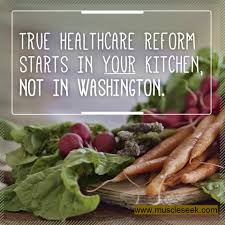
While the policy wonks and economists and legislators and lobbyists convene to come to “yes” on a coherent approach to health reform for America, there is some (literally) low-hanging fruit that will help the nation bend the health cost curve: it’s healthy eating. Last year, the only two stocks on the Dow Jones Index that moved in a positive direction were Walmart and McDonald’s. Both have received bad raps concerning their role in the nation’s diabesity. Surprisingly, McDonald’s ended up on Health magazine’s list of the Top 10 America’s Healthiest Fast Food Restaurants this week. With 14,000 locations, this chain
Of fish oil and back pain – complementary medicine utilization shifts since 2002
The use of complementary and alternative medicine (CAM) by Americans has held steady since 2002; however, the types of therapies adopted have changed over five years. The Use of Complementary and Alternative Medicine in the United States, from the NIH’s National Center for Complementary and Alternative Medicine, follows up the agency’s 2002 report. This round, NCCAM offers more details on the use of CAM in kids, as well as CAM use by demographic factors including racial and ethnic groups. CAM is “Complementary” when used with conventional medicine, and “Alternative” when used as a substitute. The most commonly used CAM
The health impacts of the economic downturn: stress begets illness
Stress due to the economic downturn is causing more of us to be irritable, angry, sleepless, and self-medicating through food. And stress in the workplace is costing business $300 billion a year, according to the American Psychological Association (APA), due to the loss of productivity, absenteeism, turnover and increased medical costs. The APA completed its survey, Stress in America, in August 2008 — more than a month ago, well before yesterday’s biggest stock market fall in 4 years. The APA warns that the levels of stress felt by Americans due to the financial downturn can wreak significant havoc
Walmart, Caterpillar, and growing brand equity in health
George Washington ate and drank here. Now, there’s a Walmart Supercenter in that spot. There’s an important crossroads in my vicinity where four major highways meet; it’s called King of Prussia, which is the intersection of the Schuylkill Expressway (I-76), the Pennsylvania Turnpike, US 422, and US 202. A new Walmart Supercenter opens at this intersection today. Across-the-street from the new Supercenter are Neiman-Marcus, Bloomingdales, and Nordstrom, along with hundreds of other retail chains in the shopping mecca known as the King of Prussia Mall. So Walmart’s on my mind. Walmart has become a sort of touchstone for me
A View from the UK: Is Preventive Care "Worth It?"
I’m enjoying a weekend with London-based friends who travel the world and know what’s what. Today, we spent hours relishing (literally) the Borough Market in Southwark, located south of the Thames. This is London’s oldest food market, established when the Romans built the first London Bridge. The Market in its current state has been around for a quarter of a millenium. The Market boasts and hosts a glorious array of green grocers, bread bakers, Spanish food purveyors, brownie makers, organic tofu purveyors, and parmigiano reggiano vendors in one spot I’ve seen, perhaps ever. It is foodie heaven and a
Health, the New Status Symbol
We’d rather be healthy than wealthy, according to a new survey from Manning Selvage & Lee (MS&L), the PR firm that’s part of the global communications company, Publicis. MS&L polled Americans’ beliefs on health and self-esteem. Three-quarters (72%) of Americans say that being physically healthy is a symbol of personal success. 91% of Americans said they’d rather be described ads “healthy” than “wealthy.” 71% said they’d rather be seen as someone who “looks really healthy” vs. someone who’s nicely “put together or well-dressed.” These will be glad tidings for MS&L’s client base. MS&L serves a global health clientele which includes
The grocery store as health destination
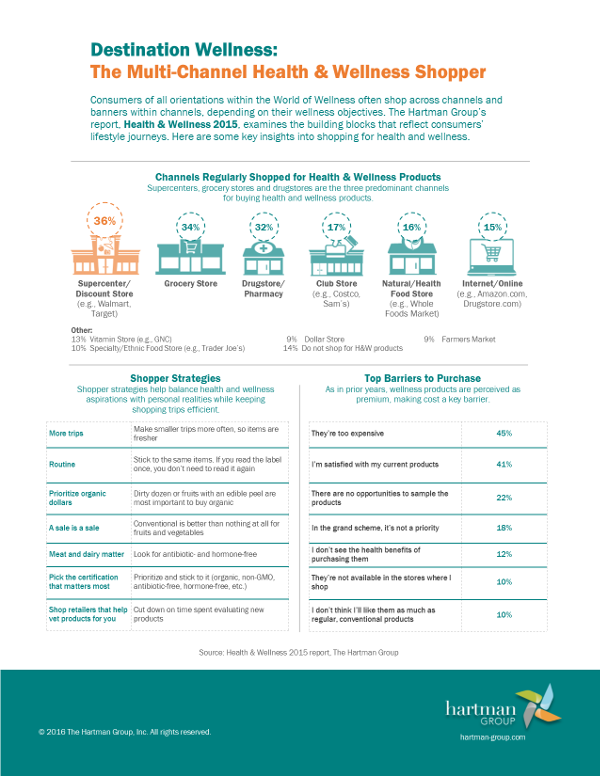
We love new food products, as evidenced by the ever-growing array and permutation of new goodies at our grocery stores. Among those who say new food products are important to them, the top reason why they buy new food products is health. Open your eyes when you’re next grocery shopping and look around you — your favorite grocer is morhping into a health destination. Whole Foods has launched its Whole Body store-within-a-store concept. Wegmans offers their Eat Well Live Well program. Even Wal-Mart, home of the $4 generic drug price-point, has begun to offer organic food based on demand according
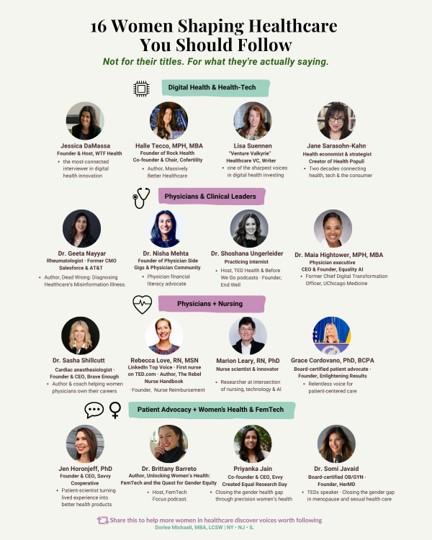 I'm gratified to be named on this updated list of 16 women's voices who are shaping health care. The curator of the list, Dorlee Michaeli, asked the question: "If someone wanted a smarter healthcare LinkedIn feed tomorrow, who should they follow today?" Glad to be one of these voices.
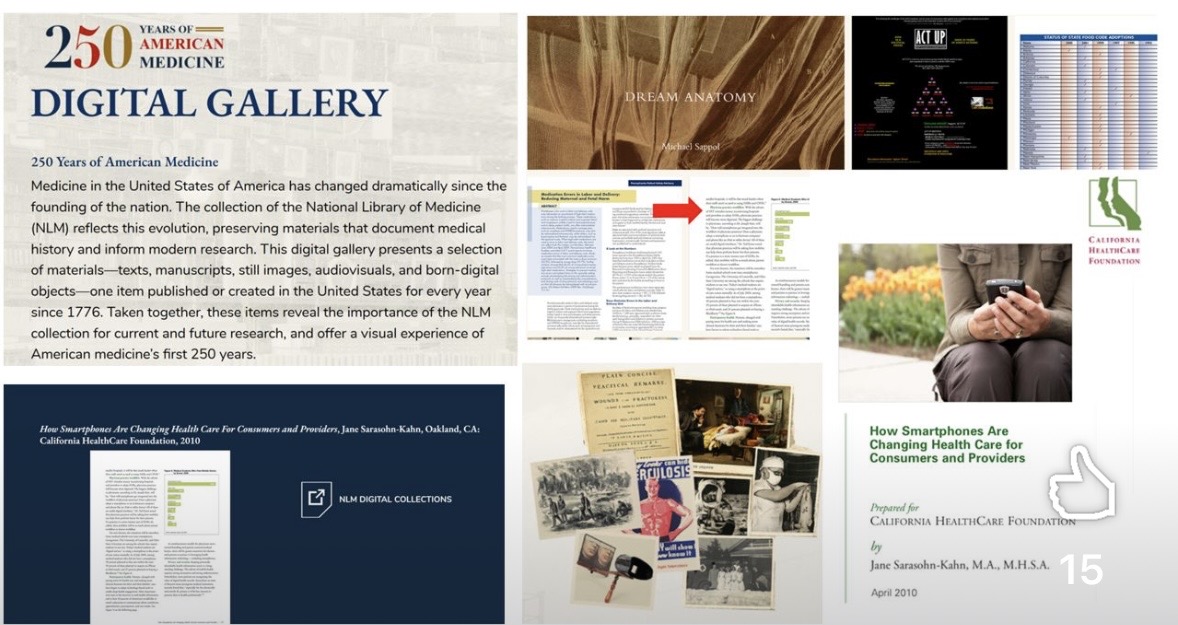 I’m celebrating America’s 250th birthday both patriotically and professionally, honored that the NLM included my 2010 paper, “How Smartphones Are Changing Healthcare for Consumers and Patients” as one of 250 items curated for the digital archive of 250 Years of American Medicine.
 I'm grateful to be part of the Duke Corporate Education faculty, sharing perspectives on the future of health care with health and life science companies. Once again, I'll be brainstorming the future of health care with a cohort of executives working in a global health care enterprise.