


Wellness takes hold among large employers – and more sticks nudge workers toward health
Employee benefits make up one-third of employers’ investments in workers, and companies are looking for positive ROI on that spend. Health benefits are the largest component of that spending, and are a major cost-management focus. In 2012 and beyond, wellness is taking center stage as part of employers’ total benefits strategies. In the 2012 Wellness & Benefits Administration Benchmarking study, a new report from bswift, a benefits administration company, the vast majority of large employers (defined as those with over 500 workers) are sponsoring wellness programs, extending them to dependents as well as active workers. Increasingly, sticks accompany carrots for
Men get more attention in health marketing
As women are generally thought of by marketers as the Chief Health Officers of their families, images of men in health advertising and media have been fewer than their female counterparts. In 1998, Pfizer promoted Viagra through Bob Dole. In 2003, Magic Johnson represented GSK’s HIV treatment Combivir. That same year, Mike Ditka, football coach, hawked Levitra, the ED drug, for GSK. Dr. Robert Jarvik has repped Lipitor (controversially), and Bobby Labonte, a NASCAR driver, endorsed Wellbutrin XL. But since the advent of direct-to-consumer health advertising, there haven’t been as many celebrity men promoting health as there have been women. Now, it’s the
Target gets into the Quantified Self biz: could this be the mainstreaming of self-monitoring?
Target, the beloved retail channel for many design-minded value-conscious consumers, has opted in to mobile health through its purchase of SMARTCOACH mobile health coaching devices. SMARTCOACH is part of a growing category of wearable devices that monitor health behaviors like walking and calories consumed. What differentiates SMARTCOACH is the “coach” element, which provides real-time feedback throughout the day. Most other devices in the market simply track and record data. And it’s feedback loops that more experts say are key to sustaining health behavior change. Target will bring the device into stores for purchase in the fall. Like some other wearable
The U.S. health consumer is health-finance illiterate, and resistant to linking wellness to health plan costs
Two in 3 employees (62%) can’t estimate how much their employers spend on health benefits. Of those who could estimate the number (which is, on average, about $12,000 according to the 2012 Milliman Medical Index), most weren’t very confident in their guess. Some 23% calculated the monthly spend by employers was less than $500 a month — less than 50% the actual contribution. Thus, most U.S. health consumers don’t fully value the amount of cash their employers spend on their health care, according to a poll from the National Business Group on Health, Perceptions of Health Benefits in a Recovering
Growing demand for customer service…from Pharma
1 in 3 online consumers (36%) is interested in receiving customer service from the pharmaceutical industry. In particular, these engaged health consumers want contact, first and foremost, with a clinical expert associated with a pharmaceutical company: namely, a doctor or a nurse. In third place would be a patient advocate representing the pharmaceutical company. During the recording of a podcast this week hosted by Med Ad News‘s managing editor Josh Slatko, featuring Monique Levy, VP of Research at Manhattan Research, Adam Budish, SVP of Sales with Epocrates, and me, Monique mentioned this data point from the latest ePharma Consumer study conducted by
Good Housekeeping features Facebook for health: health social networks go mainstream
Using social networks for health is no longer a pioneering, first-wave adoption activity: Facebook has gone mainstream in health. What’s the indicator that says we’ve hit the tipping point in consumers going Health 2,0, beyond Paging Doctor Google? A story in the July 2012 issue of Good Housekeeping magazine titled, Miracle on Facebook. What’s powerful about this is that articles on health social networks have been largely focused in health IT trade publications, business magazines like Forbes (focusing on sustainbale business modeels) and technology channels such as Fast Company and Wired. Looking at Good Housekeeping’s ad pages, its readership is mostly
Consumer ambivalence about health engagement – will OOP costs nudge us to engage?
In some surveys, U.S. consumers seem primed for health engagement, liking the ability to schedule appointments with doctors online, emailing providers, and having technology at home that monitors their health status. The chart illustrates some of these stats from a 2011 survey by Intuit. However, organizations that develop quality report cards on providers and plans, and developers of mHealth apps, will point out that consumers aren’t rushing to use the quality reports or sustain use of apps: in fact, most downloaded health apps aren’t used after one try, according to PwC’s research. How do we make sense of these different
Converging for health care: how collaborating is breaking down silos to achieve the Triple Aim
On Tuesday, 9 July 2012, health industry stakeholders are convening in Philadelphia for the first CONVERGE conference, seeking to ignite conversation across siloed organizations to solve seemingly intractable problems in health care, together. Why “converge?” Because suppliers, providers, payers, health plans, and consumers have been fragmented for far too long based on arcane incentives that cause the U.S. health system to be stuck in a Rube Goldbergian knot of inefficiency, ineffectiveness and fragmentation of access….not to mention cost increases leading us to devote nearly one-fifth of national GDP on health care at a cost of nearly $3 trillion…and going up.
The selling of a health plan, part two
Calling Don Draper, Donny Deutsch, and the spirit of David Ogilvy: the President needs you. The President must sell the Affordable Care Act to the American people now that Justice Roberts wrote the Supreme Court’s historic 5-4 majority opinion supporting the Act, and especially the individual mandate. He argued for the majority that while the mandate is unconstitutional under the Commerce Clause which would “command people to buy insurance,” he said that the mandate is a de facto tax, as people who would choose to opt out of insurance would have an alternative of paying an IRS fine. Senator Eric
58% of Americans self-rationing health care due to cost
Since the advent of the Great Recession of 2008, more Americans have been splitting pills, postponing needed visits to doctors, skipping dental care, and avoiding recommended medical tests due to the cost of those health care services. Call it health care self-rationing: the Kaiser Family Foundation (KFF) has been tracking this trend for the past several years, and the proportion of American adults rationing health demand is up to 58%. This KFF Health Tracking Poll interviewed 1,218 U.S. adults age 18 and older via landline and cell phone in May 2012. As the chart illustrates, 38% of people are “DIYing” health care
Our social network schizophrenia: how “reluctant individualism” impacts health care
While 2 in 3 U.S. adults are active on social media, we are skeptical about trustworthiness of the content we find there. Welcome to the 13th quarterly Heartland Monitor Poll from Allstate and National Journal, surveying how U.S. adults look at social media, trust, and the political future of the nation. The Poll surveyed, by landline and cell phone, 1,000 U.S. adults over 18 in May 2012. The most common social network used is Facebook, among 51% of U.S. adults, followed by Google+ (28%), Twitter (13%), LinkedIn (12%), Pinterest (6%), and MySpace (5%). While Americans are drawn to using social
Thinking about Dad as Digital “Mom”
What is a Mom, and especially, who is a “Digital Mom?” I’ve been asked to consider this question in a webinar today hosted by Enspektos, who published the report Digging Beneath the Surface: Understanding the Digital Health Mom in May 2012. I wrote my review of that study in Health Populi here on May 15. In today’s webinar, my remarks are couched as “Caveats About the Digital Mom: a multiple persona.” Look at the graphic. On the left, the first persona is a mother with children under 18. Most “mom segmentations” in market research focus on this segment. But what
Investments in wellness will grow in 2013, but social health still a novelty for employers
One-third of employers will increase investments in wellness programs in 2013. Employers look to these programs to reduce health care costs, to create a culture of health, to improve workforce productivity, and to enhance employee engagement. Workers say wellness programs are important in their choice of employer. But while employers and employee chasm agree on that point, there’s a gap between how employers see the programs’ benefits, and how aware (or unaware) employees are. Call this a Wellness Literacy Gap, akin to health literacy and health plan literacy. Over one-half of employers believe employees understand the programs they offer,
Consumer Reports becomes a resource for doctor-shopping
There’s a long-held belief among us long-time health industry analysts that Americans spend more time shopping around for cars and washing machines than for health plans and doctors. Consumer Reports is betting that’s going to change, now that Consumers Union has decided to lend its valuable, trusted brand to developing report cards on physicians, having already rated hospitals and heart surgeons. CR will call their version of the doctor’s report card Patient Experience Ratings. CR has first entered the competitive medical market of Massachusetts, and has unveiled reports on 500 primary care physicians in the state. CR worked with physician survey
Statins, food and a mobile app: Pfizer and Eating Well partner up as generic Lipitor hits the market
On May 23, 2012, Pfizer announced its teaming with EatingWell magazine to launch a mobile app for patients on Lipitor. Eight days later, on May 31, 2012, generic versions of Lipitor will hit the market. Lipitor is the best-selling drug in pharmaceutical history, to-date. Sales of the product top $125 billion. While generic atorvastatin has been available in the U.S. since November 2011 from two manufacturers, low prices for the generic will drop to $10 or less for a month’s supply at the end of May. This is Pfizer’s first foray into a prescription drug-affiliated app. The free mHealth app,
A health plan or a car: health insurance for a family of four exceeds $20K in 2012
The saying goes, “you pays your money and you makes your choice.” In 2012, if you have a bolus of $20,700 to spend, you can choose between a health plan for a family of four, or a sedan for the same family. That’s the calculation from the actuaries at Milliman, whose annual Milliman Medical Index is the go-to analysis on health care costs for a family of four covered by a preferred provider organization plan (PPO). While the 6.9% annual average cost increase is lower than the 7.3% in 2011, it is nonetheless, a record $1,335 real dollar increase at
Social media in health help (more) people take on the role of health consumer
One in 3 Americans uses social media for health discussions. Health is increasingly social, and PwC has published the latest data on the phenomenon in their report, Social media ‘likes’ healthcare: from marketing to social business, published this week. PwC polled 1,060 U.S. adults in February 2012 to learn their social media habits tied to health. Among all health consumers, the most common use of social media in health is to access health-related consumer reviews of medications or treatments, hospitals, providers, and insurance plans, as shown in the graph. Social media enables people to be better health “consumers” by giving them peers’
Leverage the American DIY attitude for health
As I leave Asia, where I’ve been for the past two weeks, for the U.S. today, I am reading the daily newspaper, the Korea Joongang News. On today’s op-Ed age is The Fountain column titled, Embracing the do-it-yourself attitude. In it, Lee Na-ree writes, “Making something with your own hands is part of the American pioneer spirit.” He describes the Maker Faire events and the project of Caine’s Arcade, a game developed by a Los Angeles boy who used auto parts from his dad’s shop. Na-ree observes that Americans are ‘regretting’ mass consumption. Health Populi’s Hot Points: I happened upon
$12 water and $10 premium increases: how price elasticity is contextual in health and life
A $10 increase in a health plan premium drove up to 3% of retired University of Michigan employees to leave the plan, according to a study from U-M published in Health Economics, The Price Sensitivity of Medicare Beneficiaries. The U-M researchers analyzed the behaviors of 3,182 retirees over four years, to assess the impact of price on beneficiaries’ health plan choices. During the four years, the premium contribution for retirees increased significantly. The researchers conducted this study, in part, to anticipate how Americans will respond to health insurance exchanges in 2014 as they bring health plan information to the market
Right-sizing food and healthcare
In our fast-texting, quick-thinking, Blink-ing society, Jason Riis talks about slowing down our relationship with food. At the Edelman Wellness Ignited meet-up on March 26, 2012, Jason riffed on food intervention and economics for healthy eating. Jason is a professor at Harvard Business School and among his many research interests is how to change culture to morph away from obesity and Type 2 diabetes toward health. The U.S. is a shopping nation: retail is destination, fun, entertaining, life, for millions of Americans. Jason’s asking what retailers can do about fast and food. This isn’t only about ‘fast food,’ which, of course,
Wellness Ignited! Edelman panel talks about how to build a health culture in the U.S.
Dr. Andrew Weil, the iconic guru of all-things-health, was joined by a panel of health stakeholders at this morning’s Edelman salon discussing Wellness Ignited – Now and Next. Representatives from the American Heart Association, Columbia University, Walgreens, Google, Harvard Business School, and urban media mavens Quincy Jones III and Shawn Ullman, who lead Feel Rich, a health media organization, were joined by Nancy Turett, Edelman’s Chief Strategist of Health & Society, in the mix. Each participant offered a statement about what they do related to health and wellness, encapsulating a trend identified by Jennifer Pfahler, EVP of Edelman. Trend 1: Integrative
Wellness and the global health citizen – carrying our own doctors, inside
Every patient carries her or his doctor inside, said the great Renaissance man, Albert Schweitzer. Based on Euro RSCG Worldwide’s Prosumer Report – My Body, Myself, Our Problem: Health and Wellness in Modern Times, health citizens globally have begun to take on Dr. Schweitzer’s vision. Clement Boisseau of Euro RSCG points out that people, globally, are fairly schizophrenic when it comes to thinking about empowerment over illness: check out the chart for perceptions by condition and disease state. Boisseau says that people perceive health today both in modern terms (such as feeling empowered to control some conditions), and archaic or “magically
Food = health: JWT foodspotting
35% of consumers who have been altering their food intake to lose weight are eating fewer processed foods, according to a recent Nielsen Global Survey. This percentage has grown from 29% in 2008. Health and wellness is one of three driving forces shaping food in 2012, according to JWT‘s What’s Cooking: Trends in Food. The other two forces, technology and foodie culture, combine with health/wellness and yield some interesting consumer trends in the milieu of food. JWT’s top food issues to watch are: – Fooducate – Nutrition scores – Fat taxes – Health and fresh vending machines – Gluten-free –
The digital future in focus, according to comScore: health grew fastest in 2011
comScore has issued its annual report on the state of the American digital consumer in U.S. Digital Future in Focus 2012 and the topline is that mobile and Facebook are redefining communication in both the digital and physical worlds. This disruptive phenomenon has transformational implications for health and health care. comScore’s macro observations are that: – Social networking, and especially Facebook, is capturing a growing proportion of online users’ time, thus redefining how brands and organizations must interact with customers offline and on-. – Google remains the search leader but Bing has grown, surpassing Yahoo! as #2 in 2011. –
Moving from operational efficiency to personalized healthcare value – IBM on redefining success in healthcare
A health system that’s built to last: this is the latest sound-bite echoing through health policy circles. The theme of sustainability is permeating all matters of policy, from education and business to health care. Enter IBM, with a rigorous approach to Redefining Value and Success in Healthcare: Charting the path to the future, from the group’s Healthcare and Life Sciences thinkers. What’s inspiring about this report is the team’s integrative thinking, bridging the relationship between operational effectiveness built on a robust information infrastructure that enables team-based care (the “collaboration” aspect in the middle of the pyramid), which then drive personalized healthcare
From volume to value: how health execs see the future of health care
Transparency and authenticity, constant and clear communication, and a drive toward value underpin the future health system — for those health leaders who can commit to these pillars of transformational change. Leading Through Transformation: Top Healthcare CEOs’ Perspectives on the Future of Healthcare summarizes the interaction among 17 health execs who convened at the second CEO Forum held by Huron Healthcare Group. The report was released in January 2012. Health leaders concur that regardless of the politics of the Affordable Care Act and its prospects for whole or partial survival beyond November 2012, market pressures in the health sector are driving
On the road to retail health: healthcareDIY and primary care, everywhere
At the ConvUrgent Care Symposium in Orlando, attendees from the worlds of clinics, ambulatory care, hospital beds, pharmacies, medical devices, life sciences, health information, health IT, health plans, academic medical centers and professional medical societies came together to share and learn about the morphing landscape of retail health. The topline message: primary care is everywhere, and based on the response to my keynote talk this morning, every stakeholder segment gets it. My mantra, courtesy of the U.S. Surgeon General Regina Benjamin: don’t look at health in isolation, that is, where the doctor and hospital are. Health happens wherever the person
The Trust Deficit – what does it mean for health care?
Technology, autos, food and consumer products — two-thirds of people around the globe trust these four industries the most. The least trusted sectors are media, banks and financial services. Welcome to the twelfth annual poll of the 2012 Edelman Trust Barometer, gauging global citizens’ perspectives on institutions and their trustworthiness. This survey marks the largest decline in trust in government in the 12 years the Barometer has polled peoples’ views. Interestingly, trust in government among US citizens stayed stable. The top-line finds a huge drop in global citizens’ trust in government, with a smaller decline for business. There’s an interplay
help comes to health care: well-designed front-of-pharmacy DIY health products
Less is more when it comes to health care utilization and outcomes. The U.S. allocates too many resources to a huge line item of waste in the health system – administrative (in terms of too many paper processes and staff to deal with them) and clinically (especially involving duplicated tests and ineffective treatments that aren’t based on evidence based medicine). “Take less” is the tagline of the company called help which is found at the URL http://www.helpineedhelp.com/. This is a consumer-facing over-the-counter drug supplier. Their product line counts 7 mature products each packaged with the health complaint they target: “Help,” I have
Connected Health and obesity – will mObesity be able to mitigate the epidemic?
It’s January and the #1 most popular post-New Year’s resolution is to lose weight, get fit, and live well. The signs of this are manifested in ads featuring Janet Jackson promoting Nutrisystem, Jennifer Hudson dueting with her then-and-now selves pitching Weight Watchers, as well as the new Weight Watchers for Men promotion starring Charles Barkley. But there are new signs that losing weight and getting fit are going beyond “diets” and food plans: research shows that moving around and getting exercise can help people sustain hard-earned weight loss more than just changing food intake and “dieting.” So the Apple store
Consumers are at the center of the business of health and wellness
The market for health and wellness has traditionally included over-the-counter medicines, gym memberships, and vitamins/minerals/supplements. In 2012, the boundaries of health/wellness are blurring beyond these line items toward preventive medical services and consumer electronics. This morphing market is discussed by Cambridge Consultants in their report on the disruptions driving The Business of Health & Wellness: Engaging consumers and making money. Cambridge correctly introduces this analysis by saying that economics, the growing prevalence of chronic diseases, an aging population, and demand consumers are shaping health/wellness, “recharacterizing” the market as one driven by “life events.” Cambridge sees that health consumers are changing their spending
What’s baked into the Affordable Care Act? Half of Americans still don’t realize there’s no-cost preventive care
The U.S. public’s views on health reform — the Affordable Care Act (ACT) – remain fairly negative, although the percent of people feeling favorably toward it increased from 34% to 37% between October and November. Still, that represents a low from the 50% who favored the law back in July 2010. It’s quite possible that American health citizens’ views on health reform are largely reflective of their more general feelings about the direction of the country and what’s going on in Washington right now, versus what’s specifically embodied in the health care law, according to the November 2011 Kaiser Health
Employers aren’t engaging with patient/health engagement
The vast majority of employers who sponsor health benefits look at those benefits as part of a larger organization culture of health. While one-third are adopting value-based health plan strategies — doubling from 16% in 2010 to 37% in 2011 — only 3% of employers are taking an integrated view of value-based benefits and corporate wellness. This is the second year for the International Foundation of Employee Benefit Plans (IFEBP) and Pfizer to examine employers’ approaches to value-based health care (VBHC). As explained by Michael Porter, the guru on health value chains, value in health care focuses on the patient at
Why a Foundation and the Federal Reserve are working together to improve health in the U.S.
Health philanthropies are about more than making grants. The Robert Wood Johnson Association, among the largest health philanthropic organizations in the world, is partnering with the Federal Reserve Bank (the Fed) on how community development impacts health — and vice versa. You cannot have a healthy community without focusing on housing, schools, and other neighborhood stakeholders, Dr. Risa Lavizzo-Mourey told the conference on Healthy Communities: Building Systems to Integrate Community Development and Health. In this context, Dr. Lavizzo-Mourey quoted Robert Kennedy who said, “The gross national product does not allow for the health of our children, the quality of their education, or
Primary care, everywhere: how the shortage of PCPs is driving innovation – especially for patient participation in their own care
The signs of the primary care crisis in America are visible: A growing number of visits to the emergency room for treating commonplace ailments Waiting lists for signing up with and queuing lines to see primary care doctors Fewer med students entering primary care disciplines Maldistribution of primary care practitioners (PCPs) in underserved areas, rural, exurban and urban. The implementation of the Affordable Care Act will (try to) enroll at least 30 million newly-insured health citizens into the U.S. health system. That’s the objective: whether being insured will actually provide people access to needed primary care is a big question given the current supply of
Every picture tells a story, and nowhere more important than in health
A picture’s not only worth the proverbial thousand words, but can save a life. So can a t-shirt…er, TeachShirt. At the Unniched meeting held on 25 October 2011 in NYC, I spent a few minutes talking with two members of Zemoga‘s brain trust: Sven Larsen, Chief Marketing Office, and the firm’s Principal Design guru, Dan Licht. We discussed how design is so critical a factor in health, and in life — particularly, in DIY health, where we are all taking on more responsibility for our own health care — clinical, financial, mental, social. Among Zemoga’s colorful and uber-creative portfolio is its concept, the
Tech fast forward families are ripe for health care self-care
Kids lead their parents in the adoption of digital technologies; that’s why the youngers are called Digital Natives. An intriguing survey of adults’ use of technologies finds that those who do so like “childlike play,” and at the same time, for kids, make them feel more grown up. The trend, Ogilvy says, is blurring generational lines: market to adults as kids, and kids as adults. This convergence is leading families to become more “units” — parents and kids increasingly on the same page in purchase decisions. In Tech Fast Forward: Plug in to see the brighter side of life, from
The economy’s impact on personal health: shopping and social
The recessionary, sluggish U.S. economy has had an impact on Americans’ mental and physical health. The least healthy citizens have experienced a disproportionately hard hit on their health and health care. But necessity being the mother of invention, some people are re-inventing their personal workflows in health care — and many of these tactics may well benefit their health in the long run. The Economy and Health: 10 Observations is the analysis from Euro RSCG‘s survey of U.S. adults’ views on their personal health in light of the continued economic downturn. The first chart shows the economy’s impact on the overall mood of
Physicians won’t be celebrating Independence Day, at least when it comes to their practices
Doctors won’t be celebrating Independence Day on July 4th — at least when it comes to their professional practices. The days of the cottage industry physician are dwindling as more doctors are losing their independence, instead opting for employment. There are several reasons for physicians’ exodus from private practice: these include increasing administrative burdens, economies of scale for adopting information and communications technology, security in uncertain futures around reimbursement, and that all-important work-life balance. Accenture points out these trends in a summary report, Clinical Transformation: Dramatic Changes as Physician Employment Grows. Accenture sees benefits accruing to health systems acquiring physician
Botox over preventive health: health consumers have spoken, delaying diagnoses
Americans are opting for Botox and cosmetic procedures more than colonoscopies and cancer tests, according to a story in Reuters. This trend makes companies like Allergan, makers of Botox and the Lap-Band for gastric surgery, very happy indeed. Plastics and gastric bypass surgeries are back up to pre-recession levels as of 2Q11. However, for companies and providers in other segments of the health care and surgery value-chain, prospects for bounceback in 2011 aren’t as promising. Various indices on consumers’ health care sentiment — such as the Thomson-Reuters Consumer Healthcare Sentiment Index and the EBRI Health Confidence Survey, show U.S. consumers’ perceptions of their ability to
Brand “Health:” where is it in the Top 100 most valuable brands?
Apple has supplanted Google as the world’s #1 most valuable brand, worth more brand-wise than Microsoft and Coca-Cola combined (#5 and #6). the other most valuable global brands are IBM, McDonalds, AT&T, Marlboro, China Mobile, and GE. Technology brands have significantly grown in value with consumers allocating more personal disposable income to products like tablet computers and smartphones, even in the face of recessionary economics the world over. Technology companies are now 1/3 of the top 100 brands. Millward Brown, the brand consultancy that is part of WPP, the global communications firm, has conducted the BrandZ top 100 most valuable
Bye-bye, Ward & June Cleaver; Hello, multi-cultural, digital-happy family
“Ward and June Cleaver have left the building,” observe analysts at Nielsen. “The white, two-parent, ‘Leave it to Beaver’ family unit of the 1950s has evolved into a multi-layered, multi-cultural construct dominated by older, childless households,” starts a report from The Nielsen Company, The New Digital American Family. Whatever ethnic flavor this Digital Family may represent, there’s one equalizer across all of them: the smartphone, which is owned by households across cultures and income levels. First, the socio-demographics paint a picture of increasingly multi-cultural households. Recent immigrants to the U.S. accounted for 90% of population growth from 2000-2010, over-indexing for Hispanic and
Welcome Migraine.com to the health care community
About 1 in 10 people in the U.S. suffer from migraine headaches. The direct cost to business for medical care and wage replacement is over $1 bn, but this underestimates the total economic impact of lost productivity to the economy and personal lives (for more on whole-health costs, read yesterday’s Health Populi, Lost Costs: Lost Productivity Represents One-Half of Health Costs for U.S. Employers). There are actually 14 kinds of headaches, as classified by the International Headache Society (IHS). Among these, there are four primary headache types: migraine, tension-type headaches, cluster headaches and trigeminal autonomic cephalagias, and a fourth
Listening in on patient-physician conversations – consumers don’t talk so much about branded drugs
What happens when a company becomes a proverbial fly on the wall in the physician’s exam room as she’s meeting with patients? Real-life insights into what health consumers ask for, and how they converse with doctors — neither of which match up to a pharma marketer’s dream (or business objective) of motivating consumers to ask their physicians to describe specific brands of drugs. Bloomberg/Business Week published a story online on November 4, 2009, which talks about Verilogue, a company that has recorded thousands of conversations between physicians and patients in different U.S. geographies and across a broad range of medical specialties. What Verilogue found through
Trust in hospitals highest over all health industry groups; pharma flat, and health plans rank lowest
Americans trust their supermarkets and local hospitals more than other industries they deal with. while tobacco and oil companies remain at the bottom of the trust-list for U.S. consumers, health insurance and managed care aren’t much ahead of them. Pharmaceutical companies rank fairly low, with only 11% of U.S. adults seeing them as “honest and trustworthy.” As a result, nearly one-half of Americans would like to see increased regulation on pharma. Over 1 in 3 Americans would like to see managed care and health insurance companies more regulated. The latest Harris Poll has found that oil, pharmaceutical, health insurance and tobacco are
Trust and authenticity are the enablers of health engagement
Without trust, health consumers won’t engage with organizations who want to cure them, sell to them, promote to them, help them. Here’s what I told a group of pharmaceutical marketers at The DTC Annual Conference in Washington , DC, on April 9, 2010. Let’s start with the World Health Organization’s definition of health: that is, the state of complete physical, mental and social wellbeing, and not just the absence of disease. This definition is being embraced by health citizens long before the silos in the health industry – including pharma – get it. That’s an important mindset to take on as
Nearly 1 in 2 women delayed health care in the past year due to costs – the economic impact on a woman’s physical, emotional, and fiscal health
Nearly 1 in 2 women put off seeking health care because the cost was too high. The kinds of services delayed included visits to the doctor, medical procedures, and filling prescription medications. The fourth annual T.A.L.K. Survey was released this week by the National Women’s Health Resource Center (NWHRC), focusing on the declining economy and its impact on women and three dimensions of their health — physical, emotional, and fiscal. 40% of women say that their health has worsened in the past five years due to increasing stress and gaining weight, according to the survey. One of the most interesting
Health care ratings games
Most Americans believe there are fair and reliable ways to gauge the quality of health care. 9 in 10 Americans are interested in their health plans having a website where you can rate doctors on issues like trust, communications, medical knowledge, availability and office environment – and participating on such social networks (THINK: The Health CAre Scoop or Zagat/WellPoint). The latest Wall Street Journal/HarrisInteractive survey published March 25 finds that 3 in 4 consumers favor patient satisfaction surveys – once again asserting they value opinions from peers (aka “people like me”) even more than those coming from institutions, whether private
The Future of Retail – Implications for Health
I’ve been looking at health care through a retail lens for some time. Perhaps it’s that I’m a rag trader’s daughter, or that I’ve been known to like shopping, that I have clients in consumer goods, or that I understand how tiered drug pricing impacts the consumption of medicines (answer: it’s all of the above). I’ve just reviewed the latest trend report from PricewaterhouseCoopers and TNS Retail Forward on the future of retailing. My mind is connecting the dots between the future of retail and the American health care consumer. Four future retail trends are already embedding in health care
My Magazine, My Health Portal
U.S. News and World Report is well-known for its Top 100 “best” lists assessing hospitals, doctors, and health plans. Watch for it to further build its position as consumer health information provider for Americans by expanding into a comprehensive health portal online. U.S. News published this cover in November 2004. So the magazine is no newcomer to this role. However, the publication and its editors (and savvy financial management) recognize the opportunity to exploit their brand position in the consumer health information space. This isn’t just about arming Americans with health information to be ‘smart.’ This is a smart move
 Jane will be working with EU- and UK-based clients in September and October 2026, collaborating with stakeholders in digital health, public/community health, retail health, and growing opportunities for health-at-home. Stay tuned to her updates here on Health Populi on-the-ground as she lives the digital nomadic work-life in Italy, Belgium, the Netherlands, and in London.
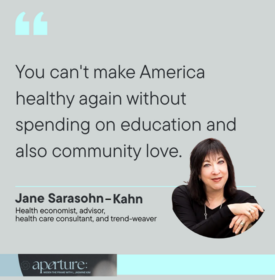 I was grateful to be Jasmine's first conversation-guest on her new podcast, "Aperture - Widen the Frame," where this expert in narrative medicine is bringing together the broad range of voices to sit at the table and address what health care needs: those humans in the health-system-loop who address health equity and empathy along with delivering evidence-based medicine for all.
 Jane joined host Dr. Geeta "Dr. G" Nayyar and colleagues to brainstorm the value of vaccines for public and individual health in this challenging environment for health literacy, health politics, and health citizen grievance. Click onto the Pfizer Value of Vaccines site and you can watch four episodes covering the challenges with adult vaccination, the employer and health plan member's journey to vaccination, reimbursement, and collaborating for proactive prevention.