


U.S. Health Costs vs. The World: Is It Still The Prices, and Are We Still Stupid?
Comparing health care prices in the U.S. with those in other developed countries is an exercise in sticker shock. The cost of a hospital day in the U.S. was, on average, $4,287 in 2012. It was $853 in France, a nation often lauded for its excellent health system and patient outcomes but with a health system that’s financially strapped. A routine office visit to a doctor cost an average of $95 in the U.S. in 2012. The same visit was priced at $30 in Canada and $30 in France, as well. A hip replacement cost $40,364 on average in the
The Not-So-Affordable Care Act? Cost-squeezed Americans still confused and need to know more
While health care cost growth has slowed nationally, most Americans feel they’re going up faster than usual. 1 in 3 people believe their own health costs have gone up faster than usual, and 1 in 4 feel they’re going out about “the same amount” as usual. For only one-third, health costs feel like they’re staying even. As the second quarter of 2013 begins and the implementation of the Affordable Care Act (ACA, aka “health reform” and “Obamacare”) looms nearer, most Americans still don’t understand how the ACA will impact them. Most Americans (57%) believe the law will create a government-run health plan,
Arianna and Lupe and Deepak and Sanjay – will the cool factor drive mobile health adoption?
Digital health is attracting the likes of Bill Clinton, Lupe Fiasco, Deepak Chopra, Dr. Sanjay Gupta, Arianna Huffington, and numerous famous athletes who rep a growing array of activity trackers, wearable sensors, and mobile health apps. Will this diverse cadre of popular celebs drive consumer adoption of mobile health? Can a “cool factor” motivate people to try out mobile health tools that, over time, help people sustain healthy behaviors? Mobile and digital health is a fast-growing, good-news segment in the U.S. macroeconomy. The industry attracted more venture capital in 2012 than other health sectors, based on Rock Health’s analysis of the year-in-review. Digital health
Gettin’ higi with it: Lupe Fiasco’s foray into public health
The latest in SoLoMo (Social, Local, Mobile) Health is a gamified tool coupled with a hardware kiosk, known as higi. The brainchild of Michael Ferro, a successful dotcom entrepreneur who now owns the Chicago Sun-Times, higi’s mission is to help people – particularly younger peeps – to take better care of themselves by scoring points and, as a result, social connections. Higi’s an African word for origin, so the health tool has some aspects relating to being in a tribe — a kind of health tribe. It also has a fun sound to it, Ferro noted, which sets the vibe
Bill Clinton’s public health, cost-bending message thrills health IT folks at HIMSS
In 2010, the folks who supported health care reform were massacred by the polls, Bill Clinton told a rapt audience of thousands at HIMSS13 yesterday. In 2012, the folks who were against health care reform were similarly rejected. President Clinton gave the keynote speech at the annual HIMSS conference on March 6, 2013, and by the spillover, standing-room-only crowd in the largest hall at the New Orleans Convention Center, Clinton was a rock star. Proof: with still nearly an hour to go before his 1 pm speech, the auditorium was already full with only a few seats left in the
A health economics lesson from Jonathan Bush, at the helm of athenahealth
At HIMSS13 there are the equivalent of rock stars. Some of these are health system CIOs and health IT gurus who are driving significant and positive changes in their organizations, like Blackford Middleton, Keith Boone, Brian Ahier, and John Halamka. Others are C-level execs at health IT companies. In this latter group, many avoid the paparazzi (read: health trade reporters) and stay cocooned behind closed doors in two-story pieces of posh real estate on the exhibition floor. A few walk the floor, shake hands with folks, and take in the vibe of the event. We’ll call them open-source personalities. The
Health is wealth and wealth, health
It’s America Saves Week (February 25-March 2, 2013). Do you know what your savings rate is? If you’re in the center of the American savings bell curve, you probably don’t have a savings plan with specific goals and don’t know your net worth. Two-thirds of U.S. adults say they have sufficient emergency savings for unexpected expenses like a visit to a doctor. However, only one-half of non-retired people believe they’re saving enough for a retirement where they’ll have a “desirable standard of living.” This six annual survey by the Consumer Federation of America, the American Savings Education Council, and the
Required reading: TIME Magazine’s Bitter Pill Cover Story
Today’s Health Populi is devoted to Steven Brill and his colleagues at TIME magazine whose special report, Bitter Pill: Why Medical Bills Are Killing Us, is required reading for every health citizen in the United States. Among many lightbulb moments for readers, key findings from the piece are: Local hospitals are beloved charities to people who live in their market – Brill calls these institutions “Non-Profit Profitmakers). They’re the single most politically powerful player in most Congressional districts The poor and less affluent more often pay the high chargemaster (“retail list”) price for health products and services vs. the wealthy
Living paycheck to paycheck: what it means for health
While 50% of Americans feel they have a sound financial position, the other half is living paycheck to paycheck. 8% say they can’t even pay for essentials. The second annual Allstate “Life Tracks” Poll finds American adults split between have’s and have not’s, with even the “have’s” feeling less than financially literate. There is an equal split between people who feel they’re in an “excellent” or “good” financial position compared with those who feel they’re in financially “fair” or “poor” shape. Men feel more financially secure than women; 3 in 4 single parents feel less well-off compared to the average
Health care cost illiteracy: consumers feel the pinch of growing costs, but don’t understand the “why?”
Health care costs for workers lucky enough to receive health insurance at work nearly doubled since 2002. Wages in that decade grew by 33%. This growing affordability gap between health costs vs. wages is shown in the chart. Health consumers in America sharply perceive this gap, according to an analysis of eight focus groups, Consumer Attitudes on Health Care Costs: Insights from Focus Groups in Four U.S. Cities from the Robert Wood Johnson Foundation. To health-covered workers, though, health care “costs” are defined as out-of-pocket health spending for insurance premiums, co-payments and deductibles that come out of paychecks and pocketbooks — not
Health and consumer spending may be flat, but consumers hard hit due to wage stagnation & self-rationing
There’s good news on the macro-health economics front: the growth rate in national health spending in the U.S. fell in 2011, according to an analysis published in Health Affairs January 2013 issue. Furthermore, this study found that consumers’ spending on health has fallen to 27.7% of health spending, down from 32% in 2000, based on three spending categories: 1. Insurance premiums through the workplace or self-paid 2. Out-of-pocket deductibles and co-pays 3. Medicare payroll taxes. A key factor driving down health spending is the growth of generic drug substitution for more expensive Rx brands. Generics now comprise 80% of prescribed
We are all health deputies in the #digitalhealth era: live from the 2013 Consumer Electronic Show
Reed Tuckson of UnitedHealthGroup was the first panelist to speak at the kickoff of the Digital Health Summit, the fastest-growing aspct of the 2013 Consumer Electronics Show (#2013CES). Tuckson implored the spillover audience to all, “self-deputize as national service agents in health,” recognizing that technology developers in the room at this show that’s focused on developers building Shiny New Digital Things have much to bring to health. As Andrew Thompson of Proteus Medical (the “invisible pill” company) said, “we can’t bend the health care cost curve; we have to break it.” This pioneering panel was all about offering new-new technologies
New Year’s Resolutions for health, and the 2013 Consumer Electronics Show
When it comes to taking on personal responsibility, the #1 New Year’s Resolution is to engage in fitness and exercise, cited by 43% of U.S. adults, followed by healthy eating, noted by 37% of people. Other resolutions involving personal responsibility are Family (26%) Spirituality and faith (22%) Managing personal finances (22%. This survey was undertaken as part of Liberty Mutual’s The Responsibility Project (RP), which is taglined: “Explore what it means to do the right thing.” Launched in 2008, Liberty Mutual’s RP has been diving into the many aspects of daily living for which we, each of us, could take responsibility…including
Call them hidden, direct or discretionary, health care costs are a growing burden on U.S. consumers
Estimates on health spending in the U.S. are under-valued, according to The hidden costs of U.S. health care: Consumer discretionary health care spending, an analysis by Deloitte’s Center for Health Solutions. Health spending in the U.S. is aggregated in the National Health Expenditure Accounts (NHEA), assembled by the Department of Health and Human Services (DHHS) Centers for Medicare and Medicaid Services (CMS). In 2010, the NHEA calculated that $2.6 trillion were spent on health care based on the categories they “count” for health spending. These line items include: Hospital care Professional services (doctors, ambulatory care, lab services) Dental services Residential
Americans’ top financial concerns are money for retirement and health care
It’s the morning after the historic 2012 Presidential Election, with President Barack Obama winning a second term in the face of a sputtering economy and eventual Fiscal Cliff as of December 31, 2012. As we toast with our beverage of choice that night, we will also be worrying about our top financial concerns: how we’ll fund our retirements, and how we’ll pay for health care eventually, and now while we’re actively employed. The Harris Poll of November 5, 2012, reveals that 3 in 4 people in the U.S. who aren’t yet retired worry they won’t have enough money to slow
What’s on senior Americans’ minds? Medicare and money
What’s keeping seniors up at night when it comes to retirement? #1, according to 6 in 10 seniors, is the future of Medicare, followed by having enough money to enjoy retirement. In particular, 61% of seniors are concerned about future out-of-pocket health care costs. It’s all about Medicare and money for U.S. seniors, found in the Allsup Medicare Advisor Seniors Survey, Medicare Planning and Trends Among Seniors, published in October 2012. Medicare could be the most beloved government program ever, as 89% of seniors say they’re satisfied with Medicare coverage. Given the program’s shaky financial future, Allsup wanted to get
Wired health: living by numbers – a review of the event
Wired magazine, longtime evangelist for all-things-tech, has played a growing role in serving up health-tech content over the past several years, especially through the work of Thomas Goetz. This month, Wired featured an informative section on living by numbers — the theme of a new Wired conference held 15-16 October 2012 in New York City. This feels like the week of digital health on the east coast of the U.S.: several major meetings have convened that highlight the role of technology — especially, the Internet, mobile platforms, and Big Data — on health. Among the meetings were the NYeC Digital Health conference, Digital
From fragmentation and sensors to health care in your pocket – Health 2.0, Day 1
The first day of the Health 2.0 Conference in San Francisco kicked off with a video illustrating the global reach of the Health 2.0 concept, from NY and Boston to Mumbai, Madrid, London, Tokyo and other points abroad. Technology is making the health world flatter and smarter…and sometimes, increasing problematic fragmentation, which is a theme that kept pinching me through the first day’s discussions and demonstrations. Joe Flowers, health futurist, offered a cogent, crisp forecast in the morning, noting that health care is changing, undergoing fundamental economic changes that change everything about it. These are driving us to what may
3 in 5 physicians would quit today if they could
Being a doctor isn’t a happy profession in 2012: 3 in 5 doctors say that, if they could, they’d retire this year. Over three-fourths of physicians are pessimistic about the future of their profession. 84% of doctors feel that the medical profession is in decline. And, over 1 in 3 doctors would choose a different professional if they had it all to do over again. The Physicians Foundation, a nonprofit organization that represents the interests of doctors, sent a survey to 630,000 physicians — every physician in the U.S. that’s registered with the AMA’s Physician Master File — in March-June
Aging in the US – seniors are health-confident, less financially so
Most seniors look forward to aging in place, and are confident in their ability to do so. Such is the top-line feel-good finding from the National Council on Aging‘s (NCOA) survey, The United States of Aging, sponsored by USA Today and United Healthcare. A majority of seniors have a sense of purpose and plans for their future. Three-fourths of older Americans say staying physically fit through exercise and proactively managing their health is important. However, only 36% of seniors say they exercise or engage in physical activity every day. 11% never do. The most common chronic conditions noted by seniors
Physicians not doing so well – financially, socially, physically – and what it means for health reform
Physicians’ wellbeing dropped in July: while providers’ mental health stayed sound since June, it’s financial, physical and social health that’s dragging providers’ overall wellness down. QuantiaMD, the social network exclusively for doctors, launched the Physician Wellbeing Index in January 2012. The Index measures four aspects of physician-reported wellbeing: physical, mental, financial, and social health. QuantiaMD says it’s the world’s only measure of “how physicians are doing as people.” Based on the Index, QuantiaMD tailors content to meet the needs of the physicians in the social network. In July, the chart illustrates that doctors’ wellbeing slipped in 3 of the 4
Why Fidelity Investments is talking health care in a YouTube video
I tore out a two-page ad from the June 17, 2012, New York Times Magazine sponsored by Fidelity Investments with the headline, “Your genetic secrets may not be a secret much longer…and we see opportunity.” The ad copy went on to talk about the emerging era of personalized medicine and big data to help patients…and to be an investment growth area. Fidelity has launched a video online as part of its ThinkingBig series at Fidelity.com/thinkingbig which talk about this complex issue. Fidelity is onto something big here. In the first iteration of the Edelman Health Barometer survey, launched in 2008, we
HealthcareDIY – from employee wellness incentives to #retailhealth, #pharmacy, & #CDHP
Most U.S. companies will increase the dollar value of health incentives offered to workers in 2012, based on the annual survey from Fidelity Investments and the National Business Group on Health addressing employers’ plans for health benefits. 3 in 4 employers used incentives in 2011 to engage employees in wellness programs, with an average incentive value of $460. This number was $260 in 2009. The poll found that employers expect employees to improve their personal health, and will increasingly ration access to benefits based on employees’ engagement with health criteria. Employers’ approaches to incentives have begun to adopt value-based benefit design strategies that
Trust and authenticity are the enablers of health engagement
Without trust, health consumers won’t engage with organizations who want to cure them, sell to them, promote to them, help them. Here’s what I told a group of pharmaceutical marketers at The DTC Annual Conference in Washington , DC, on April 9, 2010. Let’s start with the World Health Organization’s definition of health: that is, the state of complete physical, mental and social wellbeing, and not just the absence of disease. This definition is being embraced by health citizens long before the silos in the health industry – including pharma – get it. That’s an important mindset to take on as
Health, love and saving money in the recession – insights from ING Direct
Americans love their cars, their houses, and their food. Based on a survey by ING Direct, the financial services company, these are the last 3 things we would sacrifice to save money. On the other hand, the most dispensable things for Americans include day care/nannies, cleaning services, education, and gifts. Women would be more likely to sacrifice health and fitness than men in the U.S. The ING survey compares the U.S. with eight other nations including Australia, Austria, Canada, France, Germany, Italy, Spain, and the United Kingdom. Health and fitness appear more highly valued by people in France and Spain;
Demand for health products and services is down in the recession; thinking about value and self-care in health
What is value in health care? Every year we spend more and seem to get less, John Seng, Founder of Spectrum, told attendees of a webinar on the Spectrum Health Value Study on 12th May 2009. As we consumers spend more of our own money, we’ll be looking for greater value and “health ROI” from our health spending. Measuring value across a population is confounded by the fact that what one person decides to spend on ‘health’ can be different from another’s health spending choices. In other words, our personal health “marketbaskets” for health spending vary from person to person.
From the fiscal to the physical: insured workers try to lower their medical costs
This is open enrollment season for those workers fortunate enough to (1) still be employed and (2) still be offered a health benefit. It’s also the season of economic decline. According to Watson Wyatt, these workers are making different health and benefit decisions in this fiscally-constrained era. Watson Wyatt has released its 2008 version of the report, Employee Perspective on Health Care. Some of the most dramatic health behavior changes this year include: Only 19% of employees are willing to pay higher premiums to keep deductibles and copayments lower. In 2007, 38% were willing to do so. 66% of
Nearly 1 in 2 women delayed health care in the past year due to costs – the economic impact on a woman’s physical, emotional, and fiscal health
Nearly 1 in 2 women put off seeking health care because the cost was too high. The kinds of services delayed included visits to the doctor, medical procedures, and filling prescription medications. The fourth annual T.A.L.K. Survey was released this week by the National Women’s Health Resource Center (NWHRC), focusing on the declining economy and its impact on women and three dimensions of their health — physical, emotional, and fiscal. 40% of women say that their health has worsened in the past five years due to increasing stress and gaining weight, according to the survey. One of the most interesting
The Future of Retail – Implications for Health
I’ve been looking at health care through a retail lens for some time. Perhaps it’s that I’m a rag trader’s daughter, or that I’ve been known to like shopping, that I have clients in consumer goods, or that I understand how tiered drug pricing impacts the consumption of medicines (answer: it’s all of the above). I’ve just reviewed the latest trend report from PricewaterhouseCoopers and TNS Retail Forward on the future of retailing. My mind is connecting the dots between the future of retail and the American health care consumer. Four future retail trends are already embedding in health care
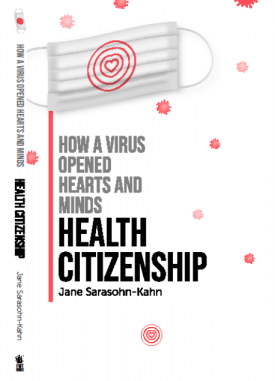
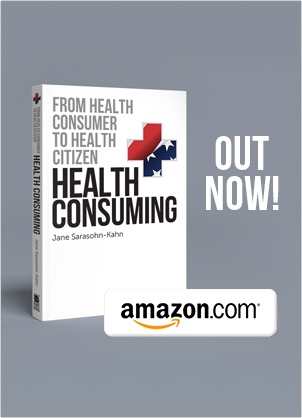
 I'm once again pretty gobsmackingly happy to have been named a judge for the 2026 CES Innovation Awards, focusing on digital health, longevity, and fitness. Preceding every year's global conference, CES receives hundreds of applications from innovators around the world building tech-based solutions to big challenges. So glad to be part of this annual initiative to see what global health-tech pioneers are cooking up to address and scale the health and well-being of fellow health citizens, globally.
You can see the results of the Digital Health Awardees here on the #CES2026 website.
I'm once again pretty gobsmackingly happy to have been named a judge for the 2026 CES Innovation Awards, focusing on digital health, longevity, and fitness. Preceding every year's global conference, CES receives hundreds of applications from innovators around the world building tech-based solutions to big challenges. So glad to be part of this annual initiative to see what global health-tech pioneers are cooking up to address and scale the health and well-being of fellow health citizens, globally.
You can see the results of the Digital Health Awardees here on the #CES2026 website. Stay tuned to Health Populi in early January as I'll be attending Media Days and meeting with innovators in digital health, longevity, and the home-for-health during CES 2026 in Las Vegas. I'll be at the conference for an entire week meeting with clients and exhibitors at the biggest-meeting-of-the-year on consumer-facing technology. I'll be reporting daily from Vegas here in the blog, sharing with you insights about the latest breakthroughs, products, and services that enable people to manage health, well-being, and medical issues in their own hands and homes.
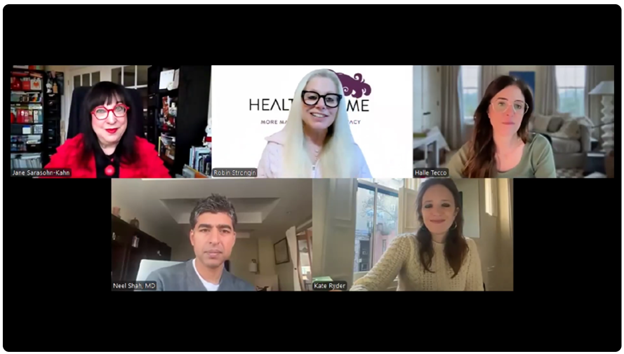 Jane collaborated on Robin Strongin's Health Dame webcast to discuss Halle Tecco's new book, Massively Better Healthcare, due out in early 2026. We brainstormed with Maven Founder Kate Ryder and the company's Chief Medical Officer Dr. Neel Shah about the state of U.S. healthcare and solutions not just to tweak at the margins but to "massively" improve health care delivery, financing, outcomes, and equity in America. It was a delightful, enlightening conversation -- I hope you'll check it out.