


Prelude to Health 2.0 2019: Thinking Consumers At the Center of Digital Health Transformation

“Digital transformation” is the corporate strategy flavor of the moment across industries, and the health are sector isn’t immune from the trend. As this 13th year of the annual Health 2.0 Conference kicks off this week, I’m focused on finding digital health innovations that engage people — consumers, caregivers, patients, health citizens all. This year’s conference will convene thought leaders across a range of themes, and as is the Health 2.0 modus operandi, live demo’s of new-new things. As Health 2.0 kicks off today in pre-conference sessions, there is useful context described in a new report from the American Hospital
Why Humana Joined CTA – The Pivot from “Health Insurance” to Behaving as a Health-Tech Start-Up

“Every company is a tech company,” Christopher Mimms asserted in the Wall Street Journal in December 2018. Connectivity, artificial intelligence, and automation are now competencies every company must master, Mimms explains. This ethos underpins Humana’s decision to join CTA, the Consumer Technology Association which hosts CES every January in Las Vegas. If you read this blog, you know one of the fastest-growing “aisles” at the annual conference is digital health. Humana joined up with CTA’s Health and Fitness Technology Division this month. Last year, Humana hired Heather Cox in the new post of Chief Digital Health and Analytics Officer, reporting directly
Health Consumers Expect Healthcare to be Digital (and Secure), Philips Future Health Index Finds

Health care system financing, delivery, and workflows widely vary across nations around the world. Philips surveyed health care professionals and consumers living in 15 countries, from North America to Asia, and found that these health systems share one over-arching objective: to provide quality care with improved experiences for both patients and healthcare professionals. Being Philips, what underpins that quality and experience is technology; Philips explored telehealth, AI, digital health records (DHRs), and other digital health tools that can engage patients. Philips published results from this global study in The Future Health Index 2019, themed “Transforming healthcare experiences, exploring the impact
Health Care Providers Grow Consumer-Facing Muscles Driven by Retail & Tech-Health Competition
As patients continue to morph into health care payers, they’re increasingly expecting value-for-money, transparency, and customer experiences that show respect, bolster trust, and deliver quality services. Is that so much to ask from health care providers? Sure is, as it turns out, based on this year’s annual report from Kaufman Hall, the 2019 State of Consumerism in Healthcare: The Bar is Rising. For several years, Kaufman Hall have developed an Index of healthcare consumerism based on several pillars that, together, gauge health care providers’ performance on consumer health engagement. Providers fall into one of four tiers, ranging from Tier 1
A Profile of People in Medicare Advantage Plans – HealthMine’s Survey of “Digital Immigrants”
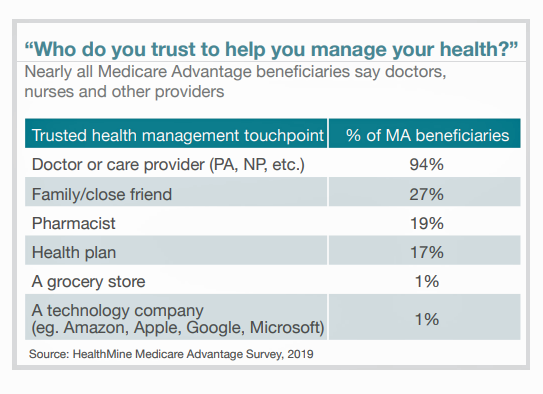
There are over 60 million enrollees in Medicare in 2019, and fully one-third are in Medicare Advantage plans. Medicare is adding 10,000 new beneficiaries every day in the U.S. Medicare Advantage enrollment is fast-growing, shown in the first chart where over 22 million people were in MA plans in January 2019. Better understanding this group of people will be critical to helping manage a fast-growing health care bill, and growing burden of chronic disease, for America. To that end, HealthMine conducted a survey among 800 people enrolled in Medicare Advantage plans ag 65 and over with at least one diagnosed
Talking “HealthConsuming” on the MM&M Podcast
Marc Iskowitz, Executive Editor of MM&M, warmly welcomed me to the Haymarket Media soundproof studio in New York City yesterday. We’d been trying to schedule meeting up to do a live podcast since February, and we finally got our mutual acts together on 6th August 2019. Here’s a link to the 30-minute conversation, where Marc combed through the over 500 endnotes from HealthConsuming‘s appendix to explore the patient as the new health care payor, the Amazon prime-ing of people, and prospects for social determinants of health to bolster medicines “beyond the pill.” https://www.pscp.tv/MMMnews/1eaJbvgovBYJX Thanks for listening — and if you
100 Million People in America Lack Broadband — an On-Ramp to Health and Safety

One in three Americans does not have a broadband connection, according to a new report from the NPD Group. This means that about 100 million people in the U.S. can’t benefit from telehealth and other digital health connections that can bolster self-care, home care, and lower cost care. Most of these folks in the broadband-digital divide live in rural America/ “The so-called digital divide, between those that can or cannot make the best use of the Internet, can be clearly felt in rural markets where the lack of broadband impacts everything from entertainment to the educational system,” Eddie Hold, President
Health Care and Consumers in 2030: A Profile from KPMG

A “one layered delivery network through which patients can move seamlessly as they age and their needs evolve” will be the new health care platform to meet patients’ demands by 2030, according to a forecast from KPMG’s Healthcare and Life Sciences Institute. In Healthcare 2030: The consumer at the center, the KPMG team explores the demographic shifts and market drivers that will challenge the health care industry in the current U.S. delivery and financing system. The lens on that 2030 future is a consumer-centric delivery model that KPMG believes will be a solution to dealing with a demographic divide between
On Amazon Prime Day, What Could Health Care Look Like?
Today is July 15, and my email in-box is flooded with all flavors of Amazon Prime’d stories in newsletters and product info from ecommerce sites — even those outside of Amazon from beauty retailers, electronics channels, and grocery stores. So I ask on what will probably be among the top ecommerce revenue generating days of all time: “What could health care look like when Amazon Prime’d?” I ask and answer this in my book, HealthConsuming, as chapter 3. For context, this chapter follows two that explain how patients in the U.S. have been morphing into health consumers based on how health
Talk to Me About My Health, Medicare Advantage Beneficiaries Tell J.D. Power
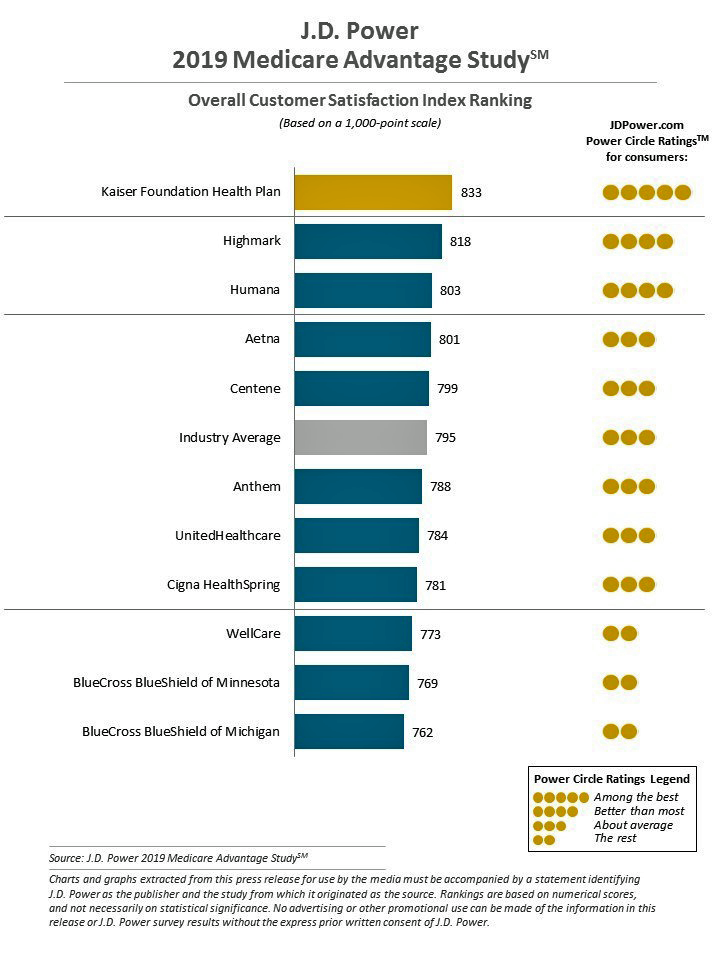
Cost is the major reason why Medicare Advantage plan beneficiaries switch plans, but people who switch also tend to have lower satisfaction scores based on non-cost factors. Those ratings have a lot to do with information and communication, according to J.D. Power’s 2019 Medicare Advantage Plan Study. The Study explores MA beneficiaries’ views on six factors: Coverage and benefits Provider choice Cost Customer service Information and communication, and Billing and payment. Kaiser Foundation Health Plan garnered the top spot for the fifth year in-a-row. By feature, Kaiser achieved 5 “Power Circles” for all factors except for cost and provider choice,
IKEA Garners the Top Health & Wellness Award at Cannes Lions 2019 – the Expanding Health/Care Ecosystem
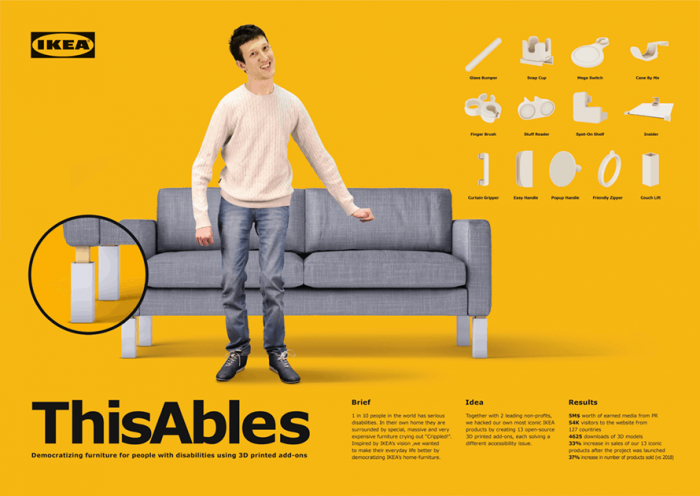
“Health is now everyone’s business,” Shaheed Peera, Executive Creative Director of Publicis LifeBrands, said this week at the 2019 Cannes Lions awards. Shaheed also led the Health & Wellness jury at Cannes Lions 2019, the mission of which is to, in the words of the award’s portal, “celebrate creativity for personal wellbeing.” The Grand Prix Lions award for Health & Wellness went to IKEA for the company’s ThisAbles campaign. ThisAbles is a project pioneered by IKEA’s team in Israel, looking to improve everyday living for people with special needs through well-designed IKEA products. IKEA collaborated with non-profit organizations to develop
Healthcare Just Got SMAC’ed – Accenture’s Post-Digital Era for Health
Social, mobile, analytics and the cloud now underpin the health care industry. We’ve been SMAC’ed, and Accenture’s Digital Health Tech Vision 2019 believes we’re in a post-digital era ripe with opportunity. Five trends comprise the Vision: DARQ Power, the acronym for Distributed ledger technology, Artificial intelligence (AI), extended Reality, and Quantum computing. Adopting these applications can help health care reduce costs, drive labor efficiency and support people-centered design and experience. Get to Know Me is the use of technology to develop and deepen relationships with people. As an example of this trend, Accenture points to Mindstrong which leverages AI and
Intent, Insiders/Outsiders and Insights — Disney Institute’s Women’s Leadership Summit
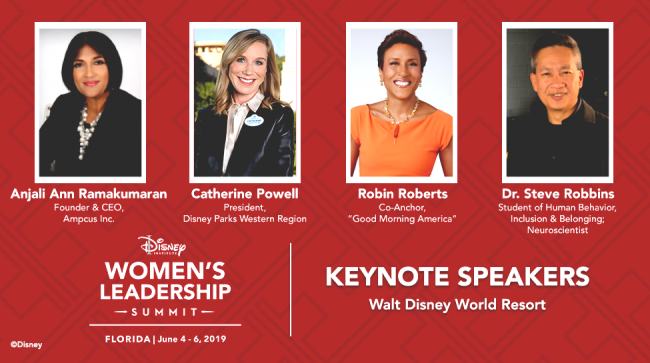
There are many forms of magic inspired by Disney, the company. There’s the obvious attraction, the Magic Kingdom, that was Walt’s original destination vision, “imagineered” in 1932. Then there are other kinds of magic. The one I’m deep into in the moment is inspiration, ideation, and “reimagineering” my own thinking about work, legacy, and social justice. I’m grateful to have had the opportunity to spend much of this week at the inaugural Disney Institute Women’s Leadership Summit. The Institute convened about 300 women (and a handful of brave “He-for-She” men keen on diversity) in Orlando to learn about and brainstorm
The Persistent Rural/Urban Broadband Gap Is Bad for Health
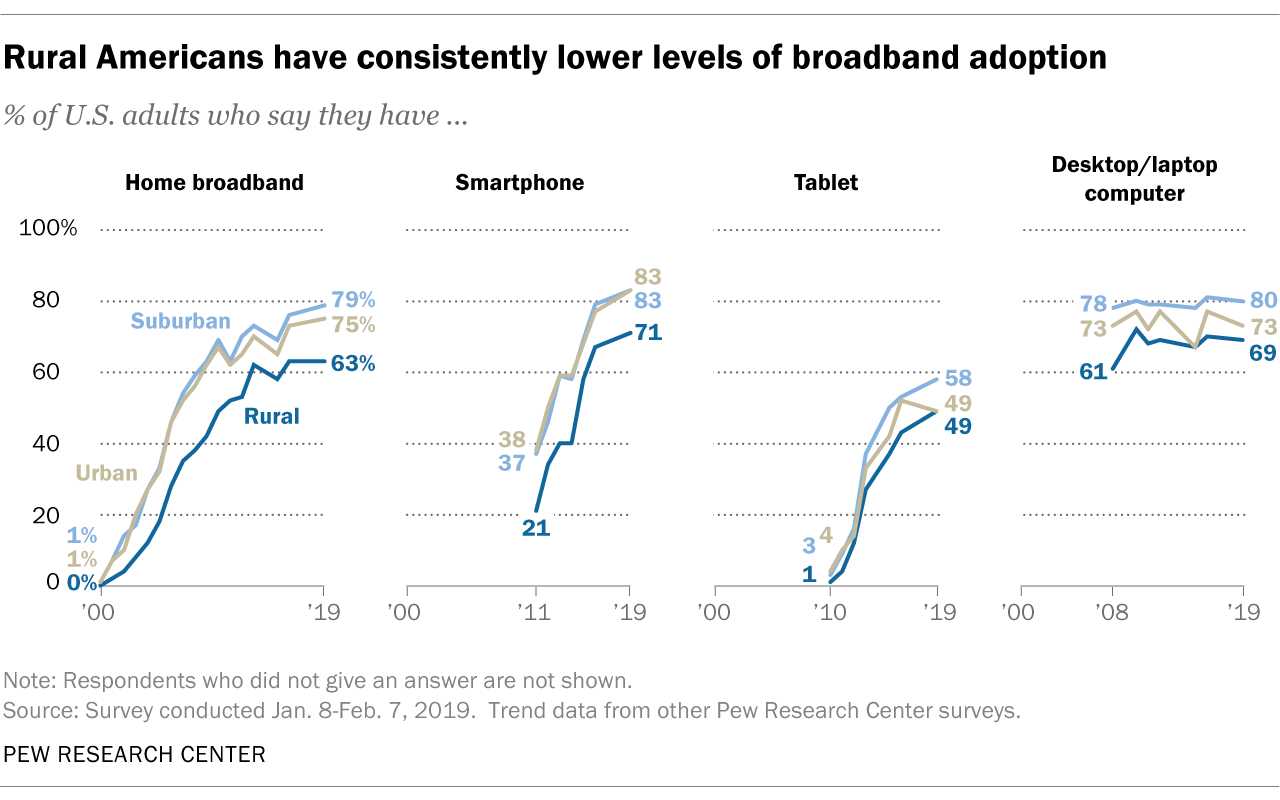
In the U.S., rural residents’ access to broadband at home continues to lag behind urban and suburban dwellers, the Pew Research Group noted in a May 2019 research note on Americans’ use of technology. The Pew survey explored Americans’ adoption of technology and found that rural dwellers are also less likely to have multiple devices than non-rural consumers. Across the four types of tech studied, it’s smartphones that top the list of penetration in rural areas (at 71%), closely followed by computers (desktop or laptop, with 69% adoption), broadband (at 63%) and tablets
Healthcare Providers’ Consumer Experience Gaps – Learnings from Kaufman Hall’s 2019 Index
Most U.S. healthcare providers are spending more time, effort and capital with an eye to engaging with patients-as-consumers, a trend quantified in the report, the 2019 State of Consumerism in Healthcare: The Bar is Rising from Kaufman Hall, summarizing results from this year’s healthcare consumerism index survey conducted among about 200 healthcare providers. “Legacy organizations will need premier-level consumer capabilities to compete in today’s increasingly consumer-centric environment,” Kaufman Hall recommends. Providers identified the key capability gaps for consumer-centric care as improving the consumer experience, offering a variety of facility-based access points, utilizing digital tools for health engagement, providing price transparency,
How Consumers’ Belt-Tightening Could Impact Health/Care – Insights from Deloitte’s Retail Team

Over the ten years between 2007 and 2017, U.S. consumer spending for education, food and health care substantially grew, crowding out spending for other categories like transportation and housing. Furthermore, income disparity between wealthy Americans and people earning lower-incomes dramatically widened: between 2007-2017, income for high-income earners grew 1,305 percent more than lower-incomes. These two statistics set the kitchen table for spending in and beyond 2019, particularly for younger people living in America, considered in Deloitte’s report, The consumer is changing, but perhaps not how you think. The authors are part of Deloitte Consulting’s Retail team. The retail spending data
Are Robots Coming to Healthcare? Consumers Say Not-So-Fast

Samsung introduced BotCare, a caring robot, at CES 2019. BotCare is part of the company’s Bixby, an AI platform that supports Samsung’s robotic offerings for environmental health (air), retail, and healthcare. Think: medication reminders and around-the-house services that a human homecare aid might perform, among other medical support tasks. But visions of Rosie-the-Robot serving up healthcare at home is beyond most consumers’ desires at this moment, according to a new survey published by the Consumer Technology Association (CTA), Robotics: Current Landscape & Consumer Perceptions. Most U.S. adults have positive views toward robotics in general, CTA found. There’s optimism for use
When Will Self-Service Come to Health Care?

At least one in three people who have tried out virtual health care have done so because they use technology in all aspects of life and want to do the same with their healthcare. This data point has informed my vision for self-care and the home as our health hub, bolstered in part through the research of Accenture from which this first graphic comes. A common theme at health care meetings these days is how and when health care will meet its Amazon, Apple, or Uber moment? Lately, one of my speaking topics is the “Amazon Prime-ing” of health consumers,
Assessing the GAO’s Report on Single-Payer Healthcare in America: Let’s Re-Imagine Workflow

Calls for universal health care, some under the banner of Medicare for All,” are growing among some policy makers and presidential candidates looking to run in 2020. As a response, the Chairman of the House Budget Committee in the U.S. Congress, Rep. John Yarmuth (D-Ky.), asked the Congressional Budget Office (CBO) to develop a report outlining definitions and concepts for a single-payer health care system in the U.S. The result of this ask is the report, Key Design Components and Considerations for Establishing a Single-Payer Health Care System, published on 1st May by the CBO. The report provides
The Convergence of Health/Care and Real Estate

There’s no denying the growth of telehealth, virtual visits, remote health monitoring and mHealth apps in the healthcare landscape. But these growing technologies don’t replace the role of real estate in health, wellness and medical care. Health care is a growing force in retail real estate, according to the ICSC, the acronym for the International Council of Shopping Centers, which has been spending time analyzing, in their words, “what landlords should know in eyeing tenants from a $3.5 trillion industry.” Beyond the obvious retail clinic segment, the ICSC points out a key driving growth lever for its stakeholders, recognizing that,
The Promise of Digital Health and the Privacy Perils – HealthConsuming Explains, Part 4

The supply side of digital health tools and tech is growing at a hockey-stick pace. There are mobile apps and remote health monitors, digital therapeutics and wearable tech from head-to-toe. Today in America, electronic health records (EHRs) are implemented in most physician offices and virtually all hospitals. Chapter 5 of my book, HealthConsuming: From Health Consumer to Health Citizen, details the promise of digital health: wearable, shareable and virtual. Today, we can also call on Alexa to remind us to take medications, play nostalgic music when we are lonely, check our physical activity status with Fitbit, and query WebMD about
Health/Care Everywhere – Re-Imagining Healthcare at ATA 2019

“ATA” is the new three-letter acronym for the American Telemedicine Association, meeting today through Tuesday at the Convention Center in New Orleans. Ann Mond Johnson assumed the helm of CEO of ATA in 2018, and she’s issued a call-to-action across the health/care ecosystem for a delivery system upgrade. Her interview here in HealthLeaders speaks to her vision, recognizing, “It’s just stunning that there’s such a lag between what is possible in telehealth and what is actually happening.” I’m so keen on telehealth, I’m personally participating in three sessions at #ATA19. On Monday 15th April (US Tax Day, which is relevant
Digital Health As A Basic Human Need – the Dentsu Digital Society Index 2019
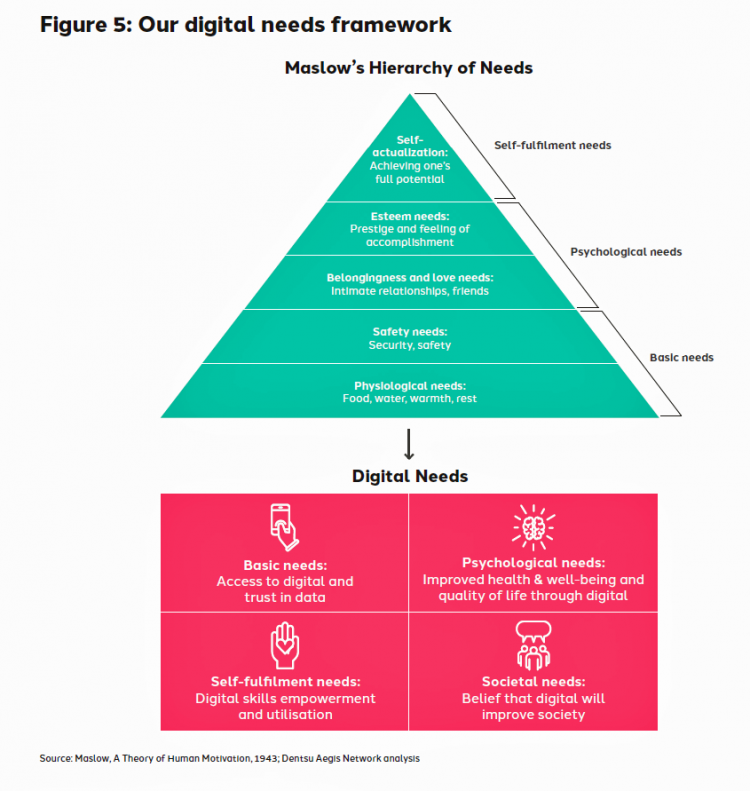
We are all Homo informaticus these days, multi-channel, multi-platform beings using digital platforms. “Computing is not about computers anymore. It is about living,” Nicholas Negroponte wrote in Being Digital. He said that in 1995. In that quarter-century since Negroponte made that prescient observation, we come to better understand that being a Digital Society has its upsides and downfalls, alike. We need a “new needs model” for the digital age, asserts a new report, Human Needs in a Digital World, the 2019 Digital Society Index report from the Dentsu Aegis network. Taking Maslow’s Hierarchy of Needs as a basic construct, the Index
Our Mobile Health Data: Shared, Identifiable, and Privacy-Deprived
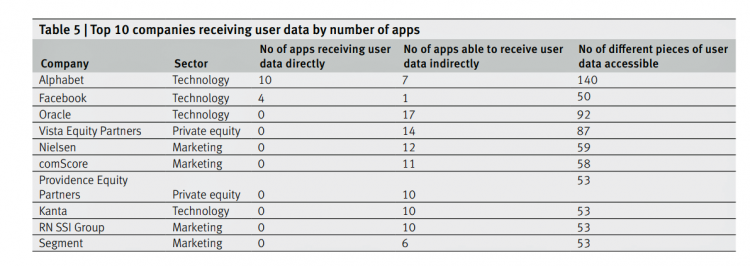
As more mobile app users — consumers, patients, and caregivers — use these handy digital health tools, much of the data we share can be re-identified and monetized by third parties well beyond those we believe we’re sharing with. This compromised health data privacy scenario comes out of research published this month in the BMJ, Data sharing practices of medicines related apps and the mobile ecosystem: traffic, content, and network analysis. The researchers, faculty from the University of Toronto (Canada) and the University of Sydney (Australia), come from nursing, pharmacy, and computer science expertise — a sound combination of disciplines
Isn’t It Eyeconic? Vision Care in the Evolving Health Care Ecosystem
The vision/optical industry is one piece of the health/care ecosystem, but the segment has not been as directly impacted by patients’ new consumer muscles until just about now. It feels like the vision industry is at an inflection point at this moment, I intuited during yesterday’s convening of Decoding the Consumer: The new science of customer behavior, the theme of the 13th annual global leadership summit hosted by Vision Monday, a program of Jobson Medical Information which is part of the WebMD family. I was grateful to have an opportunity to share my views with attendees on the vision patient as
The Evolution of Self-Care for Consumers – Learning and Sharing at CHPA
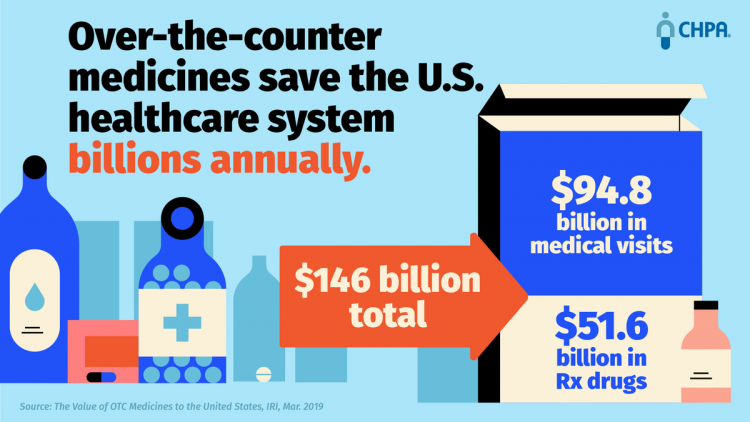
Self-care in health goes back thousands of years. Reading from Hippocrates’ Corpus about food and clean air’s role in health sounds contemporary today. And even in our most cynical moments, we can all hearken back to our grandmothers’ kitchen table wisdom for dealing with skin issues, the flu, and broken hearts. The annual conference of the Consumer Healthcare Products Association (CHPA) convened this week, and I was grateful to attend and speak on the evolving retail health landscape yesterday. Gary Downing, CEO of Clarion Brands and Chairman of the CHPA Board, kicked off the first day with a nostalgic look
Self-Care Is Healthcare In Consumers’ Hands, Peaking on Google Trends
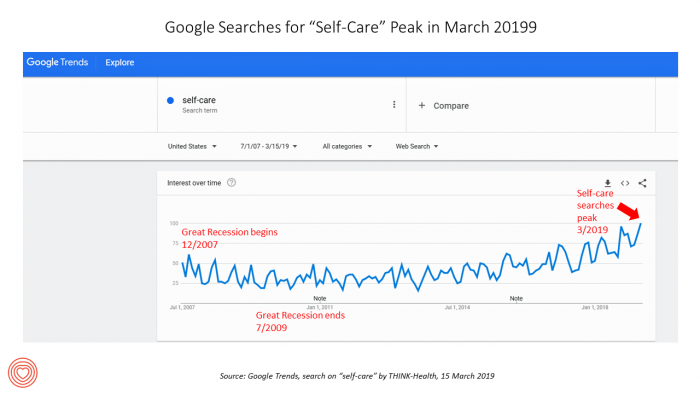
Today, the number of searches on Google using the phrase “self-care” reached a high, shown in the line graph I created on Google Trends and marked up in red. A Google search overall yielded over 2 billion results. I started this search when the Great Recession began in the U.S. in December 2007, and tracked “self-care” searches to today, 15 March 2019. I ran this little test because I’m speaking on Monday 18 March at the annual meeting of the Consumer Healthcare Products Association. CHPA was founded in 1881 as the “Proprietary Association.” In 1989, over 100 years later, the
Can AI Make Healthcare Human Again? Dr. Topol Says “Yes”
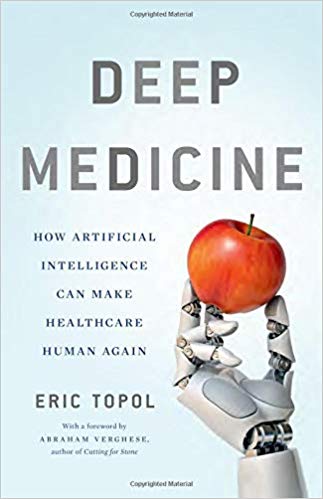
“The Fourth Industrial Age,” Dr. Abraham Verghese writes, “has great potential to help, but also to harm, to exaggerate the profound gap that already exists between those who have much and those who have less each passing year.” Dr. Verghese asserts this in his forward to Deep Medicine, Dr. Eric Topol’s latest work which explores the promise of artificial intelligence (AI), Big Data, and robotics — three legs of the Fourth Industrial Age stool. [If you don’t know the work of Dr. Verghese, and since you’re reading the Health Populi blog, you must get to know Dr. V now. Your
The Balance of Personalization and Privacy For Health/Care – Amazon and Beyond
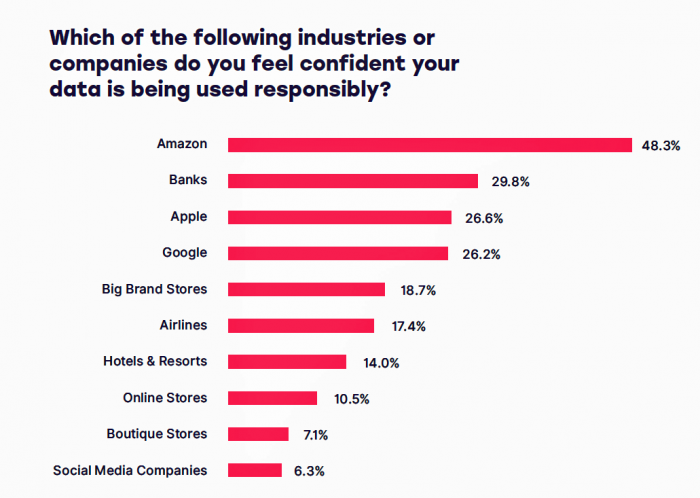
“Is it possible to take personalization too far for consumers?” asks a paper on Privacy and Personalization from SmarterHQ. The answer is, “it depends.” Consumers are sending mixed messages to marketers about their preferences for being forgotten versus being engaged and recognized. This tension has extreme relevance for personal health and healthcare, as AI and data analytics become quickly adopted by payors, insurance companies, providers, pharma, and consumer tech companies that lie outside of HIPAA privacy and security regulations. SmarterHQ polled over 1,000 consumers and found that: Most consumers are concerned about their data privacy, and believe that companies know too
Consumers’ Trust In Health And Personal Care Stores: The Growing Retail Health Ecosystem
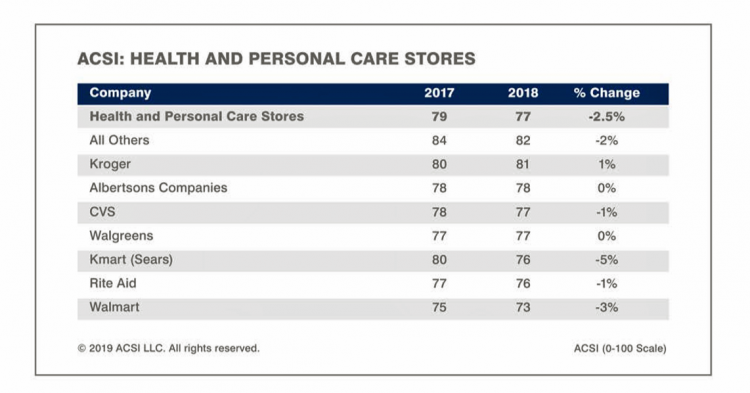
CVS + Aetna have merged to evolve a new business model for health and medical care. Walgreen’s continues to add new services beyond the core pharmacy business, and Walmart is expanding telehealth and healthier food aisles in the grocery. More grocery stores added dietitians to their operations in 2018, as well. As people take on more self-care for health care, they are looking to access products and services in retail bricks-and-mortar and ecommerce channels in the same places they buy food and other products. ACSI’s latest customer satisfaction benchmark study into retailers provides insights into the trusted channels for retail health
Time To Travel And Wait In Health Care: The Opportunity For Self-Care At Home
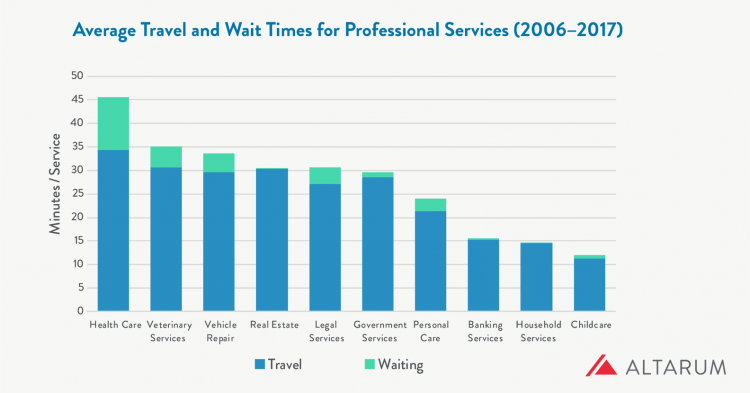
What industry compels its “consumers” to wait longer and travel further for services more than any other in a person’s daily life? That would be health care, a report from Altarum notes. People travel further and wait longer for medical services than for veterinary care (second in this line-up), auto repair, banking, and household services. The annual opportunity cost for travel and wait time in health care is $89 billion, Altarum estimated. For the average person, that translates to 34 minutes of travel time and 11 minutes waiting time at the provider’s office. In terms of personal opportunity costs, Altarum gauged the
How Genomics Can Battle Killer Bacterial Infections in the Hospital – Talking With Philips at HIMSS19
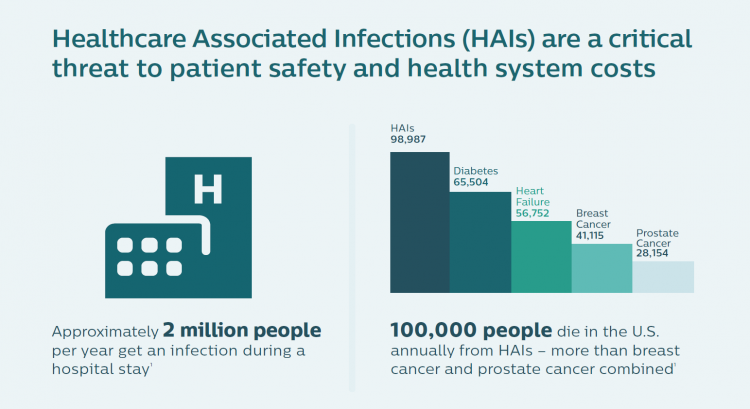
When you think “genomics,” your mind probably pictures a human DNA strand. Well, my mind did, prior to meeting with Dr. Joseph Frassica and Dr. Felix Baader at HIMSS19 to discuss Philips’ approach to the tragic problem of healthcare-acquired infections that kill patients. Ever since that conversation, my mind’s eye is filled with images of MRSA cells like those shown here. At HIMSS19, Philips launched a solution that couples clinical informatics with genomic sequencing of bacteria to quickly identify and treat patients that are affected with tough-to-treat infections that, so often, result in death. Healthcare-acquired infections (HAIs) are a worldwide
Cost and Convenience Underpin Patient Demands As Health Consumers
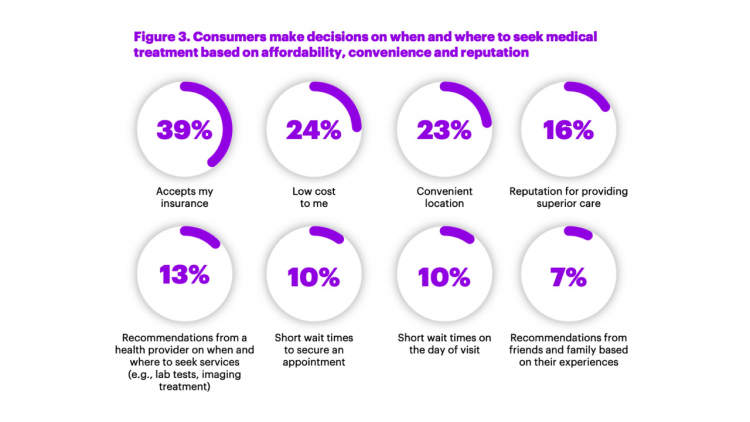
Across generations, from younger to older patients, cost, transparency and convenience drive consumer satisfaction, Accenture’s latest health consumer survey found. I had the opportunity to brainstorm the study’s findings in real-time on the day of survey launch, 12 February, with Dr. Kaveh Safavi, Brian Kalis, and Jenn Francis at HIMSS19. Our starting point was the tipping-point statistic that over 50% of people in the U.S. have chosen to use a non-traditional health care setting. Those non-traditional sites of care include walk-in and retail clinics, outpatient surgery centers, virtual health (whether on the phone, on video or via mobile apps), on-demand services,
“Telehealth is a digital distribution channel for health care” – catching up with Roy Schoenberg, President and CEO of American Well
Ten years ago, two brothers, physicians both, started up a telemedicine company called American Well. They launched their service first in Hawaii, where long distances and remote island living challenged the supply and demand sides of health care providers and patients alike. A decade later, I sat down for a “what’s new?” chat with Roy Schoenberg, American Well President and CEO. In full transparency, I enjoy and appreciate the opportunity to meet with Roy (or very occasionally Ido, the co-founding brother-other-half) every year at HIMSS and sometimes at CES. In our face-to-face brainstorm this week, we covered a wide range
Deep Human Interactions: The Antidote To More AI In Health Care – Learning From Philips’ CEO At HIMSS19
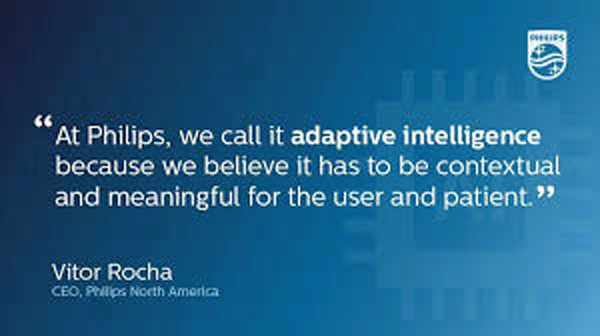
“The promise of AI is undeniable…could AI help clinicians deliver better and more humanistic care?” This question is asked and answered in a JAMA viewpoint published January 1/8 2019 titled, Humanizing Artificial Intelligence. This theme motivated a conversation held over a dinner convened by Philips hosted by Frans Van Houten this week at HIMSS19. To provide context Geoff Colvin, Fortune‘s Senior Editor, first talked about taking friction out of industries, as Lyft and Uber have done in the transport sector. “Taking friction out of industries challenges and changes business models,” Geoff noted. With Uber’s IPO valuation approaching $100 billion, I’d say that’s
Care Gets Personal at Philips for Parents and Babies
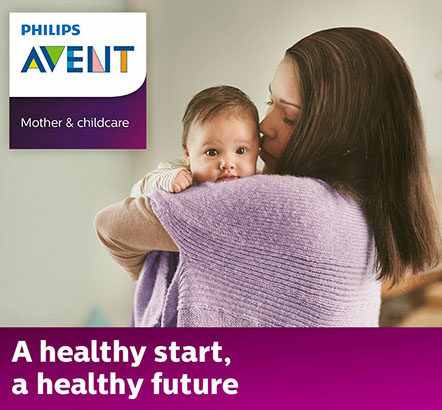
Our homes should nurture our health. In addition to nutrition and good food, positive relationships, clean air and water, and the basic needs that bolster whole health, technology is playing a growing role to help us manage health at home. At CES 2019, I spent time with Roy Jakobs, Chief Business Leader of Personal Health with Philips, to discuss the company’s evolving portfolio of products that help fulfill the mission to support people across their own continuum of health. Following CES, I wanted to further dive into one part of the portfolio very important to family health at home: the
Trust in 2019 Via Edelman: The Plotline for Women and Healthcare
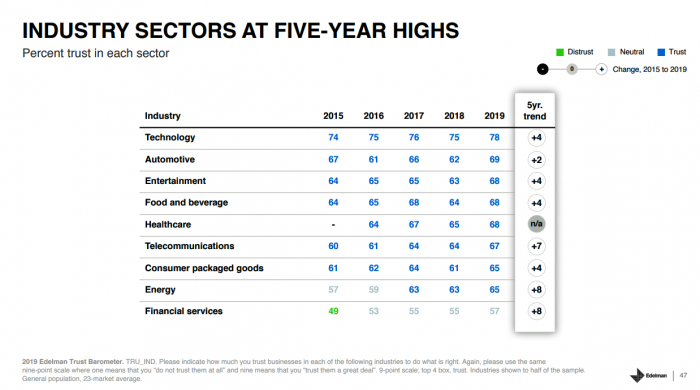
Fewer than one-half of consumers trust in government and media. Three-quarters trust employers, who in 2019 are the top-trusted institution according to the 2019 Edelman Trust Barometer released last week in Davos at the World Economic Forum. Consumers in the U.S. over-index for trust in employers, with 80% of people saying they have a strong relationship with “my employer,” compared with 73% of Britons, 66% of the French, and 59% of people in Japan. What’s underneath this is employers being trusted to provide certainty: most workers look to their employer to be a trustworthy source of information about social issues and
The Consumer and the Payor, Bingo and Trust: My Day At Medecision Liberator Bootcamp

To succeed in the business of health information technology (HIT), a company has to be very clear on the problems it’s trying to address. Now that EHRs are well-adopted in physicians’ practices and hospitals, patient data have gone digital, and can be aggregated and mined for better diagnosis, treatment, and intelligent decision making. There’s surely lots of data to mine. And there are also lots of opportunities to design tools that aren’t very useful for the core problems we need to solve, for the clinicians on the front-lines trying to solve them, and for the patients and people whom we
What If Marie Kondo Reorganized Health Care in the U.S.?

Have you read the life changing magic of tidying up, or Spark Joy, books by Marie Kondo? Her new Netflix series, Tidying Up with Marie Kondo debuted on January 1, and has enjoyed passionate early viewership by consumers in America who are among the world’s major hoarders. If you opened any pop culture magazine or newspaper in the past week, you probably saw the results of a PR blitz promoting KonMari, the trademarked name for Marie’s clean-out method. As an example, the Wall Street Journal discussed the phenomenon in Ben Zimmer’s profile, “A Guru of Organizing Becomes A Verb” published this weekend
From Yorkshire Lad to Global Design for Health: A Profile of Sean Carney of Philips
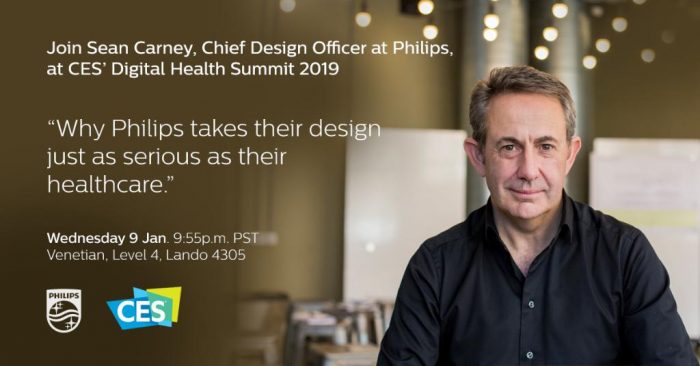
Have you heard the story about a boy born in Yorkshire, England, who studies art in Birmingham, finds his way to Finland to work with design maestro Alvar Aalto, and then crafts a printer that Steve Jobs loved? I have, at CES 2019, when I sat down with Sean Carney, Chief Designer at Philips. It’s well-known that Philips has been firmly focused on health and health care, covering both clinical/professional healthcare as well as personal health for self-care. What you may not know is that underpinning the company’s innovations is a major commitment to all aspects of design. Design is embedded
Calling Out Health Equity on Martin Luther King Day 2019
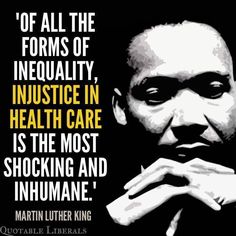
On this weekend as we appreciate the legacy of Martin Luther King, Jr., I post a photo of him in my hometown of Detroit in 1963, giving a preliminary version of the “I Have a Dream” speech he would deliver two months later in Washington, DC. Wisdom from the speech: “But now more than ever before, America is forced to grapple with this problem, for the shape of the world today does not afford us the luxury of an anemic democracy. The price that this nation must pay for the continued oppression and exploitation of the Negro or any other
The Caveats for Health/Care at CES 2019
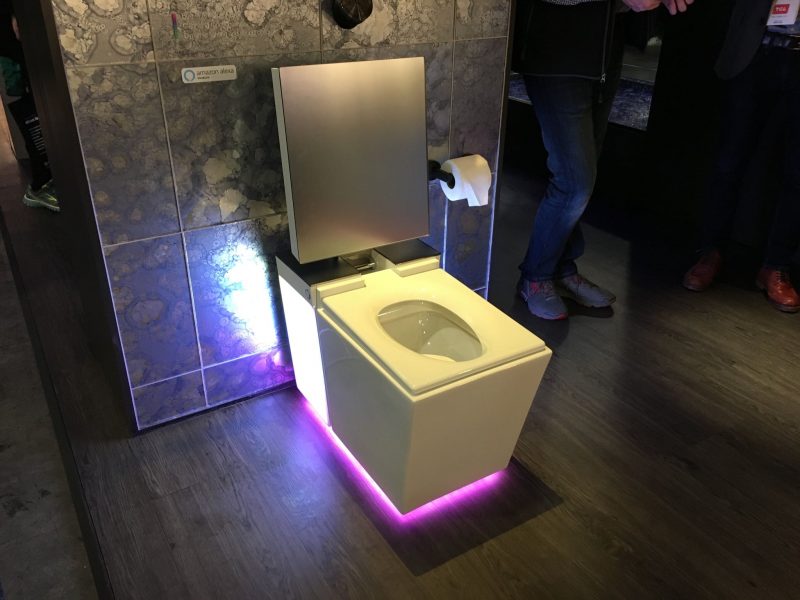
According to the Cambridge Dictionary, a “caveat” is, “a warning to consider something before doing anything more.” It is fitting that CES is held in Las Vegas, land of high risk and, with a lot of luck, reward. With that theme in mind, I depart LAS airport tonight on an aptly-named red-eye flight back home after spending an entire week here. I’m pondering not what I saw — some of which I covered daily over the past week — but what I didn’t see. Consider these the caveats for health/care at #CES2019. In no particular order… Where was the Chairman of
The Consumer as Payor – Retail Health at CES 2019

All health/care is retail now in America. I say this as most people in the U.S. who have health insurance must take on a deductible of some amount, which compels that insured individual to spend the first dollar on medical services up until they meet their financial commitment. At that point, health insurance kicks in, and then the insured may have to spend additional funds on co-payments for general medicines and services, and coinsurance for specialty drugs like injectables and high-cost new therapies. The patient is a consumer is a payor, I asserted today during my talk on the expanding
Shelly Palmer De-Hypes CES 2019 & Has Lessons for Health/Care
I had the pleasure once again of attending Shelly Palmer’s annual kick-off breakfast where he level-sets our expectations for CES two hours before the tech halls open. Shelly is a consumer tech expert and leads the Palmer Group; comments on Fox 5 in NYC, CNN, and CNBC; writes a weekly column in Advertising Age; composes music; and he’s a Renaissance Man who’s a generous sharer of knowledge with a great sense of humor and humanity. Shelly is one of my trusted touchpoints for all-things-consumer-tech. His message at the start of #CES2019: this year, the show is about connectivity and partnership.
Heart Health at #CES2019 – Food and Tech as Medicine

Self-care is the new health care as patients, now consumers at greater financial risk for medical spending, are learning. At #CES2019, I’m on the lookout for digital technologies that can help people adopt and sustain healthy behaviors that can help consumers save money on medical care and enhance quality of life-years. This week’s heart-and-food tech announcements at #CES2019 coincide with an FDA recall on a popular drug prescribed to treat hypertension (high blood pressure). Using food and tech as medicine can help people avoid going on medications like statins and others for heart health. An important example of this self-care
What #CES2019 5 Tech Trends to Watch Mean for Health/Care

As #CES2019 kicks off in Las Vegas with today’s first Media Day, the Consumer Technology Association presented its forecast on the 5 Technology Trends to Watch in 2019 — and they all play into health, wellness, and medical care. The five trends are: Artificial Intelligence on the Rise Envisioning the Smart Home of the Future Digital Health Tech Empowers Patients Esports and Sports Technology, and Smart Cities Promote Resilience. Here are how these five mega-trends can bolster our health and healthcare products and services over the next decade. AI is indeed on-the-rise in healthcare: as I have begun planning my agenda for
Data Privacy and Healthcare Access: Top Issues Shaping Consumers’ Societal ROI

Organizations that address consumers’ data privacy and access to healthcare create greater social brand equity, inspiring people to say nice things about the companies, recommend them as good employers, and be welcomed as businesses operating in peoples’ community. In The Societal ROI Index: A Measure for The Times We Find Ourselves In, Finn Partners and The Harris Poll measure U.S. companies’ reputations for social good, the project’s press release explains. “Our new data shows that the public has a definite opinion about what issues they feel companies should address and the social impact bar has been set high,” according to Amy Terpeluk,
“Seeing Is Not Believing:” Consumers Concerned About the Accuracy of Online Health Information

“Seeing is not believing” when it comes to people seeing health information on social networks. Four in five people seeking healthcare information online in social media are concerned about the accuracy of that information served up. Therefore, most consumers a very satisfied with the healthcare information they receive from nurses, eye doctors, pharmacists, dentists, nurse practitioners, doctors, and dietitians. But social media influencers. patient organizations, online patient forums, and pharmaceutical companies? Not so much. Only one-half of U.S. consumers believe that health-related information on the internet is as reliable as information from medical professionals. Welcome to The Great American Search for
Consumers Want Help With Health: Can Healthcare Providers Supply That Demand?

Among people who have health insurance, managing the costs of their medical care doesn’t rank as a top frustration. Instead, attending to health and wellbeing, staying true to an exercise regime, maintaining good nutrition, and managing stress top U.S. consumers’ frustrations — above managing the costs of care not covered by insurance. And maintaining good mental health and staying on-track with health goals come close to managing uncovered costs, Oliver Wyman’s 2018 consumer survey learned. These and other important health consumer insights are revealed in the firm’s latest report, Waiting for Consumers – The Oliver Wyman 2018 Consumer Survey of US
How Food and Data Can Support Consumers and Healthy Living: Listening at Groceryshop
Eat food, not too much, mostly plants, Michael Pollan advised us on the cover of his breakthrough book on nutrition in America, In Defense of Food. In Las Vegas, it’s not too easy to live and eat according to Pollan’s Food Rules. We’re at a fork in the road when it comes to food, retail grocery shopping, and health, which is an intersection I’m increasingly working in these days. The Groceryshop conference is further informing my understanding of the landscape of the technology that’s enabling the consumer’s ability to curate, purchase, and receive the food they want to satisfy hunger and
Food and Cooking for Health: a UK Perspective from Hammersmith & Fulham
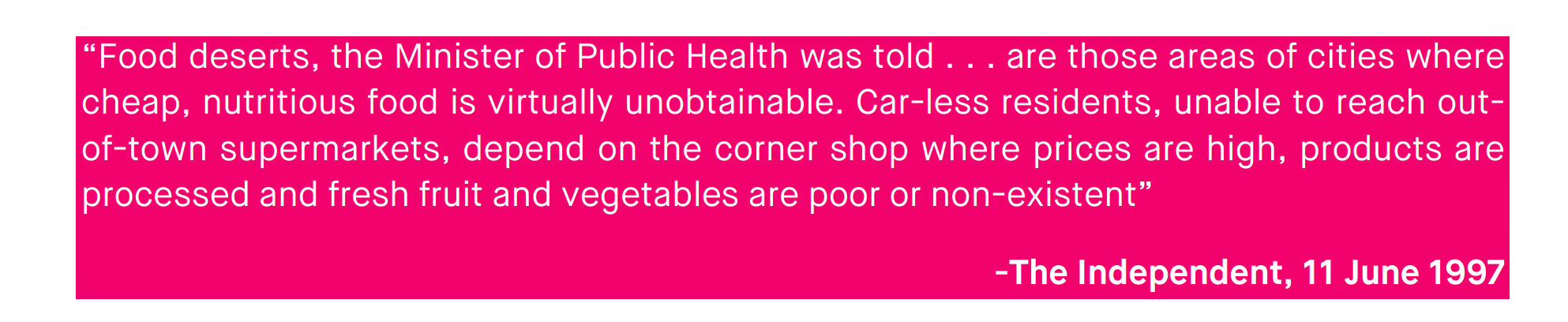
Food deserts aren’t just a U.S. phenomenon. They’re found all around the world. This week as I explore social determinants of health and technology solutions in several parts of Europe, I’ve learned more about food access challenges in the UK. These are discussed in a report published this month by the Social Market Foundation asking, What are the barriers to eating healthily in the UK? The research was supported by Kellogg’s, the food manufacturer. The first table comes from the report, and the topline shows that about 4 in 10 Britons shopped at a cheaper food store in response to high
Koen Kas, the Gardener of Health Tech Delights

The future of healthcare is not about being sick, Prof. Dr. Koen Kas believes. Having spent many years in life sciences in both research and as an entrepreneur, Koen now knows that getting and staying healthy isn’t about just developing medicines and med-tech: optimally, health requires a tincture of delight, Koen advises in his breakthrough, innovative book, Your Guide to Delight. Healthcare must go beyond traditional user-centered design, Koen’s experience has shown, and aspire toward design-to-delight. The concept of “delight” in healthcare, such as we experience in hospitality, grocery stores, and entertainment, is elusive. I’ve observed this, too, in my
The Single Market for Healthcare in Europe: Learnings for the U.S.

When I asked my longtime colleague and friend Robert Mittman, with whom I collaborated at Institute for the Future for a decade, how he managed international travel and jet lag, he said simply, “The time zone you’re in is the time zone you’re in.” This lesson has stayed with me since I received Robert’s advice over twenty years ago. Over the next two weeks, as I work alongside colleagues and clients in the EU and soon-to-Brexit UK, I am in time zones five and six hours later than my home-base of US Eastern Time. But the time zones I’m working
CVS + Aetna: Inflection Point in US Healthcare, Merger Approved Update

CVS Health’s acquisition of Aetna was approved this week by U.S. Federal regulators after months of scrutinizing the antitrust-size-market control implications of the deal. I wrote this post on the deal as an inflection point in American healthcare on 3rd December 2017 when CVS and Aetna announced their marriage intentions. This post updates my initial thoughts on the deal, given the morphing US healthcare market on both the traditional health services front and fast-evolving retail health environment. The nation’s largest retail pharmacy chain signed a deal to combine with one of the top three health insurance companies. The deal
Open Source Health Care Will Liberate Patients
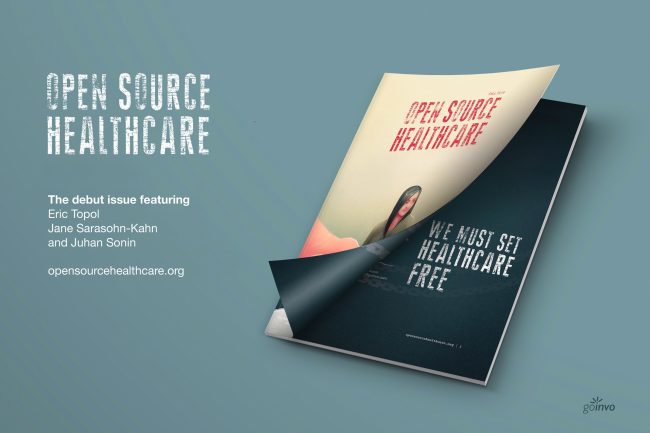
Information is power in the hands of people. When it’s open in the sunshine, it empowers people — whether doctors, patients, researchers, Presidents, teachers, students, Everyday People. Welcome to the era of Open Source Healthcare, not only the “about time” for patients to own their health, but for the launch of a new publication that will support and continue to evolve the concept. It’s really a movement that’s already in process. Let’s go back to some definitions and healthcare basics to understand just why Open Source Healthcare is already a thing. When information access is uneven, it’s considered
How MedModular Fits Into the New Lower-Cost, High-Quality, Consumer-Enchanted Healthcare World

In American health economics, there’s a demand side and a supply side. On the demand side, we’ve done a poor job trying to nudge patients and consumers toward rational economic decision making, lacking transparency, information symmetry, and basic health literacy. On the supply side, we’ve engaged in a medical arms race allocating capital resources to shinier and shinier new things, often without cost-benefit rationale or clinical evidence. On that supply side, though, I met up with an innovation that can help to bend the capital cost curve of how we envision and build new hospitals and clinics. This week, I
Most U.S. Physicians, Burned Out, Favor A Flavor of Single Payer Health System

Most physicians feel some level of burnout, hassled by electronic health records and lost autonomy. No wonder, then, that a majority of doctors favor some type single payer health system — one-quarter fully single payer, a la Britain’s National Health Service; and another one-third a single payer combined with a private insurance option, discovered in the 2018 Survey of America’s Physicians report on practice patterns & perspectives, published by The Physicians Foundation. Eight in ten physicians are working at full-capacity or are over-extended, the survey found. Furthermore, 62% of doctors are pessimistic about the future of medicine. Physician burnout is a
When Life and Health Insurance Blur: John Hancock, Behavioral Economics, and Wearable Tech

Most consumers look to every industry sector to help them engage with their health. And those companies include the insurance industry and financial services firms, we found in the 2010 Edelman Health Engagement Barometer. John Hancock, which covers about 10 million consumers across a range of products, is changing their business model for life insurance. Here’s the press release, titled, “John Hancock Leaves Traditional Life Insurance Model Behind to Incentivize Longer, Healthier Lives.” “We fundamentally believe life insurers should care about how long and well their customers live. With this decision, we are proud to become the only U.S. life insurance
Consumers Changing the Channel on Where They Shop for Health

Consumers who have long purchased over-the-counter medicines, anti-dandruff shampoo, whitening toothpaste, and cosmetics-with-benefits at food, drug and mass merchant retailers are switching to other places to shop for health, new data from AT Kearney and GMDC have found. The two organizations have collaborated to launch a new benchmarking study into health-beauty-wellness (HBW) sales, launched this weekend at the GMDC HBW Conference in Orlando. Overall, 2017 to 2018 year-on-year, HBW sales were flat-to-no growth, notwithstanding the consumer and influencer buzz around the categories. This study uncovered some very important trends underneath the macro numbers that tell a story
Retail Tomorrow, Today: A Smart Grocery Cart and Digital Samples For Paleo-Eating Moms

In our Amazon-Primed world, the future of retail is not ten years from now; it’s “tomorrow.” So GMDC, the association of retailers and brands who supply them, has formed a program called Retail Tomorrow to turbocharge the supply side with consumers who are already demanding convenience, immediate (or “soon”) gratification, and health where she/he “is.” That’s personalization, and that’s where retail health can and is making a difference in Everyday Peoples’ lives. In our DIY culture, we’re pumping our own petrol, making our own airline and hospitality reservations (from Expedia to Airbnb), trading stocks online, and cooking at home enabled by
Self-Care is Healthcare for Everyday People

Patients are the new healthcare payors, and as such, taking on the role of health consumers. In fact, health and wellness consumers have existed since a person purchased the first toothpaste, aspirin, heating pad, and moisturizing cream at retail. Or consulted with their neighborhood herbalista, homeopathic practitioner, therapeutic masseuse, or skin aesthetician. Today, the health and wellness consumer can DIY all of these things at home through a huge array of products available in pharmacies, supermarkets, Big Box stores, cosmetic superstores, convenience and dollar stores, and other retail channels – increasingly, online (THINK, of course, of Amazon — more on
Health Il-Literacy Costs

The complexity of the U.S. healthcare system erodes Americans’ health literacy, Accenture asserts in their report, The Hidden Cost of Healthcare System Complexity. And that complexity costs, Accenture calculated, to the tune of nearly $5 billion in administrative cost burden to payors. Accenture developed a healthcare system literacy index to quantify the relationship between peoples’ understanding of how health insurance works and what a lack of understanding can cost the system. The index looks at consumer comprehension of health insurance terms like premium, deductible, copayment, coinsurance, out-of-pocket
Going Digital for Health Is a New-Normal for Consumers

Using digital health tech is a new normal for U.S. consumers, including Seniors, found in the 2018 digital health consumer survey from Deloitte. The title of the report, “Consumers are on board with virtual health options,” summarizes the bullish outlook for telehealth. That’s the consumer-demand side of the equation. But the tagline begs the supply side question: “Can the health care system deliver?” For a decade or longer, we’ve noted the slow uptake of telehealth and digital health tools among healthcare providers. But the consumer pressures, along with evidence-based self-service options for health – both for “care” and for wellness,
The Top Pain Point in the Healthcare Consumer Experience is Money

Beyond the physical and emotional pain that people experience when they become a patient, in the U.S. that person becomes a consumer bearing expenses and financial pain, as well. 98% of Americans rank paying their medical bills is an important pain point in their patient journey, according to Embracing consumerism: Driving customer engagement in the healthcare financial journey, from Experian Health. Experian is best known as the consumer credit reporting agency; Experian Health works with healthcare providers on revenue cycle management, patient identity, and care management, so the company has experience with patient finance and medical expense sticker shock. In the
The Digital Health Consumer According to Rock Health
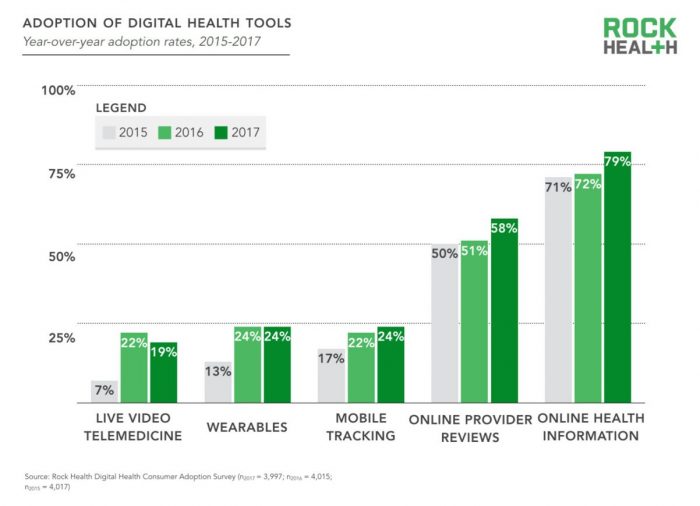
Looking for health information online is just part of being a normal, mainstream health consumer, according to the third Rock Health Digital Health Consumer Adoption Survey published this week. By 2017, 8 in 10 U.S. adults were online health information hunters. Six in 10 Americans looked for reviews of healthcare providers online, another new-normal consumer digital health activity. But only one in four people had used wearable technology for health, and one in five had participated in a live video telemedicine encounter. The Rock Health team observes that “the needle has not moved equally across every type of digital health solution.” Thus the
Best Buy Bets on AgingTech in the Expanding Retail Health Ecosystem
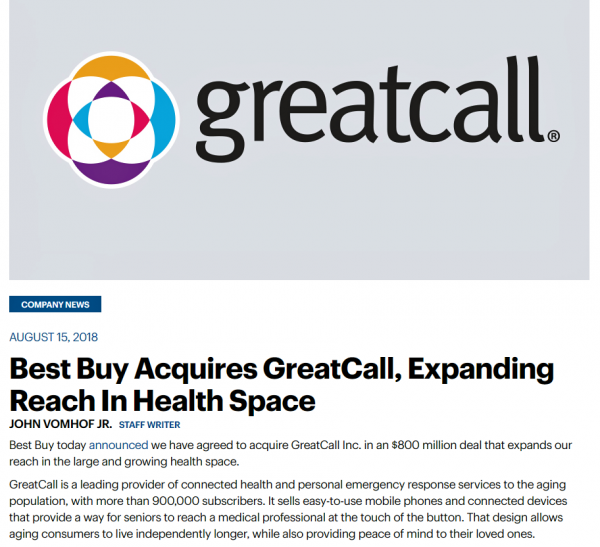
With the acquisition of GreatCall, a mature player in the aging-tech space, Best Buy is doubling down on consumer health technology@retail. This week at Best Buy. the electronics retailer, it’s out with CDs and in with technology for aging at home. The company announced that it would buy GreatCall for $800 million. A snippet from the announcement from Best Buy’s press release is shown in the first diagram, noting that GreatCall’s membership is approaching 1 million subscribers who use mobile phones and connected devices, “providing peace of mind to their loved ones.” Beyond the obvious “falling and I can’t get
Healthcare’s Profits Will Be Dramatically Redistributed as Care Shifts to Consumers: Accenture
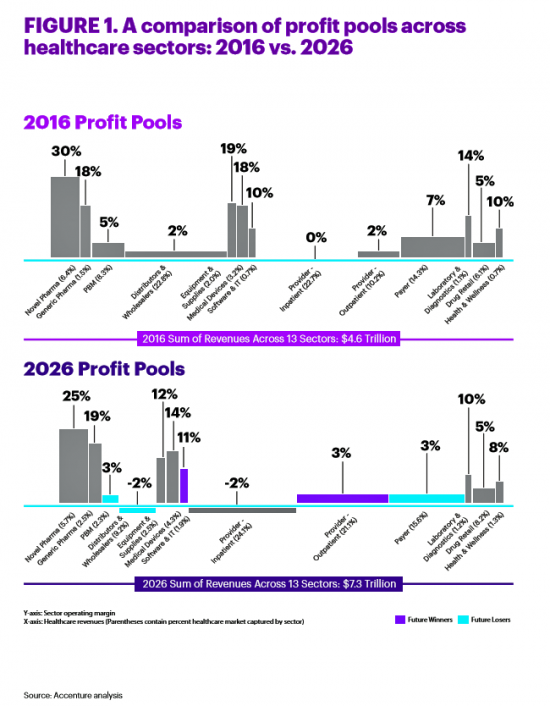
All sectors who are stakeholders in the healthcare ecosystem aren’t created equal, Accenture explains in their report, Healthcare’s future winners and losers. Observing the influx of new flavors of entrants like Amazon and Google, start-ups like Iora Health, Oscar and FetchMD, begs the question: how will legacy healthcare system players fare? Who will survive, and what will be the success factors that bolster long-term viability? To answer that question, Accenture points to three market trends that set “new rules” in healthcare: Blurred lines, which are the grey areas and adjacencies between technology, service, finance, and retail The middle of nowhere,
How Emotions and “Nocebos” Get in the Way of Preventive Healthcare
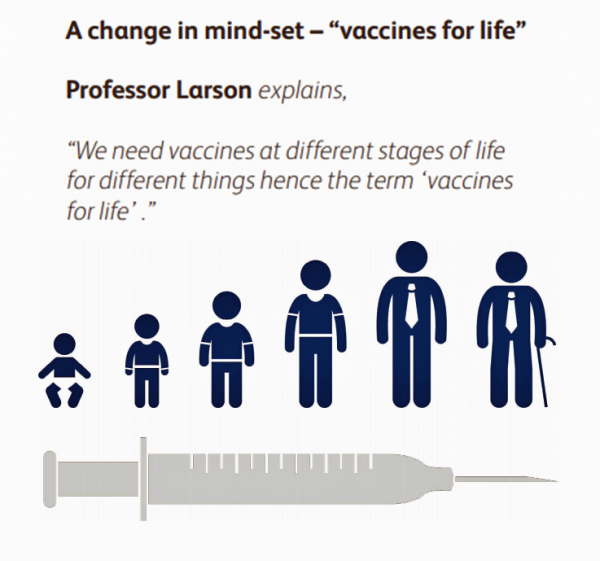
There are health facts that are based on rigorous scientific evidence. And, there are people who, for a variety of reasons, make irrational healthcare decisions without regard to those health facts. An important new report discusses the all-too-human aspects of people-as-patients, who often make health decisions based more on emotions than on the cold, hard truths that could save their lives and protect the well-being of loved ones. Preventative care and behavioural science: The emotional drivers of healthcare decisions is that report, sponsored by Pfizer Vaccines and written by the Economist Intelligence Unit (EIU). The report analyzes the psychological factors that shape consumers’ health
A Breakthrough, Sobering Report on Teens and Young Adults, Digital Health and Social Media Use: Implications for Mental Health
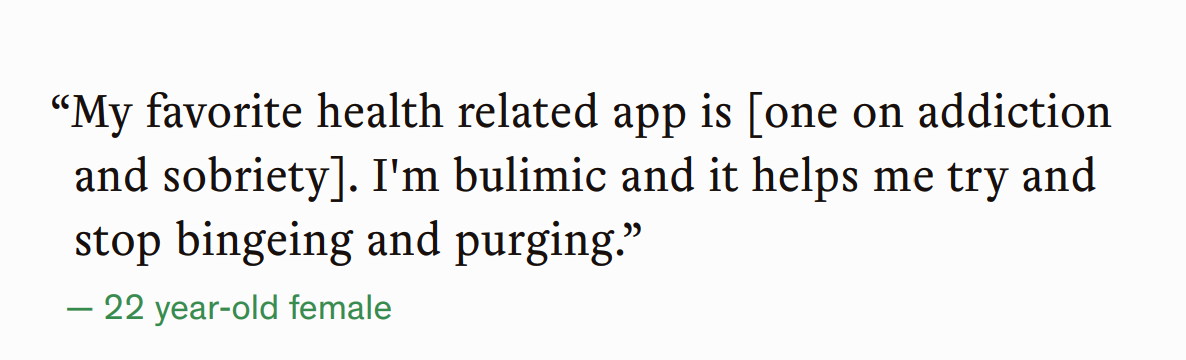
There’s a load of anecdotal data about teens and young adults (TYAs) and their always-on relationship with mobile phones and social networks. There are also hundreds of stories written in both mass media outlets and professional journals on the topic of TYAs and mental health: especially relative to depression and suicidality. In a breakthrough study, Hopelab and the Well Being Trust have sponsored the first deep-dive into the many dimensions of young people, their relationship with social media, and depression in Digital Health Practices, Social Media Use, and Mental Well-Being Among Teens and Young Adults in the U.S., The report was
Closing the Digital Health Gap Between Consumers and Physicians
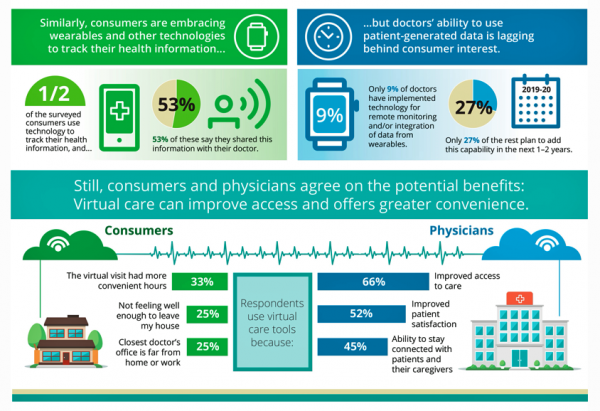
Consumers are more bullish demanding virtual and digital health tools from their physicians than doctors are in providing it, based on the research findings in What can health systems do to encourage physicians to embrace virtual care? from Deloitte. One-third of physicians have concerns about using virtual care services, such as medical errors that may result, access to technology, and data security. One in two U.S. consumers are now tracking health via digital tools, and one-half of these share the data generated by their apps. That sharing is limited by doctors’ ability to
In This Eroding Era of Trust, Consumers Look to Doctors Above Banks and Retailers for Trusted Sharing
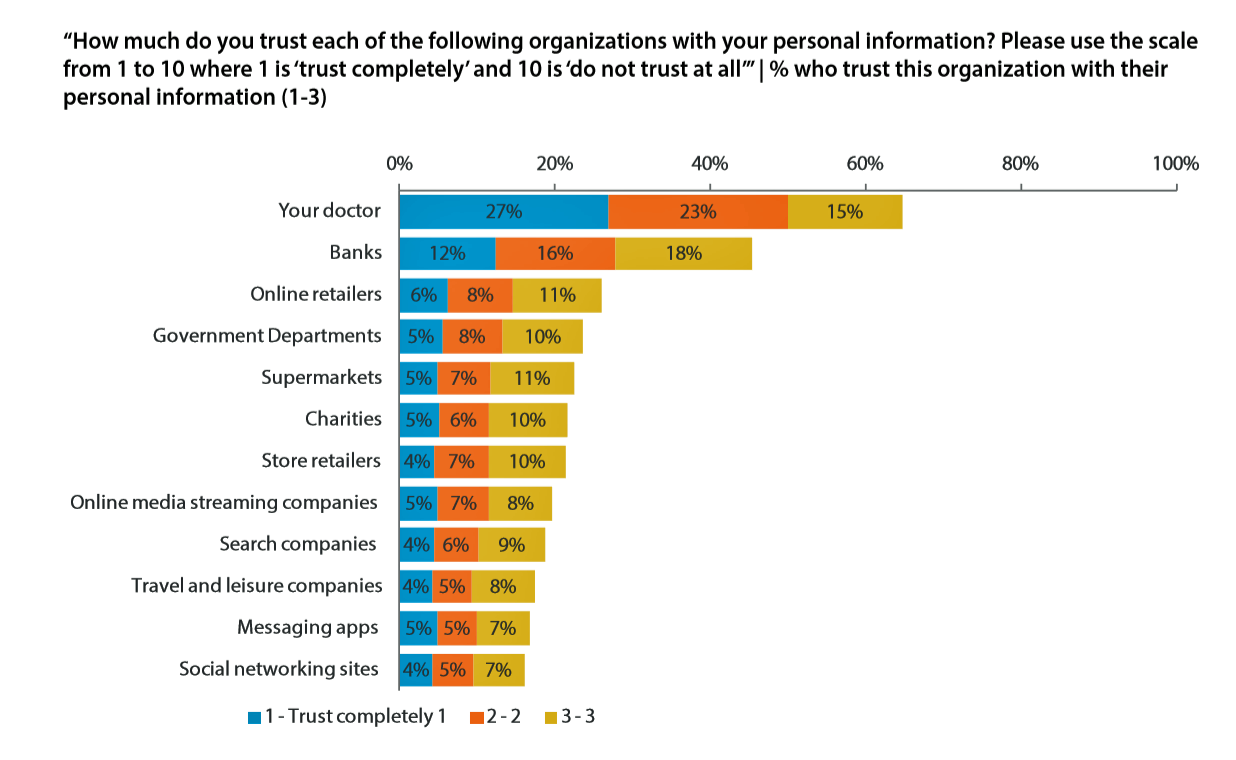
In this moment post-Cambridge Analytica/Facebook, the launch of the GDPR, and the everyday-ness of data breaches, consumers most trust doctors for sharing personal information. I’ve mined, through my health economic lens, the U.S. data published in the insightful report, Data Privacy: What the Consumer Really Thinks, a global research study from Axciom and the Data & Marketing Association (recently acquired by the Association of National Advertisers) working with Foresight Factory. The report compares consumers’ personal views on privacy and trust in ten countries: Argentina, Australia, Canada, France, Germany, the Netherlands, Singapore, Spain, the UK, and the US. We learn that Americans
Value Comes to Healthcare: But Whose Value Is It?
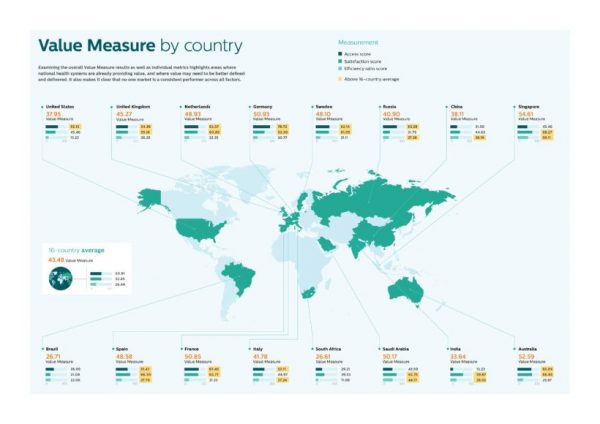
The Search for Value is the prevailing journey to a Holy Grail in healthcare these days. On that, most stakeholders working on the ground, globally. can agree. But whose value is it, anyway? Three reports published in the past few weeks give us some useful perspective on that question, woven together in today’s Health Populi blog. Let’s start with the Philips Future Health Index, which assesses value to 16 national health systems through three lenses: access, satisfaction, and efficiency. The results are shown in the map. “Value-based healthcare is contextual, geared towards providing the right care in the right place, at
Shinola Welcomes Immigrants on the 4th of July: A Love Letter from Detroit to the World Via NYC

Lady Liberty beckons to welcome the tired, the weary, and the ambitious to America in this Shinola video, made in my hometown Detroit. May this bring you joy and positive vibes on Independence Day 2018.
What the Pew Data on Americans’ Views on Technology Means for Healthcare
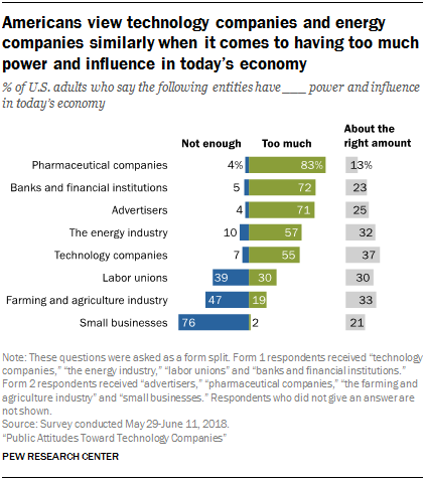
Most Americans say that pharmaceutical manufacturers, banks, advertisers, energy firms, and tech companies have too much power and influence in today’s American economy, according to Public Attitudes Toward Technology Companies, a research report from the Pew Research Center. A plurality of Americans says labor unions and farming and agriculture have too little power, along with a majority of people who believe that small business lacks sufficient power in the current U.S. economy. This data point is part of a larger consumer survey on Americans’ attitudes about the growing role of technology in society, particularly with respect to political and social impacts.
Design, Empathy and Ethics Come to Healthcare: HXD

Design-thinking has come to health/care, finally, and Amy Cueva has been beating this drum for a very long time. I’m delighted to be in her collegial circle, speaking at the conference about the evolving healthcare consumer who’s financially strapped, stressed-out, and Amazon Primed for customer service. I’m blogging live while attending HXD 2018 in Cambridge, MA, the health/care design conference convened by Mad*Pow, 26th and 27th June 2018. Today was Day 1 and I want to recap my learnings and share with you. Amy, Founder and Chief Experience Office of Mad*Pow, kicked off the conference with context-setting and inspiration. Design
Hospitals Work to Address Customer Experience Gap With Consumers, Kaufman Hall Finds

Hospital and healthcare providers are getting real about improving patient and health consumer experience, the latest Kaufman Hall research finds. The company’s 2018 State of Consumerism in Healthcare report is out, subtitled, “Activity in Search of Strategy.” Kaufman Hall has developed a Healthcare Consumerism Index for healthcare providers based on four pillars: access to care, consumer experience, pricing, and a strong foundation of consumer insights. Based on their assessment of providers on these components, Kaufman Hall found identified four tiers of performance: The top-performing group, Tier 1, includes only 8% of providers. These are the early adopters who allocate resources
Good Coffee + Engaging Design + Banking = Financial Health

As I walked by windows with Marvel-inspired superhero characters, I stopped to read their talk-bubbles: “strengthen your savings, power your financial quest, be the hero of your money, be one with your budget.” The top-line message here is that you can be your own fiscal superhero. The sign read, Capital One Cafe with Peet’s Coffee. But was it a bank branch or a cafe? I asked myself, passing by this sign yesterday morning at the corner of Walnut and 18th Streets in center city Philadelphia. It’s both, as it turned out, and when I entered I found a welcoming, beautifully
Thinking About Kate and Anthony – Suicide and Depression Is US

Yesterday at 1 pm, we learned that the incidence of suicide is up in America in a report from the Centers for Disease Control (CDC), an agency in the U.S. Department of Health and Human Services. This morning, we awake to news that Anthony Bourdain, the witty and prolific travel and food expert, took his own life. Earlier this week, Kate Spade, fashion designer and creative force, took her own life. The loss of these two bright lights, gone from our lives to suicide within a few days of each other, gives me the sad compulsion to say something, again, about
Doctors Say EHRs Are Good for Storage, But Risky for Patient Relationships and Burnout

Doctors have a complicated relationship with electronic health records (EHRs): two-thirds of primary care providers (PCPs) see value in digital records (EHRs), but at the same time believe the technology has weakened relationships with patients, detracted from clinical effectiveness, and lack streamlined user experience. That deficiency is, in three words, lack of interoperability; that challenge has required one-half of physician-users to use work-around’s to make their EHR investments more useful. These insights come out of a survey conducted among primary care providers by The Harris Poll for Stanford Medicine, published to coincide with the medical school’s convening of the EHR
Mary Meeker on Healthcare in 2018: Connectivity, Consumerization, and Costs
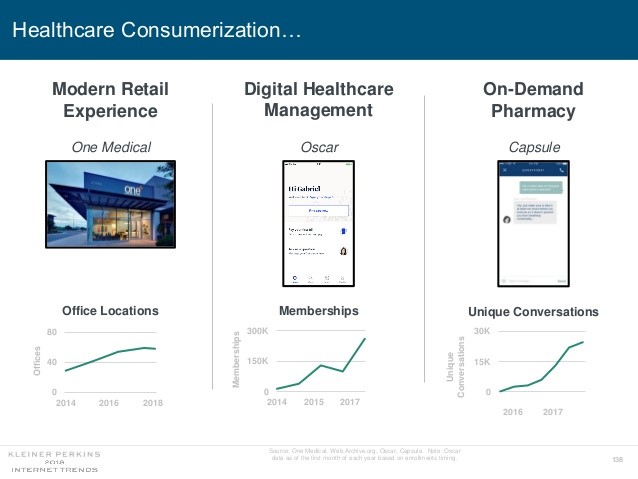
Health care features prominently in the nearly-300 slides curated by Mary Meeker in her always- informative report on Internet Trends 2018. Meeker, of Kleiner Perkins, released the report as usual at the Code Conference, held this year on 30 May 2018 in Silicon Valley. I’ve mined Meeker’s report for several years here on Health Populi: 2017 – Digital healthcare at the inflection point, via Mary Meeker 2015 – Musings with Mary Meeker on the digital/health nexus 2014 – Healthcare at an inflection point: digital trends via Mary Meeker 2013 – The role of internet technologies in reducing healthcare costs – Meeker
How to Make Healthcare More Intelligent and Trustworthy: Accenture’s Digital Health Tech Vision 2018
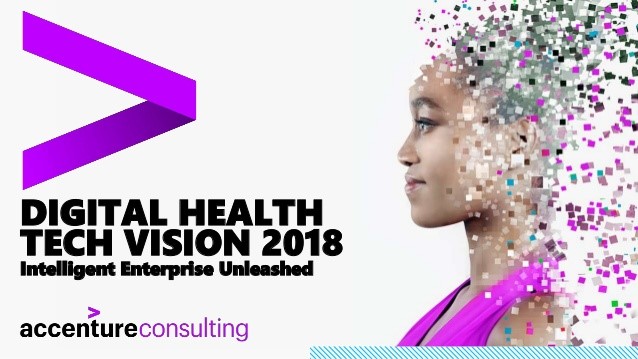
“Do no harm” has been the professional and ethical mantra of physicians since the Hippocratic Oath was first uttered by medical students. The origins of that three-word objective probably came out of Hippocrates’ Corpus, which included a few additional words: “to do good or to do no harm.” The proliferation and evolution of digital technologies in health care have the potential to do good or harm, depending on their application. Doing good and abstaining from doing harm can engender trust between patients, providers, and other stakeholders in health. Trust has become a key currency in provider/patient/supplier relationships: 94% of health executives
Think Like a LEGO Builder in Healthcare – Considering PwC’s New Health Economy Vision
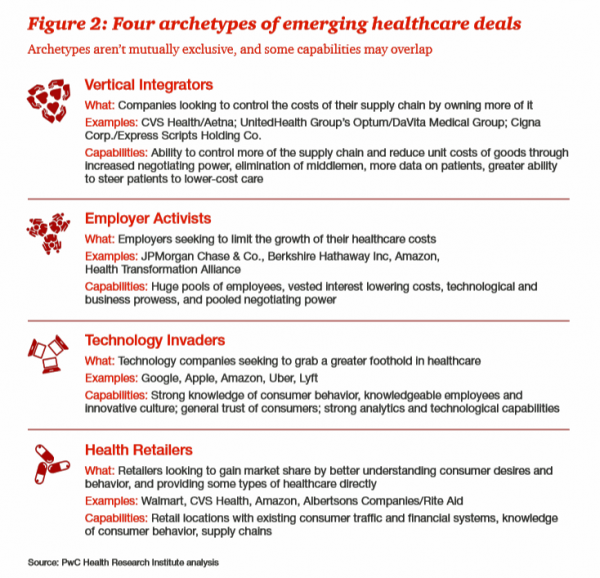
Expect “new combinations” of industry actors and technologies to reorganize and re-imagine healthcare, with an eye on both price and investments in customer experience (CX), PwC envisions in their latest report on The New Health Economy in the Age of Disruption. In this vision, healthcare will be a more flexible marketplace underpinned by data, platforms, and workers. Yes, it’s challenging to get from here-to-there, but PwC explains just how this can happen. Four archetypes, models, of healthcare deals have begun to emerge in the marketplace, illustrated by the Big Deals and announcements reshaping the industry in the past couple of years:
Food as Medicine – Philips’ Take On An Apple A Day from the Rijksmuseum
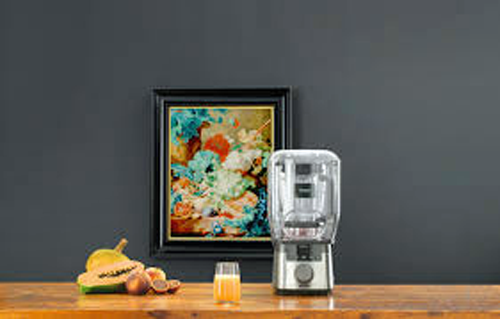
What if you went to visit a Vermeer still life with fruit, vegetables, and flowers, and the only image you saw in the famous painting was the flower and an urn? What if you heard the sounds of a juicing machine whirring as you reflected on a Rembrandt? That’s exactly what happened to museum-goers visiting Amsterdam’s Rijksmuseum. These art patrons witnessed a museum guard literally pulling an apple out of a painting, to leave a barren portrait of an urn and little else. Roll over, Anthony Oberman, the artist of “Still Life with Fruit in a Terracotta Dish,” one of
Re-Imagining Healthcare – a Lesson from Von Clausewitz in the Fog of War

When you’re on the battlefield and you can’t see what lies ahead, go high, recommended General Von Clausewitz in his book, On War. I paraphrase this prescription from the good General-strategist’s book, On War — “War is the realm of uncertainty; three-quarters of the factors on which action in war is based are wrapped in a fog of greater or lesser uncertainty. A sensitive and discriminating judgment is called for; a skilled intelligence to scent out the truth.” Governor Mark Leavitt, who held the post of Secretary of Health and Human Services under President Bush, offered this advice at the recent Liberation
Using Design to Liberate Healthcare; Learning from Dr. Andrew Chacko and Tan Le
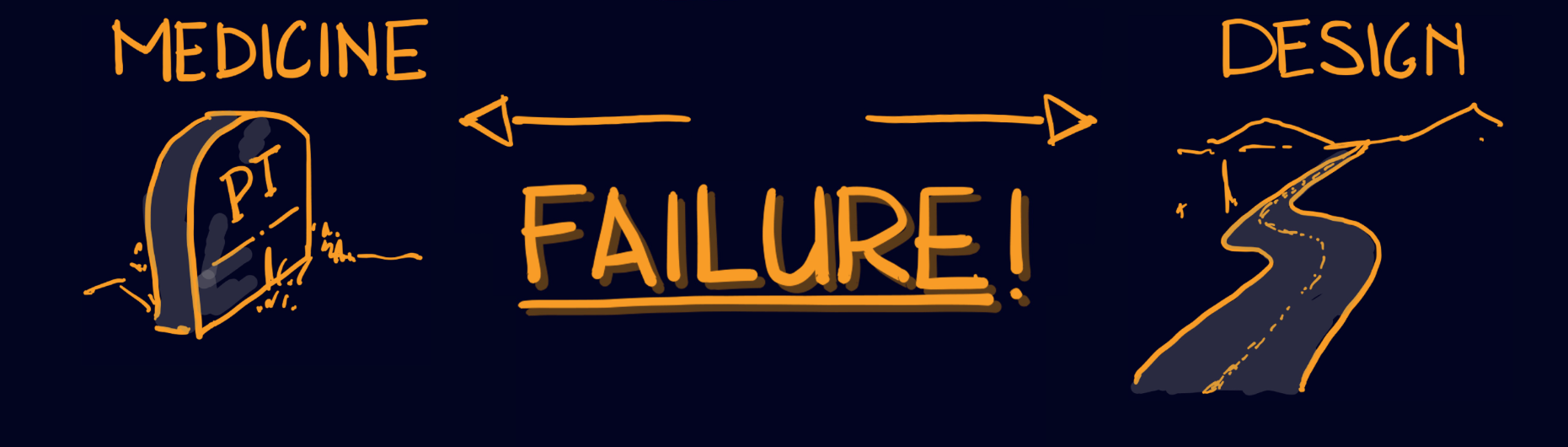
This is the second post of three written to summarize what I learned participating in Medecision’s annual meeting with the company’s partners, held March 27-29, 2018 at the Ritz-Carlton in Dallas, TX. I concluded the first of this three-part series with Dr. Don Rucker’s belief that, “Patients are the massive use-case for interoperability.” This second post focuses on the key role of designing for healthcare – for patients, caregivers, providers, all industry sector workers indeed. And designing information to make it beautiful, useable, meaningful. You’ll read about Renaissance Man/Doctor Andrew Chacko MD, a board-certified physician, French and Physics student at the Naval
Food as Medicine Update: Danone Goes B-Corp, Once Upon a Farm Garners Garner, and Livongo Buys Retrofit
As the nation battles an obesity epidemic that adds $$ costs to U.S. national health spending, there are many opportunities to address this impactful social determinant of health to reduce health spending per person and to drive public and individual health. In this post, I examine a few very current events in the food-as-medicine marketspace. Big Food as an industry gets a bad rap, as Big Tobacco and Big Oil have had. In the case of Big Food, the public health critique points to processed foods, those of high sugar content (especially when cleverly marketed to children), and sustainability. But
Livongo and Cambia Allying to Address Chronic Disease Burden and Scale Solutions to Consumers

Chronic diseases are what kill most people in the world. In the U.S., the chronic disease burden takes a massive toll on both public health and mortality, accounting for 7 in 10 deaths in America each year. That personal health toll comes at a high price and proportion of national health expenditures. A new alliance between Livongo and Cambia Health seeks to address that challenge, beginning with diabetes and scaling to other chronic conditions. Livongo has proven out the Livongo for Diabetes program, which has demonstrated positive outcomes in terms of patient satisfaction and cost-savings. The plan with Cambia is
Nudging Patients to Use EHRs: Moving Toward a Tipping Point for Consumer Health IT
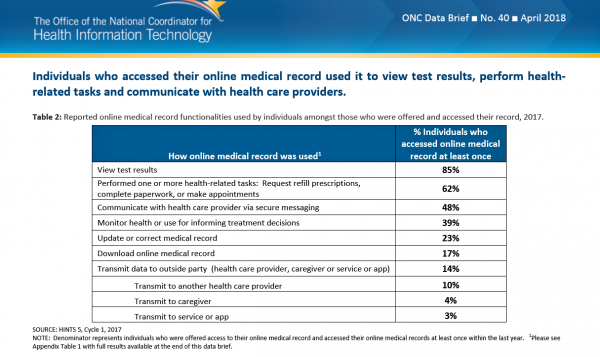
Half of U.S. patients were offered online access to their health records by providers or insurers, and one-half of them accessed the EHR at least once in the last year. One in four of those offered online EHR access looked at them more than 3 times. It takes a good nudge from a provider to motivate a patient to access online medical records, found by ONC in their latest research into consumers’ use of EHRs detailed in Individuals’ use of online medical records and technology for health needs, the ONC Data Brief No. 40, published April 2018. he concept of
What Would Healthcare Feel Like If It Acted Like Supermarkets – the 2018 Temkin Experience Ratings
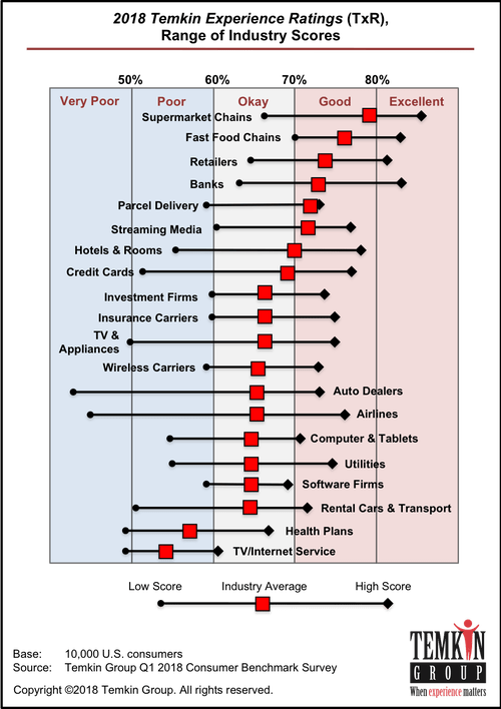
U.S. consumers rank supermarkets, fast food chains, retailers, and banks as their top performing industries for experience according to the 2018 Temkin Experience Ratings. Peoples’ experience with health plans rank at the bottom of the roster, on par with rental cars and TV/Internet service providers. If there is any good news for health plans in this year’s Temkin Experience Ratings compared to the 2017 results, it’s at the margin of “very poor” performance: last year, health plans has the worst performance of any industry (with the bar to the furthest point on the left as “low scoring”). This year, it
Please Stop Hating on Amazon, Mr. President. It’s Americans’ Favorite Brand.
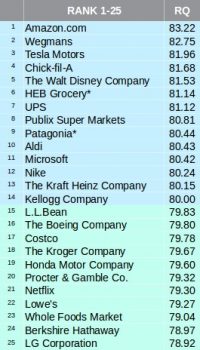
The most beloved company in America is Amazon, according to the 2018 Harris Poll Reputation Quotient Rankings which were published on 22nd March 2018. This was the third year in a row that Amazon garnered the top position in this corporate reputation poll, which gauges consumers’ views on workplace environment, social responsibility, emotional appeal, financial performance, vision and leadership, and products and services. Mr. President, why pick on Americans’ favorite brand? The brand defines the 2018 consumer’s benchmark for a best-retail experience, which is what people increasingly expect across the various interactions they have throughout a day. [As a sidebar,
FemTech is Hot, and Fitbit Knows It
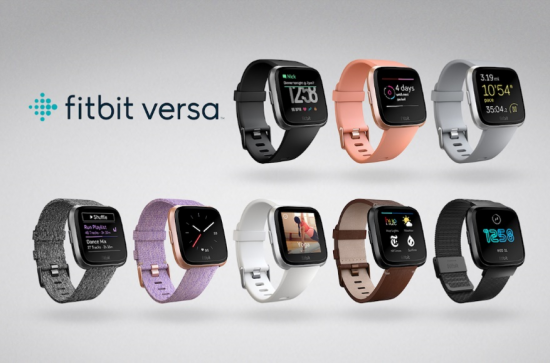
Girls Rule the World, Beyoncé has told us. But not when it comes to digital health…at least until 2018, as Fitbit has announced a woman-focused smartwatch called the Versa which is expected to hit the market in April 2018. The waterproof Versa will measure heart rate, do the usual fitness tracking metrics, and enable women to track their menstrual cycle. Fitbit has been quite clear that the device isn’t for conception or contraception. The watch will be priced at $199 at retail, a much lower price-point than the Apple Watch at $329. So here Fitbit also has an argument for
Wearable, Shareable, Virtual: The Demands of the Digital Health Consumer in 2018
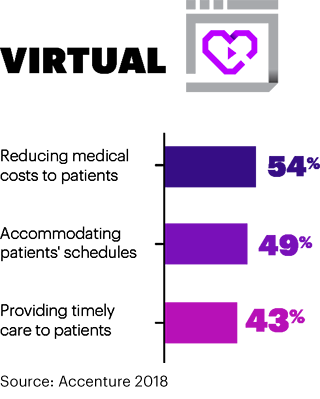
As I wrote here in April 2017, telehealth and virtual healthcare are mainstreaming. This week at the 2018 annual HIMSS conference, telehealth is playing a mainstream role in discussions about right-sizing and right-placing healthcare. The evidence for telehealth’s tipping point is rooted in new research published today by Accenture on Patients + Doctors + Machines, Accentures’ 2018 Consumer Survey on Digital Health. I sat down today with Dr. Kaveh Safavi who leads Accenture’s healthcare practice to discuss the results of this study into peoples’ atttudes toward healthcare technology and innovation. Three in four consumers in America say technology is
Collaboration is the New Innovation – Designing for Health with Amy Cueva at #HIMSS18
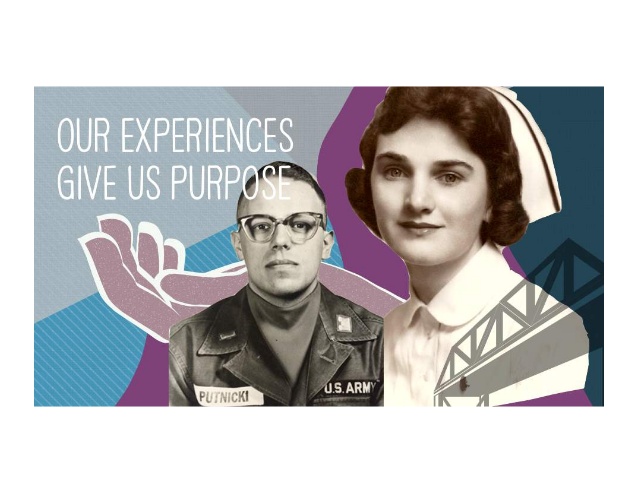
“It’s not about shiny new technologies but about designing relationships to truly impact the patient at the center of the disconnected ecosystem,” asserted Amy Cueva, Founder and CXO of the design consultancy Mad*Pow. That patient is a consumer, a caregiver; it’s you and me, Cueva explained. To reconnect the fragmented pieces of healthcare delivery, Cueva said, mantra-style, “collaboration is the new innovation.” And collaboration with patients, caregivers — the people for whom that healthcare is aimed — is the optimal workflow for effectively, enchantingly designing healthcare. In a talk she delivered at the Innovation Summit in a preconference meet-up at the annual
What the Latest Pew Consumer Data Means for #HIMSS18
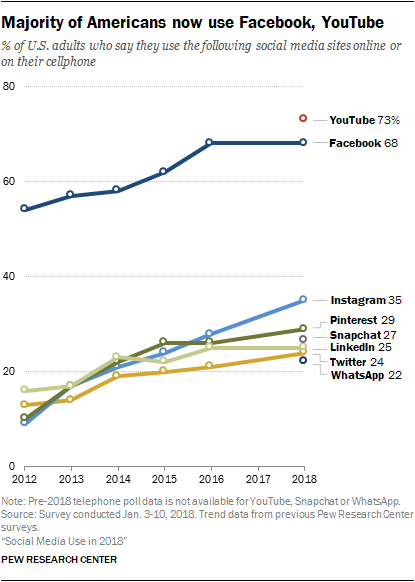
The median American uses 3 social networking platforms in 2018. Facebook is the primary platform for most Americans who use social media in 2018: two-thirds of U.S. adults use Facebook, and 3 in 4 of them check in on a daily basis. But in the past year, the percentage of people using Facebook and its corporate sister YouTube has flattened, based on the survey report, Social Media Use in 2018 from the Pew Research Center. The Pew team researched U.S. adults’ use of social media across eight popular platforms. Instagram has gained consumer favor over the past two years,
How One Hospital System Baked Love Into Their Health App
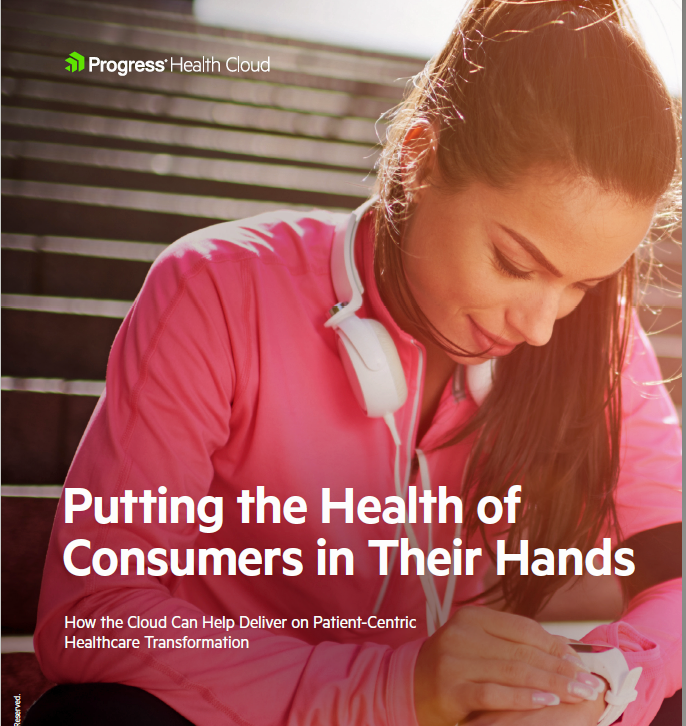
On July 18, 2017, Neil Gomes, Chief Digital Officer at Thomas Jefferson University and Jefferson Health in Philadelphia, tweeted this: When I saw this tweet, I was especially struck by Gomes’s phrase, “Designed & developed with heart/love by my @DICEGRP.” That’s Jefferson’s health solutions group that focuses on digital innovation and consumer experience. Here’s a health system that’s focused on that customer experience, which has become a critical success factor for healthcare to thrive. That’s because, as Steve Laughlin, VP and General Manager of IBM’s Global Consumer Group recently explained to me, a consumer’s last great customer experience becomes the
Add Behavioral Data to Social Determinants For Better Patient Understanding
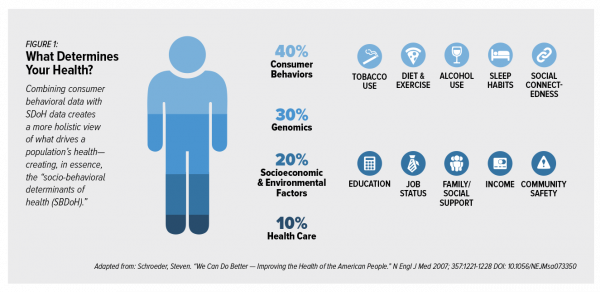
“Health agencies will have to become at least as sophisticated as other consumer/retail industries in analyzing a variety of data that helps uncover root causes of human behavior,” Gartner recommended in 2017. That’s because “health” is not all pre-determined by our parent-given genetics. Health is determined by many factors in our own hands, and in forces around us: physical environment, built environment, and public policy. These are the social determinants of health, but knowing them even for the N of 1 patient isn’t quite enough to help the healthcare industry move the needle on outcomes and costs. We need to
Building Trust and Truth in Patient Social Networks
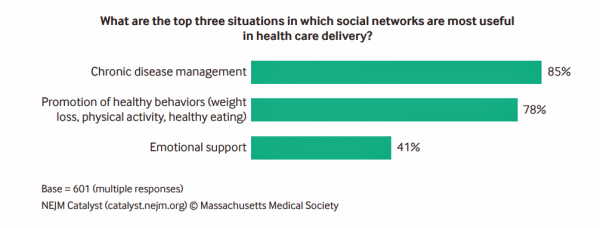
We are only just past the dawn of the second machine age, where digitization is enabling artificial intelligence. “Our new tools are destroying both trust and truth, creating a hunger for community and authenticity. We crave actual physical connection to neighbours, colleagues, and fellow townspeople, even if digitally facilitated.” Anne-Marie Slaughter wrote this in a column I read this morning in the Financial Times titled, “Our struggle with technology to protect trust and truth.” Trust and truth underpin health engagement, we learned in the first Edelman Health Engagement Barometer launched ten years ago. Those were the early days of the formation
Consumer Health and Patient Engagement – Are We There Yet?
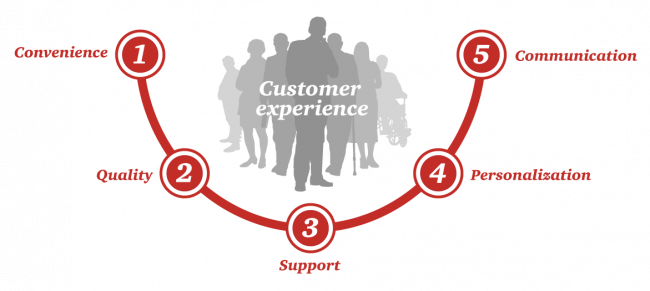
Along with artificial intelligence, patient engagement feels like the new black in health care right now. Perhaps that’s because we’re just two weeks out from the annual HIMSS Conference which will convene thousands of health IT wonks, users and developers (I am the former), but I’ve received several reports this week speaking to health engagement and technology that are worth some trend-weaving. As my colleague-friends Gregg Masters of Health Innovation Media (@2healthguru) and John Moore of Chilmark Research (@john_chilmark) challenged me on Twitter earlier this week: are we scaling sustained, real patient engagement and empowerment yet? Let’s dive into the
#Engage4Health: How Patients Are Morphing Into Healthcare Consumers, for #HIMSS18
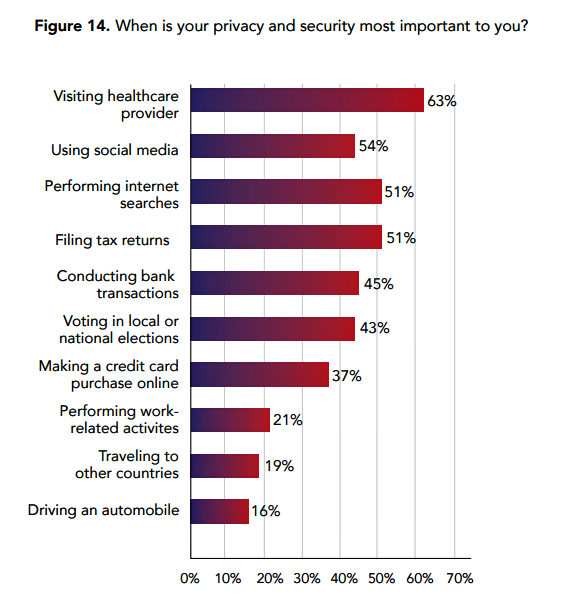
This blog appears today as part of a #HIMSS18 primer series for attendees, and the industry at large, to discuss major health IT issues that will help move health and healthcare delivery forward in 2018 – and beyond. I’m grateful to HIMSS to be one of 20 Social Media Ambassadors appointed for this year’s conference, which convenes in Las Vegas at the Sands Expo Center from March 5 to 9th, 2018. Prioritizing the patient-as-consumer through my health economic lens, the biggest priorities will be: Engaging patients in self-care and driving health and health plan literacy to better manage constrained access
When Buying a Pair of Jeans Competes With Filling a Prescription at CVS in Target
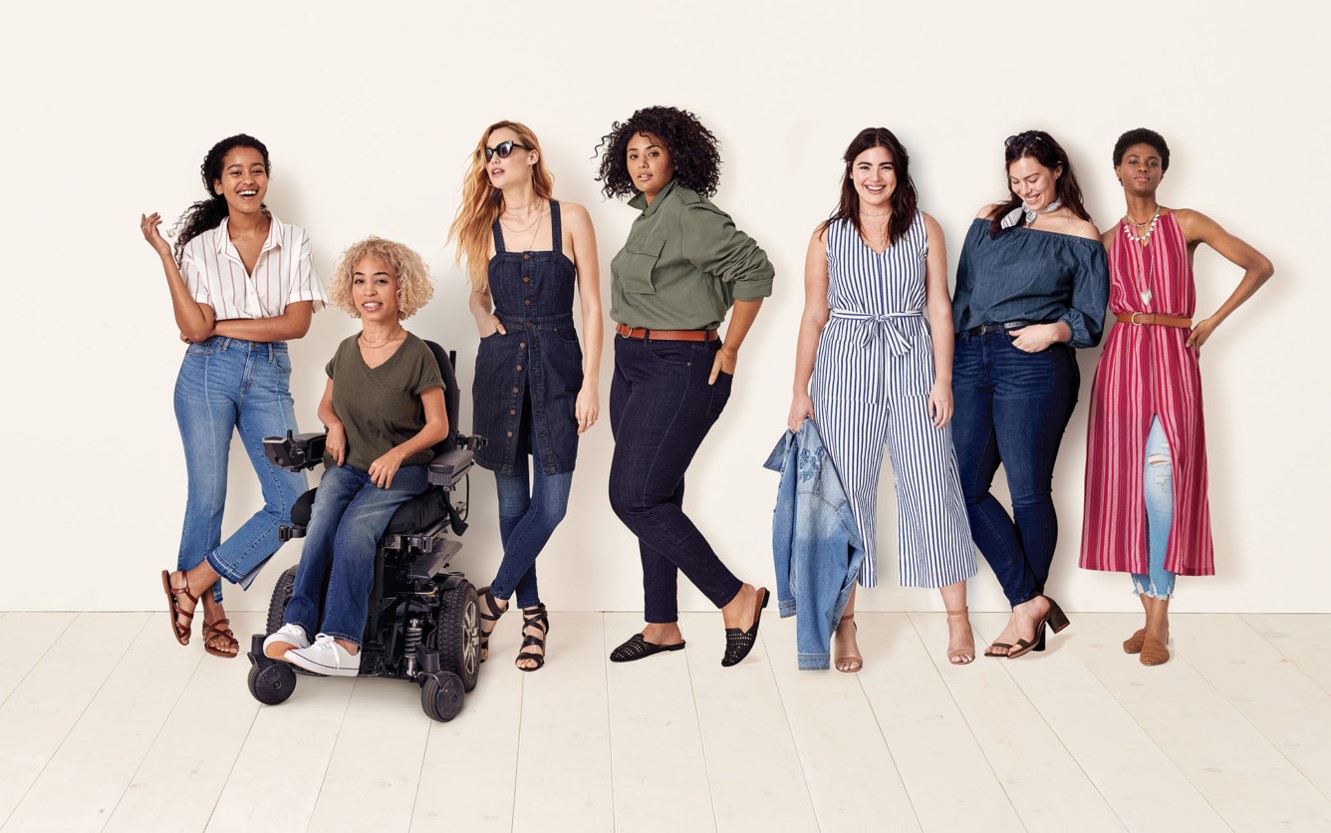
Stories about three fashion brands have me thinking about women and their health economics. Stay with me. Target unveiled its new line of clothing, Universal Thread, which features pieces that are accessible to women who may be dealing with physical limitations or sensory challenges. I first read about Universal Thread on The Mighty website, which is a community of over 1 million people interested in connecting on health and disabilities. As The Mighty described, the brand Universal Thread, “is centered around denim since it is a staple in many women’s wardrobes, but denim can be uncomfortable for many people with disabilities
 Thank you Aaron Strout for hosting our conversation on the Reaching Higher Podcast, now live on Apple, Spotify, and YouTube. We covered a lot of ground addressing health care and health citizenship, the growing prospects for our homes as our health hubs, and how our humanity is a key ingredient in health-making for all.
 Jane joined host Dr. Geeta "Dr. G" Nayyar and colleagues to brainstorm the value of vaccines for public and individual health in this challenging environment for health literacy, health politics, and health citizen grievance. Click onto the Pfizer Value of Vaccines site and you can watch four episodes covering the challenges with adult vaccination, the employer and health plan member's journey to vaccination, reimbursement, and collaborating for proactive prevention.
 I'm grateful to be part of the Duke Corporate Education faculty, sharing perspectives on the future of health care with health and life science companies. Once again, I'll be brainstorming the future of health care with a cohort of executives working in a global pharmaceutical company.