


Consumer-directed health isn’t always so healthy
Giving health consumers more skin in the game doesn’t always lead to them making sound health decisions. Over four years in consumer-directed health plans, enrollees used one-quarter fewer visits to doctors every year and filled one fewer prescription drugs. CDHP members also received fewer recommended cancer screenings, and visited the emergency room more often. These rational health consumer theory-busting findings were published in the June 2013 issue of the Health Affairs article, Consumer-Directed Health Plans Reduce The Long-Term Use of Outpatient Physician Visits And Prescription Drugs by Paul Fronstin of the Employee Benefit Research Institute and colleagues from IBM and RxEconomics,
Wellness at work – Virgin tells it all
Health, happiness and engagement among employees are closely-linked and drive productivity in the workplace. But there’s a gap between the kind of wellness services employers offer workers to bolster health, and the programs that people actually want. The current state of employer wellness programs is described in a survey conducted by Virgin HealthMiles and Workforce, The Business of Healthy Employees: A Survey of Workplace Health Priorities, published in June 2013. There’s a gap between what workers want for wellness and what employers are offering. Most-demanded by workers are health on-site food choices desired by 79% of employees; but, only 33%
Driving innovation in health through the use of open data: Health Datapalooza, Year 4
In the $3 trillion economy that is American health care, the role of information technology is central to transforming this huge piece of U.S. fiscal activity. This week convened the fourth annual Health Datapalooza (HDP) in Washington DC, with the underlying theme, “health engagement is the blockbuster drug of the 21st century” (quoting Leonard Kish). This meeting of over 2,000 registrants – huge growth from the first year’s 400 attendees — is organized by the Health Data Consortium (HDC) , whose CEO Dwayne Spradlin kicked off remarks on Day 2 of HDP4. He described the HDC, a public-private collaboration led
The role of internet technologies in reducing health care costs: Meeker inspirations
Tablets, wearables, smartphones, video and QR codes: these are fast-growing platforms moving data around the global economy. They’re also fast=growing platforms for health care where we live, work, play and pray. Mary Meeker’s annual presentation on Internet Trends at the D11 Conference, is fresh off the virtual press in its shiny new 2013 version. Meeker has been with the investment firm Kleiner Perkins Caulfield Byers (KPCB) since 2011, and was with Morgan Stanley from 1991 to 2010. She’s a veteran who’s watched the Internet basically from The Beginning. Of the 117 slides in her informative, gargantuan deck (a Meeker hallmark every
The importance of being banked for getting health insurance
While having money in the bank is always a prescription for feeling well, having a bank account is a precursor to getting health insurance under the Affordable Care Act. That fact could prevent millions of people who are eligible for health insurance premium subsidies under health reform from enrolling in a health plan. The issue of banking the un-banked in health is a little talked-about detail that, if overlooked, will scuttle the best-laid plans for health reform. That’s because if people enroll in health insurance, their monthly premiums will need to be debited from a bank account. So, without a
The health and wellness gap between insured and uninsured people
If you have health insurance, chances are you take several actions to bolster your health such as take vitamins and supplements (which 2 in 3 American adults do), take medications as prescribed (done by 58% of insured people), and tried to improve your eating habits in the past two years (56%). Most people with insurance also say they exercise at least 3 times a week. Fewer people who are uninsured undertake these kinds of health behaviors: across-the-board, uninsured people tend toward healthy behaviors less than those with insurance. This is The Prevention Problem, gleaned from a survey conducted by TeleVox
Health care costs for a family of 4 in 2013: a college education, a diamond or a 4-door sedan
If you have $22,030 in your wallet, you can buy: A princess-cut diamond A Ford Focus 4-door A year’s tuition at James Madison University (in-state, 2013-14) A health plan for a family of four. The 2013 Milliman Medical Index gauges the annual health care costs for a typical American family at $22,030, up $1,302 from 2012 — a 6.3% increase, nearly 6x the all-items increase of 1.1% for the U.S. Consumer Price Index from April 2012-April 2013. That 1.1% includes the costs of food and energy, along with cars, tobacco, shelter, and other consumer goods. In 2013, the average family will
Most employers will provide health insurance benefits in 2014…with more costs for employees
Nearly 100% of employers are likely to continue to provide health insurance benefits to workers in 2014, moving beyond a “wait and see” approach to the Affordable Care Act (ACA). As firms strategize tactics for a post-ACA world, nearly 40% will increase emphasis on high-deductible health plans with a health savings account, 43% will increase participants’ share of premium costs, and 33% will increase in-network deductibles for plan members. Two-thirds of U.S. companies have analyzed the ACA’s cost impact on their businesses but need to know more, according to the 2013 survey from the International Foundation of Employee Benefit Plans (IFEBP).
Angelina and Abercrombie: connecting the dots for healthy body image
This has been a week of shocking contrasts for women’s body image: from the triumphant, empowering public health role model of Angelina Jolie, whose op-ed column, My Medical Choice, appeared in the New York Times on May 14th, to the marketing message snafu of Abercrombie & Fitch. First, the Abercrombie affair: Mike Jeffries, CEO, said the following in a 2006 Salon interview that virally surfaced: “Because good-looking people attract other good-looking people, and we want to market to cool, good-looking people. We don’t market to anyone other than that,” identifying the “cool kids” as the company’s target market. “A lot of
The physician-consumer health IT chasm: most doctors lagging in online patient support tools
In the long-run, health information technology (HIT) will improve the quality of health care, according to 73% of U.S. physicians. However, about the same number (7 in 10 physicians) believe that the ROI on health IT is inflated and that implementing EHRs will cost more, not less. Still, market forces from health insurance plans, payers and consumers are driving health IT adoption, according to Deloitte’s survey report, Physician adoption of health information technology: implications for medical practice leaders and business partners. Electronic health records (EHR) adoption and meeting meaningful use (MU) Stage 1 criteria appears strongly related to the size
The health/wealth disconnect in America
Two in 3 Americans are uncomfortable with their financial situation. And most are totally oblivious to how much money they will need to spend on health care in the future. Seven in 10 people expect to spend less than 10% of their monthly retirement income on medical and dental expenses; but the real number is 30% of income needed for health care in retirement, according to The Urban Institute. The Wellness for Life survey, conducted for Aviva, the life and disability company, collaborating with the Mayo Clinic, finds an American health citizen out of touch with their personal health economics.
The decline and fall of pharmaceutical spending…short- or long-term phenomenon?
The prescription drug cost curve is bending…for the time being. Spending on medicines fell by 3.5% in 2012 and will continue to fall below overall health spending over the next five years to 2017. But different from general health spending, there’s a new game in town called specialty medicines, and they cost a whole lot more than the generics and the aging brands that bent the cost curve in 2012. The declining Rx spending story is only part of a complicated tale told in great detail in a comprehensive report from the IMS Institute for Healthcare Informatics, Declining Medicine Use
Marketing Digital Health to Mom 2.0 on Mother’s Day 2013
Mainstream media, both print and online, peppered their 2013 Mother’s Day gift suggestions including pod coffeemakers, bangle bracelets, candy-colored accessories and digital health devices. Say, what? In Parade magazine, Mother’s Day 2013 gift ideas included the Fitbit “smart pedometer,” linked to a “buy” site at REI. You can’t get much more mainstream than Parade. In Entertainment Weekly, Bronwyn Barnes, style maven for the magazine, wrote a one-page “Get Ready for Mom 2.0” and her recommendations included the Pebble Smartwatch, the Jawbone Up wristband, and the HoodieBuddie with earbuds built into the drawstrings. Men’s Health told sons and husbands to check
Call it DTH, direct to home: Pfizer is shipping Viagra direct to consume
While the blockbuster erectile dysfunction (ED) drug has been shipped directly to consumer’s homes for years via pharmacy benefits management companies and specialty pharmacy retailers catering to the ED segment, Pfizer wants in on the transaction and has decided to get into the Direct-to-Consumer (DTC) distribution business for a prescription drug. Call this market development Direct-to-Home, or DTH. This is a kind of sentinel event signaling a pharmaceutical manufacturer cutting out the middle-man (read: retail pharmacy), and in this case getting up-close-and-personal with users of a drug that represents quality of life. Another motivation for Pfizer is trying to stem
A physical activity shortage: Let’s Move!
Only 1 in 5 Americans got the minimum recommended amount of physical activity in 2011, based on guidelines offered by the U.S. Centers for Disease Control. More men than women met the standard: 23.4% of men versus 17.9% of women. There are wide variations across the 50 states, as the map shows, with the healthiest folks exercise-wise living in the west, Alaska, upper midwest, and New England. The range runs from a 12.7% low in West Virginia and Tennessee to 27.3 at the high end in Colorado. That bar is set at 150 minutes a week (that’s 2.5 hours) of
Dietitians provide a health bridge between food and pharmacy
The registered dietitian is an in-demand labor resource for grocery stores around the U.S. Advertising Age covered the phenomenon of the growing clout of dietitians in food chains (April 14, 2013). Let’s dig further into this phenomenon through the Health Populi lens on healthcareDIY and peoples’ ability to bend their personal health care cost curves. Stores such as Giant Eagle, Hy-Vee, Safeway and Wegmans are morphing into wellness destinations, with pharmacies and natural food aisles taking up valuable square footage to meet consumers’ growing demands for healthy choices. Some stores are formalizing their approach to food = health by formulating a
The Slow Economy Has Slowed Health Spending
Why has health cost growth in the U.S. slowed in the past few years? It’s mostly due to the economy, argues the Kaiser Family Foundation in Assessing the Effects of the Economy on the Recent Slowdown of Health Spending. The answer to this question is important because, as the American economy recovers, it begs the next question: will costs increase faster once again as they did in previous go-go U.S. economies, further exacerbating the budget deficit problems in the long-term? KFF worked with Altarum to develop an economic model to answer these questions. The chart illustrates the predicted vs. actual
FDA goes DTP(atient)
The Food & Drug Administration (FDA) launched its new website for and about patients, the Patient Network, with the tagline, “Bringing your voice to drug and device approval and safety.” With this move, the FDA moves toward social health, someplace where at least one-third of U.S. consumers already opine, shop, share personal info, crowdsource cures, and support each other on all-matters-health-and-illness. The objective of the Patient Network is, “to help FDA help patients have a bigger voice.” Dr. Margaret Hamburg, the Commissioner of the FDA, talks about the concept here. The rationale? “When patients better understand the intricacies of how
Bending the cost-curve: a proposal from some Old School bipartisans
Strange political bedfellows have come together to draft a formula for dealing with spiraling health care costs in the U.S. iin A Bipartisan Rx for Patient-Centered Care and System-Wide Cost Containment from the Bipartisan Policy Center (BPC). The BPC was founded by Senate Majority Leaders Howard Baker, Tom Daschle, Bob Dole, and George Mitchell. This report also involved Bill Frist, Pete Domenici, and former White House and Congressional Budget Office Director Dr. Alice Rivlin who together work with the Health Care Cost Containment Initiative at the BPC. The essence of the 132-page report is that the U.S. health system is
Food = Health for employers, hospitals, health plans and consumers
Food is inextricably bound up with health whether we are well or not. Several key area of the Food=Health ecosystem made the news this week which, together, will impact public and personal health. On the employer health benefits front, more media are covering the story on CVS strongly incentivizing employees to drop body mass index (BMI) through behavioral economics-inspired health plan design of a $50 peer month penalty. Michelin, whose bulky advertising icon Bibendum has more than one “spare tire,” introduced a program to combat health issues, including but not limited to BMI and high blood pressure, according to the
US Health Executives Predict the ACA Will Increase Health Insurance Premiums
As a result of implementing the Affordable Care Act (health reform), most U.S. health executives crystal balls foresee health care insurance premiums will increase over 10% in the next three years. 4 in 10 predict premiums will grow over 25% over the next 3 years. This sobering forecast comes out of a Munich RE Health survey conducted among 326 health industry executives in March 2013. Those polled included representatives from health plans, managed care, disease management firms, and health insurance brokers and agents. How do health execs expect employers would deal with such fast-rising health premium costs? Why shift more
Let patients help: the BMJ covers an American ePatient’s learnings
In this week’s BMJ (British Medical Journal), an American patient tells his story about being equipped, enabled, empowered and engaged — the many “e’s” making up the prefix of “ePatient.” This definition comes out of the work of Dr. Tom Ferguson, who worked with the e-Patient Scholars Working Group in 2007, to publish the first white paper about the phenomenon, e-Patients: how they can help us heal health care. ePatient Dave is the patient-author of the BMJ piece, making the case for shared decision-making and patient involvement in health care decisions. He writes in the conclusion, “The value delivered by skilled
1 in 5 US consumers asks a doctor for a lower-cost Rx
With U.S. health consumers spending $45 billion out-of-pocket for prescription drugs in 2011, pharmaceutical products are morphing into retail health products. As such, as they do with any other consumer good, consumers can vote with their feet by walking away from a product purchase or making the spend based on the price of the product and its attributes, along with whether there are substitutes available in the marketplace. When it comes to prescription drugs, it’s not as clear-cut, according to the Centers for Disease Control‘s analysis of data from the 2011 National Health Interview Survey titled Strategies Used by
The need for a Zagat and TripAdvisor in health care
Patient satisfaction survey scores have begun to directly impact Medicare payment for health providers. Health plan members are morphing into health consumers spending “real money” in high-deductible health plans. Newly-diagnosed patients with chronic conditions look online for information to sort out whether a generic drug is equivalent to a branded Rx that costs five-times the out-of-pocket cost of the cheaper substitute. While health care report cards have been around for many years, consumers’ need to get their arms around relevant and accessible information on quality and value is driving a new market for a Yelp, Travelocity, or Zagat in
The value of big data in health care = $450 billion
Exploiting Big Data in industry is Big News these days, and nowhere is the potential for leveraging the concept greater than in health care. McKinsey & Company estimates that harnessing big data across five dimensions of health care could yield nearly one-half trillion dollars’ worth of value in The ‘big data’ revolution in healthcare. The chart summarizes McKinsey’s calculations on the value of Big Data in health care at its maximum. Before digging into the value potential, just what is Big Data in health care? Statistics and information are generated in the health care system about patients: say, during visits
Walgreens Steps with Balance program rewards both consumers and the store
Consumers who patronize Walgreens can get rewarded for tracking their physical activity For the Steps with Balance program kickoff, self-tracking consumers can earn 20 points for every mile walked or run and 20 points for tracking weight. Walgreens implemented the Walk with Walgreens program in 2012. The program won an Effie Award for an outstanding marketing program. With the success of Walk with Walgreens, the retail pharmacy company has expanded the program beyond simple steps to include weight tracking and health goals for earning loyalty points. The program enables a few of the most popular self-tracking devices to sync so
U.S. Health Costs vs. The World: Is It Still The Prices, and Are We Still Stupid?
Comparing health care prices in the U.S. with those in other developed countries is an exercise in sticker shock. The cost of a hospital day in the U.S. was, on average, $4,287 in 2012. It was $853 in France, a nation often lauded for its excellent health system and patient outcomes but with a health system that’s financially strapped. A routine office visit to a doctor cost an average of $95 in the U.S. in 2012. The same visit was priced at $30 in Canada and $30 in France, as well. A hip replacement cost $40,364 on average in the
The Not-So-Affordable Care Act? Cost-squeezed Americans still confused and need to know more
While health care cost growth has slowed nationally, most Americans feel they’re going up faster than usual. 1 in 3 people believe their own health costs have gone up faster than usual, and 1 in 4 feel they’re going out about “the same amount” as usual. For only one-third, health costs feel like they’re staying even. As the second quarter of 2013 begins and the implementation of the Affordable Care Act (ACA, aka “health reform” and “Obamacare”) looms nearer, most Americans still don’t understand how the ACA will impact them. Most Americans (57%) believe the law will create a government-run health plan,
Most consumers will look to health insurance exchanges to buy individual plans in 2013
As the Affordable Care Act, health reform, aka Obamacare, rolls out in 2013, American health insurance shoppers will look for sources of information they can trust on health plan quality and customer service satisfaction — as they do for automobiles, mobile phone plans, and washing machines. For many years, one of a handful of trusted sources for such insights has been J.D. Power and Associates. J.D. Power released its 2013 Member Health Plan Study (the seventh annual survey) and found that most consumers currently enrolled in a health plan have had a choice of only “one” at the time
An American Nanny State? Most Americans support government tactics addressing lifestyle impacts on chronic disease
Most people like government policies targeting reducing tobacco use, requiring food manufacturers and restaurants to reduce salt content, and mandating schools to require 45 minutes of daily activity for students. A large majority of Americans (at least 8 in 10 people) support government actions to promote public health that stem chronic disease, from preventing cancer (89%) and heart disease (86%) to helping people control their diabetes (84%) and preventing childhood obesity (81%). A Survey Finds Public Support For Legal Interventions Directed At Health Behavior To Fight Noncommunicable Disease (NCD). This poll, published in the March 2013 issue of Health Affairs, profiles the
Arianna and Lupe and Deepak and Sanjay – will the cool factor drive mobile health adoption?
Digital health is attracting the likes of Bill Clinton, Lupe Fiasco, Deepak Chopra, Dr. Sanjay Gupta, Arianna Huffington, and numerous famous athletes who rep a growing array of activity trackers, wearable sensors, and mobile health apps. Will this diverse cadre of popular celebs drive consumer adoption of mobile health? Can a “cool factor” motivate people to try out mobile health tools that, over time, help people sustain healthy behaviors? Mobile and digital health is a fast-growing, good-news segment in the U.S. macroeconomy. The industry attracted more venture capital in 2012 than other health sectors, based on Rock Health’s analysis of the year-in-review. Digital health
The lights are still out on health prices for Americans – #healthcost transparency limits consumerism in health
Only two U.S. states have comprehensive health care price transparency regulations that ensure citizens’ access to clear and open health price information. While those two states, Massachusetts and New Hampshire, earn an “A” in the Report Card on State Price Transparency Laws, an addition five state earn a “B,” with the remainder of the United States garnering a “C” or less. The map illustrates that most states are red states, earning the lowest score of “F.” With the growth of high-deductible health plans (under the umbrella of so-called “consumer-directed” plans) where health consumers pay thousands of dollars to meet a spending
Do doctors want patients to have full access their own medical information? It depends.
Only one-third of U.S. physicians believe that patients should have “full access” to their electronic health records, according to Patient Access to Electronic Health Records What Does the Doctor Order?, a survey conducted by Accenture, released at HIMSS13 in March 2013. Two-thirds of doctors in the U.S. are open to patients having “limited access” to their EHRs. However, the extent to which doctors believe in full EHR access for patients depends on the type of health information contained in the record. Accenture surveyed 3,700 physicians in eight countries: Australia, Canada, England, France, Germany, Singapore, Spain and the United States, and found the doctors’
Gettin’ higi with it: Lupe Fiasco’s foray into public health
The latest in SoLoMo (Social, Local, Mobile) Health is a gamified tool coupled with a hardware kiosk, known as higi. The brainchild of Michael Ferro, a successful dotcom entrepreneur who now owns the Chicago Sun-Times, higi’s mission is to help people – particularly younger peeps – to take better care of themselves by scoring points and, as a result, social connections. Higi’s an African word for origin, so the health tool has some aspects relating to being in a tribe — a kind of health tribe. It also has a fun sound to it, Ferro noted, which sets the vibe
The Sitting Disease: health is growing at SXSW
If it’s March, it must be time for South by Southwest (SXSW), the annual conference weaving music, film and interactive tracks of speakers and conferees that overcrowds and excites Austin, Texas, with a cool vibe and even cooler ideas. I’ll be participating on Sunday 10 March 2013 at 5 pm on a panel, Sitting Will Kill You: Can Mobile Save Us?, featuring Fran Melmed, developer of the HotSeat app that nudges us to all Get Up Offa Our Things when living our typical sedentary lives; Peter Katzmarzyk, public health researcher who knows all about the relationship between too much sitting
Bill Clinton’s public health, cost-bending message thrills health IT folks at HIMSS
In 2010, the folks who supported health care reform were massacred by the polls, Bill Clinton told a rapt audience of thousands at HIMSS13 yesterday. In 2012, the folks who were against health care reform were similarly rejected. President Clinton gave the keynote speech at the annual HIMSS conference on March 6, 2013, and by the spillover, standing-room-only crowd in the largest hall at the New Orleans Convention Center, Clinton was a rock star. Proof: with still nearly an hour to go before his 1 pm speech, the auditorium was already full with only a few seats left in the
Eric Topol creatively destroys medicine at #HIMSS13
Wearing his Walking Gallery jacket painted by (im)patient advocate, Regina Holliday, Dr. Eric Topol evangelized the benefits of digital medicine and consumer empowerment in health care, largely summarizing his epic (pun intended – wait for Hot Point, below) book, The Creative Destruction of Medicine. A founder of the West Wireless Health Institute (now known as West Health), Dr. Topol is a physician and researcher at Scripps and was recently named as editor at Medscape. A new piece of Topol Trivia for me is that GQ magazine called him a rock star of science. Dr. Topol is one of the more
A health economics lesson from Jonathan Bush, at the helm of athenahealth
At HIMSS13 there are the equivalent of rock stars. Some of these are health system CIOs and health IT gurus who are driving significant and positive changes in their organizations, like Blackford Middleton, Keith Boone, Brian Ahier, and John Halamka. Others are C-level execs at health IT companies. In this latter group, many avoid the paparazzi (read: health trade reporters) and stay cocooned behind closed doors in two-story pieces of posh real estate on the exhibition floor. A few walk the floor, shake hands with folks, and take in the vibe of the event. We’ll call them open-source personalities. The
Patients globally would embrace Jetsons-style health care…but will health providers?
Patients are getting comfortable with remote health care – that is, receiving care from a health provider at a distance via, say, telehealth or via a Skype-type of set-up. Furthermore, 70% of people globally saying they would trust an automated device to provide a diagnosis that would help them determine whether or note they needed to see a doctor. Based on the findings from Cisco‘s survey summarized in the Cisco Connected Customer Experience Report – Healthcare, published March 4, 2013, just-in-time for the annual 2013 HIMSS conference, a majority patients the world over are embracing health care delivered via communications
The future of sensors in health care – passive, designed, integrated
Here’s Ann R., who is a patient in the not-too-distance-future, when passive sensors will be embedded in her everyday life. The infographic illustrates a disruption in health care for people, where data are collected on us (with our permission) that can help us improve our own self-care, and help our clinicians know more about us outside of their offices, exam rooms and institutions. In Making Sense of Sensors: How New Technologies Can Change Patient Care, my paper for the California HealthCare Foundation, I set out to organize the many types of sensors proliferating the health care landscape, and identify key
Consumer health empowerment is compromised by complex information
The U.S. economy is largely built on consumer purchasing (the big “C” in the GDP* – see note, below Hot Points). Americans have universally embraced their role as consumers in virtually every aspect of life — learning to self-rely in making travel plans, stock trades, photo development, and purchasing big-dollar hard goods (like cars and washing machines). Consumers transact these activities thanks to usable tools and information that empower them to learn, compare, and execute smarter decisions. That is, in every aspect of life but in health care. While the banner of “consumerism” in health care has been flown
Health is wealth and wealth, health
It’s America Saves Week (February 25-March 2, 2013). Do you know what your savings rate is? If you’re in the center of the American savings bell curve, you probably don’t have a savings plan with specific goals and don’t know your net worth. Two-thirds of U.S. adults say they have sufficient emergency savings for unexpected expenses like a visit to a doctor. However, only one-half of non-retired people believe they’re saving enough for a retirement where they’ll have a “desirable standard of living.” This six annual survey by the Consumer Federation of America, the American Savings Education Council, and the
The Accountable Care Community opportunity
“ACOs most assuredly will not…deliver the disruptive innovation that the U.S. health-care system urgently needs,” wrote Clay Christensen, godfather of disruptive innovation, et. al., in an op-ed in the Wall Street Journal of February18, 2013. In the opinion piece, Christensen and colleagues make the argument that Accountable Care Organizations (ACOs) as initially conceived won’t address several key underlying forces that keep the U.S. health care industry in stasis: Physicians’ behavior will have to change to drive cost-reduction. Clinicians will need “re-education,” the authors say, adopting evidence-based medicine and operating in lower-cost milieus. Patients’ behavior will have to change. This requires
Required reading: TIME Magazine’s Bitter Pill Cover Story
Today’s Health Populi is devoted to Steven Brill and his colleagues at TIME magazine whose special report, Bitter Pill: Why Medical Bills Are Killing Us, is required reading for every health citizen in the United States. Among many lightbulb moments for readers, key findings from the piece are: Local hospitals are beloved charities to people who live in their market – Brill calls these institutions “Non-Profit Profitmakers). They’re the single most politically powerful player in most Congressional districts The poor and less affluent more often pay the high chargemaster (“retail list”) price for health products and services vs. the wealthy
Health consumers don’t understand overtreatment, and their role in driving health costs
Overuse of health care is defined as the delivery of health care services for which the risks outweigh the benefits, according to a study into the utilization of ambulatory care health services published in the January 28, 2013, issue of JAMA Internal Medicine (the new title for the Archives of Internal Medicine). “Trends in the Overuse of Ambulatory Health Care Services in the United States” found that, of the estimated $700 billion that is wasted annually in U.S. health care, overuse comprises about $280 billion – over one-third of waste — equal to over 10% of total health spending in
Physicians like mobile health apps for patient health – eClinicalWorks on transformational path
A vast majority – 9 in 10 physicians – like mobile health (mHealth) apps, especially when tied to electronic health records (EHRs). eClinicalWorks surveyed physicians in January 2013, and found physicians bullish on mobile health apps for patient benefit – not just for their own office productivity and workflow. Specifically, – 93% of physicians say mobile health apps can improve patients’ health outcomes – 89% of physicians would recommend an mHealth app to a patient – 58% of doctors note a key mHealth benefit is providing patients with appointment alerts and reminders – 2 in 3 physicians say mHealth apps
Wealthy Americans’ top financial concern is affording health care in retirement
The wealthiest Americans’ top financial concern is being able to afford healthcare and support they’ll need in old age. The #2 financial concern among wealthy investors is worrying about the financial situation of their children and grandchildren, closely followed by a major family health problem occurring and someone to care for them in their old age. These health-financial worries come out of a survey among 2,056 U.S. investors age 25 and over who have at least $250,000 in investable assets conducted by UBS in January 2013. UBS found that staying health and fit is investors’ top objective, with 73% of wealthy
Lower calories are good business
The restaurant chain business employs 10% of U.S. workers and accounts for $660 bn worth of the national economy. Where restaurant chains are growing fastest is in serving up lower-calorie meals, and it’s been a boon to the bottom-line. The case for lower calories leading to better business is made in Lower-Calorie Foods: It’s Just Good Business from the Hudson Institute‘s Obesity Solutions Initiative, published February 2013. In the report, researchers analyzed nitty-gritty restaurant chain data on servings and traffic from 2006-2011 to sort out whether sales of so-called lower-calorie menu items in 21 chains led to improved business. The chains
Health cost transparency on the W-2: sticker shock at the point-of-paystub
If you receive health insurance benefits from your employer, you’ll see a new line item on your W-2, courtesy of the Internal Revenue Service: the cost of employer-sponsored group health plan coverage. This new piece of data, shown in Box 12, DD information, comes as part of health reform, The Affordable Care Act, which requires employers with over 250 workers to show how much they spend on employer-sponsored health benefits in total. This is the employer’s premium cost, and does not include the covered worker’s out-of-pocket spending (e.g., copays, coinsurance and deductibles). It is being furnished on W-2’s “for informational
Americans are first in un-health: the US health disadvantage
In the U.S., we’ll be the #1 oil producer by 2020. We’re the largest national economy in the world (to be surpassed by China before 2030). And, we’re #1 in terms of the lowest taxes paid as a percentage of national GDP. That’s all heartening news for the time being. But we’re also #1 in what I’ll call “un-health:” in auto accident mortality for adolescents, obesity rates, infant mortality, prevalence of sexually transmitted diseases, and among other public health metrics. A report from the National Research Council and Institute of Medicine (NRC/IOM) calls out what JAMA terms The US Health Disadvantage:
The more engaged a patient is, the lower their costs
There are many ways to measure and express “patient engagement.” One such metric is “patient activation,” innovated by Dr. Judith Hibbard, long affiliated with the University of Oregon. Dr. Hibbard has written extensively about the Patient Activation Measure, PAM, first described in 2004. She and a team of researchers have determined that the higher a patient’s PAM score, the lower their health costs. Hibbard et. al. published these findings in the February 2013 issue of Health Affairs, which is entirely devoted to patient engagement – a top topic in Health Populi. The team analyzed the medical records of 33,163 patients
The interoperability of consumer mHealth – reflecting on Jawbone + Massive Health + Visere
Consumers want multiple functions on single devices, smooth transitions from one screen to another, and value-laden experiences in the post-recession economy. I wrote about this phenomenon during the week of the 2013 Consumer Electronics Show, highlighting Accenture’s survey on consumer attitudes toward technology — the connected home as consumer medical home. In the fast-evolving mobile health (mHealth) era, the consumer-facing suppliers are fast-responding to these customer demands. This is fostering consumer-centered interoperability in mHealth. On the health care system and professional side of health IT, getting to interoperability remains elusive and slow-going, with a customer base (hospitals, physicians) that’s not
The flu shot economy
4 in 10 Americans got flu shots in this epidemic season, and most of these didn’t receive their immunization in their doctor’s office. The Flu Vaccination Survey from Ipsos Public Affairs, conducted in January 2013, paints a picture of U.S. health consumers who are project managing their personal approaches to preventing the flu in this historically hard-hitting flu season. The most expressed demand for flu shots has been among people 55 and over, one-half of whom have received vaccinations, with the lowest use been in the 25-35 year age group. Geographically, the most covered health citizens live in New England
Health care cost illiteracy: consumers feel the pinch of growing costs, but don’t understand the “why?”
Health care costs for workers lucky enough to receive health insurance at work nearly doubled since 2002. Wages in that decade grew by 33%. This growing affordability gap between health costs vs. wages is shown in the chart. Health consumers in America sharply perceive this gap, according to an analysis of eight focus groups, Consumer Attitudes on Health Care Costs: Insights from Focus Groups in Four U.S. Cities from the Robert Wood Johnson Foundation. To health-covered workers, though, health care “costs” are defined as out-of-pocket health spending for insurance premiums, co-payments and deductibles that come out of paychecks and pocketbooks — not
Most women want to be healthy, buy healthy
Health and wellness motivations among women cross all generations, driving them to purchase products that bolster health as they define it…not how media and stereotyping advertising have typically portrayed it, according to a survey report from Anthem Worldwide, What Women Really Want From Health and Wellness. Over all generations, 3 in 4 women say they make choices to benefit their health and wellness. Anthem asked women about the “external voices” of health/wellness messaging versus their “internal voice.” The external represent societal expectations: over 80% of women expect to take responsibility for their family’s health, and about 70% of women say the
Butter over guns in the minds of Americans when it comes to deficit cutting
Americans have a clear message for the 113th Congress: I want my MTV, but I want my Medicare, Medicaid, Social Security, health insurance subsidies, and public schools. These budget-saving priorities are detailed in The Public’s Health Care Agenda for the 113th Congress, conducted by the Kaiser Family Foundation, Robert Wood Johnson Foundation, and the Harvard School of Public Health, published in January 2013. The poll found that a majority of Americans placed creating health insurance exchanges/marketplaces at top priority, compared with other health priorities at the state level. More people support rather than oppose Medicaid expansion, heavily weighted toward 75%
Formally tracking health data changes health behavior and drives social health
Most of us keep track of some aspect of our health. Half of all people who track do so “in their heads,” not on paper, Excel spreadsheet, or via digital platform. Furthermore, 36% update their health tracking data at least once a day; but 16% update at most twice a month, and 9% update less than once monthly. Tracking for Health from the Pew Internet & American Life Project paints a portrait of U.S. adults who, on one hand are quantifying themselves but largely aren’t taking advantage of automated and convenient ways of doing so. Overall, 69% of U.S. adults track
Aetna and Costco – the broker is ‘us’
Costco and Aetna announced that the Big Box retailer would expand its marketing of Aetna health insurance policies to card-carrying members in California. Costco has already been selling health insurance through stores in Arizona, Connecticut, Georgia, Illinois, Michigan, Nevada, Pennsylvania, Texas and Virginia. Later in 2013, Aetna plans will be available in Costco stores in other state markets. BTW, Costco operates stores in 42 U.S. states (as well as Canada, the UK, Taiwan, Korea, Japan, Australia, and Mexico). All together, the company serves 37 million households. The Costco Personal Health Insurance Program offers five plans, a network of health providers, and
More consumers want to make health care decisions
U.S. consumers’ desire to take an active role in their health decisions is growing, according to the Altarum Institute Survey of Consumer Health Care Opinions. 61% of people want to make health decisions either on their own (26%) or with input from their doctor (38%). The proportion of people wanting to be “completely in charge of my decisions” rose 4 percentage points in one year, from 2011. This statistic skews younger, with 33% of people 25-34 and 31% of those 35-44 wanting to be “completely in charge.” Only 17% of those 55-64 felt like being totally in charge of their
Health reform, costs and the growing role of consumers: PwC’s tea leaves for 2013
PwC has seen the future of health care for the next year, and the crystal ball expects to see the following: Affordable Care Act implementation, with states playing lead roles The role of dual eligibles Employer’s role in health care benefits Consumers’ role in coverage Consumers’ ratings impact on health care Transforming health delivery Population health management Bring your own device Pharma’s changing value proposition The medical device industry & tax impact. In their report, Top health industry issues of 2013: picking up the pace on health reform, PwC summarizes these expectations as a “future [that] includes full implementation of
The Internet as self-diagnostic tool, and the role of insurance in online health
1 in 3 U.S. adults have enough trust in online health resources that they’ve gone online to diagnose a condition for themselves or a friend. “For one-third of U.S. adults, the Internet is a diagnostic tool,” according to Health Online, the latest survey on online health from the Pew Internet & American Life Project. Nearly one-half of these people eventually sought medical attention. One-third did not. Women are more likely to do online medical diagnoses than men do, as do more affluent, college-educated people. When people perceive they’re ‘really’ sick, 70% get information and care from a health professional and
Health and consumer spending may be flat, but consumers hard hit due to wage stagnation & self-rationing
There’s good news on the macro-health economics front: the growth rate in national health spending in the U.S. fell in 2011, according to an analysis published in Health Affairs January 2013 issue. Furthermore, this study found that consumers’ spending on health has fallen to 27.7% of health spending, down from 32% in 2000, based on three spending categories: 1. Insurance premiums through the workplace or self-paid 2. Out-of-pocket deductibles and co-pays 3. Medicare payroll taxes. A key factor driving down health spending is the growth of generic drug substitution for more expensive Rx brands. Generics now comprise 80% of prescribed
We are all health deputies in the #digitalhealth era: live from the 2013 Consumer Electronic Show
Reed Tuckson of UnitedHealthGroup was the first panelist to speak at the kickoff of the Digital Health Summit, the fastest-growing aspct of the 2013 Consumer Electronics Show (#2013CES). Tuckson implored the spillover audience to all, “self-deputize as national service agents in health,” recognizing that technology developers in the room at this show that’s focused on developers building Shiny New Digital Things have much to bring to health. As Andrew Thompson of Proteus Medical (the “invisible pill” company) said, “we can’t bend the health care cost curve; we have to break it.” This pioneering panel was all about offering new-new technologies
One-third of U.S. consumers plan to buy a new fitness tech in 2013, but most buyers are already healthy
Over one-third of U.S. consumers plan to buy a new fitness technology in the next year, especially women. They’ll buy these at mass merchants (females in particular, shopping at Target and Walmart), sporting goods retailers (more male buyers here), online and at electronics stores like Best Buy. These potential buyers consider themselves in good or excellent physical health. They’ll see the latest applications on retail store shelves in pedometers, calorie trackers, fitness video games, digital weight scales, and heart rate monitors that will be launched this week at the 2013 Consumer Electronics Show in Las Vegas. In advance of the
New Year’s Resolutions for health, and the 2013 Consumer Electronics Show
When it comes to taking on personal responsibility, the #1 New Year’s Resolution is to engage in fitness and exercise, cited by 43% of U.S. adults, followed by healthy eating, noted by 37% of people. Other resolutions involving personal responsibility are Family (26%) Spirituality and faith (22%) Managing personal finances (22%. This survey was undertaken as part of Liberty Mutual’s The Responsibility Project (RP), which is taglined: “Explore what it means to do the right thing.” Launched in 2008, Liberty Mutual’s RP has been diving into the many aspects of daily living for which we, each of us, could take responsibility…including
What Americans Want in 2013: Money, Health, and Family Time, in that order
1 in 2 people wants to improve their financial situation in 2013; 1 in 5 wants to improve their health, and another 1 in 5 seeks more time with friends and family. Ipsos Open Thinking Exchange has polled 18,000 global citizens from 24 countries under the age of 64 in December 2012 to learn that it’s money that people want, first and foremost, in the new year. Health and time for friends and family roughly tie for second place, overall. Not surprisingly, as the data chart for the U.S. shows, more people at the lowest third of household income (HHI) polled
Cost-conscious health consumers are adopting personal health IT
People enrolled in consumer-directed health plans (CDHPs) and high-deductible health plans (HDHPs) are more cost-conscious than those enrolled in more traditional plans, according to Findings from the 2012 EBRI/MGA Consumer Engagement in Health Care Survey from the Employee Benefit Research Institute (EBRI), published in December 2012. The logic behind CDHPs and HDHPs is that if health plan enrollees have more “skin in the game” — that is, personal financial exposure — they’ll behave more like health “consumers.” By 2012, 36% of employers with over 500 employees offered either HRA- or HSA-eligible plans. About 15% of working age adults are enrolled
Growing use of online health tools is replacing going to the doctor for more patients
41% of Americans are comfortable using websites that allow them to check health symptoms. Furthermore, 25% of people trust online symptom checkers, mobile apps and home-based vital sign monitors as much as they trust their doctor. In fact, roughly the same proportion uses these tools instead of going to see the doctor, according to a consumer survey from Royal Philips Electronics (Philips). The infographic illustrates some of Philip’s top-line findings from this poll, conducted among 1,003 U.S. adults 18 and over in November 2012. Over one-third of Americans also believe that technology allows them to monitor their health — a
People want more control over health care in the midst of rising costs: a tale of two surveys
Two surveys of American consumers point to their growing concern over (1) rising costs and (2) wanting control over their care. More than 1 in 3 U.S. adults put off health care due to costs in the past year, a Gallup poll found. As shown in the graph, this is the highest proportion of people forgoing care due to cost since Gallup began asking the question in 2012. This survey was conducted in November 2012. There are differences between people without insurance and those with commercial or public sector plans such as Medicare and Medicaid. Over one-half of uninsured people
Call them hidden, direct or discretionary, health care costs are a growing burden on U.S. consumers
Estimates on health spending in the U.S. are under-valued, according to The hidden costs of U.S. health care: Consumer discretionary health care spending, an analysis by Deloitte’s Center for Health Solutions. Health spending in the U.S. is aggregated in the National Health Expenditure Accounts (NHEA), assembled by the Department of Health and Human Services (DHHS) Centers for Medicare and Medicaid Services (CMS). In 2010, the NHEA calculated that $2.6 trillion were spent on health care based on the categories they “count” for health spending. These line items include: Hospital care Professional services (doctors, ambulatory care, lab services) Dental services Residential
Chronic health conditions meet social media: a recipe for patient engagement
People engage with social media as a matter of do-it-yourself (DIY) life. Increasingly, patients are engaging with social media for HealthcareDIY. As a member of the HIMSS eConnecting with Consumers Committee, we’re committed to seeing that people-patients engage more with their health and the health of their loved ones. At the same time, we advocate for health providers to engage in shared decision making, collaborative and participatory medicine and health. This is not only a key component for Meaningful Use under the HITECH Act, but greater patient engagement breeds greater health, better outcomes, and can bend the cost curve for
The physician time-squeeze and burnout: just-in-time information is part of the solution
One in two doctors is burned out. Physicians are seeing more patients in a day and spend less time with each of them. This leads to job burnout, and greater probability for medical errors and eventual liability challenges, along with feeling pushed toward early retirement. In a study published in August 2012 in the Archives of Internal Medicine, Mayo Clinic researchers learned that physicians are more burned out than workers in any other profession. And those at greatest risk of “being on a hamster wheel,” as Dr. Jeff Cain, president-elect of the American Academy of Family Physicians describes the scenario, are primary
Nurses, pharmacists and doctors rank top in honesty, says Gallup poll
Nurses, pharmacists and doctors rank tops with Americans when it comes to honesty and ethics. Most people also rate engineers, dentists, police officers, clergy and college teachers as high on honesty metrics. Lawmakers (THINK: Congress) and car salesman fall to the bottom of the honesty-and-trust roster, who only 1 in 10 Americans believe act with honesty and integrity. Other low-ranking professions on this list are HMO managers, stockbrokers, and folks in the advertising business. Welcome to this year’s Gallup Poll on consumers’ perceptions of honesty and ethics in 22 professions in the U.S. Gallup measures six health care professions
Americans #1 health care priority for the President: reduce costs
Reducing health care costs far outranks improving quality and safety, improving the public’s health, and upping the customer experience as Americans’ top priority for President Obama’s health care agenda, according to a post-election poll conducted by PwC’s Health Research Institute. In Warning signs for health industry, PwC’s analysis of the survey results, found that 7 in 10 Americans point to the high costs of health care as their top concern in President Obama’s second term for addressing health care issues. Where would cost savings come from if U.S. voters wielded the accountant’s scalpel? The voters have spoken, saying, Reduce payments
Food and health: information is not doing the job as the U.S. continues its obesity march
Notwithstanding the fact that most phones on U.S. streets are “smart” ones, most adults surf the net for health information, and most people try to change a health habit each year, Americans haven’t adopted healthier long-term relationships with food. The International Food Information Council has conducted the Food & Health Survey: Consumer Attitudes Toward Food, Safety, Nutrition & Health poll since 2006, thus enabling us to track peoples’ attitudes and behaviors over the past several years. The latest polling results appear in Is it Time to Rethink Nutrition Communications? A 5-Year Retrospective of Americans’ Attitude toward Food, Nutrition, and Health online in
Consumers seek emotional connections with health care
83% of consumers would pay more for a product or service from a company they feel puts them first, finds rbb Public Relations in their 2012 Nationwide Breakout Brand Survey. Emotional connections matter most in health care, say 76% of U.S. consumers, followed by banks (63%), professional services (62% – think: accountant, financial planner, estate lawyer), travel (56%), insurance (55%) and autos (52%). Interestingly, apparel and beauty rank the lowest in the poll – with only 18% and 19% of consumers looking for emotional connections from those industries. The top 10 breakout brands on the emotional front are Apple Amazon
Most smartphone owners seek health information online via mobile
The ubiquity of mobile phones, increasingly smart ones (one-half of all mobile phones in the U.S. ), means people are walking around, working, playing and driving with self-tracking devices and ultra-mini computers in their pockets and totebags. 52% of smartphone owners seek health information on their phones, and overall 1 in 3 people seek health information on all mobile phones — nearly doubling the percent of those seeking health info via mobile in 2010 (17%). People who are sicker, caregivers, and those who have had a big change in health are also more prone to using phones for health, as
Americans’ top financial concerns are money for retirement and health care
It’s the morning after the historic 2012 Presidential Election, with President Barack Obama winning a second term in the face of a sputtering economy and eventual Fiscal Cliff as of December 31, 2012. As we toast with our beverage of choice that night, we will also be worrying about our top financial concerns: how we’ll fund our retirements, and how we’ll pay for health care eventually, and now while we’re actively employed. The Harris Poll of November 5, 2012, reveals that 3 in 4 people in the U.S. who aren’t yet retired worry they won’t have enough money to slow
Another call for transparency in health care from employers and unions for consumers
In the wake of Hurricane Sandy, there are strange bedfellows coming together this week. First strange bedfellow moment for me this week was the video of Governor Chris Christie and President Barak Obama embracing and working together in storm-turn New Jersey yesterday. Saints be praised! to see a Republican and Democrat coming together, working together, consoling citizens together. In health care this week, another welcome strange bedfellow event is the statement issued by Catalyst for Payment Reform (CPR), an advocacy group of business, labor unions (notably, the AFL-CIO), and consumer advocates promoting broadly available information for consumers about the price and quality
Consumers blame insurance and pharma for health costs, but love their primary care doctors
The 78% of U.S. adults with primary care physicians (think: medical homes) are very satisfied with their doctors’ visits. The main reasons for this high level of satisfaction include communication (listening, talking), customer service (caring, personable), and clinical (good diagnosis and treatment). More women than men have a primary care physician relationship, more college grads do, and more people with incomes of $75,000 a year or more do, as well. 90% of those 55 and over have a primary care doctor – a stat heavily influenced by the fact that Medicare coverage kicks in for older people. This consumer profile
Elsevier’s ClinicalKey Hits the Road – a mobile healthcare search tour
There are many definitions of mobile health, and Elsevier is adding another to the list. The world’s largest medical publisher has taken its new clinical search tool, ClinicalKey, on the road. Coined the ClinicalKey Experience Tour, Elsevier is coming to a medical center near you to enable clinicians, medical librarians, and health care administrators to give ClinicalKey a spin in their hospital’s parking lot. The challenge: the amount of new medical information doubles every 5 years, while 4 in 5 physicians say they have less than five hours a month to keep up with this, according to a DoctorDirectory survey. At the same time, health care providers feel hard-pressed
Wired health: living by numbers – a review of the event
Wired magazine, longtime evangelist for all-things-tech, has played a growing role in serving up health-tech content over the past several years, especially through the work of Thomas Goetz. This month, Wired featured an informative section on living by numbers — the theme of a new Wired conference held 15-16 October 2012 in New York City. This feels like the week of digital health on the east coast of the U.S.: several major meetings have convened that highlight the role of technology — especially, the Internet, mobile platforms, and Big Data — on health. Among the meetings were the NYeC Digital Health conference, Digital
In sickness and in health: consumers expect doctors to be wellness coaches, too
4 in 5 health consumers expect doctors not only to treat them when they’re sick, but to keep them healthy. “In sickness and in health” now morphs over to the doctor-patient relationship, beyond the marriage vow. Better Health through Better Patient Communications, a survey from Varolii, finds that people are looking for health, beyond health care, from their physicians. Varolii is a customer interaction company that claims to have interacted with 1 in 3 Americans through some sort of company communication: they work with major Fortune 1000 companies, including banks, airlines, retail, and, yes, health care. They recently attracted a
From fragmentation and sensors to health care in your pocket – Health 2.0, Day 1
The first day of the Health 2.0 Conference in San Francisco kicked off with a video illustrating the global reach of the Health 2.0 concept, from NY and Boston to Mumbai, Madrid, London, Tokyo and other points abroad. Technology is making the health world flatter and smarter…and sometimes, increasing problematic fragmentation, which is a theme that kept pinching me through the first day’s discussions and demonstrations. Joe Flowers, health futurist, offered a cogent, crisp forecast in the morning, noting that health care is changing, undergoing fundamental economic changes that change everything about it. These are driving us to what may
What Jerry the Bear means for Health 2.0
A teddy bear in the arms of a child with diabetes can change health care. At least, Jerry the Bear can. Yesterday kicked off the sixth autumn mega-version of the Health 2.0 Conference in San Francisco. Co-founded by Matthew Holt and Indu Subaiya, a long-time health analyst and physician, respectively, this meeting features new-new tools, apps and devices aimed at improving individual and population health, as well as health processes and workflows for physicians, hospitals, pharma, and other stakeholders in the health care ecosystem – even health lawyers, who met on October 7 to discuss up-to-the-minute e-health law issues. Yesterday was
Pharmacists are a valuable member of the primary care team
It’s American Pharmacist Month, so let’s celebrate that key member of the health care team. Most Americans live quite close to a pharmacy, compared with peoples’ proximity to doctors, hospitals and emergency rooms. The pharmacist is not only a trusted health professional in the eyes of consumers: he/she is a key influencer on peoples’ health. And seeing as the #1 barrier to people taking prescription drugs is cost, the community-based pharmacist is in a prime position to educate, influence and motivate people to become more informed and activated health consumers. CVS Caremark’s survey of pharmacists is discussed in the company’s
Not goin’ mobile (yet): health search still mostly done on computers
As the Web Goes Mobile, Healthcare Stands Still, sums up a survey from Makovsky Health and Kelton. Their research finds that, while consumers have beloved relationships with their mobile devices (phones and tablets) and use them regularly for aspects of daily living, healthcare information search is still largely managed via desktop and laptop computers. The infographic organizes some of Makovsky-Kelton’s findings. Of note is that parents are more likely to seek health answers online, Wikipedia has gained in health use since 2011, women are more likely than men to research before filling a prescription, and recommendations from friends and family are
Primary care is the new black: Walmart and Humana team up for health
Good food is a key component of health. So when Humana partners with Walmart to discount good-for-you foods, it’s a sign in the market that two of America’s most visible health brands are looking to motivate people to eat healthier — and, to be sure, drive sales in the growing health marketplace. This unique partnership brings together one of the nation’s largest health insurance companies with the world’s largest retailer. The venture joins HumanaVitality, a rewards program providing incentives for members (currently, about one million) to make sound health decisions, and Walmart, who will offer 5% savings on products that
Personal health records and online record access – a view from the UK
Consumers’ online access to electronic health records is growing in and outside of the U.S. — particularly evident in the U.K., where the National Health Service (NHS) patients are being given online access to their health records held by primary care providers (GPs). This program is termed “Record Access” and could morph into the larger concept of personal health records which, today, aren’t prevalent in the U.K. A new report analyzes U.K. consumers’ perceptions about online health record access called, Personal Health Records: Putting Patients in Control? The report was published in the UK by 2020health.org with support from Microsoft. The report is written
In this Age of the Healthcare Consumer, most people want online access to doctors and health records
Just as people go online for travel planning. photo development. and financial transactions. they’re looking for health engagement with their doctors and health records online, too. Harris Interactive heralds this as The Age of the Healthcare Consumer. Harris Interactive polled U.S. adults and found that people are interested in a range of technologies for engaging in their health, arrayed in the chart: when asked which would be important for health providers to implement, consumers said (NET = very important + important): – Online medical record access to visits, Rx, test results, and history, 65%. 17% of consumers said their doctor
Aetna finds consumers aren’t very empowered in health
Americans find health insurance decisions the second most difficult major life decision only behind saving for retirement (36%) and slightly more difficult than purchasing a car (23%), via Aetna’s Empowered Health Index Survey. Why are health insurance choices so tough? Consumers told Aetna that the available information is confusing and complicated (88% percent), there is conflicting information (84%) and it’s difficult to know which plan is right for them (83%). Based on this survey’s findings, millions of Americans indeed feel dis-empowered by health care decision making. Who is empowered? Aetna says the empowered are likely to be more affluent, insured, married, take
Americans self-ration prescription meds: how much does this actually “save?”
U.S. health consumers continue their self-rationing behavior, forgoing prescription drug fills and doctor’s appointments due to cost. Consumer Reports annual prescription drug poll echoes the news, consistent with other surveys finding Americans skipping necessary care from Kaiser Family Foundation and the American Osteopathic Association. I’ve discussed the trend of health self-rationing identified in these polls in past Health Populi posts, here and here. Since 2011, nearly 1 in 2 health citizens younger than 65 — that is, those people without Medicare which carries the Part D prescription drug benefit — did not fill a prescription due to cost. This proportion
Consumerism growing in health care, says Altarum
Patients are morphing into health care consumers with growing use of technology for medical shopping and health engagement, according to a survey conducted by Altarum, the health services research organization. Virtually all (99%) of U.S. health citizens want to play a role in medical decisions about their care. However, consumers vary in just how much of that responsibility they want to assume: – 35% want to make the final decision with some input from doctors and other experts – 29% want to be completely in charge of their decisions – 28% want to make a joint decision with equal input
More primary care office hours, lower health care costs
It’s become evident that more health care does not often lead to better health: Shannon Brownlee’s seminal book, Overtreated, uncovered the negative relationship between more health care and worse outcomes. However, when it comes to accessing primary care, more may be a good thing. In Extended Office Hours and Health Care Expenditures: A National Study, published this week in the Annals of Family Medicine, researchers found that offering longer office hours, into evenings and weekends, leads to lower total health care expenditures for patients than practices without extended hours. Extended hours are also associated with lower prescription drug and office visit
Democratizing Health IT – it’s National Health IT Week
Among factors that contribute to patients’ positive experiences with health care providers, the doctor’s ability to access ‘my’ overall medical history is nearly as important to consumers as the doctor’s overall knowledge, training and expertise. This enlightening data point comes to us from a Harris Interactive poll conducted in July 2012 and published this week. This news is important because it’s National Health IT Week. I attended the kickoff meeting for #NHITWeek yesterday in Washington, DC, held in the Department of Health and Human Services headquarters building named for Hubert Humphrey – an early public health proponent (and trained pharmacist,
A handful of health plans adopts HIT to get closer to consumers
Health payers and plans are realigning their business operations to get closer to consumers. Anticipating the impact of the Affordable Care Act (ACA), coupled with the continuing trend toward consumer-driven health plans, Chilmark Research published the 2012 Benchmark Report: Payer Adoption of Emerging Consumer Tech in August 2012. John Moore, industry analyst and founder of Chilmark, and I had an email exchange to discuss the report. JSK: Why is this topic so timely now? JM: Payers have been trying for years to engage their members with less than stellar results. The advent of new consumer technologies such as social media, mobile,
Free statins at the grocery: retail health update
I spotted this sign yesterday at my local Wegmans, the family-owned grocery chain founded in upstate NY and growing down the northeast corridor of the U.S. Many months ago, a similar sign promoted “free antibiotics” at the store. What does a grocery chain’s pharmacy doling out “Free” [asterisked] generic Lipitor mean to the larger health ecosystem? On the upside, health is where we live, work, play and pray, as Dr. Regina Benjamin, the Surgeon General, has said. This has become a mantra for us at THINK-Health, and regular Health Populi readers may be tiring of my repeated use of this
Wellness takes hold among large employers – and more sticks nudge workers toward health
Employee benefits make up one-third of employers’ investments in workers, and companies are looking for positive ROI on that spend. Health benefits are the largest component of that spending, and are a major cost-management focus. In 2012 and beyond, wellness is taking center stage as part of employers’ total benefits strategies. In the 2012 Wellness & Benefits Administration Benchmarking study, a new report from bswift, a benefits administration company, the vast majority of large employers (defined as those with over 500 workers) are sponsoring wellness programs, extending them to dependents as well as active workers. Increasingly, sticks accompany carrots for
Men get more attention in health marketing
As women are generally thought of by marketers as the Chief Health Officers of their families, images of men in health advertising and media have been fewer than their female counterparts. In 1998, Pfizer promoted Viagra through Bob Dole. In 2003, Magic Johnson represented GSK’s HIV treatment Combivir. That same year, Mike Ditka, football coach, hawked Levitra, the ED drug, for GSK. Dr. Robert Jarvik has repped Lipitor (controversially), and Bobby Labonte, a NASCAR driver, endorsed Wellbutrin XL. But since the advent of direct-to-consumer health advertising, there haven’t been as many celebrity men promoting health as there have been women. Now, it’s the
Aging in the US – seniors are health-confident, less financially so
Most seniors look forward to aging in place, and are confident in their ability to do so. Such is the top-line feel-good finding from the National Council on Aging‘s (NCOA) survey, The United States of Aging, sponsored by USA Today and United Healthcare. A majority of seniors have a sense of purpose and plans for their future. Three-fourths of older Americans say staying physically fit through exercise and proactively managing their health is important. However, only 36% of seniors say they exercise or engage in physical activity every day. 11% never do. The most common chronic conditions noted by seniors
 Jane will be working with EU- and UK-based clients in September and October 2026, collaborating with stakeholders in digital health, public/community health, retail health, and growing opportunities for health-at-home. Stay tuned to her updates here on Health Populi on-the-ground as she lives the digital nomadic work-life in Italy, Belgium, the Netherlands, and in London.
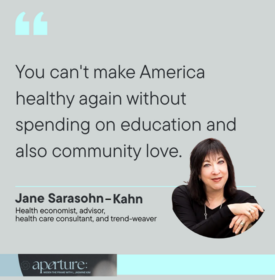 I was grateful to be Jasmine's first conversation-guest on her new podcast, "Aperture - Widen the Frame," where this expert in narrative medicine is bringing together the broad range of voices to sit at the table and address what health care needs: those humans in the health-system-loop who address health equity and empathy along with delivering evidence-based medicine for all.
 Jane joined host Dr. Geeta "Dr. G" Nayyar and colleagues to brainstorm the value of vaccines for public and individual health in this challenging environment for health literacy, health politics, and health citizen grievance. Click onto the Pfizer Value of Vaccines site and you can watch four episodes covering the challenges with adult vaccination, the employer and health plan member's journey to vaccination, reimbursement, and collaborating for proactive prevention.