


Musings with Mary Meeker on the Digital/Health Nexus
People in the U.S. spend over five-and-a-half hours a day with digital media in 2015, with time on mobile devices exceeding use of laptop and desktop computers. The growth of mobile means people are using and seeking more just-in-time services in daily living, and this has big implications for health/care, based on the annual mega-report on Internet Trends from Mary Meeker, KPCB’s internet analyst. “People” in health/care are patients, consumers and caregivers; people in health/care are also health plan administrators, employer benefits managers, doctors, nurses, allied health professionals, financial managers in hospitals, pharmacists, and the entire range of humans who
Avoiding Wrinkles: A World Without Tobacco
May 31st is World No Tobacco Day, heralded by the World Health Organization, and celebrated by the advocacy group Action on Smoking and Health (with the very appropriate acronym ASH). Smoking is one of the most addictive (anti-)health behaviors around, so persuading people to quit the habit continues to challenge public health advocates. Enter ASH’s engaging campaign called “The Wrinkler,” with the introductory question, “Ever notice how some people who are 25 look 45?” The video continues to explain how we can “expedite the aging process….Ladies, wish you were half your age? Don’t wait for him to look younger; make yourself
All women are health workers
The spiritual and emotional top the physical in women’s definition of “health,” based on a multi-country survey conducted in Brazil, Germany, Japan, the UK and the U.S. The Power of the Purse, a research project sponsored by the Center for Talent Innovation, underscores women’s primary role as Chief Medical Officers in their families and social networks. The research was sponsored by health industry leaders including Aetna, Bristol-Myers Squibb, Cardinal Health, Eli Lilly and Company, Johnson & Johnson, Merck & Co., Merck KGaA, MetLife, Pfizer, PwC, Strategy&, Teva, and WPP. The study’s summary infographic is titled How the Healthcare Industry Fails
Health care costs for a family of four in the U.S. reach $24,671 in 2015
The cost of a PPO for a family of four in America hits $24,671 in 2015, growing 6.3% over 2014’s cost. The growth in health care costs will be driven by high specialty prescription drug costs. The 6.3% growth rate in health costs is a stark increase compared with the twelve month April 2014-March 2015 decline in the Consumer Price Index of -0.1%. Welcome to the 2015 Milliman Medical Index, subtitled “Will the typical American family of four be driving a ‘Cadillac plan’ by 2018?” The MMI gauges the average cost of an employer-sponsored preferred provider organization (PPO) health plan and includes all
Consumers seek retail convenience in healthcare financing and payment
Health care consumers face a fragmented and complicated payment landscape after receiving services from hospitals and doctors, and paying for insurance coverage. People want to “view their bills, make a few clicks, pay…and be done,” according to Jamie Kresberg, product manager at Citi Retail Services, a unit of Citibank. He’s quoted in Money Matters: Billing and payment for a New Health Economy from PwC’s Health Research Institute. The healthcare service segment most consumers are satisfied with when it comes to billing and payment is pharmacies, who score well on convenience, affordability, reliability, and seamless transactions – with only transparency being
Capital investments in health IT moving healthcare closer to people

In recent weeks, an enormous amount of money has been raised by organizations using information technology to move health/care to people where they live, work, and play… This prompted one questioner at the recent ANIA annual conference to ask me after my keynote speech on the new health economy, “Is the hospital going the way of the dinosaur?” Before we get to the issue of possible extinction of inpatient care, let’s start with the big picture on digital health investment for the first quarter of 2015. Some $429 mm was raised for digital health in the first quarter of 2015,
No relief for consumers’ healthcare costs
U.S. consumers are spending $1 in every $5 dollars in the household on health care, and personal cost curves aren’t going to bend down anytime soon. Three surveys published in April confirm my financially unwell forecast for American health citizens. Kaiser Family Foundation’s April 2015 Health Tracking Poll finds most people say health care costs or going up or holding flat, shown in the first diagram from the KFF survey. U.S. adults told KFF the top health care priorities for the President and Congress should focus on health costs, such as: Making sure high-cost drugs for chronic conditions, such as HIV,
It’s a retail health world: consumers at the helm of health/care
Retail health v1.0 encompassed the pharmacy, then embraced urgent care and retail health clinics co-located in brick-and-mortar pharmacy chain stores. In v2.0, retail health encompasses all health/care, really, because people, patients and consumers are essentially self-insured up to the point when their health plan kicks in some cash. The high-deductible health plan era is ushering in the retail health era, broadly writ. Hospitals & Health Networks magazine (HHN) ran a story titled Think Like a Retailer to Engage Patients, covering founder of WEGO Health Jack Barrette‘s and my panel presentation at the 2015 HIMSS conference in Chicago last week. Writer
Health is where we live, work, and shop…at Walgreens
Alex Gourley, President of The Walgreen Company, addressed the capacity crowd at HIMSS15 in Chicago on 13th April 2015, saying his company’s goal is to “make good health easier.” Remember that HIMSS is the “Health Information and Management Systems Society” — in short, the mammoth health IT conference that this year has attracted over 41,000 health computerfolk from around the world. So what’s a nice pharmacy like you, Walgreens, doing in a Place like McCormick amidst 1,200+ health/tech vendors? If you believe that health is a product of lifstyle behaviors at least as much as health “care” services (what our
John Hancock flips the life insurance policy with wellness and data
When you think about life insurance, images of actuaries churning numbers to construct mortality tables may come to mind. Mortality tables show peoples’ life expectancy based on various demographic characteristics. John Hancock is flipping the idea life insurance to shift it a bit in favor of “life” itself. The company is teaming with Vitality, a long-time provider of wellness tools programs, to create insurance products that incorporate discounts for healthy living. The programs also require people to share their data with the companies to quality for the discounts, which the project’s press release says could amount to $25,000 over the
Consumers trust retailers to manage health as much as health providers
40% of U.S. consumers trust Big Retail to manage their health; 39% of U.S. consumers trust healthcare providers to manage their health. What’s wrong with this picture? The first chart shows the neck-and-neck tie in the horse race for consumer trust in personal health management. The Walmart primary care clinic vs. your doctor. The grocery pharmacy vis-a-vis the hospital or chain pharmacy. Costco compared to the chiropractor. Or Apple, Google, Microsoft, Samsung or UnderArmour, because “digitally-enabled companies” are virtually tied with health providers and large retailers as responsible health care managers. Welcome to The Birth of the Healthcare Consumer according
Transparency in health care: not all consumers want to look
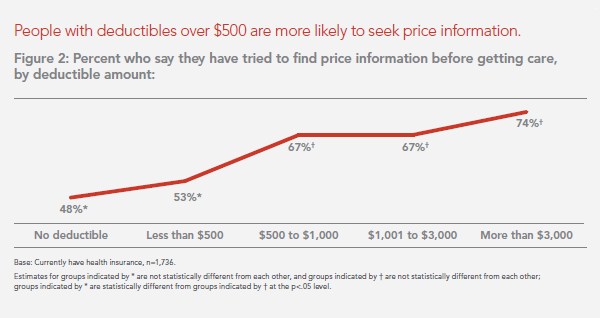
Financial wellness is integral to overall health. And the proliferation of high-deductible health plans for people covered by both public insurance exchanges as well as employer-sponsored commercial (private sector) plans, personal financial angst is a growing fact-of-life, -health, and -healthcare. Ask any hospital Chief Financial Officer or physician practice manager, and s/he will tell you that “revenue cycle management” and patient financial medical literacy are top challenges to the business. For pharma and biotech companies launching new-new specialty drugs (read: “high-cost”), communicating the value of those products to users — clinician prescribers and patients — is Job #1 (or #2,
Health is a growth industry at SXSW
Health is the hot topic at SXSW. While edgy new movies and hot music are the foundational elements of the annual South-by-Southwest festival, health and health care are the fast-growing themes at the meet-up, where the new-new, month-old beautiful JW Marriott Hotel by the Convention Center hosted most of the digital health track sessions. Digital health today goes well beyond mobile apps and genomic futures. Philips was a major presence this year at SXSW with its vision, shared by me, THINK-Health, and the HeathcareDIY team, of connected health where we live, work, play, pray and learn. In the case of
The Internet of Things in health care – technology for good in HuffPo
As sensors begin to proliferate our “Things,” from refrigerators to cars, toasters to t-shirt, our health could benefit mightily. Approaching this weekend’s South-by-Southwest Interactive meet-up in Austin, several authors have crowdsourced views on using technology for good in ImpactX, a special section in the Huffington Post sponsored by Cisco. I was asked to develop a view on using technology for good — for health and health care. Here’s my offering: How the Internet of Things Can Bolster Health. The promise of sensor-laden stuff in our lives can work for personal and public health in myriad ways — from perceiving impending epidemics
The blurring landscape of digital health: the Health 2.0 team puts it in focus
They’re the team that built a brand with the phrase “Health 2.0” before the world barely recognized v 1.0 in healthcare. This week, those folks that brought you the Health 2.0 Conference unveiled the Market Intel database of over 3,000 companies, trying to make sense out of a very blurry and fast-morphing market landscape. I spoke with Matthew Holt and Kim Krueger of Health 2.0 earlier this week to discuss just what’s in this mine of information, and what they intend to do with it. In full disclosure, I have been a colleague and friend of Matthew Holt since his
Digital health love – older people who use tech like health-tech, too
As people take on self-service across all aspects of daily living, self-care in health is growing beyond the use of vitamins/minerals/supplements, over-the-counter meds, and trying out the blood-pressure cuff in the pharmacy waiting for a prescription to be filled. Today, health consumers the world over have begun to engage in self-care using digital technologies. And this isn’t just a phenomenon among people in the Millennial generation. Most seniors who regularly use technology (e.g., using computers and mobile phones) are also active in digitally tracking their weight, for example, learned in a survey by Accenture. Older people who use technology in daily
A health agenda comes to the 2015 Oscars
The 87th annual 2015 Oscars show (#Oscars15) feted more than the movie industry: the event celebrated health in both explicit and subtle ways. Julianne Moore took the golden statuette for Best Actress, playing the title role in Still Alice, the story a woman diagnosed with early-onset Alzheimer’s Disease. In accepting her award, Moore spoke of the need to recognize and “see” people with Alzheimer’s – so many people feel isolated and marginalized, Moore explained. Movies help us feel seen and not alone – and people with Alzheimer’s need to be seen so we can find a cure, she asserted. See Moore’s lovely
Left Swipe Dat – this is how health messaging is done
In our ADHD-addled, over-messaged and noisy world, it’s hard to break through the media clutter and binge-watching to get a health message out. Here’s the way it’s done: an engaging, humorous, impactful and crisp campaign focusing on making smoking so un-sexy and un-cool, you swipe the prospective date off of your Tinder app. Watch and learn, from The Truth. You can follow the campaign on Twitter using the hashtag #LeftSwipeDat. Kudos to the truth® anti-smoking campaign and the creative team who got this blend of message and medium so right. truth® is part of the Legacy project which is funded by the
The phone is a gateway drug to health: what MyFitnessPal knows, and what Under Armour gets
65 million people know that food journaling works for losing weight, that it’s engaging to do on a well-designed app, and that health is social. MyFitnessPal (MFP) has the distinction of being a top health app used longer by more people and more effectively than probably any other mobile health tool. Under Armour, the athletic goods company, now has MFP under its corporate umbrella, along with Endomondo, another very popular motivating mobile health tool. You may know Under Armour as a company that manufactures and markets functional workout gear. But this deal is so not about the wearable. It’s about
Privacy and the Internet of Your Healthy Things – the FTC says less (data) is more
The FTC has weighed in on privacy and security and the Internet of Things (IoT) in a report published on 27th January 2015. When it comes to IoT and devices that connect to the internet, the FTC will focus on Enforcing privacy laws Educating consumers and business on privacy and security for connected devices Participate in multi-stakeholder groups such as the NTIA’s team considering guidelines for facial recognition, and Advocate with other agencies, at the state level, and with courts. The report summarizes input received in a FTC workshop conducted in November 2013 with IoT industry experts, and offers recommendations
Who is perfect? Advocacy ads for real people.
What is the nature of disability? What is the nature of beauty? What is perfection? Who among us is perfect? These questions are at the heart (literally and figuratively) of a project undertaken by Pro Infirmis, a Switzerland-based advocacy organization raising awareness of people with disabilities, promoting the International Day of Persons with Disabilities in December 2013. Mannequins in fashionable shops on Zurich’s tony street the Bahnhofstrasse were replaced by new ones, artfully, painstakingly and lovingly created, as shown in the video. Pro Infirmis’s website tells us “who” we are looking at in human and 3-D life-size mannequin form: Miss Handicap 2010,
Building the health ecosystem: new bedfellows coming together
2015 is already becoming a year where bedfellows of different stripes are joining together to build a health care ecosystem well beyond hospitals, doctors and health plans. Announcements launched last week at the 2015 Consumer Electronics Show in Las Vegas, and coming out this week at the J.P. Morgan Conference in San Francisco, the first two weeks of 2015 reveal that new entrants and legacy health stakeholders are crossing corporate and cultural chasms to (try and) solve challenges that prevent us from getting to that Holy Grail of The Triple Aim: improving health care outcomes, driving down per capita costs,
More from the 2015 CES – Shelly Palmer’s 3 Laws of the Digital World and What They Mean for Health Care
Three laws that shape the digital world have kicked into high gear, changing our lives in ways we cannot yet imagine. Those three forces are Metcalfe’s Law (in brief, the increasing value of networks), Moore’s Law (that processing power doubles every 18 months, or even faster), and the Law of Accelerating Returns (the fast pace of technological change). The guy who told me about that at the 2015 Consumer Electronics Show (#CES2015) was Shelly Palmer, something of a Renaissance Man in the evolving digital world, advising communications companies, composing music, patenting TV technology, investing in ventures, hosting shows on digital living,
Health and wellness at CES 2015 – trend-weaving the big ideas
Health is where we live, work, play and pray — my and others’ mantra if we want to truly bend (down) the cost curve and improve medical outcomes. If we’re serious about achieving the Triple Aim — improving public health, lowering spending, and enhancing the patient/health consumer experience (which can drive activation and ongoing engagement) — then you see health everywhere at the 2015 Consumer Electronics Show in Las Vegas this week. With this post, I’ll share with you the major themes I’m seeing at #CES2015 related to health, wellness, and DIYing medical care at home. The meta: from health care to self-care.
Getting real about consumer demand for wearables: Accenture slows us down
Are you Feelin’ Groovy about wearables? Well slow down, you move too fast… …at least, according to Accenture’s latest survey into consumers’ perspectives on new technologies, published this week in conjunction with the 2015 Consumer Electronics Show in Las Vegas, the largest annual convention in the U.S. featuring technology for people. At #CES2015, we’re seeing a rich trove of blinged-out, multi-sensor, shiny new wearable things at the 2015 Consumer Electronics Show. Swarovski crystals are paired with Misfit Wearables, called the Swarovski Shine, shown here as a shiny new thing, indeed. Withings launched its Activite fitness tracking watch in new colors.
The Internet of Healthy Me – putting digital health in context for #CES2015
Men are from Mars and Women, Venus, when it comes to managing health and using digital tools and apps, based on a poll conducted by A&D Medical, who will be one of several hundred healthcare companies exhibiting at the 2015 Consumer Electronics Show this week in Las Vegas. Digital health, connected homes and cars, and the Internet of Things (IoT) will prominently feature at the 2015 Consumer Electronics Show in Las Vegas this week. I’ll be attending this mega-conference, meeting up with digital health companies and platform providers that will enable the Internet of Healthy “Me” — consumers’ ability to self-track,
Health IT Forecast for 2015 – Consumers Pushing for Healthcare Transformation
Doctors and hospitals live and work in a parallel universe than the consumers, patients and caregivers they serve, a prominent Chief Medical Information Officer told me last week. In one world, clinicians and health care providers continue to implement the electronic health records systems they’ve adopted over the past several years, respond to financial incentives for Meaningful Use, and re-engineering workflows to manage the business of healthcare under constrained reimbursement (read: lower payments from payors). In the other world, illustrated here by the graphic artist Sean Kane for the American Academy of Family Practice, people — patients, healthy consumers, newly insured folks,
Women are natural disruptors for health
“Disruption” is a well-used word these days in business and, in the past few years, in the health care business. That’s because there’s a general consensus that the U.S. health care system is broken. “System” is a word that I shouldn’t use as my friend J.D. Kleinke smartly argued that it’s that lack of system-ness that makes using the phrase “health care system” an Oxymoron. The fragmented health care environment creates innumerable pain points when accessing, receiving, and paying for services. And it’s women who feel so much of that pain. In that context, I’m gratified and humbled to be one
Women-centered design and mobile health: heads-up, 2014 mHealth Summit
This post is written as part of the Disruptive Women on Health’s blog-fest celebrating the 2014 mHealth Summit taking place 7-11 December 2014 in greater Washington, DC. Women and mobile health: let’s unpack the intersection. On the supply side of the equation, Good Housekeeping covered health tracking-meets-fashion bling in the magazine a few weeks ago in article tucked between how to cook healthy Thanksgiving side dishes and tips on getting red wine stains out of tablecloths. This ad appeared in a major sporting goods chain’s 2014 Black Friday pre-print in my city’s newspaper last week. And along with consumer electronics brand faves like
PwC on wearables – the health opportunity is huge, but who will pay?
“A wearable future is around the corner,” PwC says. So it’s appropriate the consulting firm’s new report is indeed titled The Wearable Future. Wearable technologies — smartwatches, sensor-laden workout gear, activity tracking wristbands, and Google Glass, among them — are more than individual tracking and information devices. They’re part of a larger ecosystem called The Internet of Things (IoT), which is made of lots of stuff, each ‘thing’ incorporating a sensor that measures something. Those measurements can track virtually everything that someone does throughout the day: beyond the obvious steps taken, hours slept, and GPS coordinates, sensors can sense movement
Health care as a retail business
The health care industry is undergoing a retail transformation, according to Retail Reigns in Health Care: The rise of consumer power and its organization & workforce implications from Deloitte. Deloitte’s report published in October 2014 focuses on the health insurance business, which is newly-dealing with uninsured people largely unfamiliar with how to evaluate health plan options. This by any definition requires new muscles for both buyers and sellers on a health insurance exchange: new product access + uninformed consumer = retail challenge. Deloitte notes another supply and demand challenge, and that’s with the health insurance company workforce: while 93% of health
Specialty pharmaceuticals’ costs in the health economic bulls-eye
This past weekend, 60 Minutes’ Leslie Stahl asked John Castellani, the president of PhRMA, the pharmaceutical industry’s advocacy (lobby) organization, why the cost of Gleevec, from Novartis, dramatically increased over the 13 years it’s been in the market, while other more expensive competitors have been launched in the period. (Here is the FDA’s announcement of the Gleevec approval from 2001). Mr. Castellani said he couldn’t respond to specific drug company’s pricing strategies, but in general, these products are “worth it.” Here is the entire transcript of the 60 Minutes’ piece. Today, Health Affairs, the policy journal, is hosting a discussion
Activity tracking is consumers’ #1 demand for smartwatches
Of all the functions a smartwatch could play, it’s activity tracking that’s top of most consumers’ minds. GfK conducted a survey in August 2014 among 5,000 smartphone-owning consumers in five countries — China, Germany, South Korea, the UK, and the U.S. The market research firm found that 29% of people see “activity tracking” the most important function. Phone calls ranked second with 13% of consumers, telling time 11%, and 10% voted for basic apps and navigation system. 7% of consumers noted the smartwatch would be desirable for basic web search. In this survey, activity tracking included the broad definition covering
Health-wear – at Health 2.0, health met fashion, function and care
Wearables met health and medicine at the 8th annual Health 2.0 Conference in Santa Clara, CA, last week. I had the real pleasure of shepherding a wearables panel of five innovators during the conference, in a well-attended session followed by an energetic Q&A. The organizations who demonstrated their tools and brainstormed the wearables market included, in alphabetical order, Atlas Wearables, Heartmath, MySugr, SunSprite and Withings. I hasten to add that among the five presenters, two were women: that 2 in 5 = 40% gender representation is, happily to my way of thinking about women’s roles in health-making, a very good
Health info disconnect: most people view accessing online records important, but don’t perceive the need to do so
There’s a health information disconnect among U.S. adults: most people believe online access to their personal health information is important, but three-quarters of people who were offered access to their health data and didn’t do so didn’t perceive the need to. The first two graphs illustrate each of these points. When people do access their online health records, they use their information for a variety of reasons, including monitoring their health (73%), sharing their information with family or care providers (44%), or downloading the data to a mobile device or computer (39%). In this context, note that 1 in 3
Joan Rivers lessons for health and wellness: think like a Bee and Laugh
If laughter is the best medicine, Joan Rivers earned an MD in my personal health ecosystem. My parents loved and laughed with her comedy when pioneered stand-up comedy on TV, and I became increasingly intrigued in and impressed by her vitality, her tenacity, and her survival strategies. I also shared a love of her bee pins with my mother-in-law; the pins were created by Joan and her team for QVC, the electronic retailer, with whom Joan forged a profitable and popular line of fashion, jewelry and home decor. The bee, Joan explained, is anatomically and aerodynamically unfit to fly. Yet,
Understanding the patient journey – using real-world data
It’s de rigueur for any organization marketing a product or service in health care to be “patient-centered” these days. “Patient engagement” and “health engagement” are phrases found on health conference agendas, whether pitching to attendees in pharma and life sciences, health IT, health insurance, or healthcare (to hospitals and physicians, alike). One paradigm for patient-centricity that’s more mature than most is IMS Health’s Patient Journey construct, which the data-driven company has been talking about since 2012. While the concept focused mainly on pharmaceutical marketing and medication adherence, it’s useful for all industry segments looking to motivate behavior change in health
Best Hospitals, Marketing and Money – more on transparency in health care
As Americans become health care shoppers, learning to spend “their” money to meet high deductibles and manage expenses in health savings accounts, they seek information — made transparent through trusted, sometimes branded, sources. One of these is U.S. News & World Reports, which has published the U.S. News & World Reports Best Hospitals list since 1990, and as such, has become a popular go-to source for engaged patients looking for information on hospitals before receiving surgery, seeking second opinions for a medical condition, or moving to a new town looking to affiliate with a health system. But in February 2014, a
Self-care – the role of OTCs for personal health financial management
Make-over your medicine cabinet. That’s a key headline for International Self-Care Day (ISD) on July 24, 2014, an initiative promoting the opportunity for people to take a greater role in their own health care and wellness. Sponsored by the Consumer Healthcare Products Association (CHPA), consumer products companies, health advocacy organizations, and legislators including John Barrow (D-GA), a co-sponsor of H.R. 2835 (aka the Restoring Access to Medications Act), the Day talked about the $102 billion savings opportunity generated through people in the U.S. taking on more self-care through using over-the-counter medicines. After the 2008 Recession hit the U.S. economy, industry analysts
Big Data Come to Health Care…With Big Challenges – Health Affairs July 2014
“For Big Data, Big Questions Remain,” an article by Dawn Falk in the July 2014 issue of Health Affairs, captures the theme of the entire journal this month. That’s because, for every opportunity described in each expert’s view, there are also obstacles, challenges, and wild cards that impede the universal scaling of Big Data in the current U.S. healthcare and policy landscape. What is Big Data, anyway? It’s a moving target, Falk says: computing power is getting increasingly powerful (a la Moore’s Law), simpler and cheaper. At the same time, the amount of information applicable to health and health care
Homo informaticus – the global digital consumer
Consumers around the world are feeling more knowledgeable, self-confident and realistic, enabled by mobile platforms, the democratic power of social “choruses,” and a more sharing economy featuring collaborative consumption. As peoples’ phones get smarter and smarter, they carry more powerful multichannel information devices in their hands which empower Homo Informaticus – the new global digital consumer, described in EY’s report, How to copilot the multichannel journal. EY polled 29,943 consumers in the Consumers on Board survey living in 34 countries: across the Americas, Asia-Pacific, the Middle East, India and Africa. Homo informaticus is the rational consumer smartly using technology to filter information.
People want mobile health by phone, and FICO knows it
Most people (54%) want their mobile phones to enable health care interactions, according to Mobile Thought Leadership, a paper from FICO that summarizes data from a survey conducted with health citizens around the world. FICO conducted research among 2,239 adult smartphone users in the UK, Australia, Brazil, China, France, Germany, India, Italy, Japan, Korea, Mexico, Russia, Turkey and the United States. The data discussed here in Health Populi refer to a subset covering just U.S. consumers. Among the one-half of consumers interested in doing more health care interactions via mobile in the future, the most popular options are: receiving reminders of appointments,
Go, You Chicken Fat, Go! Kennedy Met the Music Man for Health (and Apple Takes a Bite)
What do you get when you pair Meredith Wilson, the writer-composer of The Music Man, with Robert Preston (who acted the starring role of Harold Hill, the traveling music-band instrument salesman) with a President committed to reversing the “softness” he saw in American health citizens? You get “Go, You Chicken Fat, Go,” a rousing band-and-choir backed anthem to promote people to engage in more exercise and shed their “chicken fat.” President Kennedy was the public health Prez who, in 1960, asked Meredith Wilson to pen a national anthem to motivate Americans who he considered were growing “soft.” Back in the
The business case for getting more social in health
While the U.S. spends more per person on health care than any other country in the world, we get a very low return on that investment. Other countries whose health citizens enjoy significantly better health outcomes spend less on health “care” (beds, technology, doctors’ salaries) and more per capita on social services and supports. There’s growing evidence that social factors impact health, and a business case to be made for spending more on social. The evidence and argument for providers spending more on social needs is explained in the research paper, Addressing Patients’ Social Needs: An Emerging Business Case for
Apple and Google and Samsung, Oh My!
Three of the world’s biggest technology companies – Apple, Google and Samsung — have made big announcements in the world of connected health in the past few weeks. A fourth is positioned to enter the fray. These major announcements illustrate the convergence of consumer technology, health, and wearables, with the potential for Big Data and population health impacts. Among the three tech giants, Samsung announced its consumer health/tech story first, on May 28, 2014, at its Digital Health Initiative meeting. Samsung unveiled the Samsung Architecture Multimodal Interactions platform, SAMI, along with the Simband prototype wristband that would enable users to
Online is to go-to place for health insurance info, but lots of uninsured people live offline
A vast majority of people shopping for a health plan on a Health Insurance Exchange for coverage in 2014 obtained information online via websites. One-half of these shoppers used only online information, and 29% combined both websites and other sources like direct assistance, informal assistance, and via (offline) media. In the Health Reform Monitoring Survey from the Urban Institute Health Policy Center, a research team, funded by the Robert Wood Johnson Foundation and the Ford Foundation, looked into data collected from the Health Reform Monitoring Survey in March 2014 at the end of the 2014 open enrollment period for the
Privatizing health privacy in the US?
8 in 10 people in the U.S. believe that total privacy in the digital world is history, based on a survey from Accenture conducted online in March and April 2014 and published in the succinctly-titled report, Eighty Percent of Consumers Believe Total Data Privacy No Longer Exists. 84% of U.S. consumers say they’re aware what tracking personal behavior can enable – receiving customized offers and content that match one’s interests. At the same time, 63% of people in the U.S. also say they have a concern over tracking behavior. Only 14% of people in the U.S. believe there are adequate safeguards
World No Tobacco Day v2014 – let’s raise (more) taxes on tobacco
Tomorrow is World No Tobacco Day. The use of tobacco is one of the most preventable public health issues on the planet. And the global tobacco epidemic contributed to 100 million deaths around the world in the 20th century. 6 million people die every year due to tobacco use — including 600,000 deaths due to exposure to secondhand smoke. About 500 million people living today will be dead from the use of tobacco products if current smoking habits continue, the World Health Organization (WHO) expects. WHO sponsors the World No Tobacco Day every year on May 31. For this year’s
We are all self-insured until we get sick – especially if we are women
During my conversation with a prominent pharma industry analyst yesterday, he observed, “As a consumer, you are self-insured until you get sick.” My brain then flashed back to a graph from the 2013 Employer Health Benefits Survey conducted annually by the Kaiser Family Foundation (KFF). The chart is shown here. It illustrates the upward line indicating that in 2013, 4 in 5 workers were enrolled in a health plan that included an annual deductible. That’s the “self-insurance” part of the observation my astute conversationalist noted. Simply put, when you are enrolled in a high-deductible health plan, You, The Consumer, are responsible for
The Season of Healthcare Transparency – Chaos, then Creation, Part 5
The consumer demand side for healthcare transparency is hungry for the light to shine on health care costs, quality and information that’s relevant and meaningful to the individual. The supply side is fast-growing, with websites and portals, government-sponsored projects, commercial-driven start-ups, and numerous mobile apps. These tools endeavor to: Help people find and access services Schedule appointments Compare peer consumers’ reviews for those providers Calculate and prepare for out-of-pocket co-payments deriving from their health plan Negotiate prices with providers Pay for the services, and Reconcile the payment with a high-deductible health plan or health savings account. On the demand side, consumers
The Season of Healthcare Transparency – Will Your Health Plan Be Your Transparency Partner? – Part 3
Three U.S. health plans cover about 100 million people. Today, those three market-dominant health plans — Aetna, Humana and UnitedHealthcare — announced that they will post health care prices on a website in early 2015. Could this be the tipping point for health care transparency so long overdue? These 3 plans are ranked #1, #4 and #5 in terms of market shares in U.S. health insurance. Together, they will share price data with the Health Care Cost Institute (HCCI), a not-for-profit organization dedicated to research on U.S. health spending. An important part of the backstory is that the HCCI was
The Season of Healthcare Transparency – HFMA’s Price Transparency Manifesto – Part 1
As Big Payors continue to shift more costs onto health consumers in the U.S., the importance of and need for transparency grows. 39% of large employers offered consumer-directed health plans (CDHPs) in 2013, and by 2016, 64% of large employers plan to offer CDHPs. These plans require members to pay first-dollar, out-of-pocket, to reach the agreed deductible, and at the same time manage a health savings account (HSA). In the past several weeks, many reports have published on the subject and several tools to promote consumer engagement in health finance have made announcements. This week of posts provides an update on
Consumers and health data sharing: managing risk via anonymity
9 in 10 U.S. adults would be willing to share their personal health information to help researchers better understand a disease or improve care and treatment options — with varying desires to control the anonymity of their data, according to the fourth Makovsky Health/Kelton Survey published April 24, 2014. This study gauged peoples’ perspectives on personal data privacy based on 1,001 responses from Americans ages 18 and older and was fielded in March 2014. The chart shows four variations on the theme of consumers’ interest in sharing their personal health data with researchers, finding that: – 40% of people
The new health economy, starring the consumer
“In the New Health Economy, ‘patients’ will be ‘consumers’ first, with both the freedom and responsibility that come with making more decisions and spending their own money.” This vision of the near-future is brought to you by the New Health Economy, a report from PwC’s Health Research Institute (HRI). The chart attests the fact that U.S. “consumers” are already spending nearly $3 trillion (with a capital “T”) on products and services that bolster personal health. This spending includes $94 billion on nutrition, $62 billion on weight loss, $59 billion on sporting goods and apparel, $45 billion on (so-called) organic and
Your health score: on beyond FICO
Over one dozen scores assessing our personal health are being mashed up, many using our digital data exhaust left on conversations scraped from Facebook and Twitter, via our digital tracking devices from Fitbit and Jawbone, retail shopping receipts, geo-location data created by our mobile phones, and publicly available data bases, along with any number of bits and pieces about ‘us’ we (passively) generate going about our days. Welcome to The Scoring of America: How Secret Consumer Scores Threaten Your Privacy and Your Future. Pam Dixon and Robert Gellman wrote this well-documented report, published April 2, 2014 by The World Privacy Forum.
Affordable medicine: a preferred future
The price of medicines is a barrier for about one billion people on the planet, for citizens in developing countries as well as middle-class families in the richest country in the world, the United States. Today is World Health Day, when for 24 hours public health advocates (including me) are calling out key issues preventing people from fully living life. One obstacle for too many people is the cost of drugs and supplies that save lives and help people add life to years. For example, bug bites can be deadly if you’re talking about the 50% of the world’s population
Doctors and mHealth apps: chaos, evidence, creation
Over one year ago, an eClinicalWorks survey found that 9 in 10 physicians would be interested in prescribing a mobile health app to a patient. That’s a big number. That’s “interest,” but that demand hasn’t yet been expressed in the current go-go app-happy environment. An opinion piece in this week’s Online First edition of the Journal of the American Medical Association (JAMA) demonstrates the fork-in-the-road facing clinicians and the disruption/opportunity that is mobile health. In “In Search of a Few Good Apps,” a Boston-based trio of writers (two physicians and one PhD) talk about “the bewildering diversity of apps available
People want to DIY with pharma
In our increasingly-DIY society, most consumers expect high levels of access and customer service from the organizations with whom we engage. With more consumers reaching into their pockets to pay for health services and products, the health industry is increasingly a retail-facing environment. So expect quality service levels from their healthcare touch points. The pharmaceutical and prescription drug touch point is not exempt from this expectation, as learned by an Accenture survey analyzed in Great Expectations: Why Pharma Companies Can’t Ignore Patient Services. As the first picture shows, 70% of patients think pharma companies are responsible for bundling information and services
Health care in a multiscreen world
In 2014, we are digital omnivores. Most people “consume” information and entertainment on more than one screen: 7 hours’ worth over a 5-hour period. You read that right: most people who watch TV, use a laptop or PC, smartphone or tablet are multitasking use of these devices in parallel. And above all, people are using smartphones as their primary screen. The AdReaction: Marketing in a multiscreen world report from Millward Brown paints a picture of global consumers who are cobbling together multiscreen experiences. The smartphone has become the “do it all” device if you don’t carry a laptop or tablet around, especially favored
Health data data everywhere – let’s human-scale it / Report from #SXSW #SXSH
Health data is everywhere, but not much useful to drink. Is #bigdata in health care at the top of the Hype Cycle? And how do we humanize it, make it relevant and useful for our everyday life? In other words, can this data help us hack our lives and health for the better? That question has been on my mind for the past couple of years since the convergence of big data and data analytics and health has emerged. Yesterday at the 2014 South-by-Southwest happening, I attended a panel discussion called Hacking Your Life For Better Health (#hacklife on Twitter).
HIMSS14 Monday Morning Quarterback – The Key Takeaways
Returning to terra firma following last week’s convening of the 2014 annual HIMSS conference…taking some time off for family, a funeral, the Oscars, and dealing with yet another snowstorm…I now take a fresh look back at #HIMSS14 at key messages. In random order, the syntheses are: Healthcare in America has entered an era of doing more, with less...and health information technology is a strategic investment for doing so. The operational beacon going forward is moving toward The Triple Aim: building population health, enhancing the patient’s experience, and lowering costs per patient. The CEO of Aetna, Mark Bertolini, spoke of the
Patients play a starring role at #HIMSS14 – Best In Show
Even before stepping into the Orlando Convention Center on Sunday 23 February 2014, my clairvoyant powers know the forecast of the Best in Show: the growing role of patients in health care, reflected in both the education session at the annual 2014 meeting of HIMSS as well as the product/service mix being proffered on the convention show floor. As a member of HIMSS Connected Patient Committee, I know first-hand the conscious effort and energy that the organization has committed to getting real about patients’-peoples’-caregivers’ central role in health care. The organization was built on providers and technology. When I first
Where’s TripAdvisor for health care? JAMA on physician ratings sites
As more U.S. health citizens enroll in high-deductible health plans – now representing about 30% of health-insured people in America – health plan members are being called on to play the role of consumer. Among the most important choices the health consumer makes is for a physician. Ratings sites and health care report cards ranking doctors by various characteristics have been in the market for over a decade. However, little has been known on the public’s knowledge about the availability of these information sources, nor of peoples’ use of physician rating sites. This question is addressed in Public Awareness, Perception, and
The value of health IT – driving ROI takes a village
This is my second post for the #HIMSS14 Blog Carnival, written to coincide with the annual 2014 HIMSS Conference convening health IT leaders in Orlando, FL, 23-28 February 2014. I am gratified to be one of a dozen+ Social Media Ambassadors to the Conference. The first post, on why health IT ‘should’ matter to consumers, can be found here. Investments in the digital health space reached nearly $2 billion in 2013, based on Rock Health’s look back at venture funding in the market. These financings covered $245 mm that went toward electronic health records and clinical workflow; $161 toward analytics
My Healthy Valentine: socialize health with your loved ones
Today, Valentine’s Day, is full of the signs of love. I’ve gotten several hugs and “I love you’s” from my daughter (a teenager – how fortunate am I?!); my husband returned home from a business trip in inclement weather, in time to share a romantic evening; my Facebook page has countless hugs and loving messages from friends near and far; and, I received real paper Valentine cards, old school style. But the best healthy Valentine gift I got was that my husband went for a check-up with his doctor, my daughter ate a great big breakfast before she went to
Watson goes wellness
IBM’s data analytics engine Watson, having cut its teeth on complex health care conditions like cancer, is now entering an even more challenging space: wellness. Why is wellness more challenging? Because understanding a person’s wellness goes beyond mining data from health care claims silos in hospitals, pharmacies, and physicians’ electronic health records. Wellness happens where we live, work, play and pray. Wellness is nurtured through choices made every day at home, in the workplace, and at moments-of-truth in the grocery store and restaurant where slick marketing messages planted in our subconscious compete with our more rational minds that tell us to
What CVS going tobacco-free means for health and business

Bravo! to CVS/pharmacy who today announced it would pull tobacco products from store shelves by October 2014. “The sale of tobacco products is inconsistent with our purpose,” the company’s press release asserts. The move will cost CVS $1.5 billion in revenue annually, as the company seeks to consolidate its position as a health company. CVS/pharmacy is part of CVS Caremark, which includes the retail pharmacy chain (the second-largest in the U.S.), a pharmacy benefit management company (Caremark), and retail health clinics (Minute Clinics). CVS Caremark also participates in a healthy communities program issuing grants for projects that focus on health
Connected Health – the technology is ready, providers on the cusp
The convergence of technology developments – such as the internet, mobile phone adoption, cloud computing, sensors, electronic health records – with societal evolution including consumerism, demand for transparency, and “flatter” organizations – enable the phenomenon of Connected Health. Connected Health by definition includes mobile health (mHealth), telehealth and telemedicine, as presented in the February 2014 issue of Health Affairs which is dedicated to this theme. Why Connected Health’s time is Now relates to those factors cited above, and the underlying challenge of managing health care costs. While all nations in the developed world are facing difficult health economies, the U.S. spends so
U.S. families face medical financial burdens; health care in the SOTU
A growing proportion of American families are facing money problems related to health care, according to the report, Financial Burden of Medical Care: A Family Perspective, No. 142 in the NCHS Data Brief series from the CDC, published January 2014 and based on 2012 data. 1 in 4 families are dealing with some financial burden due to medical care. “Financial burdens” in health include problems paying medical bills in the past 12 months, shared by 16.5% of families; and medical bills being paid over time, faced by 21.4% of families. 1 in 10 families (9%) have medical bills they are
Pharma and the health industry: when will they finally meet us Where We Live?
Millions of health citizens, consumers, patients and caregivers flock to Facebook, Twitter and Wikipedia every day the world over to seek health information, advocate for patients’ access to a cancer therapy on a health blog, engage in peer-to-peer health care in a social network, and bolster each others’ management of chronic medical conditions in a chat community. Yet the pharmaceutical and medical device industries rank well behind other industries vis-à-vis the use of social media, asserts Engaging patients through social media, with the punchline question: is healthcare ready for empowered and digitally demanding patients? from the IMS Institute for Healthcare Informatics, published on
What, We Worry? Thinking About Healthcare (Costs) Is Stressing Us Out
Three-quarters of us are concerned about health care, a fraction fewer than those of us worried about the economy. Underneath stress about healthcare, people are worried about costs and the impact of the Affordable Care Act (ACA). Say hello to the Healthcare Worry Scale, developed by Chase Communications, a firm focused on marketing and media, largely in the health industry. Chase found that: – 93% believe that their health care costs will continue to increase – 49% say the ACA’s impact is a “major” worry – 43% say getting a disease, medical condition, or injury that health insurance doesn’t fully
Health Care Everywhere at the 2014 Consumer Electronics Show
When the head of the Consumer Electronics Association gives a shout-out to the growth of health products in his annual mega-show, attention must be paid. The #2014CES featured over 300 companies devoted to “digital health” as the CEA defines the term. But if you believe that health is where we live, work, play, and pray, then you can see health is almost everywhere at the CES, from connected home tech and smart refrigerators to autos that sense ‘sick’ air and headphones that amplify phone messages for people with hearing aids, along with pet activity tracking devices like the Petbit. If
Health is everywhere – seeing health in JWT’s Top 100 Trends for 2014
Of 100 broad-based trends to expect in 2014, most relate in some way to health. I’ve reviewed every one of the 100 forecast points in JWT’s 100 Things to Watch in 2014 report, and it seems Health is Everywhere. Let me point out many, which I’ve allocated to health-ified buckets (note that JWT organizes the list of 100 by alphabet, from “A” to “Z,” so they are not in any prioritized or strategic order). The most direct-health impacting bucket of trends are those in health tech. These include E-cigarette regulation (#35), Glassware (#42), Haptic technology (#46), Needle-free vaccines (#64), Oculus Rift (#65), OTT TV (#66), Telediagnostics
mHealth will join the health ecosystem – prelude to the 2014 Consumer Electronics Show
The rise of digital health at the 2014 Consumer Electronics Show signals the hockey-stick growth of consumer-facing health devices for fitness and, increasingly, more medical applications in the hands of people, patients, and caregivers. This year at #CES2014, while the 40% growth of the CES digital health footprint will get the headlines, the underlying story will go beyond wristbands and step-tracking generating data from an N of 1 to tools that generate data to bolster shared-decision making between people and the health system, and eventually support population health. For example: – Aetna is partnering with J&J to deploy their Care4Today
3 Things I Know About Health Care in 2014
We who are charged with forecasting the future of health and health care live in a world of scenario planning, placing bets on certainties (what we know we know), uncertainties (what we know we don’t know), and wild cards — those phenomena that, if they happen in the real world, blow our forecasts to smithereens, forcing a tabula rasa for a new-and-improved forecast. There are many more uncertainties than certainties challenging the tea leaves for the new year, including the changing role of health insurance companies and how they will respond to the Affordable Care Act implementation and changing mandates
Be thankful for your good life. Now think about what a good death would be.
This Thanksgiving, we’re once again participating in the annual Engage With Grace blog rally, encouraging those who haven’t considered their end-of-life preferences to start thinking about them, and asking those who have done it to consider how their decisions may have changed over time. It’s good food for thought. Wishing you all a happy, healthy holiday season. Most of us find ourselves pretty fascinating… flipping through photos and slowing down for the ones where we’re included, tweeting our favorite tidbits of information, Facebook-ing progress on this or that… We find other people captivating as well. In fact, there’s a meme going around
More chronically ill people use online health resources – but they’re not so social, Pew finds
People who are diagnosed with at least one chronic medical condition are more likely to seek information online, use social media to understand peer patients’ reviews on drugs and treatments, and learn from other patients about their personal health experiences. While that’s encouraging news for a health empowerment headline, the underlying challenge that should prevent congratulatory fist-bumps among patient-engagement proponents is that people living with chronic disease are less likely to have internet access. Why? Because chronically ill people tend to be older and less educated, and they’re also less likely to be working. Simply put, “People living with chronic
23andme & Me
23andme received word from the Food & Drug Administration (FDA) on November 22, 2013, that they must cease and desist selling the company’s Saliva Collection Kit and Personal Genome Service (PGS). FDA explained in their Warning Letter, “Most of the intended uses for PGS listed on your website, a list that has grown over time, are medical device uses under section 201(h) of the FD&C Act. Most of these uses have not been classified and thus require premarket approval or de novo classification, as FDA has explained to you on numerous occasions. “Some of the uses for which PGS is intended are
Color us stressed – how to deal
Coast-to-coast, stress is the modus vivendi for most Americans: 55% of people feel stressed in every day life, according to a study from Televox. A Stressful Nation: Americans Search for a Healthy Balance paints a picture of a nation of physically inactive people working too hard and playing too little. And far more women feel the stress than men do. 64% of people say they’re stressed during a typical workday. 52% of people see stress negatively impacting their lives. And nearly one-half of people believe they could better manage their stress. As a result, physicians say that Americans are experiencing negative
Make health care “feel” more like retail via transparency
Consumers who are well-covered by health insurance are in favor of talking about costs with their doctors. This research finding illustrates the fact that price transparency in health care isn’t just the concern of un- and under-insured people, but that shining the light on the price of health care is everybody’s business. But it’s also the case that most physicians aren’t yet involved in these health-financial conversations with their patients. Two studies presented at the recent 2013 annual meeting of the American Society of Clinical Oncology (ASCO) learned that patients are keen to know more about health care costs from
When health care costs are a side effect
4 in 5 U.S. patients – 81% of them – want an equal say in health care decisions with their care provider, according to a 2013 Institute of Medicine study. At the same time, patients choose to take “drug holidays,” opting out of taking three or more doses of medicines in a row, or adopt “trail mix” approaches to taking prescriptions, casually and inappropriately mixing Rx drugs. Welcome to your world, pharma industry: where people say they want control, but somehow don’t exercise it in the way you — drug companies — define as “compliance” or “adherence.” Customer experience in
Gamification in health – make the person the quarterback
Games are part of peoples’ lives in the 20-teens. Gamification has been used in military and business training and now is a growing method to help change peoples’ behavior across a variety of issues — health, among them. But it’s not all “fun and games” when it comes to succeeding in applying gaming methods in health, according to Gaming to Engage the Healthcare Consumer, a report from ICF International. ICF’s roots are in the defense industry, and the team that wrote this paper together have decades of experience in military applications. These learnings can be quite useful when translated into the
Mobile health apps – opportunity for patients and doctors to co-create the evidence
There are thousands of downloadable apps that people can use that touch on health. But among the 40,000+ mobile health apps available in iTunes, which most effectively drive health and efficient care? To answer that question, the IMS Institute for Healthcare Informatics analyzed 43,689 health, fitness and medical apps in the Apple iTunes store as of June 2013. These split into what IMS categorized as 23,682 “genuine” health care apps, and 20,007 falling into miscellaneous categories such as product-specific apps, fashion and beauty, fertility, veterinary, and apps with “gimmicks” (IMS’s word) with no obvious health benefit. Among the 23,682 so-called
Getting to health engagement will require more than a patient portal
Patient and health engagement is the flavor du jour in health circles these days, from the corridors of hospitals to the caffeinated marketing meetings in Big Pharma’s east coast meet-ups. But there’s no standard agreement on what we mean by peoples’ health engagement, whether by patient or well consumer. In Market Insights: The Evolution of Consumer Engagement in Health Care, Porter Research endeavors to deepen our understanding of this important concept. In the introductory section of the paper, “Understanding Engagement,” Porter proffers that industry – providers, payers and employers – consider engagement as “changing consumer behavior through increased participation in consumers’ own health
Consumers trust and welcome health and insurance providers to go DTC with communications
Consumers embrace ongoing dialog with the companies they do business with, Varolii Corporation toplines in a survey report, What Do Customers Want? A Growing Appetite for Customer Communications. Across all vertical industries consumers trust for this dialogue, health care organizations – specifically doctors, pharmacists, and insurance companies – are the most trusted. Examples of “welcome-comms” would be reminders about upcoming appointments or vaccinations (among 69% of people), notices to reorder or pick up a prescription (57%), and messages encouraging scheduling an appointment (39%). In banking, notices about fraudulent activity on one’s account is the most welcomed message beating out appointment
A new medical side-effect: out-of-pocket health care costs
When we say the phrase “side effects,” what do we think of? The FDA says that “all medicines have benefits and risks. The risks of medicines are the chances that something unwanted or unexpected could happen to you when you use them. Risks could be less serious things, such as an upset stomach, or more serious things, such as liver damage.” There’s a new risk in town in health care, and it’s the equivalent of an upset stomach when it comes to a co-pay for a branded on-formulary drug, or liver damage if it involves a coinsurance percent of “retail”
Shopping, everywhere, for health
When it comes to retail shopping, most people spend most of their time shopping in brick-and-mortar stores – not online. 92% of spending happens in stores. 3 in 10 people spend most their shopping time online. Brick-and-mortar is far from dead, concludes the report Recasting the Retail Store in Today’s Omnichannel World from AT Kearney. This study looked into the shopping behaviors for consumers in the US and the UK in February 2013. What is true is that the growth of online retail has taught consumers how to shop on the basis of more transparent pricing and supply. This then drives
7 Women and 1 Man Talking About Life, Health and Sex – Health 2.0 keeping it real
Women and binge drinking…job and financial stress…sleeplessness…caregiving challenges…sex…these were the topics covered in Health 2.0 Conference’s session aptly called “The Unmentionables.” The panel on October 1, 2013, was a rich, sobering and authentic conversation among 7 women and 1 man who kept it very real on the main stage of this mega-meeting that convenes health technology developers, marketers, health providers, insurers, investors, patient advocates, and public sector representatives (who, sadly, had to depart for Washington, DC, much earlier than intended due to the government shutdown). The Unmentionables is the brainchild of Alexandra Drane and her brilliant team at the Eliza
A tale of vaccines, public school, and family medical rights
This is a personal post about a very personal idea: medical rights and freedom of choice. When it has to do with your child, especially when she is a minor, then it’s ever-the-more personal. I have permission to use my daughter’s name, Anna, for this post. Anna’s public high school hosted a flu vaccine clinic this week. As I believe and live the mantra that health is where we live, work, play and pray — that health is not locked up isolated in a doctor’s office or hospital bed — I embrace the role that schools can play to bolster
Healing the Patient-Doctor Relationship with Health IT
A cadre of pioneering Americans has been meaningfully using personal health information technology (PHIT), largely outside of the U.S. health care system. These applications include self-tracking and wearable health technologies, mobile health apps, and digital medical tracking devices like glucometers that streamline tracking and recording blood glucose levels. In the meantime, only 21% of doctors surveyed by Accenture currently allow patients to have online access to their medical summary or patient chart – very basic components of the electronic health record. We know what’s primarily driving health providers’ adoption of health IT: namely, the HITECH Act’s provisions for incentives. But
Health information search online, an hour a week. Time with a doctor? An hour a year.
In game-scoring unit terms, 52 is the number of hours an average American spends seeking health information online each year. The 1 (hour) is roughly equivalent to the approximate total time a patient spends with a physician (an average of 3 visits, with an average time per vision of 20 minutes). Thus, 52:1. This means that the average U.S. health consumer spends much more time DIYing her health using digital information resources than speaking face-to-face with their physician in the doctor’s office. Still, the physician continues to be a go-to source for health information, according to Makovsky, a health communications
Consumers don’t get as much satisfaction with high-deductible health plans
Since the advent of the so-called consumer-directed health care era in the mid-2000s, there’s been a love-gap between health plan members of traditional plans, living in Health Plan World 1.0, and people enrolled in newer consumer-driven plans – high-deductible health plans (HDHPs) and consumer-directed health plans (CDHPs). That gap in plan satisfaction continues, according to the Employee Benefits Research Institute (EBRI)’s poll of Americans’ consumer engagement in health care. The survey was conducted with the Commonwealth Fund. As the bar chart illustrates, some 62% of members in traditional plans were satisfied (very or extremely) with their health insurance in 2012.
Chief Health Officers, Women, Are In Pain
Women are the Chief Health Officers of their families and in their communities. But stress is on the rise for women. Taking an inventory on several health risks for American women in 2013 paints a picture of pain: of overdosing, caregiver burnout, health disparities, financial stress, and over-drinking. Overdosing on opioids. Opioids are strong drugs prescribed for pain management such as hydrocodone, morphine, and oxycodone. The number of opioid prescriptions grew in the U.S. by over 300% between 1999 and 2010. Deaths from prescription painkiller overdoses among women have increased more than 400% since 1999, compared to 265% among men.
Americans’ health insurance illiteracy epidemic – simpler is better
Consumers misunderstand health insurance, according to new research published in the Journal of Health Economics this week. The study was done by a multidisciplinary, diverse team of researchers led by one of my favorite health economists, George Loewenstein from Carnegie Mellon, complemented by colleagues from Humana, University of Pennsylvania, Stanford, and Yale, among other research institutions. Most people do not understand how traditional health plans work: the kind that have been available on the market for over a decade. See the chart, which summarizes top-line findings: nearly all consumers believe they understand what maximum out-of-pocket costs are, but only one-half do.
The health care automat – Help Yourself to healthcare via online marketplaces
Imagine walking into a storefront where you can shop for an arthroscopy procedure, mammogram, or appointment with a primary care doctor based on price, availability, quality, and other consumers’ opinions? Welcome to the “health care automat,” the online healthcare marketplace. This is a separate concept from the new Health Insurance Marketplace, or Exchange. This emerging way to shop for and access health care services is explored in my latest paper for the California HealthCare Foundation (CHCF), Help Yourself: The Rise of Online Healthcare Marketplaces. What’s driving this new wrinkle in retail health care are: U.S. health citizens morphing into consumers,
Losing your eyebrows, finding health and beauty
My friend Rachel leads education at Sephora in the King of Prussia Mall in suburban Philadelphia, PA. I’ve come to consider Rachel as my personal guress on all matters related to skin care. She’s a trusted member of my personal health ecosystem. I met with Rachel last week to consult on what lipsticks contain SPFs that could prevent my lips from burning in the sun for my vacation week on Lakes George and Placid. She informed me that very few cosmetic lip products have sufficient sun protection ingredients to protect my lips-on-the-Lakes. We accomplished our consult for my very small
People are growing their health-consumer muscles in 2013
Most Americans are concerned about their ability to for medical bills, even when they have health insurance. As a result, most are comfortable asking their doctor about how much their medical treatment will cost. People are becoming savvier health care shoppers largely because they have to: 37% of people in the U.S. have an annual health insurance deductible over $2,000, according to the Spring/Summer 2013 Altarum Institute Survey of Consumer Health Care Opinion, published on 11th July 2013. Many of the media stories coming out of the Altarum survey since its publication have been about people and their trust in
Google, your new-tritionist
Your new-nutritionist is now Google, which launched a nutrition utility through Google Search. “From the basics of potatoes and carrots to more complex dishes like burritos and chow mein, you can simply ask, ‘How much protein is in a banana?’ or ‘How many calories are in an avocado?’ and get your answer right away,” the official Google Search blog explains. Over 1,000 items – fruits, vegetables, meats, dairy items, and prepared meals like Chinese and Mexican take out, as mentioned in Google’s quote above – are searchable via web and mobile, powered by Google’s Knowledge Graph. The Knowledge Graph is the
Health and wellness, the economy and the grocery store
Consumers in America are spending more, and especially at the grocery store. Most people say they want to eat healthy — but, although they’re spending more at the food store, one-half of supermarket shoppers say cost is the main obstacle for healthy eating. 2 in 3 U.S. grocery shoppers define health and wellness as being physically fit and active, and over half believe that feeling good about yourself is another facet of health. Not being overweight equals health for about one-half of U.S. shoppers. The Why? Behind the Buy, from Acosta Sales & Marketing, explores buying patterns among U.S. consumers
Cost prevents people from seeking preventive health care
3 in 4 Americans say that out-of-pocket costs are the main reason they decide whether or not to seek preventive care, in A Call for Change: How Adopting a Preventive Lifestyle Can Ensure a Healthy Future for More Americans from TeleVox, the communications company, published in June 2013. TeleVox surveyed over 1,015 U.S. adults 18 and over. That’s the snapshot on seeking care externally: but U.S. health consumers aren’t that self-motivated to undertake preventive self-care separate from the health system, either, based on TeleVox’s finding that 49% of people say they routinely exercise, and 52% say they’ve attempted to improve eating habits.
 Jane joined host Dr. Geeta "Dr. G" Nayyar and colleagues to brainstorm the value of vaccines for public and individual health in this challenging environment for health literacy, health politics, and health citizen grievance. Click onto the Pfizer Value of Vaccines site and you can watch four episodes covering the challenges with adult vaccination, the employer and health plan member's journey to vaccination, reimbursement, and collaborating for proactive prevention.
 I'm grateful to be part of the Duke Corporate Education faculty, sharing perspectives on the future of health care with health and life science companies. Once again, I'll be brainstorming the future of health care with a cohort of executives working in a global health care enterprise.
 Jane will be working with EU- and UK-based clients in September and October 2026, collaborating with stakeholders in digital health, public/community health, retail health, and growing opportunities for health-at-home. Stay tuned to her updates here on Health Populi on-the-ground as she lives the digital nomadic work-life in Italy, Belgium, the Netherlands, and in London.